- 01
Who Is Korean for Kids for, and Who Should Skip It?
- 02
How Should You Run a Session?
- 03
Unit 1: Vowel Shapes
- 04
Unit 2: Consonant Pictures
- 05
Unit 3: Build Blocks
- 06
Unit 4: Hello and Family
Who Is Korean for Kids for, and Who Should Skip It?
Korean for Kids is for an adult who wants to teach a child their first Korean, and for a child who is ready to read letters. A parent, grandparent, tutor or classroom teacher can run it, even with no Korean. The child should be able to read and write in their first language, which in practice means about age 6 or older. The pace suits ages 6 to 12; older children can move faster.
Skip this path, or choose another, if:
- The child is a toddler or under about 5 and cannot yet read in their first language. This is guidance, not a research claim. Younger children get more from simple play with words and songs than from letter lessons, and you can come back later.
- You are a teenager or adult learning for yourself. Take Hangul in a week or the Korean for Beginners course instead.
- The child already speaks Korean at home and needs reading and spelling. The heritage learners course is closer to that need, though it is written for older learners.
How Should You Run a Session?
Run each session in five short steps and stop at 15 minutes, even if the child wants more. Short, regular sessions beat long ones, and ending while the child is still keen makes the next session easier to start.
| Minutes | Step | What the adult does |
|---|---|---|
| 0–2 | Hello and warm-up | Say 안녕하세요 together and replay last time's best word |
| 2–5 | Review | Show picture cards or a printable from the last unit |
| 5–10 | New material | Introduce 3 to 5 new letters or words with audio |
| 10–13 | Game | Play the unit game, such as a pointing or finding game |
| 13–15 | Goodbye | Praise one thing; say what comes next time |
Three habits help: say each word first, let the child repeat it, then let the child say it alone; keep your praise specific ("you made the ㅁ box nicely"); and let the child tap the audio buttons themselves. Audio plays only when tapped, and the pages do not ask for a child's name or any personal details. You do not need an account.
따라 해 보세요.
ttara hae boseyo.
Please repeat after me.
The line above is the adult's most useful phrase. Say it, play the clip, and let the child copy.
Unit 1: Vowel Shapes
Unit 1 teaches four vowels by their shapes: ㅏ, ㅗ, ㅜ and ㅣ, which sound like "ah", "oh", "oo" and "ee". Vowels come first because every Hangul syllable needs one, and their shapes are simple lines.
Use these picture ideas as memory aids. They are not the official history of the letters, but they match the letters' real design, which uses a flat line for the ground, a short mark for the sky and a standing line for a person:
- ㅣ is a person standing.
- ㅏ is a person with a short stick pointing to the right: say "ah" as you point right.
- ㅗ is a short mark above a flat line, like a small hill or a sun on the ground: say "oh" as you point up.
- ㅜ is a short mark below a flat line, like a hanging lamp or a bowl: say "oo" as you point down.
Game: call a vowel sound, and the child points the arm in that direction, right for ㅏ, up for ㅗ, down for ㅜ, and standing tall with arms at the sides for ㅣ. Full details of each letter are in the basic vowels lessons.
Checkpoint: the child can match each of the four vowels to its sound when you say it.
Lesson Review
Unit 2: Consonant Pictures
Unit 2 teaches five consonants with pictures: ㄱ, ㄴ, ㅁ, ㅅ and ㅇ. The pictures help a child remember the shape, and each pairs with a sound you can say with the vowels from Unit 1.
| Letter | Picture idea | Sound |
|---|---|---|
| ㄱ | a corner of a room | g (like "go") |
| ㄴ | a slide with a flat bottom | n |
| ㅁ | a box or window | m |
| ㅅ | a tent or a roof | s |
| ㅇ | a ball | silent at the start of a syllable |
The fifth letter surprises children: ㅇ at the start of a syllable is silent, so 아 is just "ah". Tell them ㅇ is a ball that holds the place when there is nothing to say. The picture mnemonics lesson has more ideas and the consonants section covers all the letters.
Game: draw a letter in the air with a finger, or on the child's back, and the child guesses it. Ask: 이 글자는 뭐예요? ("What is this letter?").
이 글자는 뭐예요?
i geuljaneun mwoyeyo?
What is this letter?
Checkpoint: the child can name the sound of each of the five consonants.
Lesson Review
Unit 3: Build Blocks
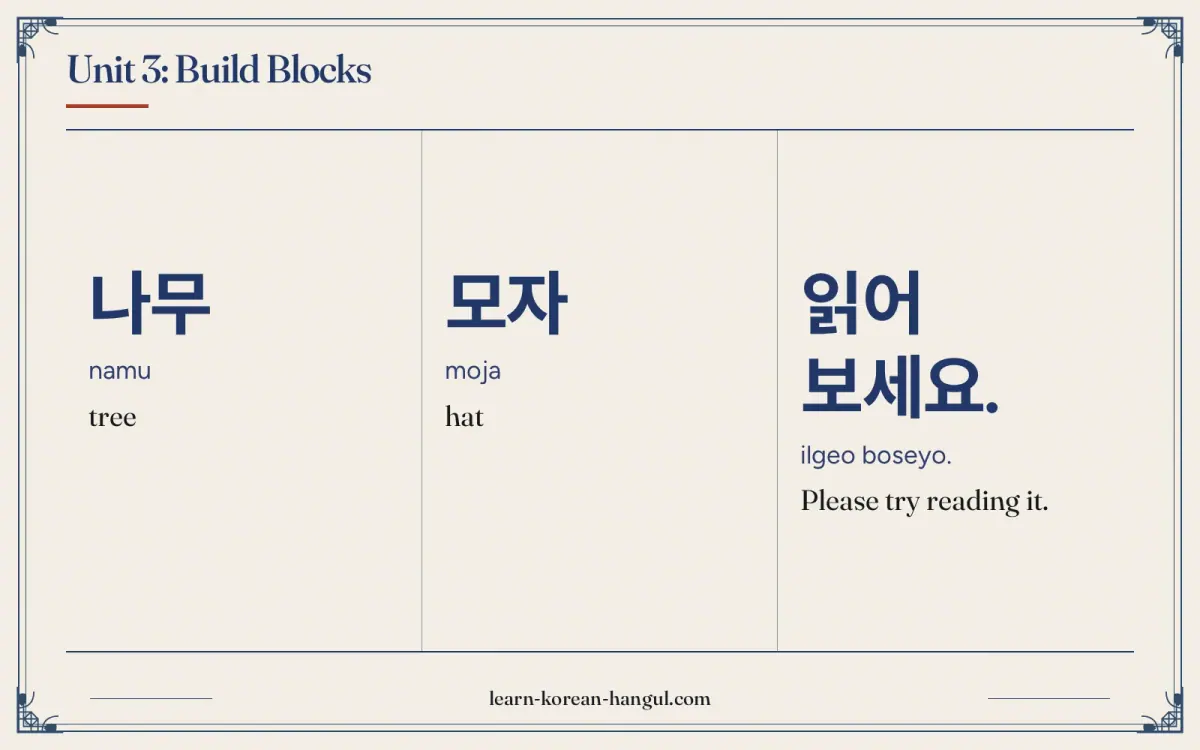
Unit 3 puts a consonant and a vowel together to make a syllable block, such as ㄴ + ㅏ = 나. A Hangul block is like a small building made of two or three pieces. The consonant goes to the left or on top, and the vowel goes to the right or below.
Use letter cards to build blocks together. Then read two words made from the letters so far plus one bonus letter:
나무
namu
tree
모자
moja
hat
나무 uses ㄴ, ㅏ, ㅁ, ㅜ and 모자 uses ㅁ, ㅗ, ㅈ, ㅏ. Add ㅈ as a bonus letter: it sounds like "j" and looks like a hat on a stand. The adult prompt for this unit is a good habit for every later unit:
읽어 보세요.
ilgeo boseyo.
Please try reading it.
Game: lay out six cards, three consonants and three vowels, and let the child make as many blocks as they can in two minutes. Say each block aloud as it is made.
Checkpoint: the child can read 나무 and 모자 and build two other blocks.
Lesson Review
Unit 4: Hello and Family
Unit 4 gives the child their first real Korean: a greeting and the words for mum and dad. Children say 안녕하세요 to adults and teachers, and 안녕 to friends of their own age and younger children. Teach the polite one first.
안녕하세요.
annyeonghaseyo.
Hello.
Next come the family words 엄마 (eomma, mum) and 아빠 (appa, dad). They are short words that young children enjoy saying, so they make a quick confidence boost.
우리 엄마예요.
uri eommayeyo.
This is my mum.
Add 할머니 (halmeoni, grandmother) and 할아버지 (harabeoji, grandfather) when the child is ready. Replace 엄마 with 아빠, 할머니 or 할아버지 to make new sentences, as in 우리 아빠예요. The Korean greetings lessons and the family words lessons have more.
Game: bring or draw photos of family members. The adult holds up one, and the child says the sentence for it.
Checkpoint: the child can say hello politely and name four family members.
Lesson Review
Unit 5: Count to Ten
Unit 5 teaches 하나 to 열 (one to ten), the native Korean numbers. Children use these to count objects, which is exactly what they do all day: counting toys, apples and friends. The Sino-Korean numbers (일, 이, 삼) come later, for things like dates and prices.
| 1 | 2 | 3 | 4 | 5 |
|---|---|---|---|---|
| 하나 hana | 둘 dul | 셋 set | 넷 net | 다섯 daseot |
| 6 | 7 | 8 | 9 | 10 |
|---|---|---|---|---|
| 여섯 yeoseot | 일곱 ilgop | 여덟 yeodeol | 아홉 ahop | 열 yeol |
Say the first five together, then the second five.
When you count things, the numbers 1 to 4 change shape before the counter word 개 ("piece"): 한 개, 두 개, 세 개, 네 개. Do not worry about the rule yet; just let the child copy the sentence.
사과가 세 개예요.
sagwaga se gaeyeyo.
There are three apples.
Game: put ten small objects in a bowl. Ask the child to take out 하나, then 둘, up to 열, and to count them back in Korean. The native Korean numbers section explains the rules for older children.
Checkpoint: the child can count from 1 to 10 aloud without help.
Lesson Review
Unit 6: Colours and Animals
Unit 6 teaches four colours and six animals, with a question and answer to use them. Colours and animals are favourite topics for many children, so this unit works as a reward for the earlier work.
| Colour | Korean | RR |
|---|---|---|
| red | 빨간색 | ppalgansaek |
| blue | 파란색 | paransaek |
| yellow | 노란색 | noransaek |
| green | 초록색 | choroksaek |
| Animal | Korean | RR | Sound it makes |
|---|---|---|---|
| puppy | 강아지 | gangaji | 멍멍 (meongmeong) |
| cat | 고양이 | goyangi | 야옹 (yaong) |
| rabbit | 토끼 | tokki | |
| bear | 곰 | gom | |
| bird | 새 | sae | |
| fish | 물고기 | mulgogi |
Teach the pattern 무슨 색이에요? ("What colour is it?") and its answer. Then name an animal.
무슨 색이에요?
museun saegieyo?
What colour is it?
빨간색이에요.
ppalgansaegieyo.
It is red.
이건 강아지예요.
igeon gangajiyeyo.
This is a puppy.
Children love Korean animal sounds, which differ from English ones. A dog says 멍멍, not "woof woof".
Game: hold up a coloured card and an animal card. The child says the colour and the animal, and then makes the animal's sound. More words are in the lessons on Korean colours and Korean animals.
Checkpoint: the child can name the four colours and four of the six animals.
Lesson Review
Unit 7: Printables and Games
Unit 7 is a review unit built around printables and games. Use it to consolidate everything and to celebrate. The Hangul worksheets include letter-tracing and reading sheets that match Units 1 to 3, and the Korean flashcards cover words from Units 4 to 6.
Three games that work with any group:
- Letter hunt. Hide letter cards around a room. The child finds one and calls out the sound and a word.
- Memory match. Lay out pairs of cards, each with a word and a matching picture. Turn two over at a time.
- Bingo. Fill a 3 x 3 grid with words from Units 4 to 6. Call words in Korean, and the child covers them.
Call-outs for the games:
The words mean "Found it!" and "One more time!", which are two handy phrases for any game. For quick checks, the Korean quizzes offer short tests an older child can try with an adult nearby.
Checkpoint: the child can read the five consonants, four vowels and two words from Unit 3 without picture help.
Lesson Review
How Old Should a Child Be to Start?
Start when the child can read and write comfortably in their first language, which for most children is around age 6. Reading letters in Hangul uses the same skill as reading letters in any alphabet. A child who is still learning to read in their own language may find Korean letters one demand too many. Children from about 10 who read well can also follow Hangul in a week with an adult nearby, as a faster alternative.
Do not worry about starting late. Hangul is a small system, and an older child can finish Units 1 to 3 in a couple of sessions.
What If Your Child Loses Interest?
If your child loses interest, change the activity before you change the plan. Most loss of interest comes from sessions that run long, material that is too hard or too much sitting still. Try these in order:
- Shorten the session to 8 or 10 minutes and end with a game.
- Add movement. Point, hop, clap syllables or act out the animals.
- Go back one unit. Repeating something easy restores confidence.
- Let the child teach you. Ask them to show you how to read a block, and make mistakes on purpose.
- Take a break. A week away is fine; children often return with the letters still in mind.
Avoid bribes and quizzing. The aim is a child who associates Korean with play, and that is worth more than any one letter.
Audio, Privacy and Scope
All audio in this course is pronunciation audio generated with text-to-speech. Nothing plays automatically. The course does not ask for an account, a child's name or any contact details.
This course covers a first taste of Korean reading, greeting, counting and naming. It does not teach grammar, and it does not replace a class with a teacher. Allow about two hours in total for the seven units, spread over a few weeks. That is a typical estimate for a child working with an adult, not a promise.
What Should You Do Next?
After Unit 7, continue with the rest of the consonants and the full set of vowels, then move to short phrases. Compare other routes on the Korean course paths page. If your child already speaks some Korean at home, the heritage learners course is the next to look at.
Frequently Asked Questions
Can a parent who doesn't speak Korean teach this?
Yes. Every Korean word and phrase in the course has audio and a Revised Romanization guide, and each unit has a short "say this" script for the adult. You do not need to be fluent, only willing to play the clip, repeat it and let the child repeat after you. Learning alongside the child is fine, and children often enjoy correcting a parent.
How many sessions per week work best?
Two or three short sessions a week suit most children aged 6 to 12, with each session limited to 10 to 15 minutes. This is practical guidance, not a research finding. Short, regular sessions keep the games fun and the new letters fresh. If a child asks for more, add a review game rather than a longer lesson.
Is this suitable for classroom use?
Yes. The seven units can run as seven short lessons, and the printables work for pairs or small groups. One teacher can play the audio from a single device for the whole class. Check the licence line on each download for the permitted use. For a mixed-ability class, let faster pupils do the extension game at the end of each unit.
Does the course include songs?
No, the course does not include songs. It uses short chants, counting games and picture cards, which you can set to a rhythm of your own. If your child likes music, many families add children's songs from other sources, which this course neither supplies nor reviews.