
- 01
Who Is This Heritage Course for, and Who Should Skip It?
- 02
Which Gaps Do Korean Heritage Learners Usually Have?
- 03
Take the 10-Question Self-Check
- 04
Module 1: Hangul Spelling Gaps
- 05
Module 2: Spelling Versus Pronunciation
- 06
Module 3: Spacing and Punctuation
Who Is This Heritage Course for, and Who Should Skip It?
This course is for Korean heritage learners: people who grew up hearing or speaking Korean at home, often with family, but who have had little or no schooling in Korean. You may understand a lot and speak informally, yet hesitate to read the news, write a message to an elder or fill in a form. The course keeps your speaking as it is and works on reading, spelling and register.
Take another path if:
- You have no spoken Korean. Start with Korean for Beginners or Hangul in a week. This course assumes you can follow everyday speech.
- You can read and write Korean confidently already. Use the self-check below; if you score nine or ten, jump to Module 5.
- You are choosing a course for a young child. Look at Korean for Kids.
Heritage speakers differ a great deal: some have the vocabulary of a child, others fluent family conversation. The self-check finds your own gaps.
Which Gaps Do Korean Heritage Learners Usually Have?
Korean heritage learners usually have a strong ear and a weak pen. They learned Korean by hearing it, so their gaps follow from that. Five show up again and again:
- Spelling by sound. Korean spelling often differs from pronunciation, so spelling a word as you hear it gives errors such as 가치 for 같이 ("together").
- Sound-alike pairs. Pairs such as 되/돼, 안/않 and ㅐ/ㅔ sound alike for many speakers, so the ear cannot decide.
- Spacing. Korean has rules for where to put spaces (띄어쓰기) that speakers rarely meet at home.
- Register. Family Korean is usually casual, with a few polite forms. Formal speech (합니다체) and written honorifics such as 께서 are missing.
- Sino-Korean vocabulary. Words of Chinese origin dominate formal and written Korean, and home vocabulary is usually native Korean.
None of these is a failure. They are the expected gaps of someone who learned a language orally, and each one has a short list of rules to learn. The modules below take them in order.
Take the 10-Question Self-Check
Take this self-check before you start. It takes about five minutes and each question tests one gap. Choose an answer, read the explanation and note the questions you missed.
Practice · 10
Which is correct? 내일 가도 ( )?
Show answer
돼요
돼 is the contraction of 되어. Test: replace it with 하 or 해. 가도 해요 works, so you need 돼요.
Which is correct? 저는 커피를 ( ) 마셔요.
Show answer
안
안 is the short form of 아니 and goes before the verb. 않 appears in -지 않다, as in 마시지 않아요.
Which is correct? 오늘이 ( )이에요?
Show answer
며칠
며칠 is one word and is always written this way, for "what date" or "how many days".
Which spelling means "together"?
Show answer
같이
같이 is said [가치], but it is spelled 같이. 가치 is a different word meaning "value".
Which word means "crab"?
Show answer
게
게 is crab and 개 is dog. Many speakers say them alike, so you must learn the spelling.
Which spacing is correct?
Show answer
갈 수 있어요
수 is a dependent noun, so it is written as a separate word on both sides: 갈 수 있어요.
Which is the honorific version of 할머니가 밥을 먹어요?
Show answer
할머니께서 밥을 드세요
께서 marks an honorific subject and 드세요 is the honorific form of eating. The other two lack the honorific verb.
Which is the standard spelling? 내일 전화( )
Show answer
할게요
The ending is spelled -ㄹ게요 although it is said with a tense sound [할께요].
Which is correct? 저는 의사( ).
Show answer
예요
After a vowel, use 예요. After a consonant, use 이에요, as in 학생이에요.
Which is the formal -ㅂ니다 form of 먹어요?
Show answer
먹습니다
After a consonant, the formal ending is -습니다: 먹습니다. 먹읍시다 means "let us eat".
Use your score and the table to decide where to begin.
| Questions you missed | Start with |
|---|---|
| 5 | Module 1: Hangul spelling gaps |
| 1, 2, 3, 4, 8 or 9 | Module 2: spelling versus pronunciation |
| 6 | Module 3: spacing and punctuation |
| 7 or 10 | Module 4: honorifics and formal speech |
| none | Modules 5 to 7 |
Scoring 9 or 10 means you can skim Modules 1 to 4 and go to Module 5. A score of 6 to 8 means taking the modules for the questions you missed. A score of 5 or less means taking all seven in order. These are suggestions, not test results.
Module 1: Hangul Spelling Gaps
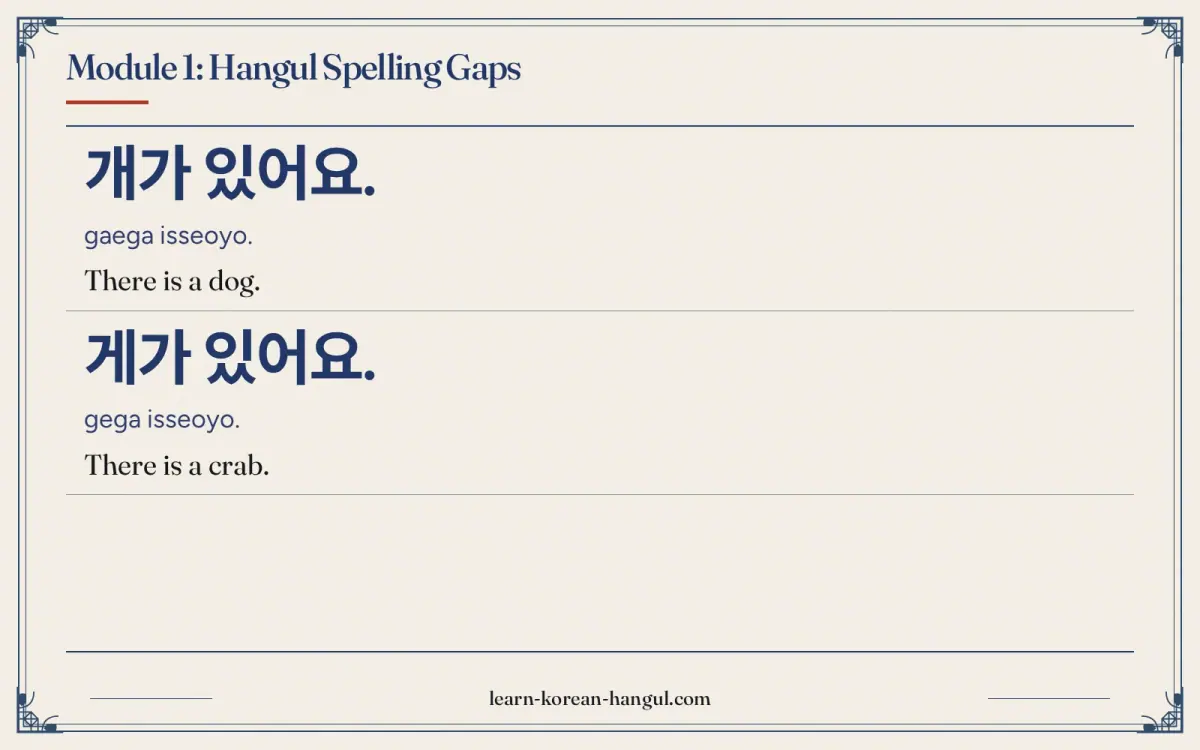
Module 1 deals with ㅐ and ㅔ, the pair that causes the most spelling errors. The standard pronunciation rules (Article 4) still list ㅐ and ㅔ as two vowels, but most Seoul speakers today pronounce them the same. So your ear cannot tell you whether to write 게 or 개, and you must learn the spelling word by word. The lesson on ㅐ and ㅔ and the page on ㅐ vs ㅔ pronunciation cover the sound.
Learn the pairs that carry different meanings:
| ㅐ word | Meaning | ㅔ word | Meaning |
|---|---|---|---|
| 개 (gae) | dog | 게 (ge) | crab |
| 새 (sae) | new; bird | 세 (se) | three (before a counter) |
| 매다 (maeda) | to tie | 메다 (meda) | to carry on the shoulder |
개가 있어요.
gaega isseoyo.
There is a dog.
게가 있어요.
gega isseoyo.
There is a crab.
You may hear no difference between these two clips, and that is the point: only the spelling and the context tell the words apart. Three habits help. Learn each pair with a picture or a sentence. Write the word from memory after hearing it. And use a spell checker as a safety net; the Korean spell checker page explains how.
Checkpoint: spell 개, 게, 새 and 세 correctly from the English meaning, without looking.
Lesson Review
Module 2: Spelling Versus Pronunciation
Module 2 teaches that Korean spelling shows the word's base form, while speech applies sound changes. The principle behind it is written into the first article of the Hangul orthography rules (한글 맞춤법 제1항): standard words are written as they sound, but in line with the grammar. So you write 같이, not 가치, even though you say [가치].
The change here is palatalization: final ㄷ or ㅌ before 이 is said as ㅈ or ㅊ. So 같이 becomes [가치], 굳이 ("necessarily") becomes [구지] and 해돋이 ("sunrise") becomes [해도지]. The page on palatalization lists the cases.
같이 가요.
gachi gayo.
Let us go together. (said [가치 가요])
Alongside this comes a short list of errors that sound alike. Learn each with a test:
| Pair | Test | Right form |
|---|---|---|
| 되 / 돼 | Replace with 하 or 해 | 가도 돼요 (like 가도 해요) |
| 안 / 않 | 않 only appears in -지 않다 | 안 마셔요, 마시지 않아요 |
| 며칠 / 몇 일 | 며칠 is one word | 오늘이 며칠이에요? |
| -ㄹ게요 / -ㄹ께요 | Spelling uses ㄱ, sound is tense | 전화할게요 [전화할께요] |
| 예요 / 이에요 | Vowel then 예요; consonant then 이에요 | 의사예요, 학생이에요 |
내일 가도 돼요?
naeil gado dwaeyo?
May I go tomorrow?
내일 전화할게요.
naeil jeonhwahalgeyo.
I will call tomorrow. (said [전화할께요])
The detailed pages are 되 vs 돼, 안 vs 않, 며칠 vs 몇 일, -ㄹ게 vs -ㄹ께 and 예요 vs 이에요. The wider list is under Korean spelling rules.
Checkpoint: answer the five tests above without looking at the table.
Lesson Review
Module 3: Spacing and Punctuation
Module 3 teaches 띄어쓰기, the rules for putting spaces between words. The basic principle is that each word is written separately, and particles attach to the word before them. Three rules cover most mistakes.
- Particles attach. 학교에서, never 학교 에서.
- Dependent nouns are spaced. Words such as 수 ("way, possibility"), 것 and 때 always stand apart: 갈 수 있어요, 먹을 것, 어릴 때.
- Counters are spaced from their numbers. 친구 두 명, 사과 세 개.
저는 내일 갈 수 있어요.
jeoneun naeil gal su isseoyo.
I can go tomorrow.
친구 두 명이 왔어요.
chingu du myeongi wasseoyo.
Two friends came.
Two more rules need care. Verbs made with 하다 are usually one word (공부하다), and an auxiliary verb such as 보다 is normally spaced from the main verb (먹어 보세요), although writing it together is also allowed. The lessons on spacing rules, dependent noun spacing and auxiliary verb spacing give the full list with exceptions.
Checkpoint: correct a short paragraph written with no spaces in the dependent nouns.
Lesson Review
Module 4: Honorifics and Formal Speech
Module 4 moves you from family Korean to respectful and formal Korean. Heritage speakers typically speak casually to parents and siblings and may not know the forms for elders, teachers and workplaces. Three tools matter.
| Tool | What it does | Example |
|---|---|---|
| -(으)시- | Respects the subject of the sentence | 주무세요 ("sleeps", respectful) |
| 께서 / 께 | Honorific subject and "to" particles | 할머니께서, 선생님께 |
| -ㅂ니다 / -습니다 | Formal polite ending (합니다체) | 학생입니다, 먹습니다 |
The honorific respects the person you are talking about, not the listener, and you never use it for yourself. Some verbs have special honorific forms: 먹다 becomes 드시다, 자다 becomes 주무시다 and 있다 (to be somewhere) becomes 계시다.
할머니께서 주무세요.
halmeonikkeseo jumuseyo.
Grandmother is sleeping.
선생님께 드릴게요.
seonsaengnimkke deurilgeyo.
I will give it to the teacher. (said [드릴께요])
저는 학생입니다.
jeoneun haksaengimnida.
I am a student. (formal)
Formal endings are used in speeches, announcements, interviews and many workplaces. Start with honorifics, then the honorific -시- and formal speech.
Checkpoint: say three sentences about a grandparent using 께서 and the honorific -시-.
Lesson Review
Module 5: Sino-Korean Words and Hanja
Module 5 shows that many Korean words are built from Chinese-origin roots, called Sino-Korean words, and that the roots repeat. You probably already say dozens of these words. Learning the root lets you guess new ones. The root 學 (학, "study, learn") appears in 학교 (school), 학생 (student) and 학년 (school year). The root 校 (교, "school") appears in 학교 and 대학교 (university).
Their spoken forms also show sound changes you already make: 학교 is said [학꾜] and 학년 is said [항년].
You do not need to write hanja, the Chinese characters behind these roots, to read modern Korean; ordinary text is written in Hangul. Treat hanja as a memory aid for roots, not as a second alphabet to master. Start with the Sino-Korean words section, which shows how the roots combine.
Checkpoint: build the meaning of 대학교 from the roots 大, 學 and 校.
Lesson Review
Module 6: Read Real Texts
Module 6 gets you reading news-style paragraphs, where written Korean differs from speech. News and articles use the plain written style, with sentences ending in -다 (for example 열었다 "opened") rather than -요. The paragraph below is short and uses only common words.
서울시는 오늘 새 도서관을 열었다.
seoulsineun oneul sae doseogwaneul yeoreotda.
Seoul city opened a new library today.
도서관에는 어린이 책이 많다.
doseogwaneneun eorini chaegi manta.
The library has many children's books.
Read each sentence aloud, find the verb at the end, and say what changes if you switch to polite speech (열었어요, 많아요). Then move on to the lessons in real-world texts.
Checkpoint: read a ten-sentence article aloud and summarise it in two polite sentences.
Lesson Review
Module 7: Write Messages and Letters
Module 7 puts everything into a short formal message. A message to a teacher, a manager or an elder follows a simple shape: greeting, who you are, the point, an apology or thanks, and a closing. Use the formal polite ending throughout.
A model message to a teacher:
안녕하세요, 선생님. 저는 3반 민수입니다. 내일 수업에 늦을 것 같습니다. 죄송합니다. 감사합니다.
내일 수업에 늦을 것 같습니다.
naeil sueobe neujeul geot gatseumnida.
I think I will be late for class tomorrow.
Check the message against the earlier modules: 늦을 것 같습니다 has spaced words (Module 3), the ending is formal (Module 4), and 수업에 has the particle attached. The lessons on messages and letters give templates for emails, thank-you notes and letters to relatives.
Checkpoint: write and proofread a five-sentence message to a teacher, using the checks from Modules 2 to 4.
Lesson Review
Why Do Fluent Speakers Misspell Korean?
Fluent speakers misspell Korean because their knowledge comes from listening, and spelling is a separate skill. In a language with regular spelling the two match. Korean spelling is regular, but it represents the word's meaning-bearing base form, so it does not always match the sound. Anyone who relies on the ear will write 가치 for 같이.
It helps to know that schooled Korean children also make these errors and learn them over years in class. You are catching up on a taught skill, not correcting a personal weakness. The reliable fix is to read a lot, write a little every week and check doubtful words in a dictionary or spell checker.
Should You Take TOPIK as a Heritage Learner?
Consider TOPIK, the Test of Proficiency in Korean, if you need a certificate for study, work or a visa, and not only to measure yourself. Rules, dates, fees and formats change, so check the official source, topik.go.kr, for eligibility, registration and the current test format. Our TOPIK pages explain the structure in general terms, starting with what is TOPIK.
Heritage learners often find the listening section easier than reading and writing, since they have heard the language for years. The writing section rewards formal register, spacing and correct spelling, which are exactly this course's topics. Doing Modules 2 to 4 before a TOPIK attempt is a sensible preparation, but this course is not a TOPIK course and cannot promise a score.
How Long Does the Course Take?
The course takes roughly 20 hours: the self-check about 10 minutes, Modules 1 to 4 about 2 to 3 hours each and Modules 5 to 7 about 3 hours each. At 45 minutes a day, that is about four weeks; at 20 minutes a day, about two months. These are typical estimates for self-study, not promises, and a high self-check score shortens them. After the course you should spell the common sound-alike words correctly, apply the spacing rules, use honorific and formal forms, read a short news paragraph and write a brief formal message. Continue with the Korean course paths page for next steps.
Audio and Scope
All audio is pronunciation audio generated with text-to-speech. Bracketed pronunciations, such as [가치], show the spoken form. This course teaches standard Korean as written and spoken in Seoul, and does not cover regional dialects.
Frequently Asked Questions
Can heritage learners use this alongside Korean school classes?
Yes. Weekend Korean schools usually follow their own curriculum, and this course can sit beside it. Use the self-check to find the gaps your class does not cover, and bring the spelling and spacing lessons to your teacher for extra practice. The two do not need to match week by week, so use whichever module you need when you need it.
Can I skip the Hangul modules?
If you can already read Hangul smoothly, yes. This course does not re-teach the alphabet; Module 1 is about spelling pairs that sound alike, not about letter shapes. If you read Hangul slowly or cannot read it, take the Hangul in a week course first, then come back. Your speaking can stay as it is.
Is family dialect a problem for standard Korean?
No, but it may show up. Many heritage speakers learned Korean from parents who speak a regional variety or who left Korea years ago, so some words or endings may differ from current standard usage. Nothing is wrong with that at home. For writing, school and exams, learn the standard form (표준어) alongside what you already say.
How do I practise formal speech without a teacher?
Listen and repeat formal Korean such as announcements and news, shadowing a sentence at a time. Rehearse short work or school situations aloud in the 합니다체, and write brief formal messages, then read them aloud. A relative or tutor can check your honorific endings. Do the polite and formal forms in Module 4 until they feel automatic.