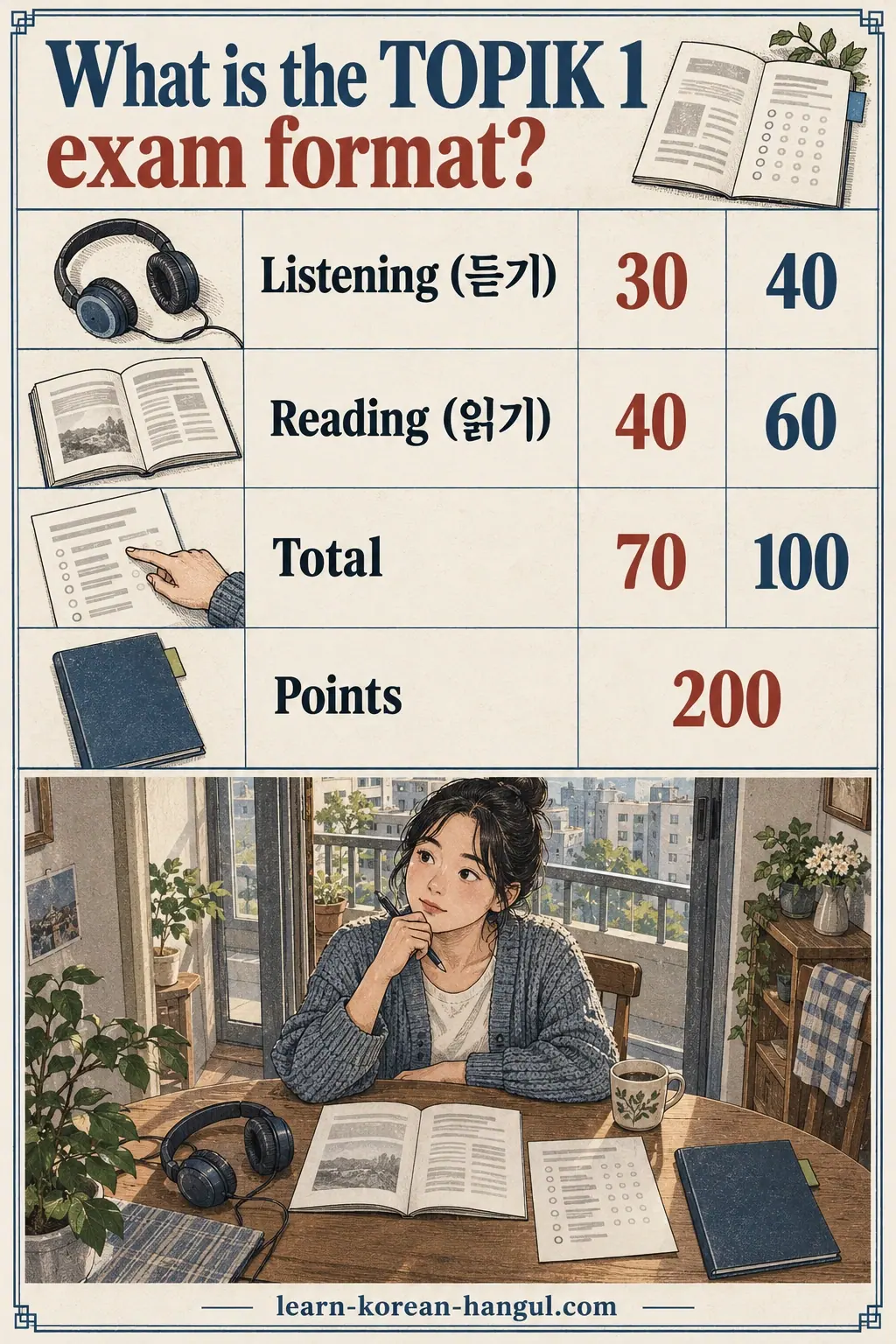
The TOPIK 1 exam format has two sections: listening with 30 questions in 40 minutes and reading with 40 questions in 60 minutes, for 200 points. Both sections are four-option multiple choice, taken in one 100-minute period. TOPIK 1 has no writing or speaking, and it awards Level 1 at 80 points and Level 2 at 140.
What Is the TOPIK 1 Exam Format?
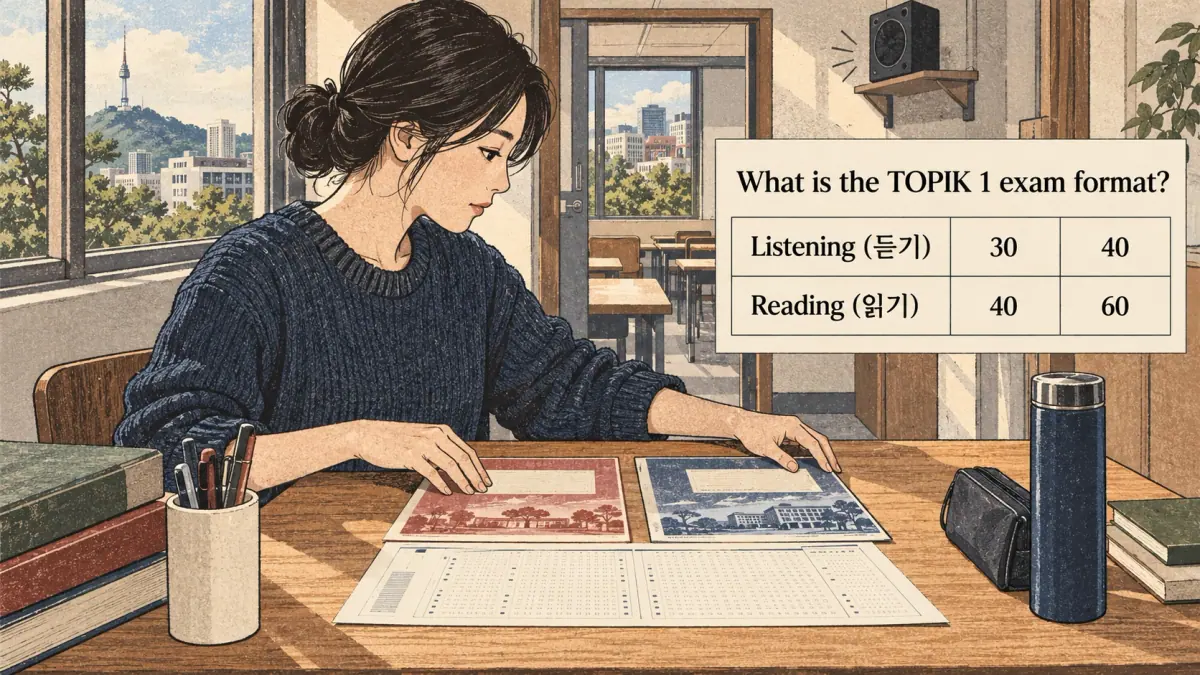
The TOPIK 1 exam format is the structure of TOPIK I, the beginner paper of the Test of Proficiency in Korean: two timed sections, each worth 100 points, answered on one answer sheet. The table shows the paper-based test (PBT) as described by the National Institute for International Education (NIIED, 국립국제교육원) in the official guide on topik.go.kr.
| Section | Question numbers | Questions | Minutes | Points | Answer type |
|---|---|---|---|---|---|
| Listening (듣기) | 1-30 | 30 | 40 | 100 | 4-option multiple choice |
| Reading (읽기) | 31-70 | 40 | 60 | 100 | 4-option multiple choice |
| Total | 1-70 | 70 | 100 | 200 |
The two section names are printed on the booklet and the answer sheet.
듣기 (deutgi) is listening, and 읽기 (ilgi) is reading, said [일끼]. The format has stayed stable for years, but NIIED can revise it, so confirm the figures in the current guide before your test. TOPIK II, the higher paper, is a different test with writing; the TOPIK exam format page compares both. The order in which the two sections run matters as much as their size.
TOPIK 1 Exam Structure on Test Day
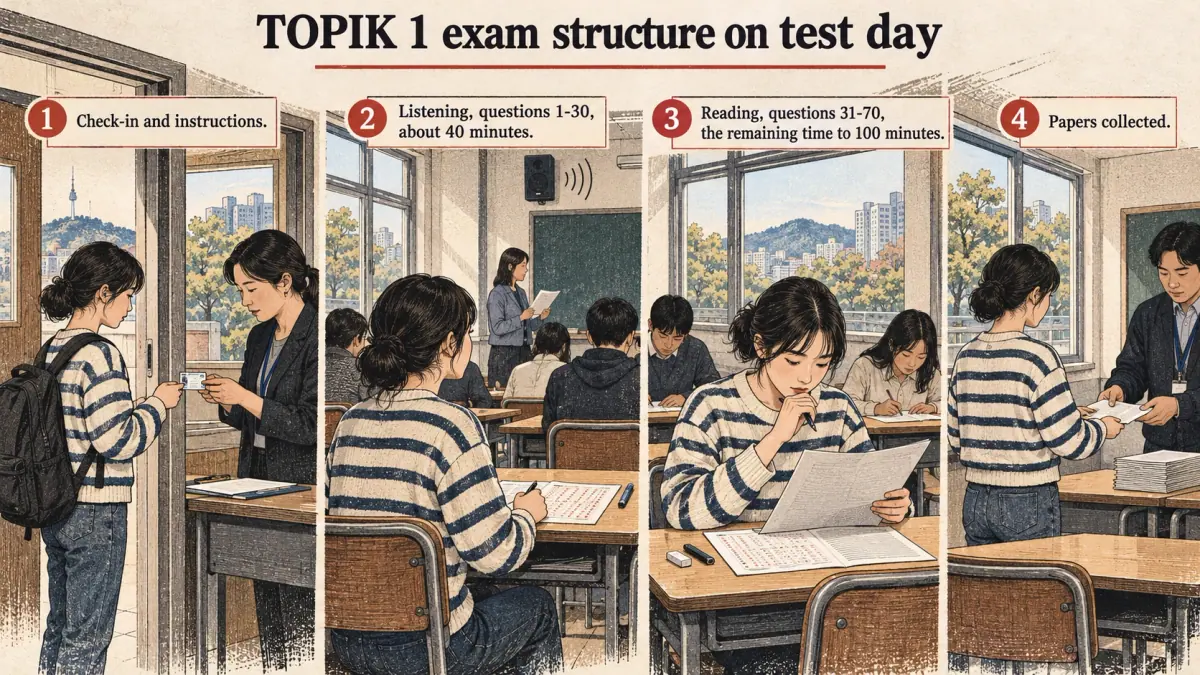
The TOPIK 1 exam structure on test day is one continuous period: listening first, then reading, with no break between them. Everything happens in the same room on the same answer sheet.
- Check-in and instructions. You arrive before the entry deadline, show your admit card and photo ID, switch off and store devices, and fill in your name and candidate number on the answer sheet.
- Listening, questions 1-30, about 40 minutes. The recording runs at a fixed pace. You cannot pause or replay it, and the next item starts on its own.
- Reading, questions 31-70, the remaining time to 100 minutes. When the listening audio ends, you turn to the reading pages and work at your own pace.
- Papers collected. The proctor collects the answer sheet and the question booklet at the end of the period.
The single numbering, 1 to 70, is a useful landmark. If you see question 31, you have reached reading, and the clock is now yours to manage. The exact clock times are printed on your admit card and differ between Korea and overseas centres. The section that comes first is also the one where you have least control.
What Is in the TOPIK 1 Listening Section?
The TOPIK 1 listening section contains 30 four-option questions about short spoken Korean: everyday questions and answers, short dialogues in shops and at home, simple announcements and short conversations about plans. The recordings are clear and moderate in speed, and the questions move from very short to longer exchanges.
The question types below are typical of recent past papers. The question ranges are approximate, because NIIED can move or change item types between sessions.
| Approximate questions | Task | What you hear | What you choose |
|---|---|---|---|
| 1-4 | Pick the natural answer to a question | one short question | the reply that fits |
| 5-6 | Pick the next line in a set exchange | a greeting, thanks or apology | the matching response |
| 7-10 | Identify the place | a two-line dialogue | where it happens (bank, shop, school) |
| 11-14 | Identify the topic | a two-line dialogue | what they talk about (weather, family, hobby) |
| 15-16 | Pick the matching picture | a short dialogue | one of four pictures |
| 17-21 | Pick the statement that matches | a longer dialogue | the true sentence |
| 22-24 | Identify the main idea | a dialogue with an opinion | what the speaker thinks |
| 25-30 | Answer two questions about one recording | an announcement or longer conversation | purpose, detail or matching content |
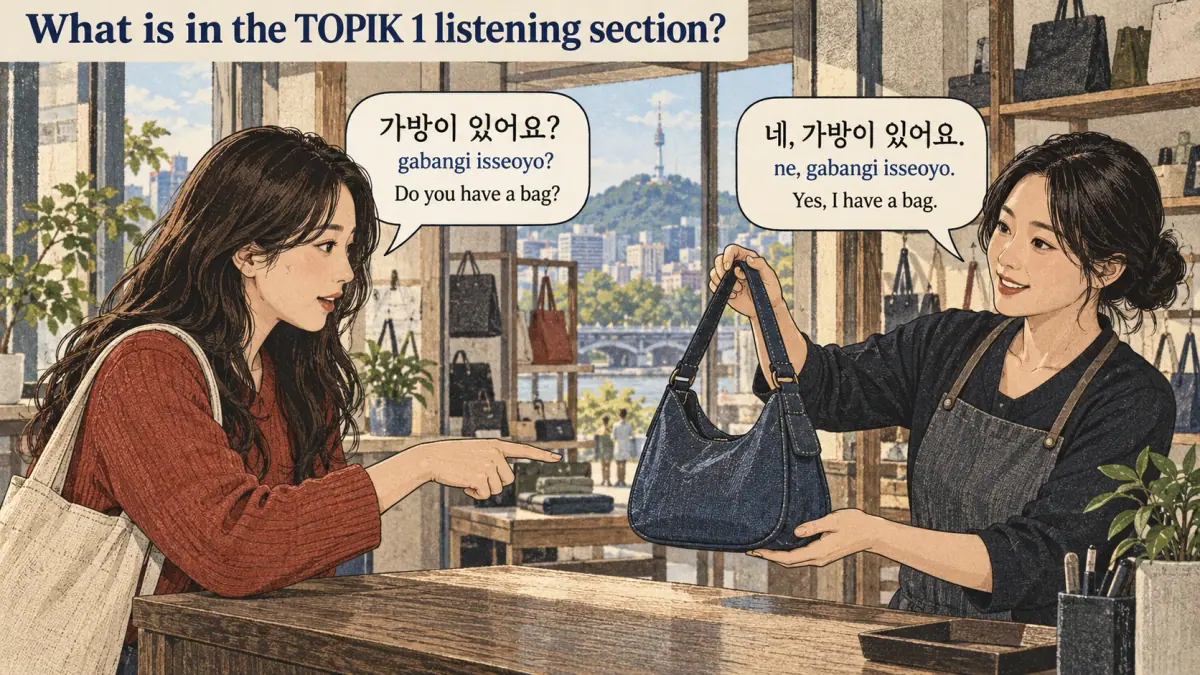
A sample in the style of questions 1-4 shows how short the first items are. You hear a question:
가방이 있어요?
gabangi isseoyo?
Do you have a bag?
The four options are printed in the booklet: ① 네, 가방이 있어요. ② 네, 가방이 아니에요. ③ 아니요, 가방이 좋아요. ④ 아니요, 가방을 사요. The answer is ①, because a yes-no question with 있어요? ("is there / do you have") takes a reply with the same verb.
네, 가방이 있어요.
ne, gabangi isseoyo.
Yes, I have a bag.
The wrong options are traps for learners who catch only the first word: ② starts with 네 but answers a different question, and ③ and ④ use the right noun with the wrong verb. This sample is written for this page in the style of the test, not copied from a real paper.
The listening section has a feature that shapes strategy: you can read the options before each recording starts. Use the seconds between items to read the next four options, so you know what to listen for. Detailed strategies for every item type are on TOPIK listening.
Instruction Phrases to Recognise
TOPIK 1 instructions are written in Korean only, and the same few phrases repeat on every paper. Recognising them at a glance saves several seconds per item, which adds up to minutes across 70 questions. The phrases below are typical of recent papers; the exact wording can vary slightly.
| Instruction (Korean) | Romanization | Meaning | Where it appears |
|---|---|---|---|
| 다음을 듣고 알맞은 것을 고르십시오 | daeumeul deutgo almajeun geoseul goreusipsio | Listen and choose the correct one. | many listening items |
| 여기는 어디입니까? | yeogineun eodiimnikka? | Where is this? | listening, place items |
| 무엇에 대해 말하고 있습니까? | mueose daehae malhago itseumnikka? | What are they talking about? | listening, topic items |
| 무엇에 대한 이야기입니까? | mueose daehan iyagiimnikka? | What is this about? | reading, topic items |
| 내용과 같은 것을 고르십시오 | naeyonggwa gateun geoseul goreusipsio | Choose the one that matches the content. | listening and reading detail items |
| 맞지 않는 것을 고르십시오 | matji anneun geoseul goreusipsio | Choose the one that does not match. | reading, notice items |
The last two rows are the ones that cost points. 같은 것 asks for the true statement and 맞지 않는 것 asks for the false one, so circle the key word in the booklet before you read the options. A useful habit is to say the instruction to yourself in English before answering: "find the false one". Readers who learn these six phrases before the test rarely misread a question type.
With the instruction phrases in hand, the reading section is easier to navigate.
What Is in the TOPIK 1 Reading Section?
The TOPIK 1 reading section contains 40 four-option questions about short written Korean, from two-sentence texts to short paragraphs. It starts with simple topic and fill-the-blank items, moves to notices and advertisements, and ends with paired questions about longer texts.
| Approximate questions | Task | Typical text | What you choose |
|---|---|---|---|
| 31-33 | Identify the topic | two short sentences | the topic word (weather, family, food) |
| 34-39 | Fill the blank | one or two sentences | the right word or particle |
| 40-42 | Find the statement that does not match | a notice, sign, ticket or text message | the false option |
| 43-45 | Find the statement that matches | a short paragraph | the true option |
| 46-48 | Identify the main idea | a short paragraph | what the writer mainly thinks |
| 49-70 | Answer paired questions, put sentences in order, fill blanks in longer texts | paragraphs, emails, short articles | detail, order, purpose or main idea |
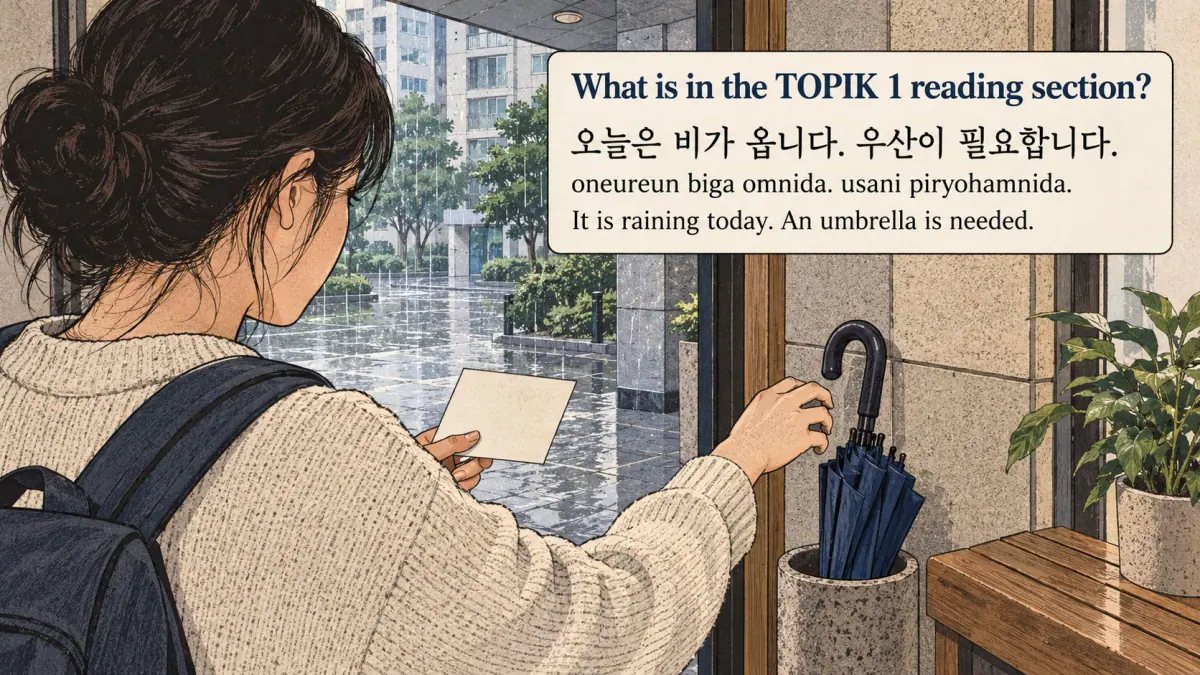
A sample in the style of questions 31-33 shows the first task. The instruction asks what the text is about:
무엇에 대한 이야기입니까? (mueose daehan iyagiimnikka?) means "What is this about?" It is said [무어세 대한 이야기임니까]. The text follows:
오늘은 비가 옵니다. 우산이 필요합니다.
oneureun biga omnida. usani piryohamnida.
It is raining today. An umbrella is needed.
The options are ① 날씨 (weather) ② 계절 (season) ③ 주말 (weekend) ④ 여행 (travel). The answer is ① 날씨, because rain and an umbrella both point to the weather. Note that reading texts use the formal -습니다 / -ㅂ니다 endings (합니다체), so 옵니다 and 필요합니다 should look familiar before test day.
Most reading instructions end with the same phrase:
알맞은 것을 고르십시오 (almajeun geoseul goreusipsio) means "Choose the correct one", said [알마즌 거슬 고르십씨오]. Learn it together with 맞지 않는 것 ("the one that does not match") and 같은 것 ("the same one"), because mixing them up is one of the easiest ways to lose points on items 40-45. Reading strategies by item type are on TOPIK reading. Knowing the item types leads naturally to the question of what language they draw on.
TOPIK 1 Syllabus: Topics, Words and Grammar
TOPIK 1 has no official word list or textbook syllabus. NIIED publishes level descriptions and sample papers, and those show the scope: personal and everyday topics, basic vocabulary and beginner grammar used in short, simple texts.
| Area | What TOPIK 1 covers | Examples |
|---|---|---|
| Topics | self, family, home, school and work, shopping, food, weather, transport, hobbies, plans, public places | introducing yourself, buying fruit, asking the way |
| Vocabulary | concrete everyday words, numbers, time, prices, days and dates | 사과 (apple), 버스 (bus), 주말 (weekend) |
| Grammar | basic particles, polite and formal present, past and future, common connectors | 은/는, 이/가, 을/를, -아요/어요, -았어요/었어요, -고, -지만 |
| Text types | dialogues, notices, signs, tickets, text messages, short diary-style paragraphs | a bakery opening-hours notice |
The vocabulary scale is often estimated at about 800 words for Level 1 and about 1,500 to 2,000 for Level 2. These are estimates commonly cited by teachers and textbooks, not official figures, so use them as rough targets. A topic-by-topic word list is on the TOPIK 1 vocabulary list, and the grammar patterns with examples on the TOPIK 1 grammar list.
Knowing the content tells you what to study; the clock tells you how to use it on the day.
How Should You Pace Yourself on TOPIK 1?
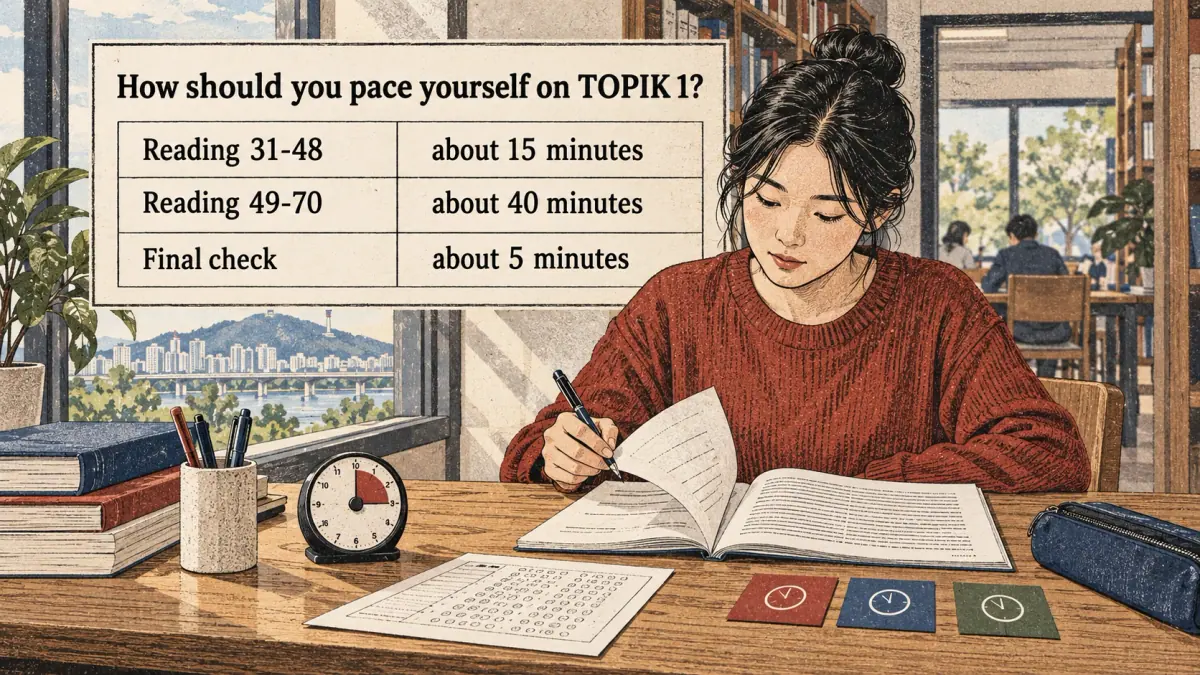
Pace TOPIK 1 by budgeting about 80 seconds per listening question (set by the audio) and 90 seconds per reading question, then spending less time on early reading items so the long texts at the end get more. The averages come straight from the official counts: 40 minutes for 30 listening questions and 60 minutes for 40 reading questions.
| Section | Total time | Average per question | Suggested checkpoints |
|---|---|---|---|
| Listening | 40 minutes | about 80 seconds, audio included | paced by the recording; read the next options in each gap |
| Reading 31-48 | about 15 minutes | about 50 seconds | reach question 49 by minute 15 of reading |
| Reading 49-70 | about 40 minutes | about 110 seconds | reach question 60 by minute 35 of reading |
| Final check | about 5 minutes | make sure every answer is marked |
The checkpoints are editorial suggestions built from the official timings, not official rules. The reasoning is simple: questions 31-48 use one or two lines of text each, while questions 49-70 use full paragraphs, often with two questions per text. Spending the same 90 seconds on every item would leave too little time at the end.
A Worked Pacing Example
A candidate starts reading at question 31 and reaches question 49 after 22 minutes instead of 15. That leaves 38 minutes for 22 questions, about 100 seconds each, which is still workable but tight. If the same candidate reaches question 49 after 30 minutes, only 30 minutes remain for 22 long questions, about 80 seconds each, and the last texts will be rushed.
The fix is to decide in advance: if a short item takes more than about a minute, mark your best guess, note the number in the booklet and move on. Return to it only if time remains at the end. Practise this rule on full, timed papers; the step-by-step preparation plan on how to pass TOPIK 1 builds it into weekly mocks. Pacing turns into points through the scoring rules.
How Is TOPIK 1 Scored?
TOPIK 1 is scored by adding the points for correct answers: up to 100 in listening and up to 100 in reading, for a total out of 200. The total alone decides the level: 80 to 139 is Level 1, 140 to 200 is Level 2, and below 80 earns no level.
| Total score | Result | Share of 200 |
|---|---|---|
| 0-79 | no level | under 40% |
| 80-139 | Level 1 | 40-69% |
| 140-200 | Level 2 | 70% and above |
Three scoring rules shape strategy:
- Point values vary by question. Because 30 or 40 questions must add up to 100 points per section, the questions do not all carry the same value. The value is printed next to the instruction in the booklet.
- There is no negative marking. A wrong answer and a blank answer both score zero, so guess rather than leave any question empty.
- There is no section minimum under the current rules. A strong listening score can make up for weaker reading. Check the current guide, because older versions of the test worked differently.
A worked example: a candidate earns 54 in listening and 31 in reading. The total is 85, which is Level 1. Level 2 would need 55 more points, so this candidate's next target is reading, where the gap is widest. What Level 1 means in practice is on TOPIK level 1, and how points are weighted across both TOPIK papers on TOPIK score.
Answer Sheet and Booklet Rules
On the paper-based TOPIK 1, you mark answers on a machine-read answer sheet (often called an OMR sheet) and read the questions in a separate booklet. Every question has four options, ① to ④, and you fill in one per question with the pen specified in the official guide, usually supplied at the centre.
Four practical rules prevent lost points:
- Mark the sheet as you go. During listening, mark each answer before the next recording starts. During reading, transfer answers after each page rather than at the end.
- Check the question number. Because numbering runs from 1 to 70 on one sheet, a skipped line shifts every later answer. Check the number every ten questions.
- Use the booklet for notes. Underlining key words and crossing out wrong options is generally allowed, but only the answer sheet is scored.
- Follow the correction rule. Each guide explains how to correct a mark; an unclear mark may be read as no answer.
The answer sheet details are part of the official guide and the admit card instructions, so read them once before the test day.
Paper and Internet Versions of TOPIK 1
TOPIK 1 is offered on paper (PBT) and on computer at a test centre (IBT). Both award Level 1 and Level 2 with the same cut scores, but the IBT is not the paper test on screen: its question counts, timing and some item types differ.
| Feature | PBT TOPIK 1 | IBT TOPIK 1 |
|---|---|---|
| Sections | listening, reading | listening, reading |
| Questions and minutes | 30 + 40 questions, 40 + 60 minutes | different; see the IBT guide |
| Answering | pen on an answer sheet | on screen |
| Levels and cut scores | Level 1 at 80, Level 2 at 140 | the same |
Everything on this page describes the paper test unless it says otherwise. If you choose the computer version, read TOPIK IBT and the official IBT sample test before you practise. Whichever version you sit, real past papers are the best preparation.
TOPIK 1 Sample Questions and past Papers
The best TOPIK 1 sample questions are the official past papers that NIIED releases on topik.go.kr, with audio files and answer keys for many sessions. Not every session is released, but enough are available for several full mock tests.
Use them in this order:
- One untimed paper to learn the item types and instructions.
- Section drills on the item types you miss most often, such as places in listening or notices in reading.
- Full timed papers under the 40 + 60 minute limits, with an answer sheet you print yourself.
How to find, download and score them is on TOPIK past papers. Practice papers expose the misreadings below quickly.
Common Misconceptions about the TOPIK 1 Format
Learners often assume TOPIK 1 has a short writing task. Actually, TOPIK 1 has only listening and reading; writing appears only on TOPIK II.
Learners also assume there is a break before reading. Actually, the paper test runs as one 100-minute period, so reading starts as soon as the audio ends.
A third assumption is that the instructions are in English for beginners. Actually, everything is in Korean, which is why the instruction phrases above are worth learning.
A fourth assumption is that a perfect paper gives Level 3. Actually, TOPIK 1 stops at Level 2, even at 200 out of 200; Level 3 and above come only from TOPIK II.
What This Page Covers and Does Not
This page describes the TOPIK 1 paper test: sections, question numbers, item types, timing, pacing, scoring and the answer sheet. It does not cover registration, fees or dates, and it gives no IBT figures because they differ and can change. The question-type ranges are typical patterns from past papers, not an official list. If the official guide on topik.go.kr differs from this page, the official guide is right.
Frequently Asked Questions
Is there a break between the TOPIK 1 sections? No. On the paper-based test, TOPIK 1 listening and reading run in one 100-minute period without a break. When the listening audio ends, you continue straight into reading. Plan to use the bathroom and settle before the period starts, and check the admit card and official guide for the exact timetable.
Can I write in the TOPIK 1 test booklet? Making notes in the question booklet is generally allowed on the paper test, for example underlining key words or crossing out wrong options. Only the answer sheet is scored, though, so a correct answer circled in the booklet but not marked on the sheet earns nothing. Follow the proctor's instructions on the day.
How many options does each TOPIK 1 question have? Every TOPIK 1 question has four options, numbered ① to ④, and exactly one is correct. You mark one option per question on the answer sheet. Because there is no penalty for wrong answers, a guess on a question you cannot solve still has a one-in-four chance of earning its points.
Are TOPIK 1 instructions in English? No. TOPIK 1 instructions and questions are written in Korean only, even at beginner level. The same short instruction phrases repeat on every paper, such as 알맞은 것을 고르십시오, "choose the correct one". Learning these phrases before the test saves reading time and prevents mistakes about what each question asks.
How many questions are on TOPIK 1? TOPIK 1 has 70 questions on the paper-based test: 30 in listening and 40 in reading. They are numbered straight through from 1 to 70 on one answer sheet. The internet-based test (IBT) uses a different number of questions and a different timing, so check its own guide if you choose it.
What to Read Next
Now that you know the TOPIK 1 exam format, the next step is the language it draws on: continue with the TOPIK 1 vocabulary list. Every other beginner-test page is listed in the TOPIK I section.