What you will be able to do after this lesson
- Name 20 cooking verbs and give the polite present of each.
- Pick the right heat verb: 끓이다, 삶다, 찌다, 볶다, 튀기다 or 굽다.
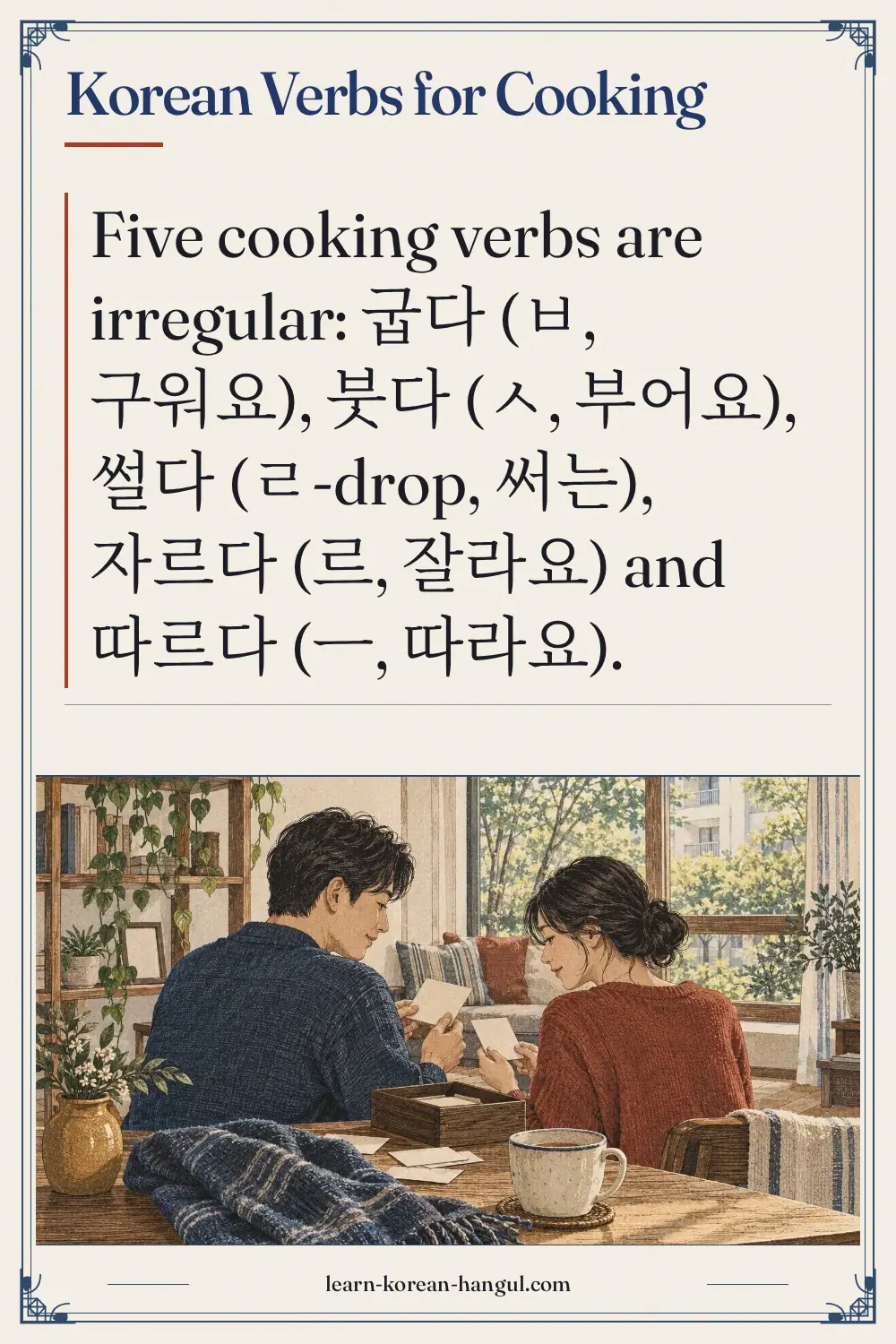
- Spot the five irregular verbs in the kitchen: 굽다, 붓다, 썰다, 자르다 and 따르다.
- Read and write a four-step recipe in Korean.
Before you start: read how Korean conjugation works. The nouns for food and utensils are in Korean cooking vocabulary. Time: about 40 minutes. Level: A2.
Which Verbs Are Used for Cooking in Korean?
Korean cooking verbs are action verbs that name what you do to food: heat it, cut it, mix it, pour it or serve it. English often uses one verb ("cook") or a broad verb ("fry"), but Korean picks a verb for the method, so the verb tells the reader how the dish was made. The 20 verbs here fall into four groups.
| Group | Verbs | Count |
|---|---|---|
| Heat verbs | 끓이다, 굽다, 볶다, 튀기다, 찌다, 삶다, 데우다, 부치다 | 8 |
| Prep verbs | 썰다, 자르다, 섞다, 넣다, 씻다, 반죽하다, 무치다 | 7 |
| Pour and serve verbs | 붓다, 따르다, 담다 | 3 |
| Freeze and melt verbs | 얼리다, 녹다 | 2 |
Every verb takes an object marked with 을/를 (물을 끓여요), except 녹다, which has no object because the ice melts by itself. The tables give the polite present, which is the form used in recipes spoken to a friend or a family, and the modifier, which you need to say "boiled eggs" (삶은 계란). The first group is the largest.
Heat Verbs
Heat verbs describe how food is cooked: in water, in oil, over fire or in steam. The choice of verb tells you the method, and swapping two heat verbs changes the dish.
| Verb | RR | Meaning | Polite present | Modifier (present / past) | Class |
|---|---|---|---|---|---|
| 끓이다 | kkeurida | to boil (something), to make by boiling | 끓여요 | 끓이는 / 끓인 | regular |
| 굽다 | gupda | to grill, to roast, to bake | 구워요 | 굽는 / 구운 | ㅂ irregular |
| 볶다 | bokda | to stir-fry | 볶아요 | 볶는 / 볶은 | regular |
| 튀기다 | twigida | to deep-fry | 튀겨요 | 튀기는 / 튀긴 | regular |
| 찌다 | jjida | to steam | 쪄요 | 찌는 / 찐 | regular |
| 삶다 | samda | to boil food until cooked through | 삶아요 | 삶는 / 삶은 | regular |
| 데우다 | deuda | to heat up, to warm | 데워요 | 데우는 / 데운 | regular |
| 부치다 | buchida | to pan-fry (jeon, pancakes) | 부쳐요 | 부치는 / 부친 | regular |
- 물을 끓여요. (I boil water.)
- 고기를 구워요. (I grill meat.)
- 야채를 볶아요. (I stir-fry vegetables.)
- 닭을 튀겨요. (I deep-fry chicken.)
- 만두를 쪄요. (I steam dumplings.)
- 계란을 삶아요. (I boil eggs.)
- 국을 데워요. (I heat up the soup.)
- 전을 부쳐요. (I pan-fry jeon.)
The most common confusion is between 끓이다, 삶다 and 찌다. 끓이다 means to bring a liquid to the boil or to make something by boiling it, such as soup or ramyeon: 라면을 끓여요. 삶다 means to boil food in water until it is cooked through, such as eggs, potatoes or noodles: 계란을 삶아요. 찌다 means to cook with steam, such as dumplings or sweet potatoes. Another pair is 볶다 and 튀기다. 볶다 uses a little oil and constant stirring, and 튀기다 uses a lot of oil. The next group is about preparation.
Prep Verbs
Prep verbs are the actions before the heat: cutting, washing, mixing and adding. Learners use 넣다 and 자르다 early, and the rest appear in recipes.
| Verb | RR | Meaning | Polite present | Modifier (present / past) | Class |
|---|---|---|---|---|---|
| 썰다 | sseolda | to slice, to chop | 썰어요 | 써는 / 썬 | ㄹ-drop |
| 자르다 | jareuda | to cut | 잘라요 | 자르는 / 자른 | 르 irregular |
| 섞다 | seokda | to mix | 섞어요 | 섞는 / 섞은 | regular |
| 넣다 | neota | to put in, to add | 넣어요 | 넣는 / 넣은 | regular |
| 씻다 | ssitda | to wash | 씻어요 | 씻는 / 씻은 | regular |
| 반죽하다 | banjukada | to knead dough | 반죽해요 | 반죽하는 / 반죽한 | 하다 |
| 무치다 | muchida | to season and toss (namul, salads) | 무쳐요 | 무치는 / 무친 | regular |
- 파를 썰어요. (I slice green onions.)
- 고기를 잘라요. (I cut the meat.)
- 재료를 섞어요. (I mix the ingredients.)
- 냄비에 물을 넣어요. (I put water in the pot.)
- 쌀을 씻어요. (I wash the rice.)
- 밀가루를 반죽해요. (I knead the flour into dough.)
- 나물을 무쳐요. (I season the vegetables.)
Two details matter here. First, 썰다 and 자르다 both mean to cut, but 썰다 is for slicing or chopping food with a knife, and 자르다 is for cutting through something into pieces, including paper, hair and rope. In a recipe, 파를 썰어요 ("I slice the green onions") is the natural choice. Second, 무치다 and 반죽하다 are specialist recipe verbs: 무치다 is for tossing cooked or raw vegetables with seasoning, as in 나물을 무쳐요, and 반죽하다 is for kneading dough or mixing a batter. The following group is for pouring.
Pour and Serve Verbs
Three verbs cover pouring and serving, and they are not interchangeable. 붓다 pours something into a container, 따르다 pours a drink from a bottle or pot, and 담다 puts food into a bowl or dish.
| Verb | RR | Meaning | Polite present | Modifier (present / past) | Class |
|---|---|---|---|---|---|
| 붓다 | butda | to pour (into a container) | 부어요 | 붓는 / 부은 | ㅅ irregular |
| 따르다 | ttareuda | to pour (a drink) | 따라요 | 따르는 / 따른 | ㅡ-drop |
| 담다 | damda | to put in a bowl or dish | 담아요 | 담는 / 담은 | regular |
- 냄비에 물을 부어요. (I pour water into the pot.)
- 컵에 물을 따라요. (I pour water into a cup.)
- 밥을 그릇에 담아요. (I put rice in a bowl.)
The choice follows the container and the liquid. You 붓다 water into a pot and 따르다 water into a cup. The verb 따르다 also means "to follow" (선생님을 따라요), and 붓다 also means "to swell" (얼굴이 부었어요). Both homographs conjugate the same way as the cooking senses, so the context tells you which one you have. The ㅅ irregular page covers 붓다 in detail.
Freeze and Melt Verbs
Two verbs cover cold: 얼리다 (to freeze something) and 녹다 (to melt). The pair also shows a transitive and intransitive contrast: you 얼려요 the meat, but the ice 녹아요 by itself.
| Verb | RR | Meaning | Polite present | Modifier (present / past) | Class |
|---|---|---|---|---|---|
| 얼리다 | eollida | to freeze (something) | 얼려요 | 얼리는 / 얼린 | regular |
| 녹다 | nokda | to melt (by itself) | 녹아요 | 녹는 / 녹은 | regular |
- 고기를 얼려요. (I freeze the meat.)
- 얼음이 녹아요. (The ice melts.)
If you want to say that you melt something, such as butter, use 녹이다: 버터를 녹여요 ("I melt the butter"). The verb 얼다 is the intransitive partner of 얼리다 and means "to freeze (by itself)", as in 물이 얼어요 ("The water freezes"). Next, the irregular verbs.
Which Cooking Verbs Are Irregular?
Five cooking verbs are irregular: 굽다 (ㅂ), 붓다 (ㅅ), 썰다 (ㄹ), 자르다 (르) and 따르다 (ㅡ). Cooking is a ready practice set for these classes, because each verb comes with its own action and object. The forms below were generated with the site's conjugation engine.
| Verb | Class | Polite present | Polite past | Present modifier | "because" (-아/어서) |
|---|---|---|---|---|---|
| 굽다 | ㅂ irregular | 구워요 | 구웠어요 | 굽는 | 구워서 |
| 붓다 | ㅅ irregular | 부어요 | 부었어요 | 붓는 | 부어서 |
| 썰다 | ㄹ-drop | 썰어요 | 썰었어요 | 써는 | 썰어서 |
| 자르다 | 르 irregular | 잘라요 | 잘랐어요 | 자르는 | 잘라서 |
| 따르다 | ㅡ-drop | 따라요 | 따랐어요 | 따르는 | 따라서 |
Each verb follows its own rule.
- 굽다 (ㅂ irregular). The ㅂ becomes 우 before a vowel: 굽 + 어요 becomes 구워요. The modifier is 구운 (구운 고기, "grilled meat"). A different verb 굽다, meaning "to be bent", is regular: 굽어요. See the ㅂ irregular page.
- 붓다 (ㅅ irregular). The ㅅ drops before a vowel: 붓 + 어요 becomes 부어요. Before a consonant it stays: 붓고, 붓는.
- 썰다 (ㄹ-drop). The ㄹ drops before ㄴ, ㅂ and ㅅ, so the present modifier is 써는 (써는 사람) and the past modifier is 썬 (썬 파). The polite present 썰어요 keeps its ㄹ. See the ㄹ irregular page.
- 자르다 (르 irregular). The 르 becomes ㄹ라 before 아: 자르 + 아요 becomes 잘라요. See the 르 irregular page.
- 따르다 (ㅡ-drop). The ㅡ drops before 아: 따르 + 아요 becomes 따라요. Unlike 자르다, the ㄹ is not doubled. See the ㅡ irregular page.
Several other cooking verbs only contract, which is regular. The table shows the five that learners most often write incorrectly.
| Verb | Polite present | Polite past | Modifier | Class |
|---|---|---|---|---|
| 찌다 | 쪄요 | 쪘어요 | 찌는 | regular |
| 튀기다 | 튀겨요 | 튀겼어요 | 튀기는 | regular |
| 데우다 | 데워요 | 데웠어요 | 데우는 | regular |
| 끓이다 | 끓여요 | 끓였어요 | 끓이는 | regular |
| 얼리다 | 얼려요 | 얼렸어요 | 얼리는 | regular |
The contraction happens because a stem that ends in 이 or 우 joins the 어 of the ending: 찌 + 어요 becomes 쪄요, 튀기 + 어요 becomes 튀겨요, 데우 + 어요 becomes 데워요, 끓이 + 어요 becomes 끓여요 and 얼리 + 어요 becomes 얼려요. Learn them as regular, because they follow the general rule that the vowels merge.
What Is the Difference between 끓이다 and 끓다?
끓이다 is transitive: you boil something. 끓다 is intransitive: something boils by itself. A transitive verb takes an object with 을/를, and an intransitive verb takes a subject with 이/가. Korean has several such pairs in the kitchen, and the difference decides the particle.
| Transitive (you do it) | Intransitive (it happens) | Example |
|---|---|---|
| 끓이다 (to boil something) | 끓다 (to boil) | 물을 끓여요. / 물이 끓어요. |
| 녹이다 (to melt something) | 녹다 (to melt) | 버터를 녹여요. / 버터가 녹아요. |
| 얼리다 (to freeze something) | 얼다 (to freeze) | 물을 얼려요. / 물이 얼어요. |
The polite present of the intransitive 끓다 is 끓어요 (from the engine), and the polite present of the transitive 끓이다 is 끓여요. The two forms are one vowel apart, so say them slowly. A common error is 물을 끓어요, which treats the intransitive verb as transitive. The same logic works for 삶다 and 데우다, which are transitive only: 계란이 삶아요 is wrong, and 계란을 삶아요 is right.
How Are Cooking Verbs Pronounced?
Several cooking verbs change in speech because of a tense consonant or a consonant cluster. The standard pronunciation rules of the National Institute of Korean Language (국립국어원) tense the first consonant of the ending after many final sounds (Articles 23 and 24), so the dictionary forms sound different from their spelling. Revised Romanization does not show the tensing, which is why the romanization looks plain.
| Verb | Spelling | Pronounced | RR | Rule |
|---|---|---|---|---|
| 볶다 | 볶다 | [복따] | bokda | tensing after a final ㄱ |
| 삶다 | 삶다 | [삼따] | samda | the cluster ㄻ is said as ㅁ, then tensing |
| 굽다 | 굽다 | [굽따] | gupda | tensing after a final ㅂ |
| 섞다 | 섞다 | [석따] | seokda | tensing after a final ㄱ |
| 씻다 | 씻다 | [씯따] | ssitda | ㅅ is said as ㄷ, then tensing |
| 담다 | 담다 | [담따] | damda | tensing after a final ㅁ |
| 넣다 | 넣다 | [너타] | neota | ㅎ joins the next consonant: ㅌ |
Learners find 넣다 [너타] surprising, because the spelling has ㅎ but the sound has none of it: the ㅎ merges with the ㄷ of 다 and gives ㅌ. The polite forms do not have this problem: 넣어요 is said [너어요].
Mini Recipe: Salted Boiled Eggs
A recipe in Korean is a sequence of short polite sentences, joined with -고 ("and, then") or -(으)면 ("when, if"). The four steps below make boiled eggs. Each step uses a verb from this page, and the audio lets you hear the rhythm of a spoken recipe.
냄비에 물을 붓고 계란을 넣어요.
nambie mureul butgo gyeraneul neoeoyo.
Pour water into the pot and put in the eggs.
물이 끓으면 십 분 동안 삶아요.
muri kkeureumyeon sip bun dongan salmayo.
When the water boils, boil them for ten minutes.
삶은 계란의 껍질을 벗겨요.
salmeun gyeranui kkeopjireul beotgyeoyo.
Peel the shells of the boiled eggs.
계란을 썰어서 소금을 조금 넣어요.
gyeraneul sseoreoseo sogeumeul jogeum neoeoyo.
Slice the eggs and add a little salt.
Look at how the recipe is built. The first sentence uses -고 to join two actions. The second uses 끓으면 ("when it boils"), which is 끓다 with -(으)면, the intransitive verb because the water boils by itself, and then 삶아요 with the transitive verb for you doing the cooking. The third uses 삶은, the past modifier of 삶다, to say "boiled eggs". The fourth uses 썰어서 ("slice and then"). The -고 and -아/어서 lessons explain these endings. Both 계란 and 달걀 mean egg: 달걀 is the native Korean word, 계란 is the Sino-Korean word, and both are everyday.
Try the same pattern with ramyeon: 물을 끓여요, 면을 넣어요, 계란을 넣어요, 그릇에 담아요.
Practice: Choose the Right Kitchen Verb
Choose the best answer for each question, then read the explanation.
Practice · 6
Which verb means "to deep-fry"?
Show answer
튀기다
튀기다 uses a lot of oil. 볶다 is stir-fry with a little oil.
What is the polite present of 굽다 (to grill)?
Show answer
구워요
굽다 is ㅂ irregular for "grill": ㅂ becomes 우, giving 구워요. The verb 굽다 meaning "be bent" is regular (굽어요).
What is the polite present of 자르다 (to cut)?
Show answer
잘라요
자르다 is 르 irregular: the 르 becomes ㄹ라, giving 잘라요.
Which sentence is correct for "The water boils"?
Show answer
물이 끓어요.
끓다 is intransitive, so the water is the subject with 이: 물이 끓어요. The transitive 끓이다 takes 을/를.
Which verb pours a drink into a cup?
Show answer
따르다
따르다 pours a drink. 붓다 pours into a pot, and 담다 puts food in a bowl.
How is 볶다 pronounced?
Show answer
[복따]
The final ㄱ is a stop, so the ㄷ of 다 becomes tense: [복따]. RR writes bokda.
Four mistakes cause most errors with cooking verbs.
- Writing 구어요 for 굽다. The ㅂ becomes 우: write 구워요.
- Writing 자라요 for 자르다. The 르 becomes ㄹ라: write 잘라요 (자라요 is the polite present of 자라다, "to grow").
- Using 끓다 with an object. Say 물을 끓여요, not 물을 끓어요.
- Pronouncing 넣다 with an h. It is said [너타].
What this page does not cover. It covers 20 verbs and one recipe, not the full vocabulary of Korean cooking. It leaves out knife skills, regional cooking terms, honorific forms and the nouns for ingredients, which are in Korean cooking vocabulary. The irregular classes have their own pages, and the full set of seven is in the irregular verbs chart.
What Should You Learn after Korean Cooking Verbs?
After Korean cooking verbs, study the irregular verbs chart, which puts all seven irregular classes in one table with their polite present, past, formal and -(으)면 forms. You have already met five of the classes here.
Frequently Asked Questions
What are the Korean cooking verbs? The main Korean cooking verbs are 끓이다 (boil), 굽다 (grill), 볶다 (stir-fry), 튀기다 (deep-fry), 찌다 (steam), 삶다 (boil through), 썰다 (slice), 섞다 (mix) and 붓다 (pour). Korean chooses the verb by the cooking method, so each verb tells you how the dish was made.
How do I say boil in Korean? Use 끓이다 for boiling something, as in 라면을 끓여요 ("I boil ramyeon"), and 끓다 when the liquid boils by itself, as in 물이 끓어요. Use 삶다 when you boil food until it is cooked through, such as eggs: 계란을 삶아요. The polite present of 끓이다 is 끓여요.
Which cooking verbs are irregular? Five common cooking verbs are irregular: 굽다 (ㅂ, 구워요), 붓다 (ㅅ, 부어요), 썰다 (ㄹ-drop, 썰어요 with the modifier 써는), 자르다 (르, 잘라요) and 따르다 (ㅡ, 따라요). Others, such as 찌다 (쪄요) and 튀기다 (튀겨요), only contract and are regular.
What is the difference between 끓이다 and 끓다? 끓이다 is transitive and means to boil something: 물을 끓여요 ("I boil water"). 끓다 is intransitive and means to boil by itself: 물이 끓어요 ("The water boils"). Use 을/를 with 끓이다 and 이/가 with 끓다. Korean has similar pairs for melting (녹이다/녹다) and freezing (얼리다/얼다).
About this page. Last updated 2026-10-09. The Korean text on this page was machine-generated and reviewed and signed off by Min-ji Park on 15 October 2026. Forms were cross-checked with the site's rule-based conjugation engine. Romanization follows the Revised Romanization of Korean and is shown only as a learning aid.