Sino Korean Prefixes and Suffixes at a Glance
A prefix goes in front of a word and a suffix goes after it. In Sino-Korean words, each syllable stands for one character, and the affixes are the characters that appear again and again. 현실 (reality) plus -적 becomes 현실적 (realistic). 가능 (possible) with the prefix 불- becomes 불가능 (impossible). The patterns are productive, which means Koreans keep using them to make new words.
| Affix | Character | Job | Example |
|---|---|---|---|
| 불- / 부- | 不 | not | 불가능 (impossible) |
| 무- | 無 | without | 무료 (free of charge) |
| 비- | 非 | non- | 비공개 (private) |
| 미- | 未 | not yet | 미완성 (unfinished) |
| 반- | 反 | anti-, against | 반대 (opposition) |
| -적 | 的 | -al, -ic | 현실적 (realistic) |
| -화 | 化 | -ise, -ation | 세계화 (globalisation) |
| -성 | 性 | -ness, -ity | 중요성 (importance) |
| -자 | 者 | person | 연구자 (researcher) |
| -가 | 家 | expert | 전문가 (specialist) |
| -력 | 力 | power, ability | 능력 (ability) |
| -학 | 學 | study of | 경제학 (economics) |
This lesson belongs to Sino-Korean Words. For the choice between Sino-Korean and native words, see Sino-Korean vs Native Korean Words. For the characters themselves, the hanja families 不 (불/부), 學 (학), 家 (가) and 力 (력/역) go further. You do not need to know hanja to use this page.
Which Sino-Korean Prefixes and Suffixes Should You Learn First?
Start with the ones that give the most words for the least effort. -적 and -성 are the most productive suffixes in newspapers and textbooks. 불- is the most common prefix. Learn them in this order.
- Start with. -적 (사회적), -성 (가능성), -화 (세계화), 불- (불가능).
- Then add. -자 (연구자), -학 (경제학), 무- (무료), 비- (비공개).
- Last. 반- (반대), 미- (미완성), and the sound change 불 → 부.
Suffixes (-적, -성, -화, -학, -자)
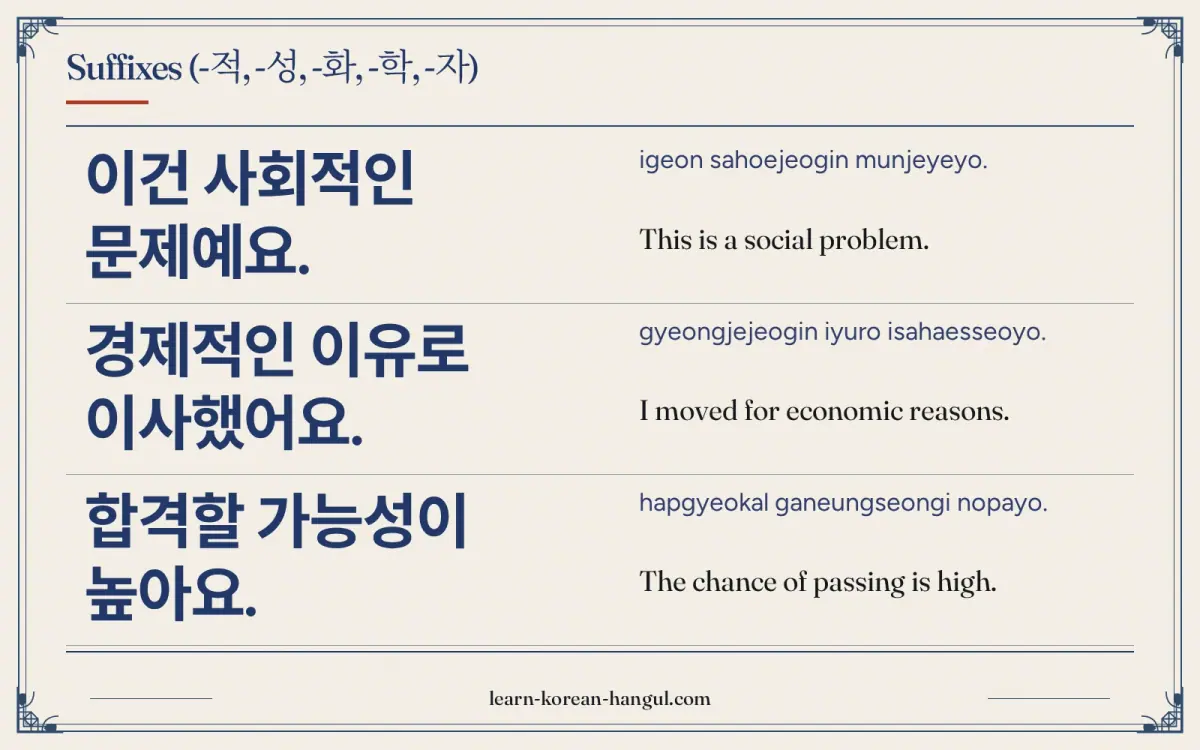
Suffixes decide the part of speech. -적 makes a describing word that sits before a noun or turns into an adverb with 으로. -성 makes a noun for a quality. -화 makes a noun for a process, and it can become a verb with 하다 or 되다. -학 and -자 make nouns for a field and a person. Each table below builds five words. Revised Romanization is in the second column, with the spoken form in brackets where it differs from the spelling.
-적 (的)
-적 turns a noun into a word that describes: 사회 (society) becomes 사회적 (social). It can come before a noun, with or without 인: 사회적 문제 or 사회적인 문제. It becomes an adverb with 으로: 사회적으로 (socially). It becomes a predicate with 이다: 이건 사회적이에요. In standard pronunciation the suffix is plain [적], so 사회적 is [사회적], although many people say [쩍] in everyday speech. After ㄱ, or after ㄹ in a Sino-Korean word, the ㅈ is tense by rule: 현실적 [현실쩍].
| Word | Revised Romanization | Built from | Meaning | Audio assetId |
|---|---|---|---|---|
| 사회적 | sahoejeok | 社會 society + 的 | social | au-pg-vocabulary-word-types-sino-korean-word-building-1 |
| 경제적 | gyeongjejeok | 經濟 economy + 的 | economic; economical | au-pg-vocabulary-word-types-sino-korean-word-building-2 |
| 개인적 | gaeinjeok | 個人 individual + 的 | personal | au-pg-vocabulary-word-types-sino-korean-word-building-3 |
| 기본적 | gibonjeok | 基本 basis + 的 | basic; fundamental | au-pg-vocabulary-word-types-sino-korean-word-building-4 |
| 현실적 | hyeonsiljeok [현실쩍] | 現實 reality + 的 | realistic | au-pg-vocabulary-word-types-sino-korean-word-building-5 |
-성 (性)
-성 turns a describing word or a noun into a quality: 가능 (possible) becomes 가능성 (possibility, the chance). It is a noun, so it takes particles and 이/가 있다: 가능성이 있어요. The suffix is usually said with a tense ㅅ: [썽].
| Word | Revised Romanization | Built from | Meaning | Audio assetId |
|---|---|---|---|---|
| 가능성 | ganeungseong [가능썽] | 可能 possible + 性 | possibility; chance | au-pg-vocabulary-word-types-sino-korean-word-building-6 |
| 중요성 | jungyoseong [중요썽] | 重要 important + 性 | importance | au-pg-vocabulary-word-types-sino-korean-word-building-7 |
| 필요성 | piryoseong [피료썽] | 必要 needed + 性 | necessity; need | au-pg-vocabulary-word-types-sino-korean-word-building-8 |
| 안전성 | anjeonseong [안전썽] | 安全 safe + 性 | safety (as a quality) | au-pg-vocabulary-word-types-sino-korean-word-building-9 |
| 창의성 | changuiseong [창의썽] | 創意 creative idea + 性 | creativity | au-pg-vocabulary-word-types-sino-korean-word-building-10 |
-화 (化)
-화 means to turn into or to become: 세계 (world) becomes 세계화 (globalisation). To make it a verb, add 하다 for an active process (세계화하다, to globalise) or 되다 for a passive process (세계화되다, to be globalised). It also attaches to loanwords: 디지털화.
| Word | Revised Romanization | Built from | Meaning | Audio assetId |
|---|---|---|---|---|
| 세계화 | segyehwa | 世界 world + 化 | globalisation | au-pg-vocabulary-word-types-sino-korean-word-building-11 |
| 도시화 | dosihwa | 都市 city + 化 | urbanisation | au-pg-vocabulary-word-types-sino-korean-word-building-12 |
| 산업화 | saneophwa [사너퐈] | 産業 industry + 化 | industrialisation | au-pg-vocabulary-word-types-sino-korean-word-building-13 |
| 디지털화 | dijiteolhwa | digital (loanword) + 化 | digitalisation | au-pg-vocabulary-word-types-sino-korean-word-building-14 |
| 자동화 | jadonghwa | 自動 automatic + 化 | automation | au-pg-vocabulary-word-types-sino-korean-word-building-15 |
-학 (學)
-학 means the study of: 경제 (economy) becomes 경제학 (economics). It is the usual ending of names of school subjects and academic fields.
| Word | Revised Romanization | Built from | Meaning | Audio assetId |
|---|---|---|---|---|
| 경제학 | gyeongjehak | 經濟 economy + 學 | economics | au-pg-vocabulary-word-types-sino-korean-word-building-16 |
| 사회학 | sahoehak | 社會 society + 學 | sociology | au-pg-vocabulary-word-types-sino-korean-word-building-17 |
| 심리학 | simnihak [심니학] | 心理 mind + 學 | psychology | au-pg-vocabulary-word-types-sino-korean-word-building-18 |
| 언어학 | eoneohak [어너학] | 言語 language + 學 | linguistics | au-pg-vocabulary-word-types-sino-korean-word-building-19 |
| 철학 | cheolhak | 哲 wisdom + 學 | philosophy | au-pg-vocabulary-word-types-sino-korean-word-building-20 |
-자 (者)
-자 means a person who does or is something: 연구 (research) becomes 연구자 (researcher). It is used for roles, jobs and groups.
| Word | Revised Romanization | Built from | Meaning | Audio assetId |
|---|---|---|---|---|
| 연구자 | yeonguja | 研究 research + 者 | researcher | au-pg-vocabulary-word-types-sino-korean-word-building-21 |
| 소비자 | sobija | 消費 spending + 者 | consumer | au-pg-vocabulary-word-types-sino-korean-word-building-22 |
| 노동자 | nodongja | 勞動 labour + 者 | worker | au-pg-vocabulary-word-types-sino-korean-word-building-23 |
| 과학자 | gwahakja [과학짜] | 科學 science + 者 | scientist | au-pg-vocabulary-word-types-sino-korean-word-building-24 |
| 참가자 | chamgaja | 參加 taking part + 者 | participant | au-pg-vocabulary-word-types-sino-korean-word-building-25 |
Worked Examples
Read each sentence aloud. The affix word carries the key idea of each sentence.
이건 사회적인 문제예요.
igeon sahoejeogin munjeyeyo.
This is a social problem.
경제적인 이유로 이사했어요.
gyeongjejeogin iyuro isahaesseoyo.
I moved for economic reasons.
합격할 가능성이 높아요.
hapgyeokal ganeungseongi nopayo.
The chance of passing is high.
저는 운동의 중요성을 알아요.
jeoneun undongui jungyoseongeul arayo.
I know the importance of exercise.
우리는 세계화 시대에 살고 있어요.
urineun segyehwa sidaee salgo isseoyo.
We live in the age of globalisation.
도시화가 빠르게 진행됐어요.
dosihwaga ppareuge jinhaengdwaesseoyo.
Urbanisation advanced quickly.
대학교에서 경제학을 전공했어요.
daehakgyoeseo gyeongjehageul jeongonghaesseoyo.
I majored in economics at university.
사회학 수업을 들어요.
sahoehak sueobeul deureoyo.
I take a sociology class.
그는 유명한 연구자예요.
geuneun yumyeonghan yeongujayeyo.
He is a famous researcher.
소비자 가격이 올랐어요.
sobija gagyeogi ollasseoyo.
The consumer price went up.
Other useful suffixes follow the same pattern. -가 (家) names an expert: 전문가 (specialist) and 작가 (writer). -력 (力) names power or ability: 능력 (ability) and 경쟁력 (competitiveness). Both come back in the hanja families linked above.
What Do You Need to Know about Prefixes (비-, 불-, 무-, 반-)?
Prefixes go in front of a Sino-Korean word and flip its meaning. Most of them mean "not" in some way, and Korean separates the shades of "not" carefully. Do not use them as interchangeable. The tables show the words you will meet first.
불- (不) and 부- (不)
| Word | Revised Romanization | Built from | Meaning | Audio assetId |
|---|---|---|---|---|
| 불가능 | bulganeung | 不 + 可能 possible | impossible | au-pg-vocabulary-word-types-sino-korean-word-building-26 |
| 불편 | bulpyeon | 不 + 便 convenient | inconvenient; uncomfortable | au-pg-vocabulary-word-types-sino-korean-word-building-27 |
| 불안 | buran [부란] | 不 + 安 safe | anxiety; unease | no clip |
| 불만 | bulman | 不 + 滿 full | dissatisfaction | no clip |
| 불필요 | bulpiryo [불피료] | 不 + 必要 needed | unnecessary | no clip |
| 부정확 | bujeonghwak | 不 + 正確 accurate | inaccurate | no clip |
| 부적절 | bujeokjeol [부적쩔] | 不 + 適切 suitable | inappropriate | no clip |
| 부당 | budang | 不 + 當 right | unjust; unfair | no clip |
| 부족 | bujok | 不 + 足 enough | shortage; lack | au-pg-vocabulary-word-types-sino-korean-word-building-28 |
| 부주의 | bujuui | 不 + 注意 attention | carelessness | no clip |
The prefix 不 is read 불 in most words and 부 before ㄷ and ㅈ. That is why the last five words say 부-: 부정확, 부적절, 부당, 부족 and 부주의. Do not guess this one, because the spelling follows the sound. Say 부정확, not 불정확, and 부적절, not 불적절. The family page for 不 (불/부) lists more words.
무- (無)
| Word | Revised Romanization | Built from | Meaning | Audio assetId |
|---|---|---|---|---|
| 무료 | muryo | 無 + 料 fee | free of charge | au-pg-vocabulary-word-types-sino-korean-word-building-29 |
| 무관심 | mugwansim | 無 + 關心 interest | indifference | no clip |
| 무책임 | muchaegim [무채김] | 無 + 責任 responsibility | irresponsible | no clip |
| 무의미 | muuimi | 無 + 意味 meaning | meaningless | no clip |
| 무제한 | mujehan | 無 + 制限 limit | unlimited | no clip |
비- (非)
| Word | Revised Romanization | Built from | Meaning | Audio assetId |
|---|---|---|---|---|
| 비공개 | bigonggae | 非 + 公開 public | private; not open to the public | au-pg-vocabulary-word-types-sino-korean-word-building-30 |
| 비공식 | bigongsik | 非 + 公式 official | unofficial | no clip |
| 비정상 | bijeongsang | 非 + 正常 normal | abnormal | au-pg-vocabulary-word-types-sino-korean-word-building-31 |
| 비현실적 | bihyeonsiljeok [비현실쩍] | 非 + 現實的 realistic | unrealistic | no clip |
| 비전문가 | bijeonmunga | 非 + 專門家 specialist | non-specialist; layperson | no clip |
반- (反)
| Word | Revised Romanization | Built from | Meaning | Audio assetId |
|---|---|---|---|---|
| 반대 | bandae | 反 + 對 facing | opposition; the opposite | au-pg-vocabulary-word-types-sino-korean-word-building-32 |
| 반정부 | banjeongbu | 反 + 政府 government | anti-government | no clip |
| 반사회적 | bansahoejeok | 反 + 社會的 social | antisocial | no clip |
| 반비례 | banbirye | 反 + 比例 proportion | inverse proportion | no clip |
Be careful with 반. The prefix 反 means "anti", as in 반대. A different 반 means "half" (半), as in 반달 (half moon). They are different characters that sound the same, so decide from the meaning.
미- (未)
| Word | Revised Romanization | Built from | Meaning | Audio assetId |
|---|---|---|---|---|
| 미완성 | miwanseong | 未 + 完成 completion | unfinished | au-pg-vocabulary-word-types-sino-korean-word-building-33 |
| 미확인 | mihwagin [미화긴] | 未 + 確認 confirmation | unconfirmed | no clip |
| 미해결 | mihaegyeol | 未 + 解決 solution | unresolved | no clip |
| 미정 | mijeong | 未 + 定 decided | undecided | no clip |
| 미성년자 | miseongnyeonja | 未 + 成年者 adult | minor; person under legal age | no clip |
무-, 비-, 불- and 미-
These four all give a negative, but each negates in a different way. Use this guide when you meet a new word, then confirm in a dictionary.
| Prefix | Plain meaning | Think of it as | Examples |
|---|---|---|---|
| 불- | not (able, good, comfortable) | a state or quality is missing or wrong | 불가능, 불편, 불안 |
| 무- | without, none | a thing is absent | 무료 (no fee), 무관심 (no interest), 무책임 (no responsibility) |
| 비- | non-, not of this kind | outside a category | 비공개 (not public), 비공식 (not official), 비전문가 (not a specialist) |
| 미- | not yet | still to happen | 미완성 (not yet finished), 미확인 (not yet confirmed) |
The match is not mechanical. 불가능 is the standard word, and 비가능 and 무가능 are not words. If you want to say "impossible", use 불가능. If you want to say "unofficial", use 비공식. When in doubt, check the dictionary.
이 서비스는 무료예요.
i seobiseuneun muryoyeyo.
This service is free.
이 방은 비공개예요.
i bangeun bigonggaeyeyo.
This room is closed to the public.
물이 부족해요.
muri bujokaeyo.
There is a shortage of water.
이 일은 혼자서는 불가능해요.
i ireun honjaseoneun bulganeunghaeyo.
This job is impossible alone.
Reading New Words
Use a four-step routine on any Sino-Korean word you do not know.
- Find the affix. Look at the first and last syllable for 불-, 무-, 비-, -적, -성, -화, -학 or -자.
- Read the middle. What is left is usually a word you know, such as 현실 or 가능.
- Put the parts together. 비 + 현실 + 적 is non- + reality + -al, so "unrealistic".
- Check the part of speech. -적 describes, -성 -화 -학 -자 name things, and 하다 or 되다 makes a verb.
Try it on two words from the list. 불확실성 (bulhwaksilseong) is 불 + 확실 + 성, so "not certain" turned into a quality: uncertainty. 비공식적 (bigongsikjeok) is 비 + 공식 + 적, so "non-official" turned into a describing word: unofficial. In 비공식적 [비공식쩍] and 불확실성 [불확씰썽], listen for the tense ㅉ and ㅆ.
Now decode these five words without help. Cover the right-hand columns first.
| Word | Parts | Meaning |
|---|---|---|
| 비민주적 (biminjujeok) | 비 + 민주 + 적 | undemocratic |
| 불평등 (bulpyeongdeung) | 불 + 평등 | inequality |
| 현대화 (hyeondaehwa) | 현대 + 화 | modernisation |
| 신뢰성 (sillwoeseong) | 신뢰 + 성 | reliability |
| 무차별 (muchabyeol) | 무 + 차별 | indiscriminate |
The next three practice headlines are written for this lesson in newspaper style and are not from any news source. Each one uses affixes you now know.
| Practice headline | Parts to find | Meaning |
|---|---|---|
| 디지털화로 소비자 불편 줄었다 | 화, 자, 불 | Digitalisation reduced inconvenience for consumers |
| 무료 공개 행사에 참가자 몰려 | 무, 자 | Participants flock to a free public event |
| 경제적 불안에 소비 심리 위축 | 적, 불 | Consumer sentiment shrinks amid economic anxiety |
What Do You Need to Know about Common Pairs?
Many affix words come in pairs with their opposite. Learn the pair together and you learn two words for the price of one.
| Positive | Negative | Meaning of the pair |
|---|---|---|
| 가능 (ganeung) | 불가능 (bulganeung) | possible / impossible |
| 안정 (anjeong) | 불안정 (buranjeong) | stable / unstable |
| 공개 (gonggae) | 비공개 (bigonggae) | public / private |
| 정상 (jeongsang) | 비정상 (bijeongsang) | normal / abnormal |
| 현실적 (hyeonsiljeok) | 비현실적 (bihyeonsiljeok) | realistic / unrealistic |
| 관심 (gwansim) | 무관심 (mugwansim) | interest / indifference |
| 책임 (chaegim) | 무책임 (muchaegim) | responsibility / irresponsibility |
| 확인 (hwagin) | 미확인 (mihwagin) | confirmed / unconfirmed |
| 유료 (yuryo) | 무료 (muryo) | paid / free |
Notice that the negative of a word can use different prefixes. 가능 takes 불, 공개 takes 비, 관심 takes 무 and 확인 takes 미. You cannot choose the prefix freely, so learn it with the word. 유료 and 무료 use the characters 有 (to have) and 無 (to lack), so they are a pair of their own.
How Do You Pronounce These Words?
The affixes change the sound of the words around them. Standard pronunciation follows the National Institute of Korean Language (국립국어원) rules, and the romanization follows the Revised Romanization of Korean, which does not write tensing caused by a neighbouring sound.
| Spelling | Sounds like | What changes |
|---|---|---|
| 사회적 | [사회적] | The standard keeps -적 plain; [사회쩍] is common in everyday speech. |
| 현실적 | [현실쩍] | After ㄹ in a Sino-Korean word, ㅈ becomes tense. |
| 가능성 | [가능썽] | The suffix -성 is usually said with a tense ㅅ. |
| 불안 | [부란] | The ㄹ of 불 links to the empty ㅇ of 안. |
| 불필요 | [불피료] | No change at the join; 필요 is said [피료]. |
| 심리학 | [심니학] | The ㄹ of 리 becomes [ㄴ] after ㅁ. |
| 과학자 | [과학짜] | After the final ㄱ, ㅈ of 자 becomes tense. |
| 산업화 | [사너퐈] | The ㅂ of 업 links to 화, and ㅂ and ㅎ join into [ㅍ]. |
RR writes the sound change, so it shows 부란 as buran, but it does not show the tensing in [현실쩍] and [가능썽]. For 산업화, the Revised Romanization keeps the h in a noun: saneophwa.
Audio and Slow Playback
Each word and sentence has its own clip. The clips below replay five longer words slowly. Play one, repeat it, then play it again and compare.
What Mistakes Do Learners Make with Sino-Korean Prefixes and Suffixes?
Five mistakes come up often.
- Treating 불-, 무-, 비- and 미- as interchangeable. 불가능 is a word, but 비가능 and 무가능 are not. Check each word the first time you meet it.
- Forgetting 불 → 부. Say 부정확 and 부적절, not 불정확 or 불적절. The prefix becomes 부 before ㄷ and ㅈ.
- Using -적 as a verb. Do not say 사회적해요. Say 사회적이에요 (it is social), 사회적인 문제 (a social problem) or 사회적으로 (socially).
- Adding -적 to native words. -적 belongs to Sino-Korean roots. Say 정신적 (mental), not 마음적.
- Mixing the two 반. 반대 (反, against) and 반달 (半, half) share a sound but not a meaning.
The first mistake is the most common. A new word is always safest when you look it up, because the affix gives the idea, not the exact word.
Practice: Sort and Recall
Take the quiz below. It sorts ten words and ideas from this lesson. Eight right means you have the pattern. For spaced repetition of the words themselves, use the Sino-Korean words flashcards and the other vocabulary flashcard decks. A printable sorting sheet is available in A4 and US Letter; see the vocabulary worksheets page.
Practice · 10
What does the suffix -성 add to a word?
Show answer
the quality or possibility of something
-성 (性) makes a quality noun, as in 가능성 (possibility) and 중요성 (importance).
What does 세계화 (segyehwa) mean?
Show answer
globalisation
세계화 is 世界 (world) + 化 (-ise), so globalisation.
Which prefix means "without" in 무료 (free of charge)?
Show answer
무-
무- (無) means without. 무료 is "without a fee", so free of charge.
Before which two consonants does 불 change to 부?
Show answer
ㄷ and ㅈ
불 becomes 부 before ㄷ and ㅈ, as in 부당 and 부정확.
Which is the correct word for "impossible"?
Show answer
불가능
불가능 is the standard word. The other forms are not Korean words.
Which word means "scientist"?
Show answer
과학자
과학자 is 科學 (science) + 者 (person), so scientist. 소비자 is consumer, 노동자 is worker and 연구자 is researcher.
Which word means "unfinished" (not yet completed)?
Show answer
미완성
미- (未) means not yet. 미완성 is "not yet finished", so unfinished.
Which word means "unofficial"?
Show answer
비공식
비- (非) means non-. 비공식 is "not official", so unofficial.
Which suffix names a field of study?
Show answer
-학
-학 (學) means the study of: 경제학, 심리학, 철학.
What does 반사회적 (bansahoejeok) mean?
Show answer
antisocial (against society)
반사회적 is 反 (anti) + 社會 (society) + 的 (-al), so antisocial.
Sino-Korean Prefixes and Suffixes Sorting Sheet (PDF)
Where to Go Next
Go back up to Sino-Korean Words or move on to Sino-Korean vs Native Korean Words to learn which words use which side. For the characters behind the affixes, start with the hanja families.
Frequently Asked Questions
What Does the Suffix -적 Do to a Word?
-적 (的) turns a noun into a describing word. 사회 (society) becomes 사회적 (social), and 현실 (reality) becomes 현실적 (realistic). It can sit before a noun, take 으로 to become an adverb, or take 이다 to become a predicate: 사회적인 문제, 사회적으로, 사회적이에요.
How Is 무- Different from 비- and 불-?
무- means without: 무료 is without a fee. 비- means non-, outside a category: 비공개 is not public. 불- means not, for a state or quality that is missing or wrong: 불편 is not comfortable. The meanings overlap, so learn each word with its prefix and check the dictionary.
Can I Make up My Own Sino-Korean Words?
Not safely. The affixes are productive, which means Koreans keep making new words with them, but each word becomes standard only when people use it. 비가능 and 무가능 are not words, although 불가능 is. Look a word up before you use it.
How Can I Practise Sino-Korean Prefixes and Suffixes?
Take the ten-question quiz on this page, then pick five affixes and write two words for each. Decode each new Sino-Korean word you meet in four steps: find the affix, read the middle, put the parts together, check the part of speech.
Where Can I Find Flashcards for Sino-Korean Prefixes and Suffixes?
The Sino-Korean words flashcards deck covers common Sino-Korean words, and the vocabulary flashcard decks page lists the other decks. A deck of the affix words from this lesson is planned. Until then, use the tables on this page as a card list.
Is the Romanization on This Page Official?
It follows the Revised Romanization of Korean, which South Korea adopted on 7 July 2000 and whose rules the National Institute of Korean Language (국립국어원) publishes. It is a learning aid and does not mark every sound change, so rely on the Hangul and the audio.