Hanja 家: the Essentials
Hanja 家 is the character for "house" and "family". Its 음훈 (the pair of the native meaning word and the Korean reading, as dictionaries list it) is 집 가. The meaning word 집 is the everyday native noun for "house" or "home", and 가 is the sound the character has inside Sino-Korean words. So 집 can stand alone (집에 가요, "I go home"), while 가 only works inside compounds such as 가족 and 작가.
The character is commonly explained as a pig (豕) under a roof (宀): in ancient farming households, animals lived close to the family. Whether or not the story is exactly right, it gives you a picture to attach to the meaning of "household".
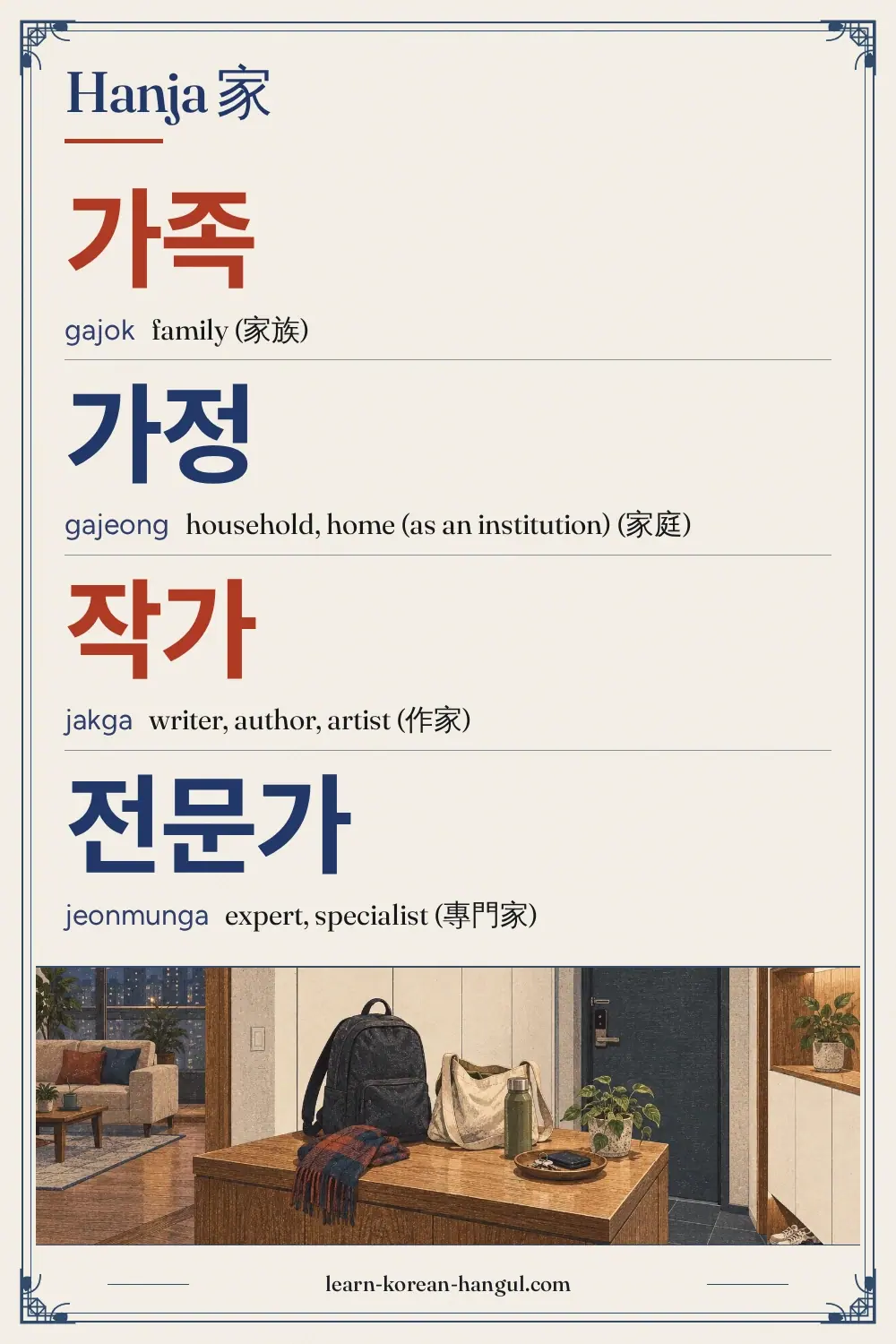
The family has two halves. The first half is home words: 가족, 가정, 가구, 가사, 가전, 농가. The second half is people words, where -가 at the end of a noun names an expert: 작가, 화가, 음악가, 전문가, 정치가. The card below sums up the character.
| Item | Detail |
|---|---|
| Character | 家 |
| 음훈 | 집 가 |
| Reading | 가 (ga) |
| Core meaning | house; home; family; expert (as a suffix) |
| Radical | 宀 (roof; Kangxi radical 40) |
| Strokes | 10 |
| Words on this page | 12 |
The roof radical 宀 sits on top of many characters about buildings and shelter, such as 室 (room), 安 (safe) and 客 (guest). The hanja radicals section explains how to use radicals to look up characters. Now to the word list.
Which Words Does 家 Build?
These 12 words are the best ones to learn first. They cover family and home life, objects in the home, and the many words that name experts and professions. Revised Romanization (RR) appears only as a learning aid, and square brackets show the spoken form where it differs from the spelling.
| Word | Characters | RR | Meaning | How the characters add up |
|---|---|---|---|---|
| 가족 | 家族 | gajok | family | 家 house + 族 clan |
| 가정 | 家庭 | gajeong | household, home (as an institution) | 家 house + 庭 yard |
| 작가 [작까] | 作家 | jakga | writer, author, artist | 作 make + 家 expert |
| 전문가 | 專門家 | jeonmunga | expert, specialist | 專 focus + 門 field + 家 expert |
| 화가 | 畫家 | hwaga | painter, artist | 畫 picture + 家 expert |
| 음악가 [으막까] | 音樂家 | eumakga | musician | 音 sound + 樂 music + 家 expert |
| 가구 | 家具 | gagu | furniture | 家 house + 具 tool |
| 가전 | 家電 | gajeon | home appliances | 家 house + 電 electricity |
| 농가 | 農家 | nongga | farm household, farmhouse | 農 farming + 家 household |
| 가사 | 家事 | gasa | housework, household chores | 家 house + 事 matter |
| 국가 [국까] | 國家 | gukga | nation, state | 國 country + 家 household |
| 정치가 | 政治家 | jeongchiga | politician, statesman | 政 govern + 治 rule + 家 expert |
The family has two layers. In 가족, 가정, 가구, 가전, 가사 and 농가, 家 means a house or household, and it comes at the start or in the middle. In 작가, 화가, 음악가, 전문가 and 정치가, it is a suffix, and it comes at the end. When you meet a new word that ends in 가, ask whether the first part names a field (a skill) or a place (a home).
The suffix -가 is highly productive. Others are 건축가 (architect), 사업가 (businessperson), 평론가 (critic), 소설가 (novelist) and 연주가 (performer). Treat it like "-ist" in English: it names a person who works at a craft or in a field. A short list of such words appears in the decoding exercises below.
The 12 Words One by One
가족 (家族, gajok): family. The standard word for family, as in your closest relatives: 가족사진 (family photo), 가족 여행 (family trip), 대가족 (large family) and 핵가족 (nuclear family). It is neutral and not especially formal. Its close relative 식구 (食口, "mouths to feed") also means members of a household. With the possessive, say 우리 가족.
가정 (家庭, gajeong): household, home (as an institution). "The house and its yard", so the home as a unit of society: 가정 교육 (upbringing at home), 가정 방문 (home visit), 행복한 가정 (a happy home). May is called 가정의 달 (the Month of Families) in Korea, because Children's Day, Parents' Day and Teachers' Day all fall in it. Compared with 가족, 가정 is the household, not the people.
작가 [작까] (作家, jakga): writer, author, artist. "An expert in making", so a writer, a novelist or an artist who creates works: 소설 작가 (novelist), 웹툰 작가 (webtoon artist), 작가님 (respectful address). The ㄱ before 가 makes the 가 tense, [작까]. A writer can also be called 저자 (author of a book) or 글쓴이 (the writer of a text).
전문가 (專門家, jeonmunga): expert, specialist. Someone who has trained in a particular field: 컴퓨터 전문가 (a computer expert), 건강 전문가 (a health expert). 專門 means "specialised field", so the full word is "an expert in a specialised field". The opposite is 초보자 (beginner). After the nasal ㄴ, the word is spoken as [전문가], with a plain 가.
화가 (畫家, hwaga): painter, artist. An artist who paints: 유명한 화가 (a famous painter), 화가의 작품 (the painter's work). Because the syllable before 가 ends in a vowel, the 가 stays plain. A person who draws cartoons is a 만화가 (cartoonist), formed with the same suffix. Caution: the 화가 in 화가 나다 (to be angry) is a different word: 화 (火, anger) plus the subject particle 가.
음악가 [으막까] (音樂家, eumakga): musician. A person who makes or plays music professionally: a composer, conductor or performer. The final ㄱ of 악 stays at the end of its syllable and makes the 가 tense, so the word is said [으막까]. For a pop singer, use 가수 (歌手), and for a player of an instrument, use 연주자 (performer) or name the instrument, such as 피아니스트.
가구 (家具, gagu): furniture. "Tools of the house": tables, beds, wardrobes and shelves. 가구점 (furniture shop), 가구를 사다 (to buy furniture) and 가구를 옮기다 (to move furniture) are typical uses. Be careful with the homophone 가구 (家口), a household as a unit, in 1인 가구 (one-person household). The words are spelled alike and said alike.
가전 (家電, gajeon): home appliances. Electric devices for the home: a fridge, a washing machine, a TV. The word is covered in more detail on the family page for 電 (전). Here it shows the "house" sense of 家 in a modern word: 가전제품 (home appliances), 가전 매장 (appliance shop).
농가 (農家, nongga): farm household, farmhouse. A household that farms: 농가 소득 (farm household income), 농가 주택 (farmhouse). The 家 here is the "household" sense. A farmer as a person is 농부 (農夫) or 농민 (農民). The nasal ㅇ before 가 does not make it tense, so the word is [농가].
가사 (家事, gasa): housework, household chores. The chores of a home: cooking, cleaning and laundry. 가사 노동 (domestic labour), 가사를 돕다 (to help with housework), 가사 도우미 (a home helper). A homophone, 가사 (歌詞), means song lyrics. The 事 in this word is explained on the family page for 事 (사).
국가 [국까] (國家, gukga): nation, state. The country as a political body, with the 家 in its old sense of a ruler's household. The word is covered in more detail on the family page for 國 (국). The sound is [국까], with a tense ㄲ after the final ㄱ, the same as in 작가 [작까].
정치가 (政治家, jeongchiga): politician, statesman. A person who works in politics, with a respectful tone: 훌륭한 정치가 (a great statesman). In news you also see 정치인 (politician, neutral) and 국회의원 (member of the National Assembly). The same letters can also be 정치 (politics) plus the subject particle 가, as in 정치가 어렵다 (politics is hard), so context decides whether you are reading the profession or the field.
Sentences to Hear the Words in Use
Six of the words appear in short sentences. Listen to each one, then read it aloud. The brackets in the word table show how the words are said in connected speech.
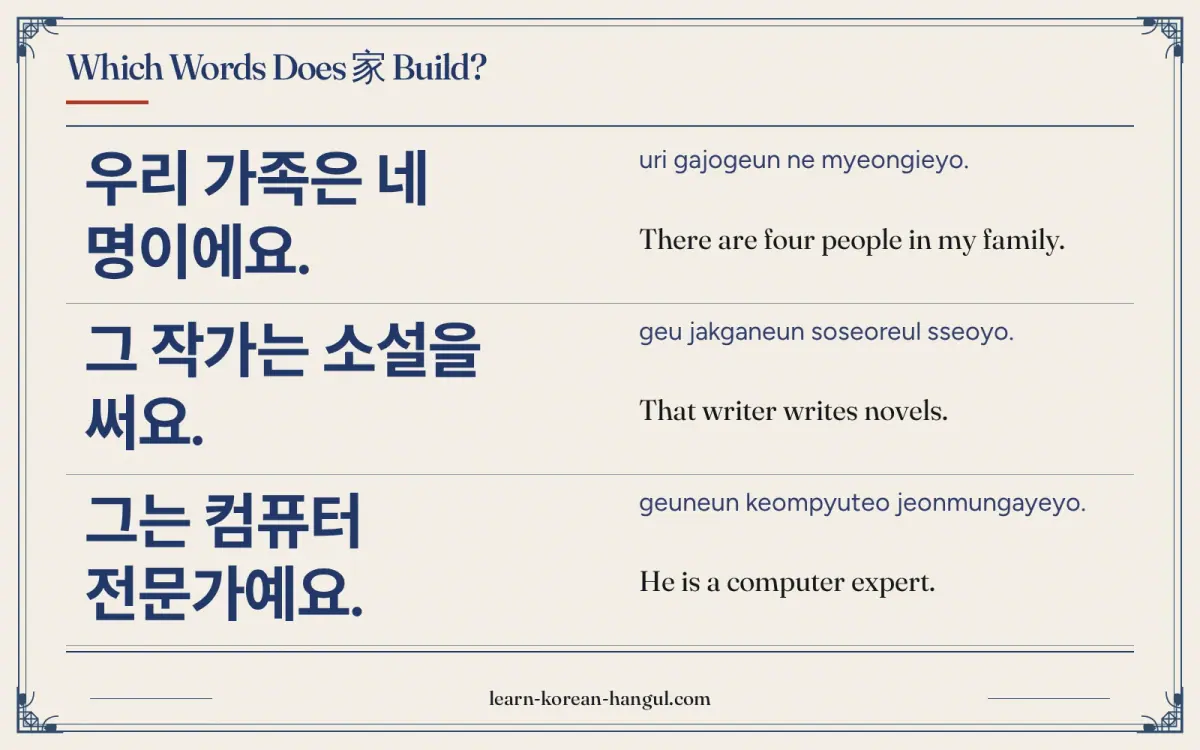
우리 가족은 네 명이에요.
uri gajogeun ne myeongieyo.
There are four people in my family.
그 작가는 소설을 써요.
geu jakganeun soseoreul sseoyo.
That writer writes novels.
그는 컴퓨터 전문가예요.
geuneun keompyuteo jeonmungayeyo.
He is a computer expert.
그 화가의 그림이 유명해요.
geu hwagaui geurimi yumyeonghaeyo.
That painter's pictures are famous.
새 가구를 샀어요.
sae gagureul sasseoyo.
I bought new furniture.
주말에는 가족이 가사를 나눠서 해요.
jumareneun gajogi gasareul nanwoseo haeyo.
On weekends the family shares the housework.
How Is 家 Read in Different Words?
The reading of 家 is the same in every word: 가. It has no second reading, and it does not fall under the initial-sound rule (두음법칙), because 가 does not begin with ㄹ or ㄴ. The only thing that changes is whether the ㄱ of 가 is plain or tense.
Rule box: -가 is tense after a final ㄱ. When the syllable before 가 ends in ㄱ, the ㄱ of 가 becomes tense (ㄲ).
- 작가 → [작까]
- 국가 → [국까]
- 음악가 → [으막까] (the ㅁ links forward, then the final ㄱ of 악 makes 가 tense)
Revised Romanization does not write tensing caused by a sound change, so it gives jakga, gukga and eumakga. The rule is explained on the page about Sino-Korean tensification.
Rule box: no tensing after a vowel or a nasal. After a vowel (화가, 정치가) or a nasal consonant (전문가, 농가), the ㄱ stays plain. So 화가 is [화가], 전문가 is [전문가] and 농가 is [농가]. A learner who says [화까] or [전문까] is adding a tense sound that standard speech does not have. The same holds for 가구 [가구], 가사 [가사] and 가전 [가전], where 가 comes first and nothing precedes it.
A linking detail. In 음악가 the ㅁ of 음 links forward to the vowel of 악, giving [으막], and the final ㄱ then makes the next 가 tense: [으막까]. In 가족 the final ㄱ is unreleased, and the word is said [가족] with the tongue held back for the last sound. Practise both slowly, then speed up.
For the vowel, the ㅏ in 가 is an open vowel, like the "a" in "father", and the consonant ㄱ is a plain (lax) sound between English "g" and "k". Do not confuse it with the aspirated ㅋ in 카, which has a strong puff of air. Listen to the audio and compare the plain and the tense versions of 가 side by side.
What Is Easy to Confuse with 家?
-가, -자, -사 and -원. Korean has several suffixes for people. They look alike in English, but each one carries a different idea.
| Suffix | Character | Idea | Examples |
|---|---|---|---|
| -가 | 家 | an expert at a craft or field | 작가, 화가, 전문가 |
| -자 | 者 | a person who does something | 학자, 기자, 소비자 |
| -사 | 師 or 士 | a trained professional | 의사, 교사, 변호사 |
| -원 | 員 | a member or an employee | 회사원, 공무원 |
The suffix -가 is the most "artistic" of the four. A 작가 creates works, while a 기자 reports and a 교사 teaches.
가정: three words. 가정 (家庭) is the household or home. The same spelling also stands for 假定 (an assumption) in 가정하다 (to suppose), and for 家政 (home economics) in the school subject 가정. Context makes it clear: 행복한 가정 is a happy home, and 가정해 보세요 is "suppose that".
가구: furniture and household. 가구 (家具) is furniture. 가구 (家口) is a household as a statistical unit, as in 1인 가구 (a one-person household) and 가구 수 (the number of households). Newspapers use the second one often, so you will meet both in different contexts.
가사: housework and lyrics. 가사 (家事) is housework. 가사 (歌詞) is song lyrics, the word you use when you say 가사를 외우다 (to memorise the lyrics). The two share a sound and a spelling, so the sentence has to tell you which is meant.
가 from other characters. Many unrelated characters are also read 가: 歌 (노래 가) in 가수 (singer), 價 (값 가) in 가격 (price), 加 (더할 가) in 추가 (addition), 可 (옳을 가) in 가능 (possible), 街 (거리 가) in 상가 (shopping arcade) and 假 (거짓 가) in 가짜 (fake). The Hangul is identical. A few of these are common in the first thousand words, so learn them as separate characters.
가족, 식구 and 가정. For the people in your family, 가족 is the neutral word. 식구 (食口) is closer to "the people you eat with", and sounds warmer or more domestic: 식구가 몇 명이에요? (How many are in your family?). 가정 is the household as an institution. Use 가족 when in doubt.
Practice This Family
The 12 Words as Flashcards
The deck below has one card for each of the 12 words, with audio. The table shows the same cards, so you can study from either one.
| # | Korean | RR | Meaning | Character and note |
|---|---|---|---|---|
| 1 | 가족 | gajok | family (家族) | 家 (집 가) + 族 (겨레 족). 가족사진 = family photo. |
| 2 | 가정 | gajeong | household, home (as an institution) (家庭) | 家 + 庭 (뜰 정). 가정의 달 = May, family month. |
| 3 | 작가 [작까] | jakga | writer, author, artist (作家) | 作 (지을 작) + 家. Said [작까]. 웹툰 작가 = webtoon artist. |
| 4 | 전문가 | jeonmunga | expert, specialist (專門家) | 專 (오로지 전) + 門 (문 문) + 家. Opposite: 초보자. |
| 5 | 화가 | hwaga | painter, artist (畫家) | 畫 (그림 화) + 家. 만화가 = cartoonist. |
| 6 | 음악가 [으막까] | eumakga | musician (音樂家) | 音 (소리 음) + 樂 (노래 악) + 家. Said [으막까]. Pop singer: 가수. |
| 7 | 가구 | gagu | furniture (家具) | 家 + 具 (갖출 구). 가구점 = furniture shop. |
| 8 | 가전 | gajeon | home appliances (家電) | 家 + 電 (번개 전). 가전제품 = home appliances. |
| 9 | 농가 | nongga | farm household, farmhouse (農家) | 農 (농사 농) + 家. Person: 농부 / 농민. |
| 10 | 가사 | gasa | housework, household chores (家事) | 家 + 事 (일 사). Not 가사 (歌詞, lyrics). |
| 11 | 국가 [국까] | gukga | nation, state (國家) | 國 (나라 국) + 家. Said [국까]. |
| 12 | 정치가 | jeongchiga | politician, statesman (政治家) | 政 (정사 정) + 治 (다스릴 치) + 家. Neutral: 정치인. |
Practice · 12
- 01가족
Show answer
gajok
family (家族)
- 02가정
Show answer
gajeong
household, home (as an institution) (家庭)
- 03작가
Show answer
jakga
writer, author, artist (作家)
- 04전문가
Show answer
jeonmunga
expert, specialist (專門家)
- 05화가
Show answer
hwaga
painter, artist (畫家)
- 06음악가
Show answer
eumakga
musician (音樂家)
- 07가구
Show answer
gagu
furniture (家具)
- 08가전
Show answer
gajeon
home appliances (家電)
- 09농가
Show answer
nongga
farm household, farmhouse (農家)
- 10가사
Show answer
gasa
housework, household chores (家事)
- 11국가
Show answer
gukga
nation, state (國家)
- 12정치가
Show answer
jeongchiga
politician, statesman (政治家)
Decode Three Unseen Words
建築家 건축가 (geonchukga). 建築 "build" + 家 "expert". An architect. The final ㄱ of 축 makes the 가 tense: [건축까].
事業家 사업가 (saeopga). 事業 "business" + 家 "expert". A businessperson or entrepreneur. The final ㅂ of 업 makes the 가 tense: [사업까].
家訓 가훈 (gahun). 家 "family" + 訓 "teaching". A family motto, often written and hung on a wall in the home: 우리 집 가훈 (our family's motto). Said [가훈].
Check Yourself
Each question asks you to decode a word or answer a question about 家. The answers are checked as you go.
Practice · 6
작가 is 作 "make" + 家. What does 작가 mean?
Show answer
writer or artist
작가 (作家) is a writer or an artist who makes works. Family is 가족, furniture is 가구 and housework is 가사.
How is 작가 said in normal speech?
Show answer
[작까]
After the final ㄱ of 작, the 가 is tense, so the word is [작까]. RR still writes jakga.
Which sentence uses 가구 to mean "furniture"?
Show answer
새 가구를 샀어요.
새 가구를 샀어요 means "I bought new furniture". In 1인 가구, 가구 is a different word (家口) meaning a household.
전문가 is 專門 "specialised field" + 家. Who is a 전문가?
Show answer
an expert
전문가 (專門家) is an expert or specialist. The opposite is 초보자, a beginner.
Which suffix means "a trained professional", as in 의사 and 교사?
Show answer
-사
-사 (師) names a trained professional, as in 의사 and 교사. -가 is an expert in a craft, -자 is a person who does something and -원 is a member or an employee.
How is 화가 (painter) said?
Show answer
[화가]
After a vowel the 가 stays plain, so 화가 is [화가]. The tense [화까] would be wrong. Also, the 화가 in 화가 나다 (to be angry) is a different word, 화 (anger) plus the particle 가.
What to Learn Next
You now have 12 words and the two jobs of 家: "home" and "expert". A good next step is the family of 事 (사), because 가사 (housework) joins 家 and 事. See 事 (사) for the affairs and meals words. For the electric devices in the home, return to 電 (전), and for 국가 see 國 (국).
To see how this fits the whole section, return to the hanja word families page. The Sino-Korean vocabulary page lists similar words by topic, and the hanja hub places the family among the other character pages. For more single characters, see the 100 most useful hanja, and for a study routine, how to learn hanja.
Frequently Asked Questions
What does -가 mean at the end of a word?
At the end of a word, -가 (家) names an expert or practitioner of a field or craft: 작가 (writer), 화가 (painter), 음악가 (musician), 전문가 (expert) and 정치가 (politician). It works like "-ist" or "-er" in English. Do not confuse it with the subject particle 가, as in 의사가 (the doctor, as the subject), which is a grammar particle and not part of the word.
Is 家族 formal?
No. 가족 (家族) is a neutral, everyday word for family, used in speech and in writing. If you want something warmer, you can say 식구 (the people of the household), and for the household as a unit, 가정.
What is the difference between 家庭 and 家族?
가족 (家族) is the people: your parents, brothers and sisters. 가정 (家庭) is the household as a place and an institution, such as a happy home, home education or the month of May, 가정의 달. You can say 우리 가족, but you would not normally say 우리 가정 in conversation.
Which professions use -가?
The -가 suffix is used for creative, intellectual and public-figure roles: 작가 (writer), 화가 (painter), 음악가 (musician), 건축가 (architect), 사업가 (businessperson), 정치가 (politician) and 전문가 (expert). Other professions use different suffixes: 의사 and 교사 use -사, 학자 and 기자 use -자, and 회사원 and 공무원 use -원.