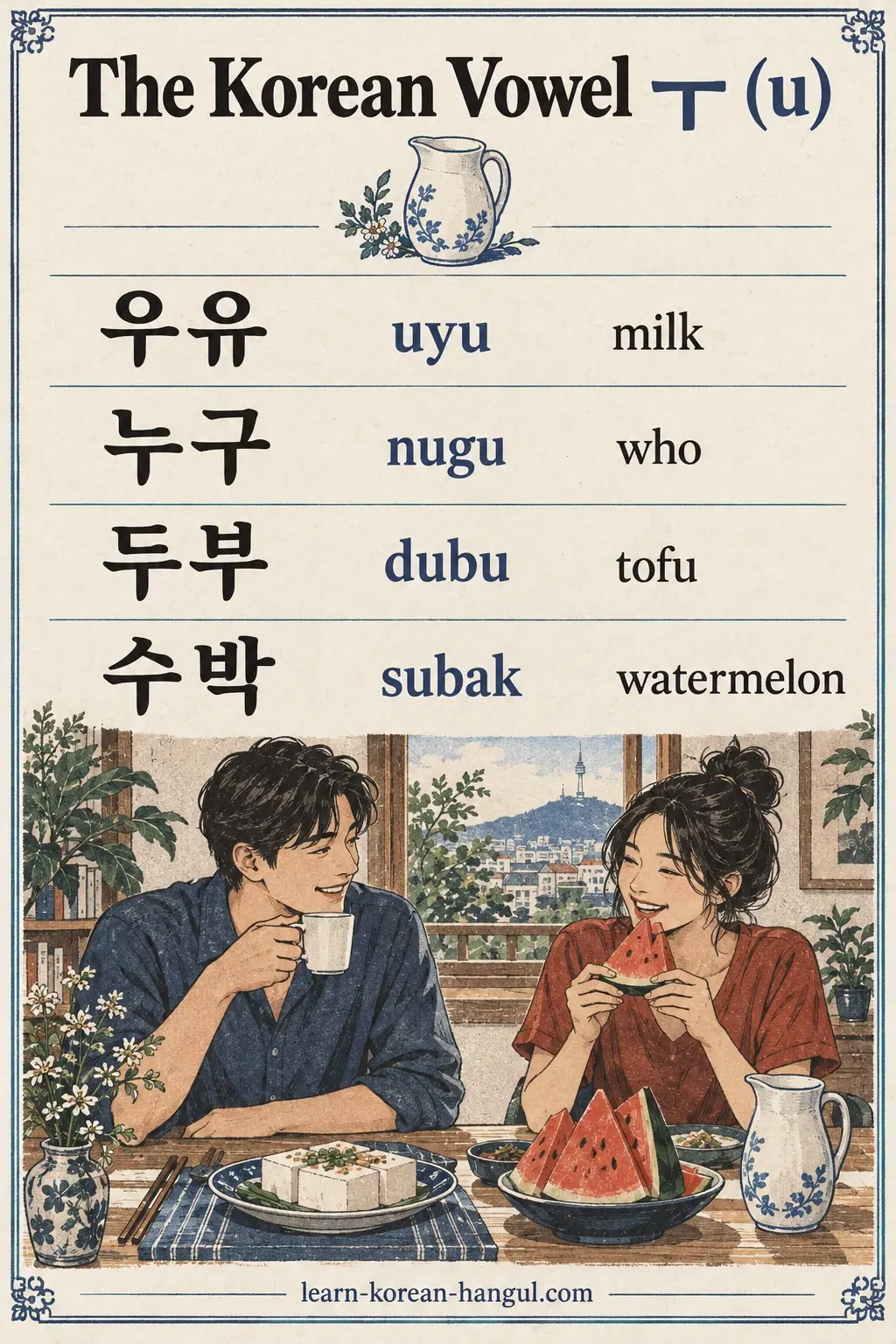
What you will be able to do after this lesson
- Pronounce ㅜ with rounded, forward lips and a short, steady sound.
- Write ㅜ in 2 strokes and place it under a consonant, as in 구 and 두.
- Distinguish 굴 from 글 and 오리 from 우리 by ear.
- Read seven example words aloud, from 우유 to 부산.
- Name the three vowels that start with ㅜ: ㅝ, ㅞ and ㅟ.
Before you start: the lesson on the previous vowel lesson (ㅗ) helps because the two are neighbours. Time: about 20 minutes. Level: A0.
How Do You Pronounce the Korean Vowel ㅜ?

ㅜ is pronounced [u]: a rounded "oo" as in English "food", with the jaw nearly closed and the lips tightly rounded. Say it as one short, steady sound. Listen to the vowel name 우.
Revised Romanization, South Korea's official Latin-letter system, writes ㅜ as "u". The English letter "u" often means "you" or "cup", so treat the spelling as a learning aid. The recording is the model.
Mouth and Tongue Position for ㅜ
Three body cues help you copy ㅜ:
- Lips: round them into a small circle and push them forward, as if you were about to whistle.
- Jaw: keep it nearly closed, higher than for ㅗ.
- Tongue: raise the back of the tongue toward the soft palate, and keep the tip down.
Phoneticians call ㅜ a high back rounded vowel. "High" means the tongue is raised, so the mouth opening is small. Move from ㅗ to ㅜ and you will feel the jaw rise and the lips tighten.
| Letter | Jaw | Lips | Tongue | Nearest English sound |
|---|---|---|---|---|
| ㅜ | nearly closed | tightly rounded, pushed forward | high, back | "oo" in "food" |
| ㅡ | nearly closed | spread, unrounded | high, back | no English match; "oo" with a smile |
| ㅗ | half open | rounded | mid, back | "o" in Spanish "no" |
How Is ㅜ Different from English Vowels?
ㅜ differs from English "oo" because English "oo" often glides, and because English spelling uses "u" for different sounds. In "food" the vowel is long and slightly closes at the end. In "cup" the letter "u" stands for a different, unrounded vowel altogether. Korean ㅜ is always the rounded vowel, and it stays short and steady.
Hangul gives you a clean rule: ㅜ is [u] in every word, and a word with ㅜ never has the "uh" of "cup". If you hear yourself saying "cup" for 구, round your lips more.
A fast test: say "who" and freeze your lips at the end. That shape is ㅜ.
Why Is ㅜ Drawn This Way?
ㅜ is drawn as a horizontal line with a short stroke below it because Hangul's vowels were built from three shapes: a dot (heaven), a horizontal line (earth) and a vertical line (a standing person). ㅜ is the earth line with the heaven dot below it. The design is explained in the Hunminjeongeum Haerye (1446), the guide that came with the original alphabet.
Compare it with ㅗ, where the dot sits above the line. The dot's position sorts the vowel into a family. Dots below or to the left mark dark vowels (음성 모음, eumseong moeum): ㅜ and ㅓ. The plain line ㅡ has no dot, but the original design also grouped it with the dark vowels. Dots above or to the right mark bright vowels (양성 모음, yangseong moeum): ㅗ and ㅏ.
So ㅜ counts as a dark vowel in vowel harmony (모음조화, moeumjohwa), and ㅜ pairs with ㅗ as dark against bright. This matters in verb endings: a stem whose last vowel is ㅜ takes 어요. For example, 주다 (to give) becomes 줘요 (gives, polite). Bright and dark vowels explains the pattern.
How to Write ㅜ in 2 Strokes
Write ㅜ with two strokes, in this order:
- Draw the long horizontal line from left to right.
- Draw the short vertical stroke below it, from the middle of the line downward.
Practise on Paper
- line across, then tick down.
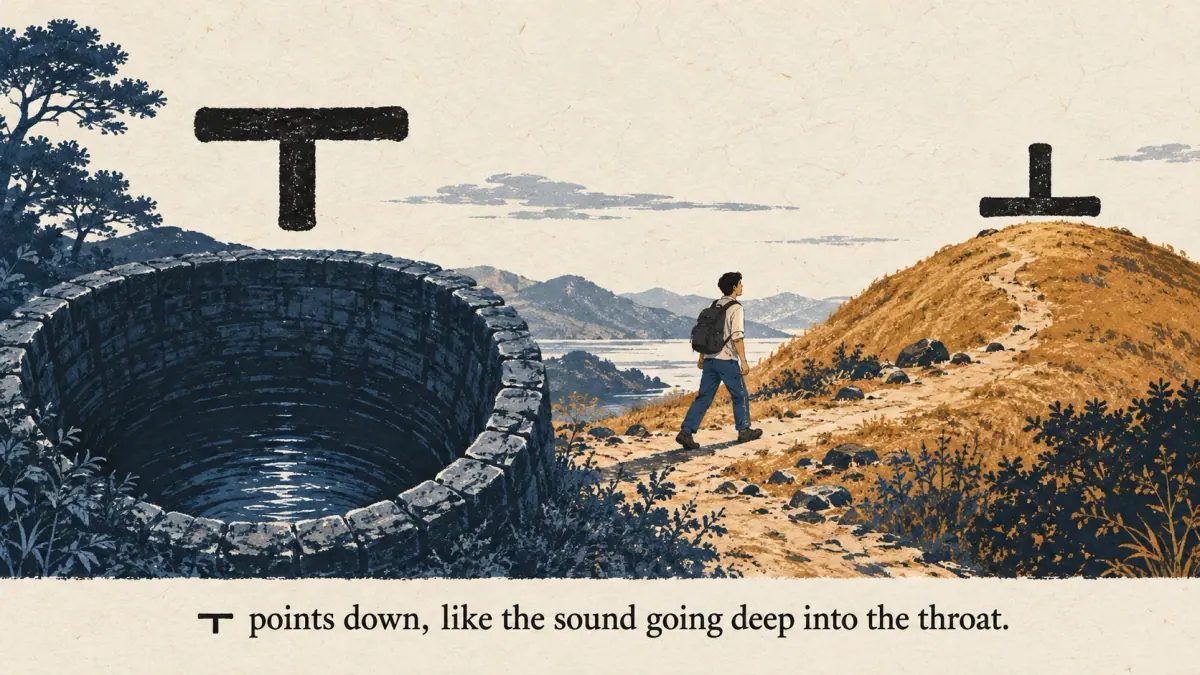
The short stroke hangs from the middle of the line, never from an end. Here is a memory cue: ㅜ points down, like the sound going deep into the throat. In contrast, ㅗ points up. Mixing them up is the most common handwriting error at this stage. For all vowels together, see Korean vowel stroke order.
Where Does ㅜ Sit in a Syllable Block?
ㅜ sits under its consonant, because it is a horizontal vowel. Korean letters are packed into square blocks, and a horizontal vowel pushes the consonant up and the vowel down.
| Vowel type | Long stroke direction | Consonant goes | Example |
|---|---|---|---|
| Vertical (ㅏ ㅓ ㅣ) | up and down | on the left | 가, 나 |
| Horizontal (ㅗ ㅜ ㅡ) | left to right | on top | 구, 누 |
In 구, ㄱ is the roof and ㅜ is the floor. The layout is taught in detail in horizontal-vowel blocks.
Writing ㅜ Alone as 우
Written alone, ㅜ is spelled 우, with the silent consonant ㅇ above it. Every Korean syllable block needs a first consonant slot. When a syllable begins with a vowel sound, ㅇ fills that slot and makes no sound at the start of a block. So "oo" is written 우, never ㅜ alone, and 우 is also the name of the letter.
The 구 Row: ㅜ with the Consonants
The 구 row is the basic consonants joined to ㅜ: 구 누 두 루 무 부 수 우 주 추 쿠 투 푸 후. The vowel never changes. Only the consonant changes, so this row trains the consonants and the vowel at the same time.
| Block | Letters | Revised Romanization |
|---|---|---|
| 구 | ㄱ + ㅜ | gu |
| 누 | ㄴ + ㅜ | nu |
| 두 | ㄷ + ㅜ | du |
| 루 | ㄹ + ㅜ | ru |
| 무 | ㅁ + ㅜ | mu |
| 부 | ㅂ + ㅜ | bu |
| 수 | ㅅ + ㅜ | su |
| 우 | ㅇ + ㅜ | u |
| 주 | ㅈ + ㅜ | ju |
| 추 | ㅊ + ㅜ | chu |
| 쿠 | ㅋ + ㅜ | ku |
| 투 | ㅌ + ㅜ | tu |
| 푸 | ㅍ + ㅜ | pu |
| 후 | ㅎ + ㅜ | hu |
Keep the vowel the same length in every syllable. English speakers tend to lengthen ㅜ in open syllables such as 수, so aim for a clipped sound.
Worked Example: Reading 우유, 누구 and 두부
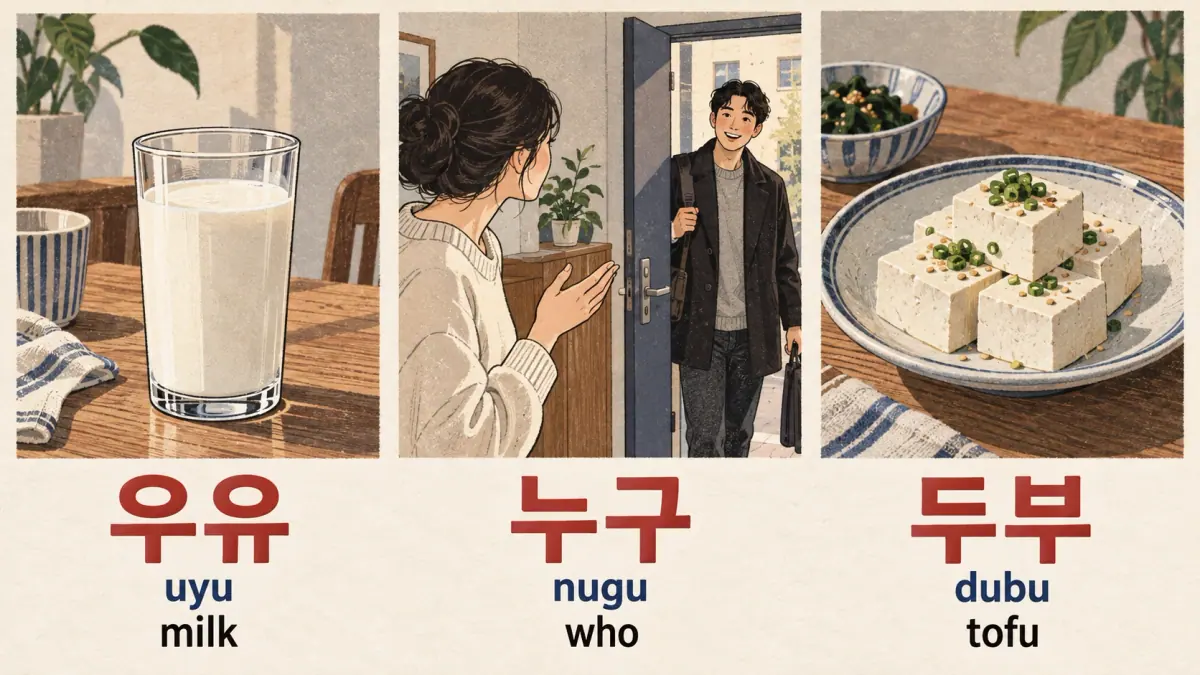
To read a Korean word, split each block into letters, say each sound, then join them. Three words give a good first practice with ㅜ.
Word 1: 우유 (uyu), "milk". The first block is ㅇ + ㅜ = 우, so the silent ㅇ leaves only [u]. The second block is ㅇ + ㅠ = 유, which is [yu], a "y" glide before ㅜ. Together they sound like [우유], "oo-yoo". The letter ㅠ is a y-vowel taught in a later lesson; here it is simply ㅜ with an extra stroke.
우유
uyu
milk
Word 2: 누구 (nugu), "who". Both blocks have a horizontal vowel: ㄴ + ㅜ = 누 and ㄱ + ㅜ = 구. The second ㄱ sits between vowels, so it is read as [g]. The word is [누구], "noo-goo". It is one of the first question words you will use.
누구
nugu
who
Word 3: 두부 (dubu), "tofu". The first block is ㄷ + ㅜ = 두, sounding [du]. The second block is ㅂ + ㅜ = 부, sounding [bu]. Only ㅂ sits between vowels, so it is voiced [b]; the first ㄷ starts the word and sounds closer to a light, unvoiced [t]. The word is [두부], "doo-boo".
두부
dubu
tofu
Here are four more words with ㅜ.
| Word | Revised Romanization | Meaning | Note |
|---|---|---|---|
| 우리 | uri | we; our | See the culture note below |
| 구두 | gudu | dress shoes | Two blocks, both with ㅜ |
| 수박 | subak | watermelon | final ㅂ is a closed stop sound; details come later |
| 부산 | busan | Busan, a port city | The English spelling Busan is this Revised Romanization |
Culture Note: Why Koreans Say 우리 for "My"
우리 literally means "we" or "our", but Koreans often use it where English says "my". For example, 우리 엄마 (uri eomma) is usually "my mom", and 우리 집 (uri jip) can mean "my home". The pattern reflects how family, school and home are felt as shared. Learn it as a set phrase for now; the grammar behind it comes later.
How Can You Hear the Difference between ㅜ, ㅡ and ㅗ?
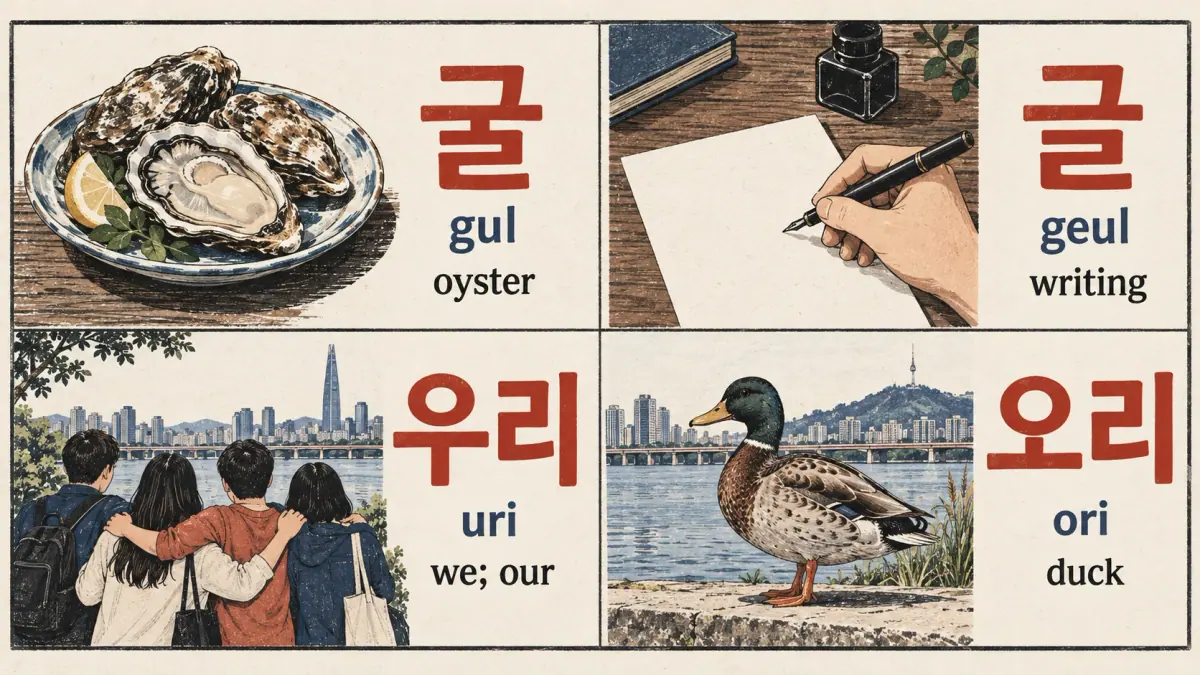
ㅜ is rounded and nearly closed, ㅡ is spread and nearly closed, and ㅗ is rounded and half open. Two lip-shape pairs show the ㅜ/ㅡ contrast: 굴 (gul, "oyster") against 글 (geul, "writing"), and 둘 (dul, "two") against 들 (deul, "field"). The pair 우리 against 오리 shows the ㅜ/ㅗ contrast through jaw height.
ㅜ: Lips Rounded and Pushed Forward. ㅡ: Lips Spread Flat, as in a Smile.
| Korean | Romanization | Meaning | Sound |
|---|---|---|---|
| 굴 | gul | oyster | |
| 글 | geul | writing |
Same Lips Contrast as above, with a Different Consonant around the Vowel.
| Korean | Romanization | Meaning | Sound |
|---|---|---|---|
| 둘 | dul | two | |
| 들 | deul | field |
ㅜ: Jaw Nearly Closed. ㅗ: Jaw Half Open.
| Korean | Romanization | Meaning | Sound |
|---|---|---|---|
| 우리 | uri | we; our | |
| 오리 | ori | duck |
For ㅜ against ㅡ, ignore the jaw and watch the lips: only the lips change. Say 굴 with a small circle, then say 글 with a smile. For ㅜ against ㅗ, the lips stay round, but the jaw rises for ㅜ. Many English speakers need repeated listening before ㅡ sounds clearly different from ㅜ, and that is normal.
What Vowels Are Built from ㅜ?
Four vowels use ㅜ as their base, which is why it is worth learning well.
| Vowel | Built from | Revised Romanization | Example |
|---|---|---|---|
| ㅠ | ㅜ + a y-glide | yu | 우유 (uyu), "milk" |
| ㅝ | ㅜ + ㅓ | wo | 뭐 (mwo), "what" |
| ㅞ | ㅜ + ㅔ | we | 웨딩 (weding), "wedding" |
| ㅟ | ㅜ + ㅣ | wi | 귀 (gwi), "ear" |
Each of these is covered later in the w-vowels section, starting from Korean w-vowels. For now, remember that ㅜ is the first half of all three w-vowels in the dark family.
Which Mistakes Do Learners Make with ㅜ?
Learners most often make three mistakes with ㅜ, and each has a simple fix.
- Under-rounding the lips so 굴 sounds like 글. Learners often assume lip shape is a minor detail. Actually lip rounding is the only difference between ㅜ and ㅡ. Fix: say 굴 in a mirror and check that the lips make a small circle.
- Writing ㅜ with the stroke above the line. Learners often assume the short stroke can go on either side. Actually a stroke above the line is ㅗ, a different vowel. Fix: remember that ㅜ points down.
- Pronouncing ㅜ like the "u" in "cup". Learners often assume Hangul "u" matches the English letter. Actually ㅜ is a rounded "oo". Fix: round the lips first, then add voice.
An expert tip: if a word with ㅜ sounds "flat" to Korean listeners, the lips are probably relaxed. Push them forward a little more than feels natural in English.
Practice: Read and Hear ㅜ
Try each task before you check the answers.
- Pick by ear. Play 굴 and 글. Which word needs rounded lips?
- Write. Write the vowel ㅜ alone as a full syllable, then write the block for [nu].
- Read. Read these words aloud and give the meaning: 우유, 누구, 두부.
- Sort. Is ㅜ a vertical or a horizontal vowel? Is the short stroke above or below the line?
Practice · 8
Which English sound is closest to Korean ㅜ?
Show answer
The "oo" in "food"
ㅜ is a rounded "oo" like "food", shorter and steady; it is never the "u" of "cup".
Which word needs rounded lips?
Show answer
굴 (oyster)
굴 has ㅜ with rounded lips; 글 has ㅡ with spread lips. Lip rounding is the only difference.
Where is the short stroke of ㅜ?
Show answer
Below the horizontal line
ㅜ points down: the short stroke hangs below the line. A stroke above the line makes ㅗ.
How do you write ㅜ alone as a syllable?
Show answer
우
A block needs a first consonant, so ㅜ alone is written 우 with the silent ㅇ on top.
What does 누구 mean?
Show answer
who
누구 (nugu) means who; 두부 is tofu and 우유 is milk.
Which pair differs in jaw height rather than lip shape?
Show answer
우리 / 오리
ㅜ and ㅗ both have round lips, but the jaw rises for ㅜ; 굴/글 and 둘/들 differ in lip rounding.
Which vowel is built from ㅜ + ㅓ?
Show answer
ㅝ
ㅜ + ㅓ gives ㅝ (wo), as in 뭐; ㅟ is ㅜ + ㅣ and ㅘ is built from ㅗ.
In everyday speech, what does 우리 엄마 usually mean?
Show answer
my mom
우리 literally means we or our, but Koreans often use it where English says "my", so 우리 엄마 is usually "my mom".
Answers to the Practice
- 굴 needs rounded lips because it has ㅜ. 글 has ㅡ, with spread lips.
- 우 is the vowel alone; 누 is ㄴ + ㅜ, pronounced [nu].
- 우유 means milk, 누구 means who, and 두부 means tofu.
- ㅜ is a horizontal vowel, and its short stroke is below the line.
If you missed an answer, replay the clip and say it with the recording. For extra drills, use the Hangul flashcard decks, which play audio only when you tap, or test your ear with the Hangul quizzes. You can build blocks yourself in the hangul syllable builder or explore every letter in the interactive hangul alphabet. To write by hand, print the korean vowels writing practice sheet.
What Should You Learn after ㅜ?
Learn ㅡ next, because it is the vowel most often confused with ㅜ. You now know the Korean vowel ㅜ: its rounded [u] sound, its two strokes, its place under a consonant, and its silent-ㅇ form 우. The next lesson is the next Hangul lesson, which uses 굴 and 글 again.
This lesson does not cover ㅜ before final consonants, or how ㅜ changes in verb endings beyond the 줘요 preview. Those topics belong to the syllable-block and grammar sections. For the whole group, return to basic Korean vowels, compare mouth diagrams on Korean vowel sounds, or print the Korean vowels chart. You can also revisit the previous vowel lesson to compare the rounded ㅜ with the more open ㅗ.
Honest limits of this page: mouth-position descriptions are approximations for English speakers, and the recordings are the reference. The standard Seoul pronunciation is described; regional speech varies.
Frequently Asked Questions

Is ㅜ like oo in food? Yes, it is close. Korean ㅜ is a rounded high back vowel like the "oo" in "food", but it is shorter and does not glide at the end. Round the lips, push them forward, and keep the sound steady. It is not the "u" of "cup", which is an unrounded vowel.
Why do Koreans say 우리 for my? 우리 literally means "we" or "our", and Koreans use it for people and places they share with others. So 우리 엄마 is usually understood as "my mom", and 우리 집 as "my home". It is a normal part of everyday speech, and learners can treat it as a common phrase pattern.
How do I tell ㅜ from ㅡ? Both vowels have a nearly closed jaw. The difference is the lips: ㅜ has rounded, forward lips, and ㅡ has spread, flat lips. Say 굴 with a small circle and 글 with a smile. In writing, ㅜ has a short stroke hanging below the line, while ㅡ is only a line.
Which way does the stroke of ㅜ point? The short stroke of ㅜ points down, hanging from the middle of the horizontal line. If the short stroke points up instead, the letter is ㅗ. A simple memory cue is that ㅜ points down like a deep sound, while ㅗ points up like a small hill.
What vowels are built from ㅜ? ㅜ is the base of four other vowels: ㅠ adds a y-glide, ㅝ joins ㅜ and ㅓ, ㅞ joins ㅜ and ㅔ, and ㅟ joins ㅜ and ㅣ. The three that start with a w-sound (ㅝ, ㅞ, ㅟ) belong to the w-vowel group and are taught in a later section.