What you'll learn
- Pronounce ㅡ with spread, unrounded lips and the tongue pulled back.
- Write ㅡ in 1 stroke and place it under a consonant.
- Hear the difference between 글 "writing" and 굴 "oyster".
- Explain why English loanwords such as 버스 and 스트레스 gain extra ㅡ syllables.
Before you start: you should know the lesson on ㅜ. Time: about 20 minutes, including practice.
Key facts about ㅡ
- Sound: "oo" with flat, spread lips; the usual IPA symbol is [ɯ].
- Romanization: "eu" in Revised Romanization, two letters for one vowel.
- Alone: written with the silent placeholder ㅇ as 으.
- Shape: a horizontal vowel, 1 stroke, written under the consonant.
- Loanwords: Korean inserts ㅡ to split English consonants: bus → 버스.
- Main contrasts: 글 vs 굴 (lips) and 그 vs 기 (tongue).
How Do You Pronounce the Korean Vowel ㅡ?
You pronounce ㅡ by spreading your lips as if for "ee", then pulling your tongue back until the sound becomes a dull, flat "oo". The lips stay unrounded the whole time. ㅡ has no close English equivalent, so play the clip several times and imitate it before reading the description.
Linguists call ㅡ a close back unrounded vowel and write it [ɯ]. "Close" means the tongue is high in the mouth. "Back" means the highest part of the tongue is near the soft palate. "Unrounded" means the lips do not form a circle. English has close back vowels, such as the "oo" in "food", but all of them are rounded, which is why English speakers find ㅡ unusual.
Mouth and Tongue Position for ㅡ
The easiest route to ㅡ starts from a vowel you already know. Follow these steps:
- Say ㅣ (ee) as in 이. Notice that your lips are spread and your tongue is high and forward.
- Keep your lips spread. Do not let them round or move forward at any point.
- Slide your tongue back while keeping it high. The sound darkens from "ee" toward a flat "oo".
- Stop when it matches the audio. That darker, flat sound is 으.
Then compare it with the 으 clip above.
You'll know you have it when you can switch between 이 and 으 without moving your lips at all, only your tongue. A second check is a pencil test: hold a pencil lightly between your lips at the corners. If you can say ㅡ without the pencil moving, your lips are not rounding.
How Is ㅡ Different from English Vowels?
ㅡ differs from every English vowel in either lip shape or tongue position. The table shows why the usual comparisons only half work.
| English sound | Example | How it compares with ㅡ |
|---|---|---|
| "oo" in "good" | good, book | Similar tongue height, but English rounds the lips |
| "oo" in "food" | food, blue | Too rounded and too long; sounds like ㅜ |
| "i" in "roses" (final, unstressed) | roses, wanted | Close for some speakers, but too far forward |
| "u" in "cup" | cup, but | Tongue too low; sounds like ㅓ |
Expert insight: the most reliable cue is not the tongue but the lips. If your lips stay spread, you will rarely be misheard, even if your tongue position is not perfect.
The flat shape of the letter itself reflects this sound and connects ㅡ to the history of the alphabet.
Why Is ㅡ Drawn This Way?

ㅡ is drawn as one flat line because it is one of the three basic shapes from which all Hangul vowels were built. The Hunminjeongeum Haerye (1446) describes the dot ㆍ as heaven, the flat line ㅡ as earth, and the upright line ㅣ as a person. ㅡ is the earth symbol on its own, used unchanged as a letter.
Other vowels add a short stroke to this line. Put a stroke above it and you get ㅗ. Put a stroke below it and you get ㅜ. This is why ㅡ, ㅗ and ㅜ all sit under the consonant and why they look like a family.
In grammar terms, ㅡ is usually classed as a dark (음성) vowel, together with ㅓ and ㅜ. In practice ㅡ behaves in a special way with verb endings, which the "Why does 쓰다 become 써요?" FAQ below explains. The page on bright and dark vowels covers the general system.
Because ㅡ is a single line, writing it is the simplest task in this whole course.
How to Write ㅡ in 1 Stroke
You write ㅡ in one stroke from left to right, keeping the line level:
- Start just below the left edge of the consonant above.
- Draw a straight horizontal line to the right.
- Stop just past the right edge of the consonant, so the line is slightly wider than the consonant.
Practise on Paper
- line across, left to right.
You'll know your ㅡ is right when it is clearly wider than the consonant and sits in the lower half of the block. A common mistake is drawing it too short, which makes handwritten 그 look like a stray mark under ㄱ. See Korean vowel stroke order to compare ㅡ with ㅗ and ㅜ.
The width of the line matters because of where ㅡ goes in a syllable block.
Where ㅡ Sits in a Syllable Block
ㅡ sits under the first consonant of a syllable block, because it is a horizontal vowel (a vowel built on the flat line). The consonant takes the top half and ㅡ takes the bottom. If the syllable has a final consonant, it goes underneath ㅡ, making three layers.
| Block | Parts | Layout | Sound (RR) | Meaning |
|---|---|---|---|---|
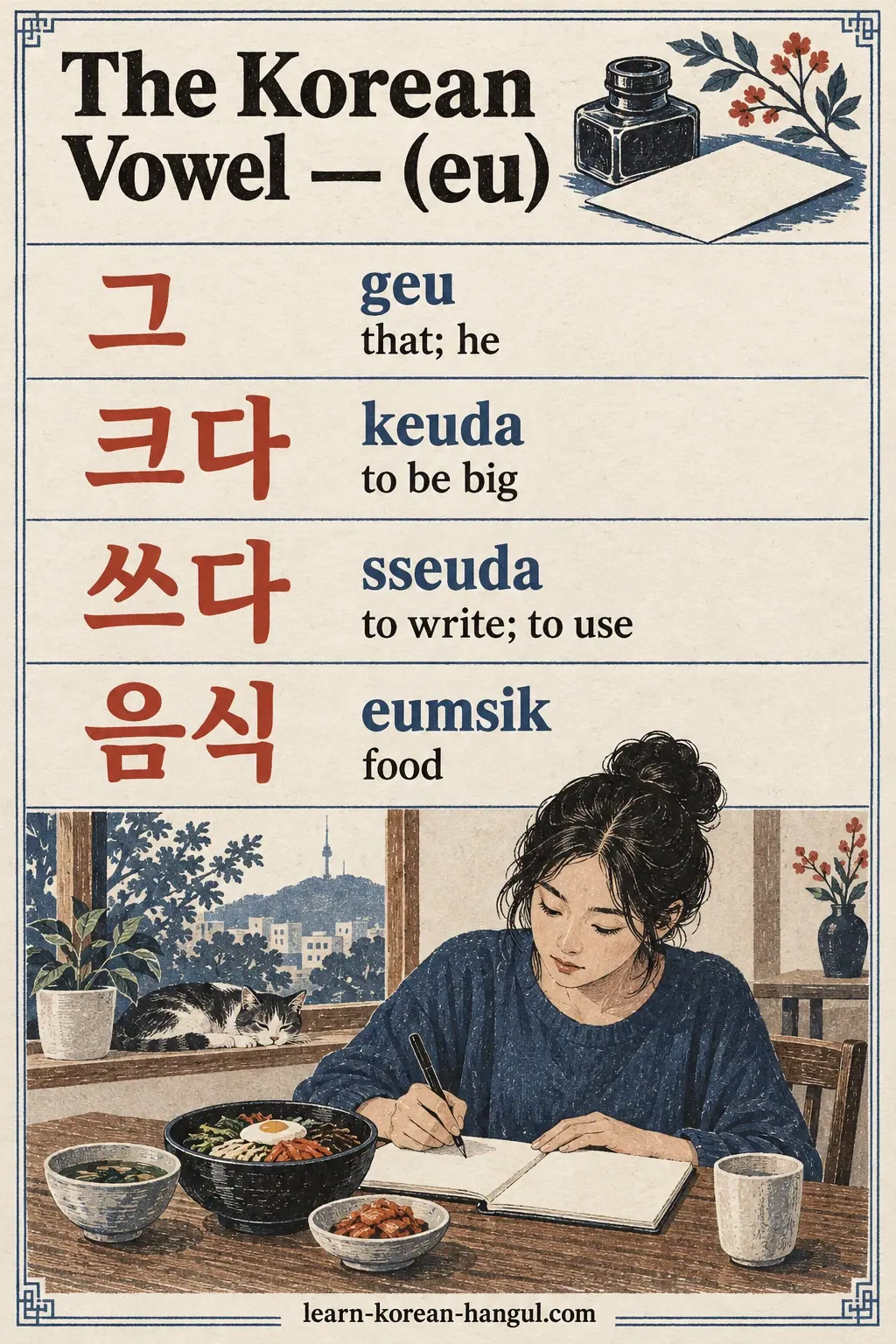
| 그 | ㄱ + ㅡ | consonant on top | geu | that; he |
| 크 | ㅋ + ㅡ | consonant on top | keu | first syllable of 크다 "to be big" |
| 글 | ㄱ + ㅡ + ㄹ | three layers | geul | writing |
| 음 | ㅇ + ㅡ + ㅁ | three layers | eum | first syllable of 음식 "food" |
This is the same layout as ㅗ, ㅛ, ㅜ and ㅠ, taught in horizontal-vowel blocks.
Writing ㅡ Alone as 으
To write ㅡ as a syllable on its own, put the silent ㅇ on top: 으. The ㅇ only holds the consonant slot, so 으 sounds exactly like the bare vowel. You meet 으 at the start of words such as 음식 "food" and 음악 "music", and in grammar endings such as -으세요 in 앉으세요 "please sit down".
With the layout clear, you can read real words that contain ㅡ.
Worked Example: Reading 그림, 버스 and 스트레스

Each of these three words shows ㅡ in a different job: inside a native word, at the end of a loanword, and as a "filler" vowel between English consonants.
그림 (geurim) "picture"
- 그 = ㄱ on top + ㅡ below → "geu", lips spread.
- 림 = ㄹ + ㅣ + final ㅁ → "rim".
- Together: 그림. Move from ㅡ to ㅣ by sliding only the tongue forward.
버스 (beoseu) "bus"
- 버 = ㅂ + ㅓ → "beo".
- 스 = ㅅ + ㅡ → "seu".
- Together: 버스, two syllables for one English syllable.
Korean writes "bus" with an extra 스 because a Korean syllable cannot end in an s sound. A final ㅅ is pronounced as a short, unreleased t, so 벗 would sound like "beot". To keep the s audible, Korean gives it its own syllable, and the vowel usually chosen is ㅡ, the most neutral vowel in the system (after ch- and j-type sounds it is ㅣ instead, as in 브리지 "bridge"). In fast speech that ㅡ is often short and weak, so do not stress it.
스트레스 (seuteureseu) "stress"
- 스 = ㅅ + ㅡ → "seu".
- 트 = ㅌ + ㅡ → "teu".
- 레 = ㄹ + ㅔ → "re".
- 스 = ㅅ + ㅡ → "seu".
- Together: 스트레스, four syllables for one English syllable.
The English word "stress" begins with three consonants, s-t-r. Korean syllables allow only one consonant before the vowel, so ㅡ is inserted after s and after t. Practise more of these in reading English loanwords in Hangul.
More example words with ㅡ:
| Word | RR | Meaning | Audio |
|---|---|---|---|
| 그 | geu | that; he | |
| 크다 | keuda | to be big | |
| 쓰다 | sseuda | to write; to use | |
| 음식 | eumsik | food |
Reading ㅡ in isolation is straightforward; the challenge is keeping it apart from its two neighbours, ㅜ and ㅣ.
ㅡ vs ㅜ vs ㅣ: Hearing the Difference

ㅡ shares its tongue height with ㅜ and its lip shape with ㅣ, so it is confused with both. ㅡ and ㅜ differ only in the lips: ㅜ is rounded, ㅡ is spread. ㅡ and ㅣ differ only in the tongue: ㅣ is forward, ㅡ is back.
Spread Lips vs Rounded Lips
| Korean | Romanization | Meaning | Sound |
|---|---|---|---|
| 글 | geul | writing | |
| 굴 | gul | oyster |
Spread Lips vs Rounded Lips
| Korean | Romanization | Meaning | Sound |
|---|---|---|---|
| 들 | deul | field | |
| 둘 | dul | two |
Tongue Back vs Tongue Forward
| Korean | Romanization | Meaning | Sound |
|---|---|---|---|
| 그 | geu | that | |
| 기 | gi | energy |
| Feature | ㅡ (eu) | ㅜ (u) | ㅣ (i) |
|---|---|---|---|
| Lips | spread | rounded, pushed forward | spread |
| Tongue | high, back | high, back | high, front |
| Letter shape | flat line | line with stroke below | upright line |
| Example | 글 "writing" | 굴 "oyster" | 기 "energy" |
A three-way drill: say 우-으-이 slowly. Between 우 and 으 only the lips change; between 으 and 이 only the tongue moves. When you can do this smoothly, you control all three vowels. For mouth diagrams of every vowel, see Korean vowel sounds.
ㅡ also combines with ㅣ to make a new letter, ㅢ, as in 의사 "doctor". It is the only compound vowel built on ㅡ, and the vowel ㅢ has its own lesson because its pronunciation changes with position.
These contrasts explain most of the errors learners make with ㅡ.
Which Mistakes Do Learners Make with ㅡ?

The three most common mistakes with ㅡ are rounding the lips, reading "eu" as two vowels, and over-stressing the ㅡ in loanwords.
Rounding the lips. Learners often assume ㅡ is the "oo" in "food". Actually ㅡ must have spread lips, because rounding turns it into ㅜ. The result is that 글 "writing" sounds like 굴 "oyster". Fix: smile slightly while you say ㅡ.
Reading "eu" as two vowels. Learners often assume "eu" means "eh-oo". Actually it is one vowel, because Revised Romanization needed two letters for a sound English spelling cannot show. Fix: read the Hangul 으 directly and ignore the romanization.
Over-pronouncing ㅡ in loanwords. Learners often say 버스 as "buh-SOO" with a strong final vowel. Actually the ㅡ in 스 is short and light in natural speech, because it was inserted only to carry the s. Fix: say 버스 with the stress on 버 and let 스 fade.
Expert insight: ㅡ is the vowel that disappears most easily in Korean grammar. Verb stems ending in ㅡ drop it before endings that start with 아 or 어: 쓰다 → 써요, 크다 → 커요. Knowing this early saves confusion when you meet verbs. The pattern is covered in ㅡ irregular verbs.
Now test yourself with four short exercises.
Practice: Read and Hear ㅡ

Do these four exercises in order. Answers follow below.
Practice · 8
What do your lips do when you say ㅡ?
Show answer
Stay spread and flat
ㅡ is unrounded: the lips stay spread. Rounding them turns ㅡ into ㅜ.
Which word means "writing"?
Show answer
글
글 has ㅡ with spread lips and means writing; 굴 has rounded ㅜ and means oyster.
How many strokes does ㅡ take to write?
Show answer
1
ㅡ is a single horizontal line drawn from left to right.
How many syllables does 스트레스 (stress) have in Korean?
Show answer
4
Korean inserts ㅡ after s and t, giving four blocks: 스-트-레-스.
Why does 버스 (bus) end in 스?
Show answer
A Korean syllable cannot end in an s sound, so ㅡ carries the s
A final ㅅ would sound like a short t, so Korean gives the s its own syllable with ㅡ.
What does 쓰다 become with the polite ending -어요?
Show answer
써요
Stems ending in ㅡ drop it before 어 or 아, so 쓰 + 어요 becomes 써요.
Between 으 and 이, what changes?
Show answer
Only the tongue position
ㅡ and ㅣ both have spread lips; the tongue is back for ㅡ and forward for ㅣ.
Which syllable is ㄱ + ㅡ + ㄹ?
Show answer
글
ㄱ on top, ㅡ in the middle and ㄹ underneath make the three-layer block 글.
Exercise 1: Read aloud. Read each word, then check with the audio: 그림, 음식, 크다, 아이스크림 "ice cream".
Exercise 2: Which vowel? Play each clip and decide whether you hear ㅡ, ㅜ or ㅣ: (a) 굴, (b) 글, (c) 기, (d) 둘, (e) 그.
Exercise 3: Count the syllables. How many syllables does each loanword have in Korean? (a) 버스, (b) 스트레스, (c) 아이스크림.
Exercise 4: Build the block. Write the syllable for each set: (a) ㅅ + ㅡ, (b) ㄱ + ㅡ + ㄹ, (c) ㅇ + ㅡ + ㅁ.
Answers to the Practice
- Exercise 1: each word has at least one ㅡ. In 아이스크림 there are two: 스 and 크.
- Exercise 2: (a) ㅜ, (b) ㅡ, (c) ㅣ, (d) ㅜ, (e) ㅡ. Four or five correct means your ear is ready.
- Exercise 3: (a) 2, (b) 4, (c) 5. English "ice cream" has two syllables; Korean adds ㅡ after s and after k.
- Exercise 4: (a) 스, (b) 글, (c) 음.
For more practice, use the Hangul flashcard decks and test ㅡ/ㅜ/ㅣ in the Hangul quizzes. Build 그, 글 and 스 yourself in the Hangul syllable builder, or hear every vowel in the interactive Hangul alphabet.
What Should You Learn after the Korean Vowel ㅡ?
After the Korean vowel ㅡ, continue to the lesson on the vowel ㅣ. You have already used ㅣ as the starting point for ㅡ, so the two lessons reinforce each other. For the whole set of ten, return to basic Korean vowels.
For handwriting, print the Korean vowels writing practice sheet, and keep the Korean vowels chart nearby.
What this lesson covers and doesn't: this page teaches the sound, shape, block position and main contrasts of ㅡ, plus why loanwords add it. It does not cover the full rules of ㅡ-irregular conjugation, the three pronunciations of ㅢ, or every loanword pattern; each has its own page. The audio models one standard Seoul pronunciation, and regional speech can differ.
Frequently Asked Questions about ㅡ
Is there an English sound like ㅡ? No standard English vowel matches ㅡ. The nearest everyday sound is the "oo" in "good" said with flat, spread lips instead of rounded ones, or the brief vowel some speakers make in "roses" at the end. Treat these as rough hints and copy the audio, because English always adds some lip rounding or moves the tongue forward.
Why does 버스 have 스 at the end? Korean cannot end a syllable with an s sound: a final ㅅ is pronounced like a short t. To keep the s of "bus", Korean adds a vowel and makes it a new syllable, 스. The vowel chosen is ㅡ because it is the weakest, most neutral Korean vowel. The same logic turns "stress" into the four syllables of 스트레스.
Why is ㅡ romanized eu? English spelling has no letter for this vowel, so Revised Romanization (2000) uses the pair "eu" to label it. The two letters stand for one sound, not "e" plus "u". Older McCune-Reischauer spellings wrote it ŭ instead, which is why you may see Han'gŭl for 한글 in older books and library catalogues.
Why does 쓰다 become 써요? Verb stems ending in ㅡ drop that ㅡ when an ending starting with 어 or 아 is added. 쓰 + 어요 loses its ㅡ, and the ㅆ joins the ending: 써요. Grammar books call this the ㅡ irregular, though it is completely regular in practice. Other examples are 크다 → 커요 and 바쁘다 → 바빠요.
Is ㅡ a vowel or a separator line? ㅡ is always a vowel inside Hangul. Beginners sometimes read it as a dash or a hyphen because it is a single flat stroke. In a block such as 그, the line under the consonant is the vowel, and the block is read "geu". A real dash in Korean text is drawn longer and is never attached under a consonant.