What you will be able to do after this lesson
- Pronounce ㅣ as a short, clear [i] without an English glide.
- Write ㅣ in 1 stroke and place it to the right of a consonant, as in 기 and 니.
- Read 시 and explain why it sounds like "shi" although Revised Romanization writes "si".
- Name nine of the eleven compound vowels that contain ㅣ.
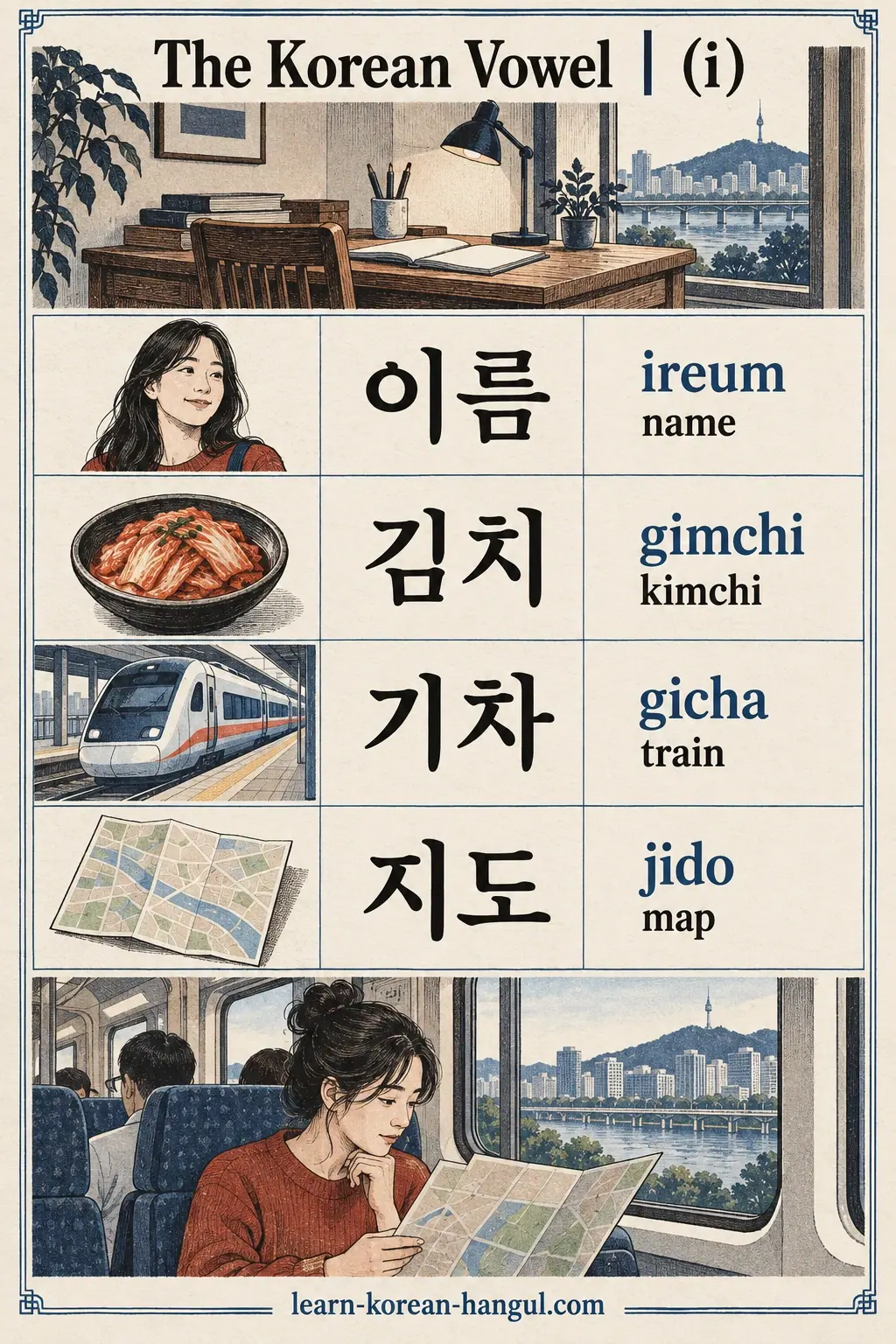
- Read seven example words aloud, from 이름 to 김치.
Before you start: the lesson on ㅏ helps because it explains syllable blocks. Time: about 20 minutes. Level: A0.
How Do You Pronounce the Korean Vowel ㅣ?

ㅣ is pronounced [i]: a clear "ee" as in English "see", with the lips spread and the tongue high at the front. Make the sound short and steady. Korean ㅣ does not slide into a "y" at the end the way English "see" can. Listen to the vowel name 이.
Revised Romanization, South Korea's official Latin-letter system, writes ㅣ as "i". That spelling is a learning aid. The recording is the model.
Mouth and Tongue Position for ㅣ
Three body cues help you copy ㅣ:
- Lips: spread them gently, as in a relaxed smile. They are not rounded.
- Jaw: keep it nearly closed.
- Tongue: raise the front of the tongue toward the hard palate, behind the upper front teeth, and keep the tip near the lower teeth.
Phoneticians call ㅣ a high front unrounded vowel. "Front" means the tongue is pushed forward, and "high" means the tongue is raised close to the roof of the mouth, which keeps the opening small. It is the opposite of ㅏ, which is low and open. Say ㅏ then ㅣ and you will feel your jaw snap shut.
| Letter | Jaw | Lips | Tongue | Nearest English sound |
|---|---|---|---|---|
| ㅣ | nearly closed | spread | high, front | "ee" in "see" (shorter, no glide) |
| ㅡ | nearly closed | spread | high, back | no English match |
| ㅏ | wide open | relaxed | low, flat | "a" in "father" |
How Is ㅣ Different from English Vowels?
ㅣ differs from English "ee" because it is shorter and does not glide. English "see" often ends with a small "y" sound. Korean ㅣ stays on one steady sound, so a Korean 이 sounds quicker and tighter.
English spelling also hides the sound. The letter "i" in English stands for "ee" in "machine", for "ih" in "bit", and for "eye" in "mine". Hangul uses ㅣ only for [i]. Once you know the shape, every ㅣ sounds the same.
A common difficulty is the consonant before ㅣ. The block 시 sounds close to English "she", although Revised Romanization writes it "si". The reason is explained in the mistakes section below.
Why Is ㅣ Drawn This Way?

ㅣ is drawn as a vertical line because the 1446 Hangul designers used a vertical line to represent a standing person. They built vowels from three symbols: a dot for heaven, a horizontal line for earth, and the vertical line for a person. The design appears in the Hunminjeongeum Haerye, the guide that explained the alphabet.
The vertical line stands alone as ㅣ. Add a dot on its right and you get ㅏ. Add a dot on its left and you get ㅓ. The person line is the core of every vertical vowel, and ㅣ is that core with nothing added.
In vowel harmony (모음조화, moeumjohwa), ㅣ is neutral (중성 모음, jungseong moeum). That means it is neither bright like ㅏ and ㅗ nor dark like ㅓ, ㅜ and ㅡ. For modern verb endings, a stem that ends in ㅣ takes 어요. For example, 마시다 (to drink) becomes 마셔요 (drinks, polite). Bright and dark vowels explains the rule in full.
How to Write ㅣ in 1 Stroke
Write ㅣ with one stroke: draw a straight line from top to bottom.
Practise on Paper
- line down.
The line runs the full height of the block, at least as tall as the consonant beside it. In a block such as 기, ㅣ stands slightly to the right of ㄱ and reaches from its top to below its tail. A frequent beginner error is to write ㅣ too short, which makes the block look lopsided. Keep it full height. For all vowels together, see Korean vowel stroke order.
Be careful not to confuse ㅣ with the digit "1", the lowercase letter "l" or the capital "I". In Korean typefaces ㅣ is a plain vertical stroke, and you tell it apart by context: it always sits beside a consonant.
Where Does ㅣ Sit in a Syllable Block?
ㅣ sits to the right of its consonant, because it is a vertical vowel. Hangul letters are packed into square blocks, and each block is one syllable.
| Vowel type | Long stroke direction | Consonant goes | Example |
|---|---|---|---|
| Vertical (ㅏ ㅓ ㅣ) | up and down | on the left | 가, 기 |
| Horizontal (ㅗ ㅜ ㅡ) | left to right | on top | 고, 그 |
In 기, ㄱ stands on the left and ㅣ on the right, with ㅣ at full height. The layout is taught in detail in vertical-vowel blocks.
Writing ㅣ Alone as 이
Written alone, ㅣ is spelled 이, with the silent consonant ㅇ in front. Every Korean syllable block needs a first consonant slot. When a syllable begins with a vowel sound, ㅇ fills that slot and makes no sound at the start of a block. So "ee" is written 이, never ㅣ alone, and 이 is also the name of the letter.
The syllable 이 is a very frequent word on its own. It can mean "tooth", "two" (in the Sino-Korean number system) or "this" (before a noun, as in 이 사람, "this person"). Context decides which meaning is meant, so listeners rarely mix them up.
The 기 Row: ㅣ with the Consonants
The 기 row is the basic consonants joined to ㅣ: 기 니 디 리 미 비 시 이 지 치 키 티 피 히. The vowel never changes. Only the consonant changes, and a few consonants change a little in sound before ㅣ.
| Block | Letters | Revised Romanization |
|---|---|---|
| 기 | ㄱ + ㅣ | gi |
| 니 | ㄴ + ㅣ | ni |
| 디 | ㄷ + ㅣ | di |
| 리 | ㄹ + ㅣ | ri |
| 미 | ㅁ + ㅣ | mi |
| 비 | ㅂ + ㅣ | bi |
| 시 | ㅅ + ㅣ | si |
| 이 | ㅇ + ㅣ | i |
| 지 | ㅈ + ㅣ | ji |
| 치 | ㅊ + ㅣ | chi |
| 키 | ㅋ + ㅣ | ki |
| 티 | ㅌ + ㅣ | ti |
| 피 | ㅍ + ㅣ | pi |
| 히 | ㅎ + ㅣ | hi |
One block in this row behaves unusually: ㅅ before ㅣ sounds close to "sh", so 시 is [shi]-like. Treat any small difference you hear from English as natural and follow the recording.
Worked Example: Reading 이름, 시 and 김치

To read a Korean word, split each block into letters, say each sound, then join them. Three words give good practice with ㅣ.
Word 1: 이름 (ireum), "name". The first block is ㅇ + ㅣ = 이, so the silent ㅇ leaves only [i]. The second block is ㄹ + ㅡ + ㅁ = 름, sounding [reum], with ㅁ closing the syllable. Together the word is [이름], "ee-reum". The ㄹ between vowels is a quick tap of the tongue, similar to the "r" in Spanish "pero".
이름
ireum
name
Word 2: 시 (si), "o'clock; poem". One block: ㅅ + ㅣ = 시. In telling the time, 시 follows a number: 한 시 is "one o'clock". As a separate word, 시 also means "poem". The sound is [시], close to English "she".
시
si
o'clock; poem
Word 3: 김치 (gimchi), "kimchi". The first block is ㄱ + ㅣ + ㅁ = 김, sounding [gim], with ㅁ closing it. The second block is ㅊ + ㅣ = 치, sounding [chi]. The word is [김치]. English borrowed the word as "kimchi", but the Korean first sound is softer than an English "k" and has less puff of air.
김치
gimchi
kimchi
Here are four more words with ㅣ.
| Word | Revised Romanization | Meaning | Note |
|---|---|---|---|
| 기차 | gicha | train | Two blocks, both with ㅣ |
| 미국 | miguk | United States | Literally "beautiful country" in Sino-Korean |
| 지도 | jido | map | Also the word for "guidance"; context decides |
| 이사 | isa | moving house | Compare with 의사 below |
Which Vowels Are Built with ㅣ?
ㅣ is part of nine of the eleven compound vowels, and its sound is the y-glide in the four y-vowels. That makes ㅣ the most reused building block in Hangul vowels.
| Vowel | Built from | Revised Romanization | Example |
|---|---|---|---|
| ㅐ | ㅏ + ㅣ | ae | 개 (gae), "dog" |
| ㅔ | ㅓ + ㅣ | e | 네 (ne), "yes" |
| ㅒ ㅖ | ㅐ/ㅔ with a y-glide | yae, ye | 예 (ye), "yes (polite)" |
| ㅚ ㅟ | ㅗ/ㅜ + ㅣ | oe, wi | 귀 (gwi), "ear" |
| ㅙ ㅞ | ㅗ+ㅐ, ㅜ+ㅔ | wae, we | 왜 (wae), "why" |
| ㅢ | ㅡ + ㅣ | ui | 의사 (uisa), "doctor" |
The y-vowels ㅑ ㅕ ㅛ ㅠ add a short stroke that stands for the sound [j], the same position as ㅣ. The compound vowels in the table each have a lesson under Korean compound vowels. The vowel ㅢ is the one to listen for next, because 의사 is the early contrast word in this lesson.
How Can You Hear the Difference between ㅣ, ㅢ and ㅡ?

ㅣ is a front vowel, ㅡ is a back vowel, and ㅢ is a glide that starts at ㅡ and ends at ㅣ. Two word pairs show the contrast: 이사 (isa, "moving house") against 의사 (uisa, "doctor"), and 기 (gi, "energy") against 그 (geu, "that").
ㅣ: One Steady Front Vowel. ㅢ: Starts at ㅡ and Slides into ㅣ.
| Korean | Romanization | Meaning | Sound |
|---|---|---|---|
| 이사 | isa | moving house | |
| 의사 | uisa | doctor |
ㅣ: Tongue Forward. ㅡ: Tongue Pulled Back, Lips Spread.
| Korean | Romanization | Meaning | Sound |
|---|---|---|---|
| 기 | gi | energy | |
| 그 | geu | that |
For ㅣ against ㅡ, feel the tongue. For ㅣ, the tip stays near the lower teeth and the front rises. For ㅡ, the tongue pulls back. English speakers can usually hear 이사 and 의사 as different words after a few tries, because the glide in ㅢ is easy to notice.
Which Mistakes Do Learners Make with ㅣ?
Learners most often make three mistakes with ㅣ, and each has a simple fix.
- Writing 시 as "shi" in official spellings. Learners often assume the Latin spelling should match the sound. Actually Revised Romanization follows the Hangul letters, so 시 is "si", as in the district name Sinchon. Fix: use "si" for official or map-style romanization, and learn the sound separately from the recording. Both spellings circulate, but only "si" is official.
- Making ㅣ a long English "ee" glide. Learners often assume longer is clearer. Actually a drawn-out, gliding ㅣ sounds un-Korean. Fix: say it quickly and stop.
- Writing ㅣ too short. Learners often assume the vertical line can be small. Actually it should be at least as tall as the consonant, or the block looks unbalanced. Fix: draw the line from the top of the block to the bottom.
An expert tip: ㅅ is pronounced [sh]-like before ㅣ and before the y-vowels, and [s] elsewhere. This is a regular sound change, so you can predict it instead of memorising it for each word.
Practice: Read and Hear ㅣ

Try each task before you check the answers.
- Pick by ear. Play 이사 and 의사. Which one contains a glide?
- Write. Write the vowel ㅣ alone as a full syllable, then write the block for [mi].
- Read. Read these words aloud and give the meaning: 이름, 기차, 김치.
- Sort. Is ㅣ a vertical or a horizontal vowel? How many strokes does it take?
Practice · 8
How is Korean ㅣ different from the English "ee" in "see"?
Show answer
It is shorter and has no y-glide
ㅣ is a short, steady [i] with spread lips; English "ee" is longer and often glides.
How many strokes does ㅣ take to write?
Show answer
1
ㅣ is one straight vertical line drawn from top to bottom.
How does Revised Romanization write 시?
Show answer
si
Revised Romanization follows the letters, so 시 is si, even though it sounds close to "she".
Which word contains a glide?
Show answer
의사 (doctor)
의사 has ㅢ, which starts at ㅡ and slides into ㅣ; 이사 has the single steady vowel ㅣ.
Where does ㅣ sit in the block 기?
Show answer
To the right of the consonant
ㅣ is a vertical vowel, so the consonant goes on the left and ㅣ on the right at full height.
What does 기차 mean?
Show answer
train
기차 (gicha) means train; 이름 is name and 지도 is map.
Which compound vowel has no ㅣ in it?
Show answer
ㅘ
Only ㅘ and ㅝ lack ㅣ; ㅐ, ㅢ and ㅟ all contain it.
In vowel harmony, what kind of vowel is ㅣ?
Show answer
Neutral
ㅣ is neutral, neither bright like ㅏ and ㅗ nor dark like ㅓ, ㅜ and ㅡ.
Answers to the Practice
- 의사 contains a glide: ㅢ starts at ㅡ and slides to ㅣ. 이사 has the single steady vowel ㅣ.
- 이 is the vowel alone; 미 is ㅁ + ㅣ, pronounced [mi].
- 이름 means name, 기차 means train, and 김치 means kimchi.
- ㅣ is a vertical vowel written in one stroke.
If you missed an answer, replay the clip and say it with the recording. For extra drills, use the Hangul flashcard decks, which play audio only when you tap, or test your ear with the Hangul quizzes. You can build blocks yourself in the hangul syllable builder or explore every letter in the interactive hangul alphabet. To write by hand, print the korean vowels writing practice sheet.
What Should You Learn after ㅣ?
Learn the first consonant, ㄱ, next, because you now have enough vowels to start building real words. You now know the Korean vowel ㅣ: its short [i] sound, its single stroke, its place beside a consonant, and its silent-ㅇ form 이. Continue with the lesson on the consonant ㄱ. Along the way you can look at the vowel ㅢ to hear how ㅡ and ㅣ combine.
This lesson does not cover ㅣ before final consonants, or the full set of sound changes around ㅅ. Those topics belong to the syllable-block and pronunciation sections. For the whole group, return to basic Korean vowels, compare mouth diagrams on Korean vowel sounds, or print the Korean vowels chart. For why the official spelling says "si", read Korean romanization rules.
Honest limits of this page: mouth-position descriptions are approximations for English speakers, and the recordings are the reference. The standard Seoul pronunciation is described; regional speech varies.
Frequently Asked Questions
Why does 시 sound like she? In Korean, the consonant ㅅ changes before ㅣ and before the y-vowels, moving toward a "sh" sound. So 시 is close to English "she", even though Revised Romanization writes it "si". The spelling follows the letters, while the sound follows the regular pronunciation pattern. Learn the sound from recordings and the spelling from the system.
Is ㅣ the same as English ee? It is close but not identical. English "ee" is longer and often ends in a small "y" glide, while Korean ㅣ is shorter and steady. Spread your lips, raise the front of the tongue, and say it briefly. If your Korean ㅣ sounds drawn out, shorten it.
Which vowels are made with ㅣ? Nine of the eleven compound vowels contain ㅣ: ㅐ, ㅔ, ㅒ, ㅖ, ㅙ, ㅚ, ㅞ, ㅟ and ㅢ. The y-vowels ㅑ, ㅕ, ㅛ and ㅠ use the sound of ㅣ as a short glide. Only ㅘ and ㅝ among the compound vowels have no ㅣ in them.
What does 이 mean on its own? 이 has several unrelated meanings: "tooth", "two" (in the Sino-Korean numbers), and "this" before a noun, as in 이 사람 "this person". Context makes the meaning clear. Written alone, the vowel ㅣ always needs the silent ㅇ in front, so the same syllable is also the name of the letter.
How many strokes does ㅣ have? ㅣ has one stroke: a straight vertical line drawn from top to bottom. It is the simplest of the 21 vowels. Keep it at least as tall as the consonant beside it so the syllable block looks balanced. A line that is too short is the most common handwriting error with this letter.