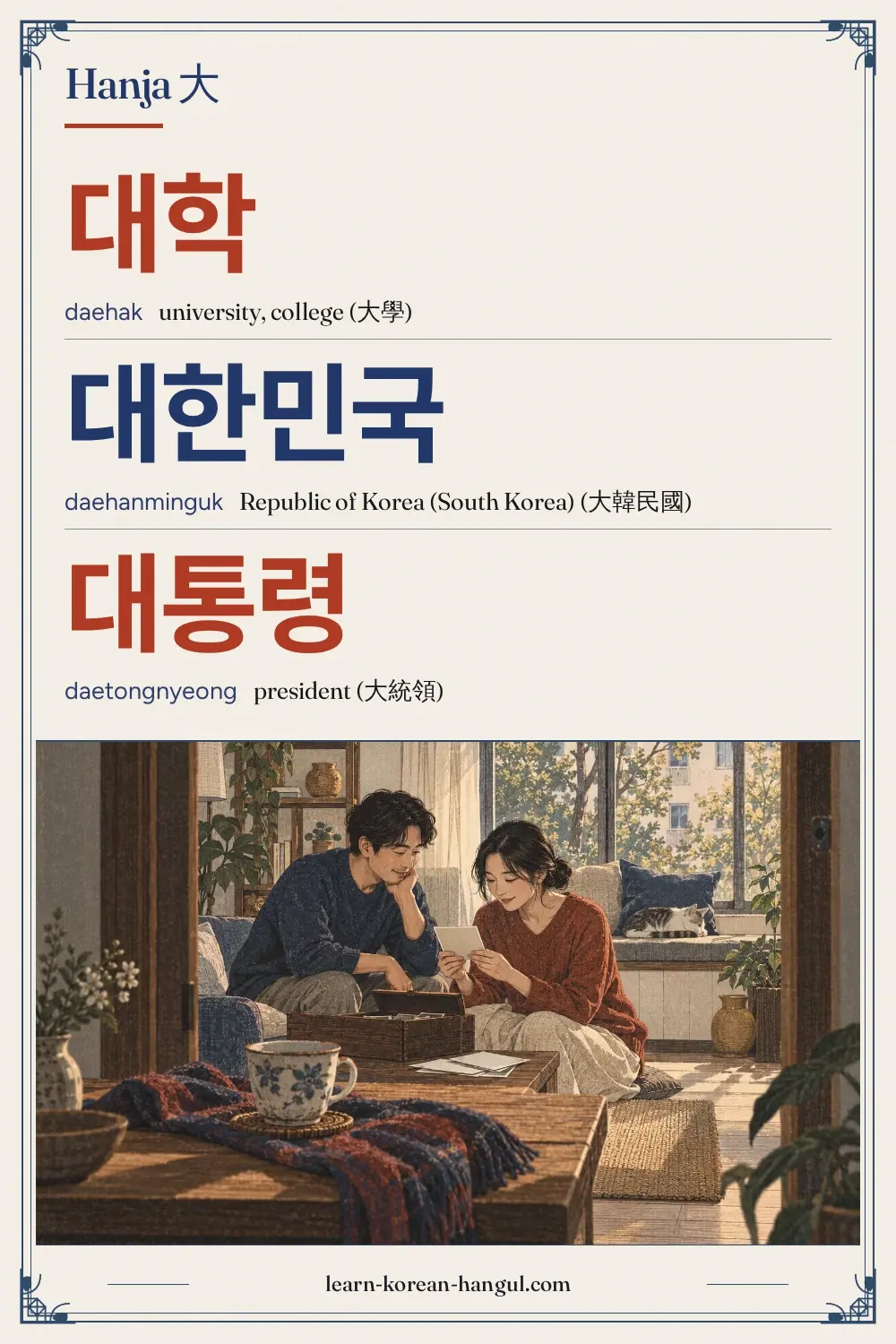
Hanja 大: the Essentials
Hanja 大 is one of the first characters that learners meet, because 대한민국 (Republic of Korea) and 대학 (university) both start with it. Its 음훈 (the pair of the native meaning word and the Korean reading, as dictionaries list it) is 큰 대. The meaning word 큰 is the modifier form of the adjective 크다, "to be big", and 대 is the reading used inside Sino-Korean words.
The character is commonly explained as a picture of a person with arms stretched wide, so that "a person at full size" came to mean "big". It is a close relative of 人 (a person with arms down) and 天 (a person with the sky above). Two senses matter in practice: "big in size or scale" (대형, 대기업) and "great in importance or quality" (위대, 대통령).
One useful contrast with native Korean: the adjective 크다 and its modifier 큰 are used on their own (큰 집, "a big house"), while 대 only works inside compounds. You can say 큰 도시 or 대도시 for "big city", and the second is simply a more compact, more formal version.
| Item | Detail |
|---|---|
| Character | 大 |
| 음훈 | 큰 대 |
| Reading | 대 (dae) |
| Core meaning | big; great; large-scale |
| Radical | 大 itself (Kangxi radical 37) |
| Strokes | 3 |
| Words on this page | 12 |
Because 大 is its own radical, it also works as a part of other characters, such as 天 (sky) and 太 (very great). You can find more on this in the hanja radicals section. Now the word list.
Which Words Does 大 Build?
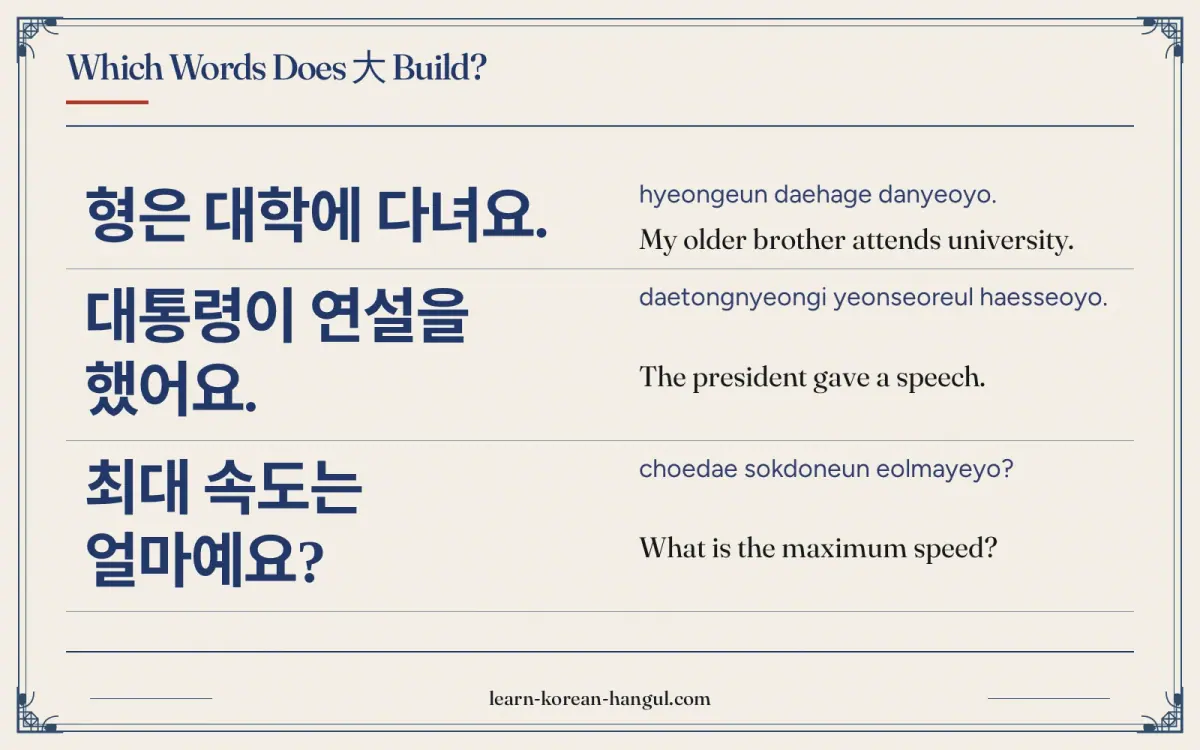
These 12 words are the best ones to learn first. They cover education, the state, size, and events. Revised Romanization (RR) appears only as a learning aid, and square brackets show the spoken form where it differs from the spelling.
| Word | Characters | RR | Meaning | How the characters add up |
|---|---|---|---|---|
| 대학 | 大學 | daehak | university, college | 大 great + 學 study |
| 대한민국 | 大韓民國 | daehanminguk | Republic of Korea (South Korea) | 大 great + 韓 Han + 民 people + 國 country |
| 대통령 [대통녕] | 大統領 | daetongnyeong | president | 大 great + 統 unify + 領 lead |
| 대사관 | 大使館 | daesagwan | embassy | 大 great + 使 envoy + 館 building |
| 대부분 | 大部分 | daebubun | most (of), the majority | 大 big + 部分 part |
| 대문 | 大門 | daemun | main gate, front gate | 大 big + 門 gate |
| 위대 | 偉大 | widae | greatness | 偉 remarkable + 大 great |
| 확대 [확때] | 擴大 | hwakdae | expansion, enlargement | 擴 widen + 大 big |
| 최대 | 最大 | choedae | maximum, the largest | 最 most + 大 big |
| 대형 | 大型 | daehyeong | large-scale, large-sized | 大 big + 型 type, mould |
| 대기업 | 大企業 | daegieop | large company, conglomerate | 大 big + 企 plan + 業 business |
| 대회 | 大會 | daehoe | competition, tournament, large meeting | 大 big + 會 meeting |
Look at where 大 sits. In 대학, 대한민국, 대통령, 대사관, 대부분, 대문, 대형, 대기업 and 대회 it comes first and works as a prefix meaning "big" or "great". In 위대, 확대 and 최대 it comes last and makes an abstract noun. The prefix use is the larger group, which means you can usually guess a new word starting with 대 if you know the second half.
As a prefix, 대- also adds intensity: 대성공 (great success), 대환영 (warm welcome) and 대인기 (big popularity) are all fairly casual and used in speech and advertising.
The 12 Words One by One
대학 (大學, daehak): university, college. "Great learning", the highest level of school. 대학교 (大學校) is the full name of a university; 대학 is used for university in general and also for a college or faculty within one. Related words are 대학생 [대학쌩] (university student), 대학원 (graduate school) and 대학교 입학 (starting university). You will find the same 學 in 학교 and 학생.
대한민국 (大韓民國, daehanminguk): Republic of Korea (South Korea). The official name of South Korea. 韓 is the traditional name Han, usually traced to the ancient Samhan (三韓) states of the southern peninsula, and 民國 (people + country) means a republic, so the name reads "Great Han Republic". The name was adopted by the Provisional Government in 1919 and kept by the republic founded in 1948. The short form is 한국. At a football match you hear it chanted as 대~한민국!
대통령 [대통녕] (大統領, daetongnyeong): president. The "great one who unifies and leads", the head of state in a republic. The sound is [대통녕], because the ㄹ after ㅇ becomes ㄴ. Compare 총리 (prime minister) and 국왕 (king). A related word is 대통령실 (the presidential office). The title is added after the name, as in 대통령님 when speaking to or about the president politely.
대사관 (大使館, daesagwan): embassy. The building of a "great envoy", the ambassador (대사). A foreign government's office in another country: 한국 대사관 (the Korean embassy). Learners meet this word when they need visas or documents. The related 영사관 (領事館) is a consulate, a smaller branch office.
대부분 (大部分, daebubun): most (of), the majority. "The big part", so "most of it". It works as a noun, as in 대부분의 학생 (most students), and as an adverb meaning "mostly": 대부분 맞아요. The word is very common in speech and writing. Note that the 部分 (부분) is itself the word for "part", and you can use it alone.
대문 (大門, daemun): main gate, front gate. The big front gate of a house or a compound. Traditional Korean houses have a 대문 that opens onto the street; 서울의 남대문 (Namdaemun, the "Great South Gate") and 동대문 (Dongdaemun, "Great East Gate") are named this way. In modern apartments, the front door is 현관문 and the gate is not needed.
위대 (偉大, widae): greatness. A word of high praise. It is nearly always used as 위대하다 (to be great) or 위대한 (great, as a modifier): 위대한 작가 (a great writer), 위대한 업적 (a great achievement). It is a formal and literary word, not used for ordinary "big" things.
확대 [확때] (擴大, hwakdae): expansion, enlargement. To make something bigger: 확대하다 (to expand, to zoom in), as in the photo-editing command 확대. Used for markets, plans and images. The ㄷ is tense in speech: say [확때], because a final ㄱ makes the next ㄷ tense. The opposite is 축소 (縮小, reduction, zoom out).
최대 (最大, choedae): maximum, the largest. The biggest possible. It works as a noun and a prefix: 최대 속도 (top speed), 최대한 (as much as possible, with 限 "limit"), and 세계 최대 (the world's largest). The opposite is 최소 (最小, minimum). The 最 also gives 최고 (the best, the highest).
대형 (大型, daehyeong): large-scale, large-sized. A modifier word for things that come in sizes: 대형 마트 (big supermarket), 대형 사고 (a major accident), 대형 TV. The opposite is 소형 (小型, small-sized). The word is a noun that attaches to the thing it describes, with no particle.
대기업 (大企業, daegieop): large company, conglomerate. A major company such as a chaebol group. Job seekers often compare 대기업 and 중소기업 (small and medium-sized business): 대기업에 취직하다 (to get a job at a big company). The opposite is 중소기업, covered in the family page for 中 (중).
대회 (大會, daehoe): competition, tournament, large meeting. A large organised gathering, usually for a contest or a conference: 마라톤 대회 (marathon), 말하기 대회 (speech contest), 전국 대회 (national tournament). It is the word to use on posters and in school notices. The 會 also appears in 회사 and 회의.
Sentences to Hear the Words in Use
Six of the words appear in short sentences. Listen to each one, then read it aloud. The brackets in the word table show how the words are said in connected speech.
형은 대학에 다녀요.
hyeongeun daehage danyeoyo.
My older brother attends university.
대통령이 연설을 했어요.
daetongnyeongi yeonseoreul haesseoyo.
The president gave a speech.
대부분 학생이 지하철을 타요.
daebubun haksaengi jihacheoreul tayo.
Most students take the subway.
최대 속도는 얼마예요?
choedae sokdoneun eolmayeyo?
What is the maximum speed?
그 사람은 대기업에 다녀요.
geu sarameun daegieobe danyeoyo.
That person works at a big company.
내일 달리기 대회가 있어요.
naeil dalligi daehoega isseoyo.
There is a running race tomorrow.
How Is 大 Read in Different Words?
The good news is that 大 never changes: it is 대 in every Sino-Korean word, whether it comes first or last. It has no second reading and, because it does not begin with ㄹ or ㄴ, the initial-sound rule (두음법칙) does not apply to it.
Rule box: tensing after ㄱ. In 확대 the final ㄱ of 확 makes the ㄷ of 대 tense, so the word is said [확때]. The same happens in 학대 [학때] (abuse). Revised Romanization does not write tensing caused by a sound change, so it gives hwakdae.
Rule box: ㄹ after ㅇ. In 대통령 the final ㅇ of 통 meets the ㄹ of 령, and the ㄹ becomes ㄴ. The word is therefore said [대통녕], and RR writes daetongnyeong. The same thing happens in 정리 [정니] and 경력 [경녁]. For the general rule, see the page on nasalization.
Most of the other words are said exactly as they are spelled: 대학 [대학], 대사관 [대사관], 대부분 [대부분], 대문 [대문], 대형 [대형], 대기업 [대기업], 대회 [대회]. Note that when 대학 is followed by 생, the combination is [대학쌩], with a tense ㅆ, just as in 학생.
For the vowel, the ㅐ in 대 is the same as in 개 (dog) and 새 (bird). The initial ㄷ is a plain (lax) sound: at the start of a word it is voiceless with only a light puff of air, somewhere between English "d" and "t", made with the tongue on the ridge behind the upper teeth. Compare the aspirated ㅌ in 태 (as in 태양, sun), which has a strong puff of air.
What Is Easy to Confuse with 大?
大 and 太. The characters differ by a single dot: 太 has an extra stroke under the crossing. It is read 태, not 대, and means "very great". You see it in 태양 (the sun), 태평양 (the Pacific) and 태극기 (the Korean flag). If a word starts with 태 and has a feeling of greatness, it is probably 太. Always check the dictionary entry rather than guessing.
大 and 犬. Another look-alike is 犬 (개 견, dog), which has one extra dot at the upper right. It appears in 애견 (pet dog) and 충견 (loyal dog). The Korean readings 대 and 견 are different, so the sound tells you which one you have.
대 in other words. Many unrelated characters are also read 대: 代 (대신할 대) in 대신 (instead) and 시대 (era), 對 (대할 대) in 대답 (answer) and 대화 (conversation), 隊 (무리 대) in 군대 (army), 臺 (대 대) in 무대 (stage), and 貸 (빌릴 대) in 대출 (loan). The Hangul looks identical. Context separates them: 대학 is about learning, 대화 about talking, and 대출 about borrowing.
큰 versus 대. The native adjective 큰 is for everyday description (큰 가방, a big bag), while 대 is for fixed compounds. You cannot say 대 가방. Use 큰 or 크다 when speaking, and 대 only in words you have met as a whole.
대한민국 versus 한국. 대한민국 is the official name, used in formal documents and sports chants. 한국 is the short name for everyday use. In English, "Korea" usually means the Republic of Korea in everyday talk. North Korea's official name is 조선민주주의인민공화국, so do not mix the two forms.
대문 versus 문. 문 (門) alone means any door or gate. 대문 means the big front gate, not a door inside the house.
Practice This Family
The 12 Words as Flashcards
The deck below has one card for each of the 12 words, with audio. The table shows the same cards, so you can study from either one.
| # | Korean | RR | Meaning | Character and note |
|---|---|---|---|---|
| 1 | 대학 | daehak | university, college (大學) | 大 (큰 대) + 學 (배울 학). 대학생 = university student. |
| 2 | 대한민국 | daehanminguk | Republic of Korea (South Korea) (大韓民國) | 大 + 韓 (나라 한) + 民 (백성 민) + 國. Short form: 한국. |
| 3 | 대통령 [대통녕] | daetongnyeong | president (大統領) | 大 + 統 (거느릴 통) + 領 (거느릴 령). Said [대통녕]. |
| 4 | 대사관 | daesagwan | embassy (大使館) | 大 + 使 (하여금 사) + 館 (집 관). 영사관 = consulate. |
| 5 | 대부분 | daebubun | most (of), the majority (大部分) | 大 + 部 (떼 부) + 分 (나눌 분). 대부분 = "the big part". |
| 6 | 대문 | daemun | main gate, front gate (大門) | 大 + 門 (문 문). Namdaemun: 남대문 (South Great Gate). |
| 7 | 위대 | widae | greatness (偉大) | 偉 (훌륭할 위) + 大. Used as 위대한 + noun. |
| 8 | 확대 [확때] | hwakdae | expansion, enlargement (擴大) | 擴 (넓힐 확) + 大. Said [확때]. Opposite: 축소. |
| 9 | 최대 | choedae | maximum, the largest (最大) | 最 (가장 최) + 大. Opposite: 최소 (minimum). |
| 10 | 대형 | daehyeong | large-scale, large-sized (大型) | 大 + 型 (모형 형). Opposite: 소형; 중형 = medium. |
| 11 | 대기업 | daegieop | large company, conglomerate (大企業) | 大 + 企 (꾀할 기) + 業 (일 업). Opposite: 중소기업. |
| 12 | 대회 | daehoe | competition, tournament, large meeting (大會) | 大 + 會 (모일 회). 말하기 대회 = speech contest. |
Practice · 12
- 01대학
Show answer
daehak
university, college (大學)
- 02대한민국
Show answer
daehanminguk
Republic of Korea (South Korea) (大韓民國)
- 03대통령
Show answer
daetongnyeong
president (大統領)
- 04대사관
Show answer
daesagwan
embassy (大使館)
- 05대부분
Show answer
daebubun
most (of), the majority (大部分)
- 06대문
Show answer
daemun
main gate, front gate (大門)
- 07위대
Show answer
widae
greatness (偉大)
- 08확대
Show answer
hwakdae
expansion, enlargement (擴大)
- 09최대
Show answer
choedae
maximum, the largest (最大)
- 10대형
Show answer
daehyeong
large-scale, large-sized (大型)
- 11대기업
Show answer
daegieop
large company, conglomerate (大企業)
- 12대회
Show answer
daehoe
competition, tournament, large meeting (大會)
Decode Three Unseen Words
大都市 대도시 (daedosi). 大 "big" + 都市 "city". A big city, as in 서울과 같은 대도시 (a big city like Seoul). The opposite is 소도시 (small city).
大成功 대성공 (daeseonggong). 大 "great" + 成功 "success". A great success, as in 영화가 대성공을 거두다 (the film became a great success).
大規模 대규모 (daegyumo). 大 "big" + 規模 "scale". Large-scale: 대규모 행사 (a large-scale event). It is close in meaning to 대형, but 대규모 describes scale, while 대형 describes size or type.
Check Yourself
Each question asks you to decode a word or answer a question about 大. The answers are checked as you go.
Practice · 6
대통령 is 大 "great" + 統 "unify" + 領 "lead". What does it mean?
Show answer
president
대통령 (大統領) is the president. A prime minister is 총리, an embassy is 대사관 and a university is 대학.
How is 확대 (expansion) said in normal speech?
Show answer
[확때]
After the final ㄱ, the ㄷ is tense, so the word is said [확때]. Revised Romanization still writes hwakdae.
대형 마트 is 大 + 型 + 마트. What kind of shop is it?
Show answer
a large supermarket
대형 means large-sized, so 대형 마트 is a large supermarket. The opposite is 소형, small-sized.
Which character differs from 大 by one dot and is read 태?
Show answer
太
太 has one more dot and is read 태, as in 태양. 犬 also adds a dot but is read 견, 天 is 천 and 人 is 인.
대기업 is 大 + 企 + 業. What is the opposite word?
Show answer
중소기업
중소기업 (中小企業) is a small and medium-sized business. 대기업 is a large company.
Which word means "maximum"?
Show answer
최대
최대 (最大) is the maximum. 최소 is the minimum, 위대 is greatness and 대회 is a competition.
What to Learn Next
You now have 12 words and a clear sense of how 大 works as a prefix. The best next step is the family of 國 (국), because 대한민국 and 한국 both contain it. See 國 (국) for the nation words. To compare "big" words with "middle" words, go to 中 (중), where 중소기업 is the contrast to 대기업.
To see how this fits the whole section, return to the hanja word families page. The Sino-Korean vocabulary page lists similar words by topic, and the Sino Korean Words Flashcards deck lets you review them with audio. For more single characters, see the 100 most useful hanja, and the 人 (인) family shows the character that 大 is often said to grow from.
Frequently Asked Questions
Why is the president called 대통령?
The word 대통령 (大統領) joins 大 "great", 統 "unify" and 領 "lead". It was formed in the modern era as a translation of the title "president" and means the great leader who unifies. The ㄹ is said as ㄴ, so the word is [대통녕]. A prime minister is 총리, a different office.
Does 大 always mean big?
No. In size words such as 대형 (large-sized) and 대문 (main gate) it means big. In importance words such as 위대 (greatness) and 대통령 it means great or senior. It can also intensify, as in 대성공 (great success). The meaning is always "greater than normal" in some way, and the second half of the word tells you which way.
What is 大韓民國?
大韓民國 (대한민국) is the official name of South Korea, "the Republic of Korea". 大 is "great", 韓 is the traditional name Han, usually traced to the ancient Samhan (三韓) states of the southern peninsula, 民 is "people" and 國 is "country". The short form, used in everyday speech, is 한국. The name was used by the Provisional Government in 1919 and by the republic established in 1948.
How is 大 different from 太?
太 has an extra dot and is read 태, not 대. It means "very great" and appears in 태양 (sun), 태평양 (the Pacific) and 태극기 (the Korean flag). 大 is the simple "big" character. Because 大 and 太 look alike and their readings differ only in aspiration (대 and 태), check the dictionary when you meet an unknown word.