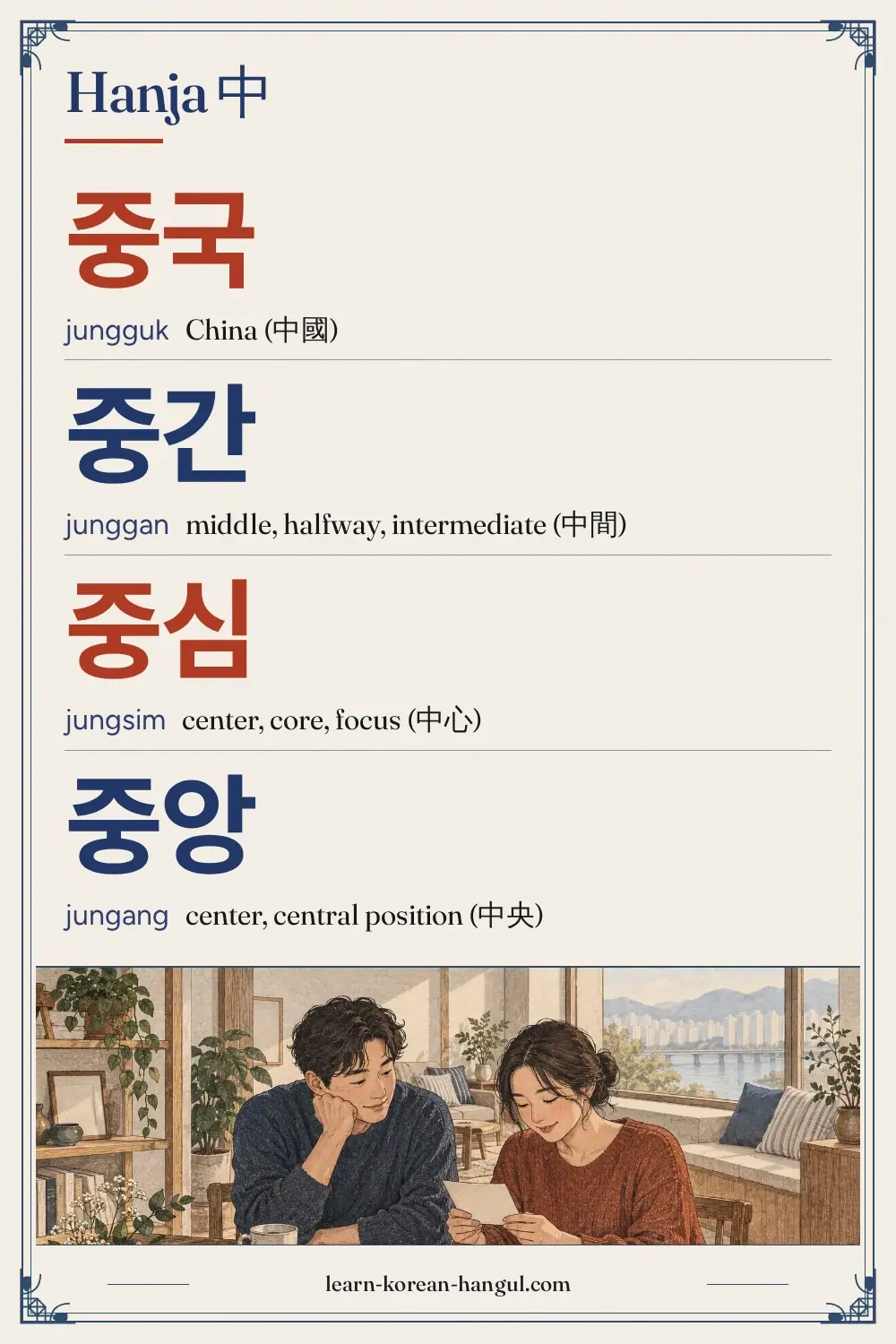
Hanja 中: the Essentials
Hanja 中 is the character for "middle". Its 음훈 (the pair of the native meaning word and the Korean reading, as dictionaries list it) is 가운데 중. The meaning word 가운데 is the native noun for "the middle" or "the center", and 중 is the sound the character has inside Sino-Korean words. The character is commonly explained as a picture of a line passing through the middle of a box, or of a pole through the middle of a target.
This family is useful because 中 has two jobs. As a first or middle syllable it means "center" or "between": 중국 (the middle country), 중간 (the middle), 중심 (the center). As a suffix attached to an activity it means "in the middle of": 식사 중 (during a meal), 통화 중 (on the phone). The second use is a bound noun, so in standard spelling it is written with a space.
The card below sums up the character.
| Item | Detail |
|---|---|
| Character | 中 |
| 음훈 | 가운데 중 |
| Reading | 중 (jung) |
| Core meaning | middle; center; inside; during |
| Radical | 丨 (vertical line; Kangxi radical 2) |
| Strokes | 4 |
| Words on this page | 12 |
The vertical line that gives 中 its radical is the same stroke that runs through the box, which is a handy visual for "the middle". The hanja radicals section explains how to use radicals to look characters up. Now to the word list.
Which Words Does 中 Build?
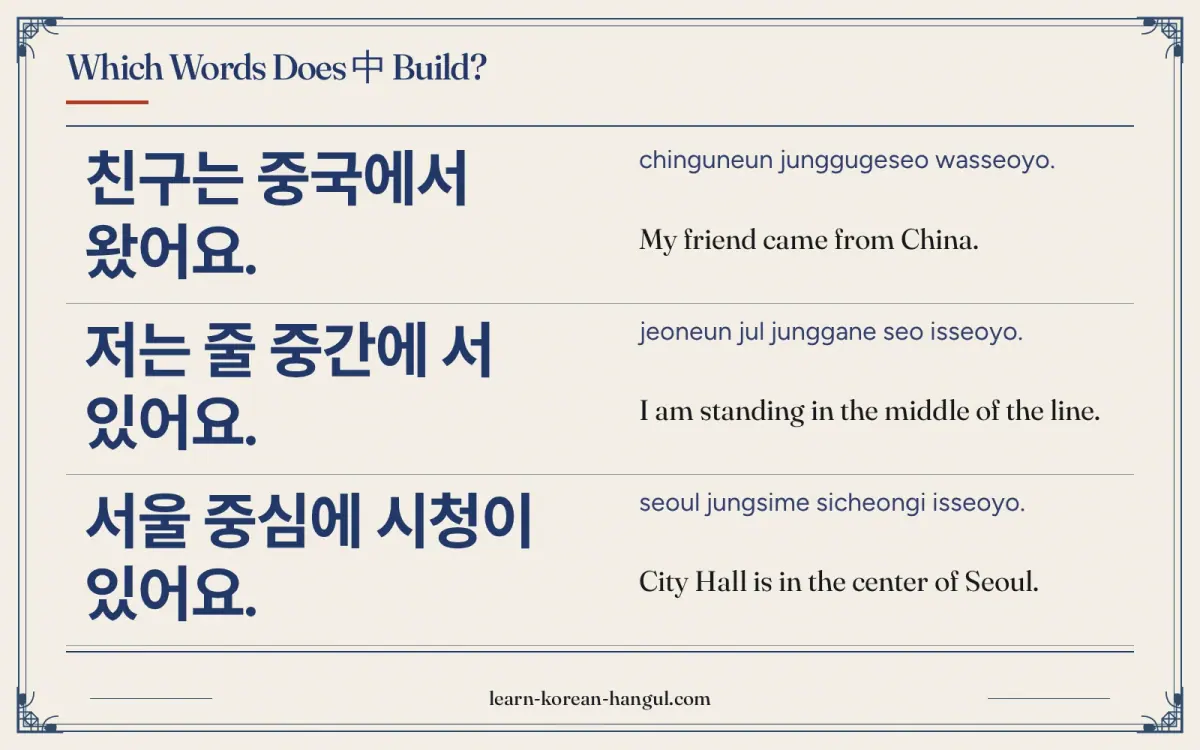
These 12 words are the best ones to learn first. They cover places, positions, school, work and everyday activities. Revised Romanization (RR) appears only as a learning aid, and square brackets show the spoken form where it differs from the spelling.
| Word | Characters | RR | Meaning | How the characters add up |
|---|---|---|---|---|
| 중국 | 中國 | jungguk | China | 中 middle + 國 country |
| 중간 | 中間 | junggan | middle, halfway, intermediate | 中 middle + 間 between |
| 중심 | 中心 | jungsim | center, core, focus | 中 middle + 心 heart |
| 중앙 | 中央 | jungang | center, central position | 中 middle + 央 center |
| 집중 [집쭝] | 集中 | jipjung | concentration, focus | 集 gather + 中 center |
| 도중 | 途中 | dojung | on the way, midway, in the middle of | 途 road + 中 in the middle |
| 중년 | 中年 | jungnyeon | middle age | 中 middle + 年 year |
| 중소기업 | 中小企業 | jungsogieop | small and medium-sized business | 中 medium + 小 small + 企業 business |
| 중학교 [중학꾜] | 中學校 | junghakgyo | middle school, junior high | 中 middle + 學 study + 校 school |
| 중고 | 中古 | junggo | secondhand, used | 中 middle + 古 old |
| 공중 | 空中 | gongjung | in the air, midair | 空 empty + 中 inside |
| 식사 중 [식싸 중] | 食事中 | siksa jung | during a meal, eating | 食事 meal + 中 in the middle of |
Notice the two roles. In 중국, 중간, 중심, 중앙, 중년, 중소기업, 중학교 and 중고 the character 中 comes first, and it means "middle", "center" or "medium". In 집중, 도중, 공중 and 식사 중 it comes last, and it means "inside" or "in the midst of". When 中 comes last, it often marks a time or a state: 도중, 집중 and 공중 are time or place words, while 식사 중 is a state.
Two more patterns follow from this. The first is level words: 초급 (beginner), 중급 (intermediate) and 고급 (advanced), where 중급 is the middle level. The second is timing words: 중순 (the middle ten days of a month, around the 11th to the 20th) and 중반 (the middle part). The same 中 does the work in all of them.
The 12 Words One by One
중국 (中國, jungguk): China. Literally the "middle country", the Chinese name for China (Zhongguo) read in Korean. Add 어 for the language (중국어), 인 for a person (중국인) or 집 for a Chinese restaurant (중국집). The ㄱ at the end is unreleased, and a following vowel pulls it across: 중국에서 is [중구게서].
중간 (中間, junggan): middle, halfway, intermediate. The point between two ends: 줄 중간 (the middle of a line), 중간고사 (midterm exam), 중간 크기 (medium size). It can also mean "midway through": 영화 중간에 (in the middle of the movie). 중간 is about being between two things; for the exact center of something, 중심 or 중앙 are better.
중심 (中心, jungsim): center, core, focus. The "heart in the middle": the core of something, in space or in importance. 도시의 중심 (the center of the city), 문제의 중심 (the heart of the problem), 생활의 중심 (the center of one's life). It also forms 중심지 (a central district) and 자기중심적 (self-centered). A fact of sound: the ㅅ after ㅇ is plain, so the word is [중심].
중앙 (中央, jungang): center, central position. The central point, especially of a space or an organisation: 광장 중앙 (the center of the square), 중앙 정부 (central government), 중앙 은행 (central bank) and 중앙선 (the center line). The two characters both mean "center", so the word feels formal and official. 央 on its own appears only in compounds.
집중 [집쭝] (集中, jipjung): concentration, focus. "Gather into the center", so to concentrate: 집중하다 (to focus), 집중력 (concentration, ability to focus), 집중 수업 (intensive course). The ㅈ is tense after the final ㅂ, so say [집쭝]. The word is very common in study talk, as in 공부에 집중하다 (to focus on study).
도중 (途中, dojung): on the way, midway, in the middle of. "In the middle of the road", so en route or midway through an activity. It nearly always takes 에: 가는 도중에 (on the way), 회의 도중에 (during the meeting), 수업 도중에 (in the middle of class). It is different from 중간, which describes a position, because 도중 describes a moment inside a journey or an action.
중년 (中年, jungnyeon): middle age. The middle stage of life, roughly the forties and fifties: 중년 남성 (a middle-aged man), 중년의 위기 (midlife crisis). Compare 청년 (young adult) and 노년 (old age).
중소기업 (中小企業, jungsogieop): small and medium-sized business. A company that is not large: 중소기업 취업 (getting a job at an SME). 中 means "medium" here, and 小 means "small". The contrast is 대기업 (large company), as in the page on 大 (대). The word is common on the news and in job-search talk. In RR, a closed compound is written as one word: jungsogieop.
중학교 [중학꾜] (中學校, junghakgyo): middle school, junior high. The three-year school between 초등학교 and 고등학교. The shorter 중학생 [중학쌩] means a middle-school student. The ㄱ at the end of 학 makes the ㄱ of 교 tense: say [중학꾜], just as 학교 is [학꾜].
중고 (中古, junggo): secondhand, used. Not new and not ancient: used goods. You will see 중고차 (used car), 중고 책 (used book) and 중고 거래 (secondhand trading, as on resale apps). 중고 in 중고생 can also be an abbreviation of 중학교 and 고등학교 (middle and high school), a different word with the same spelling. Context separates them.
공중 (空中, gongjung): in the air, midair. "Inside the empty space", the sky above: 공중에 떠 있다 (to float in the air), 공중 곡예 (aerial acrobatics). Careful: 공중전화 (public telephone) is a different word with the same sound, because there 공중 is 公衆 (the public). Both are written 공중 in Hangul.
식사 중 [식싸 중] (食事中, siksa jung): during a meal, eating. The suffix use of 中: a state of being in the middle of an activity. 식사 중이에요 means "I am eating now". The same pattern gives 통화 중 (on the phone), 회의 중 (in a meeting), 공사 중 (under construction) and 준비 중 (in preparation). The 중 is a bound noun and is written with a space. The 사 of 식사 is tense, [식싸].
Sentences to Hear the Words in Use
Six of the words appear in short sentences. Listen to each one, then read it aloud. The brackets in the word table show how the words are said in connected speech.
친구는 중국에서 왔어요.
chinguneun junggugeseo wasseoyo.
My friend came from China.
저는 줄 중간에 서 있어요.
jeoneun jul junggane seo isseoyo.
I am standing in the middle of the line.
서울 중심에 시청이 있어요.
seoul jungsime sicheongi isseoyo.
City Hall is in the center of Seoul.
공부할 때 집중이 안 돼요.
gongbuhal ttae jipjungi an dwaeyo.
I cannot concentrate when I study.
우리 동생은 중학교에 다녀요.
uri dongsaengeun junghakgyoe danyeoyo.
My younger sibling attends middle school.
지금 식사 중이에요.
jigeum siksa jungieyo.
I am eating right now.
How Is 中 Read in Different Words?
The reading of 中 is the same in every word: 중. It has no second reading, and it does not fall under the initial-sound rule (두음법칙), because 중 does not begin with ㄹ or ㄴ. What changes is the sound around it.
Rule box: tense sounds after a final stop. When the syllable before 중 ends in ㅂ, the ㅈ of 중 becomes tense: 집중 → [집쭝]. When the syllable before 교 ends in ㄱ, the ㄱ of 교 becomes tense: 학교 → [학꾜], so 중학교 → [중학꾜]. In 식사 중, the ㅅ of 사 becomes tense after ㄱ: 식사 → [식싸]. Revised Romanization does not show tensing caused by a sound change, so it writes jipjung, junghakgyo and siksa. See Sino-Korean tensification for the full rule.
Rule box: no change after ㅇ. In the words on this page that begin with 중, no tensing happens after the nasal ㅇ: 중간 is [중간], 중심 is [중심], 중앙 is [중앙] and 중고 is [중고]. A learner who says [중깐] or [중씸] is adding a change that does not exist in standard speech.
ㄴ after ㅇ. In 중년, the ㄴ stays ㄴ after ㅇ: [중년]. This differs from 대통령, where a ㄹ after ㅇ becomes ㄴ. If a word has ㄹ after 중, as in 중립 (neutrality), the ㄹ becomes ㄴ and the word is said [중닙].
For the vowel, ㅜ in 중 is a rounded back vowel like the "oo" in "moon" but shorter. The consonant ㅈ is not aspirated, so it sounds between English "j" and "ch". The final ㅇ is the "ng" of "sing". Say 중, then add 국 for 중국, and keep the final ㄱ unreleased.
What Is Easy to Confuse with 中?
중간, 중심 and 중앙. All three can be translated as "center" or "middle", but they are not interchangeable. 중간 is "in between two things": 중간 크기 is a medium size, and 중간에 서다 is to stand halfway. 중심 is "the core or focus": 도시의 중심 is the city center, and 문제의 중심 is the heart of the problem. 중앙 is "the central point, formally": 광장 중앙 is the middle of a square, and 중앙 정부 is the central government. If you are not sure, 중심 is the safest word for the center of something.
中 and 重. The character 重 (무거울 중) is also read 중 and means "heavy" or "important". It gives 중요 (important), 중량 (weight) and 존중 (respect). The Hangul is the same as for 中, so a word like 중요 can look as if it were about the middle. It is not: 중요 is 重要, "important". Context and the dictionary decide.
중고: two words. 중고 (中古) means secondhand, as in 중고차. 중고 (中高) is also an abbreviation of 중학교 and 고등학교, as in 중고생 (middle and high school students). The spelling is the same, but the meaning is different, and the context makes it clear.
공중: two words. 공중 (空中) means in the air. 공중 (公衆) means the public, which is why a public telephone is a 공중전화 and a public toilet is a 공중화장실. Do not read the 공중 in 공중전화 as "the telephone in the air".
중 in other senses. Besides 中, the syllable 중 also stands for 衆 (무리 중, crowd) in 군중 (crowd) and 대중 (the masses), for 仲 in 중매 (matchmaking), and, as a native word, for a Buddhist monk, though the respectful word is 스님. The Hangul can only tell you the sound.
중 meaning "among". Besides the suffix "during", 중 also means "among" in 중에서: 학생 중에서 (among the students), 이 중에서 (from among these). It is a bound noun and is written with a space: 이 중에서. When it follows a noun of activity, the meaning is "during".
Practice This Family
The 12 Words as Flashcards
The deck below has one card for each of the 12 words, with audio. The table shows the same cards, so you can study from either one.
| # | Korean | RR | Meaning | Character and note |
|---|---|---|---|---|
| 1 | 중국 | jungguk | China (中國) | 中 (가운데 중) + 國 (나라 국). 중국어 = Chinese language. |
| 2 | 중간 | junggan | middle, halfway, intermediate (中間) | 中 + 間 (사이 간). 중간고사 = midterm exam. |
| 3 | 중심 | jungsim | center, core, focus (中心) | 中 + 心 (마음 심). Center in space or importance. |
| 4 | 중앙 | jungang | center, central position (中央) | 中 + 央 (가운데 앙). 중앙 정부 = central government. |
| 5 | 집중 [집쭝] | jipjung | concentration, focus (集中) | 集 (모을 집) + 中. Said [집쭝]. 집중력 = focus. |
| 6 | 도중 | dojung | on the way, midway, in the middle of (途中) | 途 (길 도) + 中. 가는 도중에 = on the way. |
| 7 | 중년 | jungnyeon | middle age (中年) | 中 + 年 (해 년). Between 청년 and 노년. |
| 8 | 중소기업 | jungsogieop | small and medium-sized business (中小企業) | 中 + 小 (작을 소) + 企 + 業. Contrast: 대기업. |
| 9 | 중학교 [중학꾜] | junghakgyo | middle school, junior high (中學校) | 中 + 學 + 校 (학교 교). Said [중학꾜]. |
| 10 | 중고 | junggo | secondhand, used (中古) | 中 + 古 (예 고). 중고차 = used car. |
| 11 | 공중 | gongjung | in the air, midair (空中) | 空 (빌 공) + 中. Not 공중전화 (公衆). |
| 12 | 식사 중 [식싸 중] | siksa jung | during a meal, eating (食事中) | 食 (먹을 식) + 事 + 中. Spaced: 식사 중, 회의 중. |
Practice · 12
- 01중국
Show answer
jungguk
China (中國)
- 02중간
Show answer
junggan
middle, halfway, intermediate (中間)
- 03중심
Show answer
jungsim
center, core, focus (中心)
- 04중앙
Show answer
jungang
center, central position (中央)
- 05집중
Show answer
jipjung
concentration, focus (集中)
- 06도중
Show answer
dojung
on the way, midway, in the middle of (途中)
- 07중년
Show answer
jungnyeon
middle age (中年)
- 08중소기업
Show answer
jungsogieop
small and medium-sized business (中小企業)
- 09중학교
Show answer
junghakgyo
middle school, junior high (中學校)
- 10중고
Show answer
junggo
secondhand, used (中古)
- 11공중
Show answer
gongjung
in the air, midair (空中)
- 12식사 중
Show answer
siksa jung
during a meal, eating (食事中)
Decode Three Unseen Words
中級 중급 (junggeup). 中 "middle" + 級 "level". Intermediate level, between 초급 and 고급. Said [중급]. A class called 중급 한국어 is an intermediate Korean course.
中立 중립 (jungnip). 中 "middle" + 立 "stand". Neutral, standing in the middle between two sides. Said [중닙], because the ㄹ after ㅇ becomes ㄴ.
中旬 중순 (jungsun). 中 "middle" + 旬 "ten days". The middle ten days of a month: 이달 중순 (mid-month). Compare 초순 (the first ten days) and 하순 (the last ten days).
Check Yourself
Each question asks you to decode a word or answer a question about 中. The answers are checked as you go.
Practice · 6
중국 is 中 "middle" + 國 "country". What does 중국 mean?
Show answer
China
중국 (中國) is China, the "middle country". Korea is 한국. The word is also the base of 중국어 (Chinese language).
How is 집중 (concentration) said in normal speech?
Show answer
[집쭝]
After the final ㅂ the ㅈ is tense, so the word is [집쭝]. RR does not show this tensing and writes jipjung.
식사 중이에요 uses 중 as a suffix. What does the sentence mean?
Show answer
I am in the middle of eating.
중 after an activity noun means "in the middle of", so 식사 중이에요 means "I am eating right now".
Which word means "secondhand, used"?
Show answer
중고
중고 (中古) is secondhand, as in 중고차. 중간 is the middle, 중앙 is the center and 중년 is middle age.
Which word best fits "the heart of the problem"?
Show answer
문제의 중심
중심 is the core or focus, so 문제의 중심 is the heart of the problem. 중앙 is a formal physical center, 중간 is the middle between two things and 중년 is middle age.
중요 (important) is 重要. Which character is the 중 here?
Show answer
重 (heavy, important)
중요 (重要) uses 重 "heavy, important". The reading is the same as 中, so only the dictionary or the context tells the two apart.
What to Learn Next
You now have 12 words and the two jobs of 中: "center" and "in the middle of". The next family, 電 (전), covers electricity and technology words. See 電 (전) for the electricity words. To compare 중소기업 with its opposite, see 大 (대), and for the nation word in 중국 see 國 (국).
To see how this fits the whole section, return to the hanja word families page. The Sino-Korean vocabulary page lists similar words by topic, and the hanja hub places the family among the other character pages. For more single characters, see the 100 most useful hanja, and for a study routine, how to learn hanja.
Frequently Asked Questions
What does 중 mean after a noun?
After a noun for an activity, 중 means "in the middle of doing that": 식사 중 (during a meal), 통화 중 (on the phone), 회의 중 (in a meeting) and 공사 중 (under construction). It is a bound noun and is written with a space. It is usually followed by 이에요 or 에: 회의 중이에요, 식사 중에.
Is 중고 only "secondhand"?
No. 중고 (中古) means secondhand, as in 중고차 (used car). But 중고 can also be a short form of 중학교 and 고등학교 (middle and high school), as in 중고생, which is written 中高. The spelling in Hangul is the same, so the topic of the sentence shows which word is meant.
Why is China 중국?
중국 (中國) is the Korean reading of the Chinese name Zhongguo, "the middle country". The 中 means middle, and 國 means country. Korean reads each character in the Korean way, so the Chinese pronunciation does not appear in the Korean word. The same pattern gives 중국어 (Chinese language) and 중국인 (Chinese person).
What is the difference between 중앙 and 중심?
중심 (中心) is the core or focus, in space or in importance: 도시의 중심, 문제의 중심. 중앙 (中央) is the formal central point of a space or an organisation: 광장 중앙, 중앙 정부. In everyday speech 중심 is more common, and 중앙 appears in official names such as 중앙 은행 (central bank).