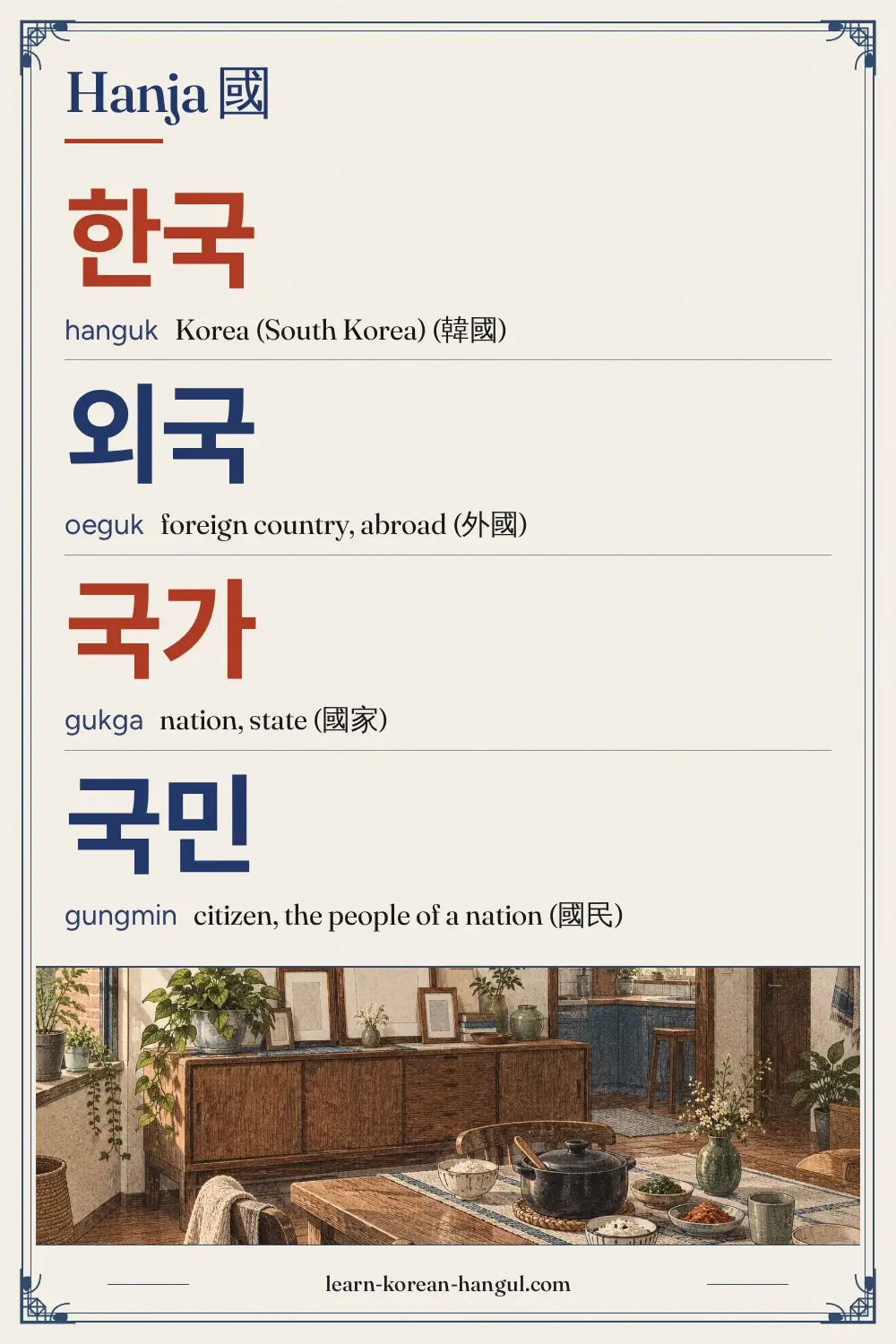
Hanja 國: the Essentials
Hanja 國 is the character for "country". Its 음훈 (the pair of the native meaning word and the Korean reading, as dictionaries list it) is 나라 국. The meaning word 나라 is the everyday native noun for "country", and 국 is the sound the character has inside Sino-Korean words. So 나라 can stand alone (우리나라, "our country"), while 국 only works inside compounds such as 외국 and 국가.
The character looks like a box (囗, a border) with a smaller character 或 inside, and in older forms 或 itself was a picture of a walled settlement guarded by a weapon. You do not need the history: it is enough to see "a territory with a border". That helps you remember the meaning of 국경 (national border) and 국내 (inside the country).
This family gives you the vocabulary of nationality, politics and international life. The card below sums up the character.
| Item | Detail |
|---|---|
| Character | 國 |
| 음훈 | 나라 국 |
| Reading | 국 (guk) |
| Core meaning | country; nation; state |
| Radical | 囗 (enclosure; Kangxi radical 31) |
| Strokes | 11 |
| Words on this page | 12 |
Korean uses the traditional form 國. The shape 国, with 玉 (jade) inside the box, is the simplified form used in mainland China and in Japanese writing, so Korean learners may see it on Chinese or Japanese signs. The hanja radicals section explains what a radical is. Now the word list.
Which Words Does 國 Build?
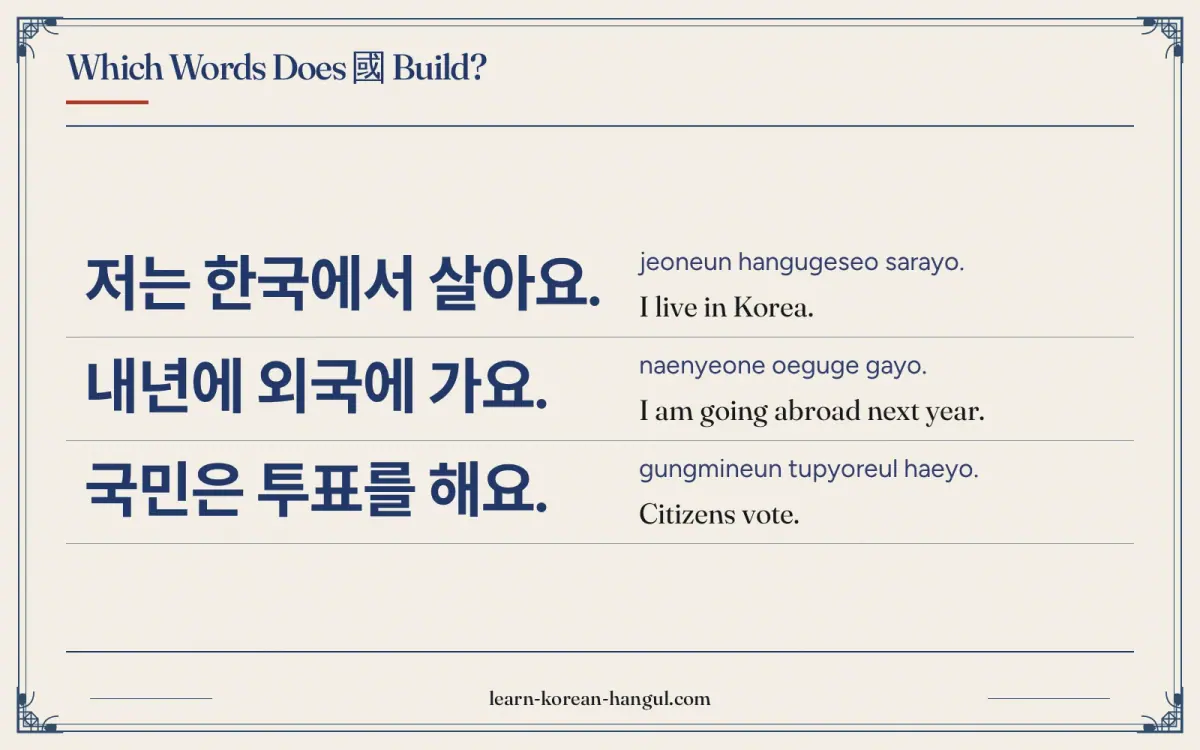
These 12 words are the best ones to learn first. They cover Korea itself, foreign countries, citizens, law and school subjects. Revised Romanization (RR) appears only as a learning aid, and square brackets show the spoken form where it differs from the spelling.
| Word | Characters | RR | Meaning | How the characters add up |
|---|---|---|---|---|
| 한국 | 韓國 | hanguk | Korea (South Korea) | 韓 Han + 國 country |
| 외국 | 外國 | oeguk | foreign country, abroad | 外 outside + 國 country |
| 국가 [국까] | 國家 | gukga | nation, state | 國 country + 家 home |
| 국민 [궁민] | 國民 | gungmin | citizen, the people of a nation | 國 country + 民 people |
| 국제 [국쩨] | 國際 | gukje | international | 國 country + 際 between |
| 국어 [구거] | 國語 | gugeo | national language; Korean (as a school subject) | 國 country + 語 language |
| 국내 [궁내] | 國內 | gungnae | domestic, inside the country | 國 country + 內 inside |
| 애국 | 愛國 | aeguk | patriotism | 愛 love + 國 country |
| 조국 | 祖國 | joguk | homeland, fatherland | 祖 ancestor + 國 country |
| 제국 | 帝國 | jeguk | empire | 帝 emperor + 國 country |
| 국회 [구쾨] | 國會 | gukhoe | National Assembly, parliament | 國 country + 會 meeting |
| 국립 [궁닙] | 國立 | gungnip | national (state-run institution) | 國 country + 立 establish |
The family splits into three groups. Place names and identity: 한국, 외국, 조국 and 국내. The state and its people: 국가, 국민, 국회, 국립, 애국 and 제국. And the language of the country: 국어. When 國 comes last, as in 한국, 외국, 조국, 제국 and 애국, it names a type of country. When it comes first, it describes something that belongs to or concerns the nation.
As a suffix, -국 names countries in the same way: 미국 (the United States), 영국 (the United Kingdom), 중국 (China) and 태국 (Thailand). The first syllable is often a Chinese-style approximation of the country's name, so 美 in 미국 does not mean "beautiful" here; it stands for part of the sound "America".
The 12 Words One by One
한국 (韓國, hanguk): Korea (South Korea). The everyday name of South Korea, from 韓, the traditional name Han (usually traced to the ancient Samhan states of the southern peninsula), and 國 "country". The ㄱ at the end is a soft, unreleased sound: the mouth closes at the back and no air comes out. Add 어 for the language (한국어), 인 for a person (한국인) or 말 for speech (한국말). A visitor from Korea is 한국 사람.
외국 (外國, oeguk): foreign country, abroad. A country other than your own: 외국에 가다 (to go abroad), 외국어 (foreign language), 외국인 (foreigner). The synonym 해외 (海外, overseas) is more common for travel and business, as in 해외여행 (overseas travel). 외국 is also the plain word for "abroad".
국가 [국까] (國家, gukga): nation, state. The formal word for a nation as a political body, with 家 meaning "household" in the old sense of a ruler's family. You will meet 국가 in 국가 기관 (national agency), 국가대표 (national representative, as in a national team) and 애국가 (the national anthem). The sound is [국까], with a tense ㄲ.
국민 [궁민] (國民, gungmin): citizen, the people of a nation. The people of a country, seen as a group: 국민 건강 보험 (national health insurance), 국민의 권리 (citizens' rights). The final ㄱ becomes ㅇ before ㅁ, so the word is said [궁민]. The sound and the spelling differ: never read it "gukmin". The related 시민 (市民) means a city dweller or citizen in the civic sense.
국제 [국쩨] (國際, gukje): international. "Between countries", used as a prefix for anything international: 국제 전화 (international call), 국제 학교 (international school), 국제 공항 (international airport) and 국제 결혼 (international marriage). The ㅈ after the final ㄱ is tense, so say [국쩨]. Compare 세계 (世界, the world), which is about the whole world rather than relations between countries.
국어 [구거] (國語, gugeo): national language; Korean (as a school subject). The "language of the country". In Korean schools 국어 is the subject called Korean, studied by native speakers: 국어 시간 (Korean class), 국어 선생님. It is distinct from 한국어, the name used for Korean as a foreign language. The final ㄱ moves to the next syllable, so 국어 is [구거].
국내 [궁내] (國內, gungnae): domestic, inside the country. Inside the country: 국내 여행 (domestic travel), 국내선 (domestic flight), 국내외 (at home and abroad). The opposite is 국외 (outside the country) and, in daily speech, 해외. The final ㄱ becomes ㅇ before ㄴ, so the word is said [궁내].
애국 (愛國, aeguk): patriotism. Love of one's country. The word appears in 애국심 (patriotic feeling), 애국자 (patriot) and 애국가 [애국까] (the national anthem). In a historical context, Korean schoolchildren learn about 애국 지사 (patriots who fought for independence). The word has a serious, formal tone.
조국 (祖國, joguk): homeland, fatherland. "The country of one's ancestors", used with deep emotion: 조국을 위해 (for the homeland), 조국 통일 (reunification of the homeland). It appears in speeches, patriotic songs and history. It is not a word for casual conversation, where people say 고향 (hometown) or 우리나라 (our country).
제국 (帝國, jeguk): empire. A state ruled by an emperor (황제). History lessons use 제국 often: 로마 제국 (Roman Empire), 대한제국 (the Korean Empire, 1897 to 1910). The related 제국주의 means imperialism. The 帝 appears in 황제 (emperor).
국회 [구쾨] (國會, gukhoe): National Assembly, parliament. Korea's parliament, and the building where it meets: 국회 의사당 (National Assembly building), 국회의원 (member of the National Assembly). The final ㄱ and the ㅎ merge into an aspirated ㅋ, so the word is said [구쾨]. Revised Romanization keeps the h in nouns and writes gukhoe.
국립 [궁닙] (國立, gungnip): national (state-run institution). Founded and run by the state: 국립 박물관 (national museum), 국립 대학교 (national university) and 국립 공원 (national park). The contrasts are 공립 (public, run by a local authority) and 사립 (private). The sound is [궁닙]: ㄹ turns into ㄴ after ㄱ, and the ㄱ then turns into ㅇ before the ㄴ.
Sentences to Hear the Words in Use
Six of the words appear in short sentences. Listen to each one, then read it aloud. The brackets in the word table show how the words are said in connected speech.
저는 한국에서 살아요.
jeoneun hangugeseo sarayo.
I live in Korea.
내년에 외국에 가요.
naenyeone oeguge gayo.
I am going abroad next year.
국민은 투표를 해요.
gungmineun tupyoreul haeyo.
Citizens vote.
저는 국제 학교에 다녀요.
jeoneun gukje hakgyoe danyeoyo.
I attend an international school.
국어 시간에 시를 읽어요.
gugeo sigane sireul ilgeoyo.
We read poems in Korean class.
이 박물관은 국립 박물관이에요.
i bangmulgwaneun gungnip bangmulgwanieyo.
This museum is a national museum.
How Is 國 Read in Different Words?
The reading of 國 never changes: it is 국 in every Sino-Korean word. What changes is how the final ㄱ of 국 sounds, because ㄱ is a consonant that blends with the next sound. The family contains several patterns, which makes it a good sound-change workout.
Rule box: ㄱ before a nasal. When 국 is followed by ㅁ or ㄴ, the final ㄱ turns into the nasal ㅇ.
- 국민 → [궁민] (gungmin)
- 국내 → [궁내] (gungnae)
- 국립 → [궁닙] (gungnip): first ㄹ becomes ㄴ, then ㄱ becomes ㅇ
Revised Romanization writes the sound that is actually spoken, so you see gung-. The general rule is on the page about nasalization.
Rule box: tense sounds after ㄱ. A plain consonant after the final ㄱ becomes tense: 국가 → [국까] and 국제 → [국쩨]. RR does not write tensing caused by a sound change, so it gives gukga and gukje. The same happens in 국경 [국껑], 국기 [국끼] and 국산 [국싼]. See Sino-Korean tensification.
Rule box: ㄱ before ㅎ and before a vowel. In 국회 the ㄱ and the ㅎ combine into an aspirated ㅋ: [구쾨]. RR keeps the h in nouns, so it writes gukhoe. In 국어 the vowel ㅓ pulls the final ㄱ across to the next syllable: [구거]. The Hangul 국어 does not change, only the sound.
Finally, 한국, 외국, 애국, 조국 and 제국 end in 국, and when they stand alone or before a pause the final ㄱ is unreleased: [한국], [외국]. Close the back of the tongue against the soft palate and do not let air escape. Some learners add a vowel at the end, which sounds unnatural.
What Is Easy to Confuse with 國?
國 and 国. The traditional form 國 is used in Korean writing, and the simplified form 国 is used in mainland China and, as a Japanese form, in Japan. If you see 国 on a sign, it is Chinese or Japanese, not Korean. The Korean reading of both is 국. The contrast with kanji and hanzi is explained on the page about hanja versus kanji and hanzi.
국 the soup. The native Korean noun 국 means soup, as in 미역국 (seaweed soup) and 국물 (broth). It is a different word from 國, with the same spelling and sound. A person who says 국이 맛있어요 is talking about soup, not about a country. Context separates the two at once.
局 in 우체국 and 약국. The character 局 (판 국) is also read 국 and means an office or bureau. It gives 우체국 (post office), 약국 (pharmacy) and 방송국 (broadcasting station). Do not read the 국 of 약국 as "country"; a pharmacy is a "medicine bureau".
國 and 園 or 圓. The enclosure radical 囗 appears in other characters that look similar: 園 (동산 원, garden) in 공원 (park), 圓 (둥글 원, round) in 원형 (circle) and 圖 (그림 도, picture) in 도서관 (library). The reading is the clue. If the word says 국, it is not 園 or 圖.
나라 versus 국가 versus 조국. 나라 is the neutral native word, used in speech: 어느 나라 사람이에요? (Which country are you from?). 국가 is the formal, political "state" or "nation". 조국 is the emotional homeland. Use 나라 when you talk to people, and keep 국가 for news, law and school.
국내, 국외 and 해외. 국내 is inside the country, and its opposites are 국외 (outside the country, rare in speech) and 해외 (overseas, the usual word). The word 외국 means a foreign country, while 해외 describes the place beyond the sea. For travel, say 해외여행.
Practice This Family
The 12 Words as Flashcards
The deck below has one card for each of the 12 words, with audio. The table shows the same cards, so you can study from either one.
| # | Korean | RR | Meaning | Character and note |
|---|---|---|---|---|
| 1 | 한국 | hanguk | Korea (South Korea) (韓國) | 韓 (나라 한) + 國 (나라 국). 한국어 = Korean language. |
| 2 | 외국 | oeguk | foreign country, abroad (外國) | 外 (바깥 외) + 國. 외국어 = foreign language. |
| 3 | 국가 [국까] | gukga | nation, state (國家) | 國 + 家 (집 가). Said [국까]. 국가대표 = national team player. |
| 4 | 국민 [궁민] | gungmin | citizen, the people of a nation (國民) | 國 + 民 (백성 민). Said [궁민]. 국민 건강 보험. |
| 5 | 국제 [국쩨] | gukje | international (國際) | 國 + 際 (사이 제). Said [국쩨]. 국제 공항. |
| 6 | 국어 [구거] | gugeo | national language; Korean (as a school subject) (國語) | 國 + 語 (말씀 어). Said [구거]. School subject name; learners study 한국어. |
| 7 | 국내 [궁내] | gungnae | domestic, inside the country (國內) | 國 + 內 (안 내). Said [궁내]. Opposite: 국외 / 해외. |
| 8 | 애국 | aeguk | patriotism (愛國) | 愛 (사랑 애) + 國. 애국가 = national anthem. |
| 9 | 조국 | joguk | homeland, fatherland (祖國) | 祖 (할아비 조) + 國. Emotional "homeland"; speech: 우리나라. |
| 10 | 제국 | jeguk | empire (帝國) | 帝 (임금 제) + 國. 로마 제국, 대한제국. |
| 11 | 국회 [구쾨] | gukhoe | National Assembly, parliament (國會) | 國 + 會 (모일 회). Said [구쾨]. 국회의원 = lawmaker. |
| 12 | 국립 [궁닙] | gungnip | national (state-run institution) (國立) | 國 + 立 (설 립). Said [궁닙]. Contrasts: 공립, 사립. |
Practice · 12
- 01한국
Show answer
hanguk
Korea (South Korea) (韓國)
- 02외국
Show answer
oeguk
foreign country, abroad (外國)
- 03국가
Show answer
gukga
nation, state (國家)
- 04국민
Show answer
gungmin
citizen, the people of a nation (國民)
- 05국제
Show answer
gukje
international (國際)
- 06국어
Show answer
gugeo
national language; Korean (as a school subject) (國語)
- 07국내
Show answer
gungnae
domestic, inside the country (國內)
- 08애국
Show answer
aeguk
patriotism (愛國)
- 09조국
Show answer
joguk
homeland, fatherland (祖國)
- 10제국
Show answer
jeguk
empire (帝國)
- 11국회
Show answer
gukhoe
National Assembly, parliament (國會)
- 12국립
Show answer
gungnip
national (state-run institution) (國立)
Decode Three Unseen Words
國境 국경 (gukgyeong). 國 "country" + 境 "border". The national border, as in 국경을 넘다 (to cross the border). Said [국껑].
國旗 국기 (gukgi). 國 "country" + 旗 "flag". The national flag. The Korean flag is called 태극기. Said [국끼].
國産 국산 (guksan). 國 "country" + 産 "produce". Made in the home country: 국산 제품 (a domestically made product). Said [국싼]. The opposite is 외제 (外製, foreign-made).
Check Yourself
Each question asks you to decode a word or answer a question about 國. The answers are checked as you go.
Practice · 6
국민 is spelled 국민. How is it said in normal speech?
Show answer
[궁민]
The final ㄱ becomes the nasal ㅇ before ㅁ, so 국민 is [궁민]. RR writes gungmin to match the sound.
외국 is 外 "outside" + 國 "country". What does 외국 mean?
Show answer
foreign country
외국 (外國) is a foreign country or "abroad". Korea is 한국, a citizen is 국민 and an embassy is 대사관.
국회 is 國 + 會. How is it said?
Show answer
[구쾨]
The final ㄱ and the ㅎ merge into an aspirated ㅋ, so the word is [구쾨]. RR keeps the h in nouns and writes gukhoe.
Which one is the traditional character used in Korea for "country"?
Show answer
國
國 is the traditional form used in Korea. 国 is the simplified or Japanese form, and 園 and 圓 are different characters read 원.
Which word means "national" for a state-run museum or university?
Show answer
국립
국립 (國立) means national, run by the state. 공립 is public, 사립 is private and 국제 is international.
In 약국 (pharmacy), what is the 국?
Show answer
the character 局 (office)
The 국 in 약국 (藥局) is 局, "office", not 國. The same 局 appears in 우체국 and 방송국.
What to Learn Next
You now have 12 words and the sound patterns of 국. The best next step is the family of 大 (대), because 대한민국 joins 大 and 韓 with 民 and 國 in a single name. See 大 (대) for that. To work on the other half of the nationality words, go to 人 (인), which explains the 인 in 한국인 and 외국인.
To see how this fits the whole section, return to the hanja word families page. The Sino-Korean vocabulary page lists similar words by topic, and the hanja hub places the family among the other character pages. The 家 (가) family explains the second half of 국가, and the 中 (중) family starts with 중국, another -국 country name.
Frequently Asked Questions
How is 國民 pronounced?
國民 (국민) is pronounced [궁민]. The final ㄱ of 국 becomes the nasal ㅇ when the next syllable starts with ㅁ. The spelling stays 국민, but the sound is gungmin. The same change happens in 국내 [궁내] and 국립 [궁닙].
Why is it 國 and not 国?
Korea writes the traditional character 國, which has 或 inside a border. The shape 国 is the simplified form used in mainland China and, as a Japanese form, in Japan. Both are read 국 in Korean, but 国 is not part of Korean writing, so do not use it in Korean hanja study.
Which words use 國 as a prefix?
Many: 국가 (nation), 국민 (citizen), 국제 (international), 국어 (national language), 국내 (domestic), 국립 (national) and 국회 (National Assembly). As a prefix, 국 means "of the nation", so 국립 is run by the state and 국산 is made at home. As a suffix it names the country itself: 한국, 외국, 제국.
What is the Korean word for country?
The everyday word is 나라, which stands alone: 어느 나라 사람이에요? For formal writing, news and law, the Sino-Korean 국가 is used, and 국 alone appears only as a suffix or in compounds, as in 한국 and 외국. When you talk about your own country with warmth, 우리나라 is the natural word.