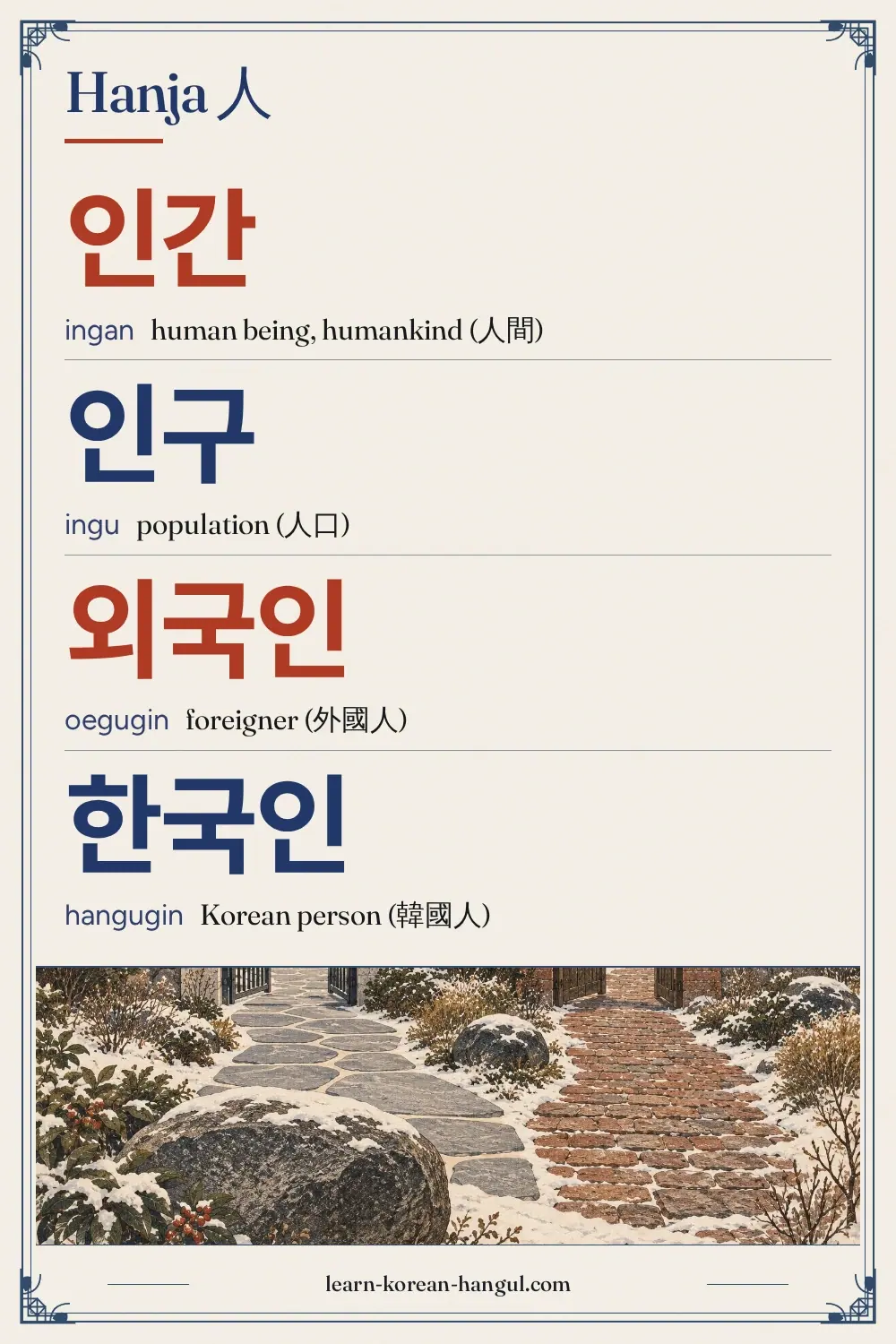
Hanja 人: the Essentials
Hanja 人 is among the simplest and most useful characters in Korean. Its 음훈 (the pair of the native meaning word and the Korean reading, as dictionaries list it) is 사람 인. The meaning word 사람 is the everyday native noun for "person", and 인 is the sound the character has inside Sino-Korean words. The character is commonly explained as a picture of a person standing in profile, with two legs.
The key difference to remember is this: 사람 can stand alone in a sentence, but 인 cannot. You say 사람이 많아요 ("There are many people"), never 인이 많아요. The syllable 인 only works inside a compound, as in 외국인 or 인구. In English terms, 사람 is the word "person", and 인 is a building block like "-ian" in "Korean" or "human" in "humankind".
The card below summarises the character. Notice that the stroke count is only two, which makes 人 an easy first character to write if you decide to try handwriting.
| Item | Detail |
|---|---|
| Character | 人 |
| 음훈 | 사람 인 |
| Reading | 인 (in) |
| Core meaning | person; people |
| Radical | 人 itself (Kangxi radical 9); 亻 on the left of other characters |
| Strokes | 2 |
| Words on this page | 12 |
As a radical, 人 changes shape to 亻 when it stands on the left of another character. That is why many characters about people, such as 休 (rest) and 作 (make), start with a small person. See the hanja radicals section for more. Now to the words themselves.
Which Words Does 人 Build?
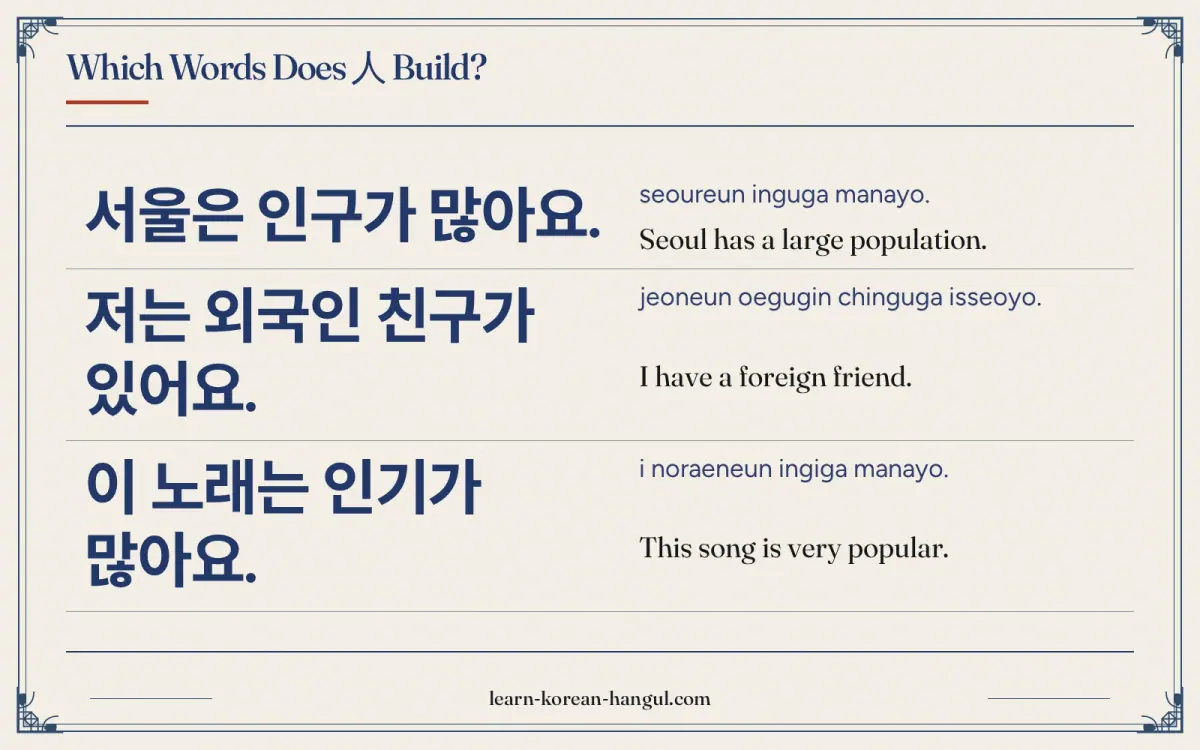
These 12 words are the best ones to learn first. They cover people in general, nationalities, population, fame, greetings and jobs. Revised Romanization (RR) appears only as a learning aid, and square brackets show the spoken form where it differs from the spelling.
| Word | Characters | RR | Meaning | How the characters add up |
|---|---|---|---|---|
| 인간 | 人間 | ingan | human being, humankind | 人 person + 間 between |
| 인구 | 人口 | ingu | population | 人 person + 口 mouth |
| 외국인 [외구긴] | 外國人 | oegugin | foreigner | 外 outside + 國 country + 人 person |
| 한국인 [한구긴] | 韓國人 | hangugin | Korean person | 韓 Korea + 國 country + 人 person |
| 인기 [인끼] | 人氣 | ingi | popularity | 人 person + 氣 spirit |
| 인생 | 人生 | insaeng | life, one's whole life | 人 person + 生 life |
| 주인 | 主人 | juin | owner, master, host | 主 master + 人 person |
| 인물 | 人物 | inmul | person of note, figure; character | 人 person + 物 thing |
| 인류 [일류] | 人類 | illyu | humankind | 人 person + 類 kind |
| 인사 | 人事 | insa | greeting; personnel | 人 person + 事 affair |
| 군인 | 軍人 | gunin | soldier, military member | 軍 army + 人 person |
| 미인 | 美人 | miin | beauty, beautiful woman | 美 beautiful + 人 person |
Two patterns organise the family. First, -인 as an ending for people categories: 한국인, 외국인, 군인, 미인, and in the same way 상인 (merchant), 노인 (elderly person) and 직장인 (office worker). Second, 인- as a start for population and human-nature words: 인간, 인구, 인류, 인물, 인사.
In counting, 인 also works as a formal counter for people, after a Sino-Korean number: 1인 가구 (one-person household), 2인용 (for two people) and 4인 가족 (a family of four). The everyday counter 명 (as in 세 명) replaces it in speech.
The 12 Words One by One
인간 (人間, ingan): human being, humankind. Literally "between people", the space where people live. The word means a human being as opposed to an animal or a machine: 인간과 동물 (humans and animals). It also appears in 인간관계 (human relationships), which is a major theme in advice columns and job interviews. Note that for "a person" in everyday speech Korean uses 사람, not 인간.
인구 (人口, ingu): population. Counting "mouths to feed" is how this word measures a population. It is used in news and school lessons: 서울의 인구 (the population of Seoul), 인구 감소 (population decline) and 인구 밀도 (population density). The character 口 "mouth" also appears in 입구 (entrance) and 출구 (exit).
외국인 [외구긴] (外國人, oegugin): foreigner. A "person from outside the country". The ending -인 attaches to a place or group to name a person: 외국인 친구 (foreign friend), 외국인 등록증 (foreigner registration card). Before a vowel, the final ㄴ links to the next syllable, so 외국인이 is said [외구기니]. In speech 외국 사람 is also common and a little softer in tone.
한국인 [한구긴] (韓國人, hangugin): Korean person. The formal and written way to say "a Korean". In conversation people more often say 한국 사람, and in forms and news you see 한국인. The same pattern gives 일본인 (Japanese person), 중국인 (Chinese person), 미국인 (American) and 프랑스인 (French person). The sound links: 한국인이 is [한구기니].
인기 [인끼] (人氣, ingi): popularity. The "spirit of the people" around someone or something: how well liked it is. Use 인기가 많다 or 인기가 있다 (to be popular) and 인기 있는 음식 (a popular food). The 기 is tense in speech: say [인끼]. Fans of K-pop will hear it in 인기 가수 (popular singer).
인생 (人生, insaeng): life, one's whole life. A person's life as a story. Here 人 begins the word. The word is covered in more detail on the page for 生 (생), where it is compared with 생활 (daily life) and 생명 (life force).
주인 (主人, juin): owner, master, host. The person who "owns" something: 가게 주인 (shop owner), 집주인 (landlord or homeowner), 개 주인 (dog owner). With 公 added you get 주인공 (主人公, the main character of a story or film). The opposite of 주인 as host is 손님 (guest).
인물 (人物, inmul): person of note, figure; character. A "person" in the sense of a notable figure or a character in a story: 역사적 인물 (historical figure), 주요 인물 (main figure) and 등장인물 (characters in a work). It can also describe how good-looking someone is in older speech, as in 인물이 좋다. Compare 사람, which is neutral.
인류 [일류] (人類, illyu): humankind. All humans as a species, in the biggest sense: 인류의 역사 (the history of humankind), 인류 문명 (human civilisation). The spelling is 인류 but the sound is [일류], because ㄴ before ㄹ becomes ㄹ. The unrelated word 일류 (一流, first-rate) therefore sounds the same.
인사 (人事, insa): greeting; personnel. One word with two meanings. As a greeting it means bowing, saying hello or showing respect: 인사하다 (to greet), 인사를 드리다 (to give respects). As a work term it means personnel matters: 인사팀 (HR team), 인사 이동 (staff transfers). The two share one root, "affairs of people".
군인 (軍人, gunin): soldier, military member. A person who belongs to the army. Because military service is common in Korea, the word is everyday: 군인 아저씨 (a soldier, said by children), 직업 군인 (professional soldier). The 軍 here also appears in 군대 (the military) and 공군 (air force).
미인 (美人, miin): beauty, beautiful woman. Traditionally a beautiful woman: 미인 대회 (beauty contest) and 미인형 (a beauty type). The word sounds a little old-fashioned in casual speech, and describing someone to their face this way can sound formal or flattering. The same 美 appears in 미술 (fine art) and 미국 (the United States).
Sentences to Hear the Words in Use
Six of the words appear in short sentences. Listen to each one, then read it aloud. Note that 군인이에요 is said with the ㄴ linked forward to the vowel.
서울은 인구가 많아요.
seoureun inguga manayo.
Seoul has a large population.
저는 외국인 친구가 있어요.
jeoneun oegugin chinguga isseoyo.
I have a foreign friend.
이 노래는 인기가 많아요.
i noraeneun ingiga manayo.
This song is very popular.
가게 주인이 아주 친절해요.
gage juini aju chinjeolhaeyo.
The shop owner is very kind.
만나면 먼저 인사해요.
mannamyeon meonjeo insahaeyo.
When we meet, I greet first.
우리 아버지는 군인이에요.
uri abeojineun guninieyo.
My father is a soldier.
How Is 人 Read in Different Words?
The reading of 人 is stable: 인 in every word. There is no second reading, and it does not fall under the initial-sound rule (두음법칙) because 인 does not start with ㄹ or ㄴ. The sound changes in this family come from its neighbours.
Rule box: linking. When a word ending in 인 is followed by a vowel, the final ㄴ moves to the next syllable.
- 외국인이 → [외구기니] (oegugini)
- 한국인은 → [한구기는] (hangugineun)
- 군인이에요 → [구니니에요] (guninieyo)
Spell the word as you hear it when you write the romanization, but keep the Hangul spelling fixed: 외국인이, not 외구기니.
Rule box: ㄴ before ㄹ. In 인류 the ㄴ of 인 sits next to the ㄹ of 류, and the two sounds blend into a double ㄹ. The result is [일류], written illyu in Revised Romanization. This is the assimilation rule in the page on consonant assimilation, and it works the same way in 신라 [실라] and 한라산 [할라산].
A tense sound to memorise: 인기 [인끼]. The 기 of 인기 is tense in speech, though the spelling does not show it. Sino-Korean tensing after ㄴ is not fully predictable, so treat 인기 [인끼] as a word to memorise, along with its meaning. Revised Romanization writes ingi, with no sign of the tense sound, so rely on the audio. The general topic is covered in Sino-Korean tensification.
Finally, notice that 인사, 인구, 인간, 인물 and 인생 have no changes at all: [인사], [인구], [인간], [인물], [인생]. The ㄴ followed by a consonant is simply ㄴ, made with the tongue tip on the ridge behind the upper teeth. Hold it for a moment before moving to the next sound, and avoid turning it into "ng".
What Is Easy to Confuse with 人?
人 and 入. The two characters look almost the same. In 人 (person) the long left stroke starts at the top, while in 入 (enter) the right stroke starts at the top and the left stroke is short. The Korean readings help: 人 is 인 and 入 is 입, as in 입구 (entrance) and 입학 (starting school). If you see 입 in a word about entering, it is 入, not 人.
인 from other characters. Several unrelated characters are also read 인: 認 (알 인, to recognise) in 인정 and 인식, 引 (끌 인, to pull) in 인용, 印 (도장 인, stamp) in 인쇄, and 仁 (어질 인, kindness). The Hangul looks identical, so the context must tell you which one is meant. For example, 인기, 인구 and 인간 are about people, while 인정 is about recognising something.
인사 means two things. The greeting sense and the personnel sense are both 人事. Context is enough: 인사를 하다 is "to greet", and 인사 이동 is "personnel transfer". Another word, 안녕하세요, is the actual phrase you say when greeting someone.
人 and 사람. Use 사람 in everyday speech and 인 inside compounds. You say 한국 사람 and 한국인 for the same meaning, but only 사람 can be counted with a number in casual speech: 두 사람, 세 사람. The compound 한국인 is more formal and is used on forms and in news.
인간 versus 사람. Choose 사람 for "person" and 인간 for "human being" in the philosophical or biological sense. Calling someone 인간 in conversation can be an insult, as in 나쁜 인간 ("a bad person"), so use it with care.
Counting people. In speech use 명: 세 명. Use the 인 counter only in fixed expressions such as 1인 가구, 2인용 and 4인 가족. Both are correct, but they are not interchangeable in casual conversation.
Practice This Family
The 12 Words as Flashcards
The deck below has one card for each of the 12 words, with audio. The table shows the same cards, so you can study from either one.
| # | Korean | RR | Meaning | Character and note |
|---|---|---|---|---|
| 1 | 인간 | ingan | human being, humankind (人間) | 人 (사람 인) + 間 (사이 간). Human being; 인간관계 = relationships. |
| 2 | 인구 | ingu | population (人口) | 人 + 口 (입 구). Population: 인구가 많다 / 적다. |
| 3 | 외국인 [외구긴] | oegugin | foreigner (外國人) | 外 (바깥 외) + 國 (나라 국) + 人. Said [외구긴]. Also 외국 사람. |
| 4 | 한국인 [한구긴] | hangugin | Korean person (韓國人) | 韓 (나라 한) + 國 + 人. Said [한구긴]. Pattern: country + 인. |
| 5 | 인기 [인끼] | ingi | popularity (人氣) | 人 + 氣 (기운 기). Said [인끼]. 인기가 많다 = to be popular. |
| 6 | 인생 | insaeng | life, one's whole life (人生) | 人 + 生 (날 생). Whole-life word; compare 생활. |
| 7 | 주인 | juin | owner, master, host (主人) | 主 (주인 주) + 人. 집주인 = landlord; 주인공 = protagonist. |
| 8 | 인물 | inmul | person of note, figure; character (人物) | 人 + 物 (물건 물). Notable figure; 등장인물 = characters. |
| 9 | 인류 [일류] | illyu | humankind (人類) | 人 + 類 (무리 류). Said [일류]. Homophone of 일류 (first-rate). |
| 10 | 인사 | insa | greeting; personnel (人事) | 人 + 事 (일 사). Two meanings: greeting; personnel. |
| 11 | 군인 | gunin | soldier, military member (軍人) | 軍 (군사 군) + 人. 직업 군인 = career soldier. |
| 12 | 미인 | miin | beauty, beautiful woman (美人) | 美 (아름다울 미) + 人. A little formal; 미인 대회 = pageant. |
Practice · 12
- 01인간
Show answer
ingan
human being, humankind (人間)
- 02인구
Show answer
ingu
population (人口)
- 03외국인
Show answer
oegugin
foreigner (外國人)
- 04한국인
Show answer
hangugin
Korean person (韓國人)
- 05인기
Show answer
ingi
popularity (人氣)
- 06인생
Show answer
insaeng
life, one's whole life (人生)
- 07주인
Show answer
juin
owner, master, host (主人)
- 08인물
Show answer
inmul
person of note, figure; character (人物)
- 09인류
Show answer
illyu
humankind (人類)
- 10인사
Show answer
insa
greeting; personnel (人事)
- 11군인
Show answer
gunin
soldier, military member (軍人)
- 12미인
Show answer
miin
beauty, beautiful woman (美人)
Decode Three Unseen Words
老人 노인 (noin). 老 "old" + 人 "person". The word is elderly person, as in 노인 복지 (elderly welfare). It is said [노인], and 노인이 is [노이니].
人形 인형 (inhyeong). 人 "person" + 形 "shape". A doll or a stuffed toy: 곰 인형 (teddy bear). The sound is [인형], with no change.
人材 인재 (injae). 人 "person" + 材 "material". Talent, or a person of ability: 인재를 키우다 (to cultivate talent). Said [인재].
Check Yourself
Each question asks you to decode a word or answer a question about 人. The answers are checked as you go.
Practice · 6
외국인 is 外 "outside" + 國 "country" + 人. What does 외국인 mean?
Show answer
foreigner
외국인 (外國人) is a foreigner, a person from outside the country. A foreign country is 외국 without 인, and population is 인구.
How is 인기 (popularity) said in normal speech?
Show answer
[인끼] with a tense ㄲ
The 기 is tense in speech, so 인기 is [인끼]. Revised Romanization does not show this, so the audio matters.
인구 is 人 "person" + 口 "mouth". What does it mean?
Show answer
population
인구 (人口) is the population. Entrance is 입구 (入口) and exit is 출구 (出口); the 口 "mouth" is the same character.
인류 is spelled 인류. How is it said?
Show answer
[일류]
The ㄴ before ㄹ becomes ㄹ, so 인류 is [일류]. It sounds the same as 일류, "first-rate".
Which sentence correctly uses 사람 and not 인?
Show answer
사람이 많아요.
사람 can stand alone, so 사람이 많아요 means "There are many people". The syllable 인 only works inside compounds like 한국인 and 인구.
인사 can mean two things. Which pair is right?
Show answer
greeting and personnel
인사 (人事) means greeting and also personnel matters, as in 인사팀 (HR team). Population is 인구 and popularity is 인기.
What to Learn Next
You now have 12 words and a feel for how 人 works as a suffix and as a prefix. A good next step is the 學 (학) family, because 학생 (student) joins 學 with 生, and the page on 生 (생) shows how 生 also means "person" at the end of some words. For the wider family of nation words, go to 國 (국), which explains the 국 in 한국인 and 외국인.
To see how this fits the whole section, return to the hanja word families page. The Sino-Korean vocabulary page lists the same sort of words by topic, and the hanja hub places the family among the other character pages. For more characters, see the 100 most useful hanja, and for a study routine, how to learn hanja.
Frequently Asked Questions
Why is a greeting called 인사?
The word 인사 (人事) means "affairs of people": how people behave towards each other. From that sense it also came to mean a greeting, the most visible part of how people treat each other. The same two characters also name personnel matters in a company, such as 인사팀 (HR team). When you say hello you say 안녕하세요; 인사 is the name of the act, not the phrase.
What is the difference between 人 and 사람?
사람 is a native Korean noun that works on its own: 사람이 많아요. 人 is read 인 and works only inside Sino-Korean compounds such as 한국인, 인구 and 군인. So the meaning is the same ("person"), but the grammar is different. When in doubt in speech, use 사람.
Is 인 used as a counter?
Yes, but only in fixed, formal expressions: 1인 가구 (one-person household), 2인용 (for two people) and 4인 가족 (family of four). In everyday speech use the counter 명 with a native number: 한 명, 두 명, 세 명. The 인 counter attaches to a Sino-Korean number and sounds written or official.
What does 人 mean in 外國人?
In 외국인 (外國人), 人 means "person who belongs to that place", so 外國 "foreign country" + 人 gives "foreigner". The same pattern builds 한국인 (Korean), 일본인 (Japanese person) and 미국인 (American). In everyday speech many people prefer 한국 사람 and 외국 사람, which mean the same.