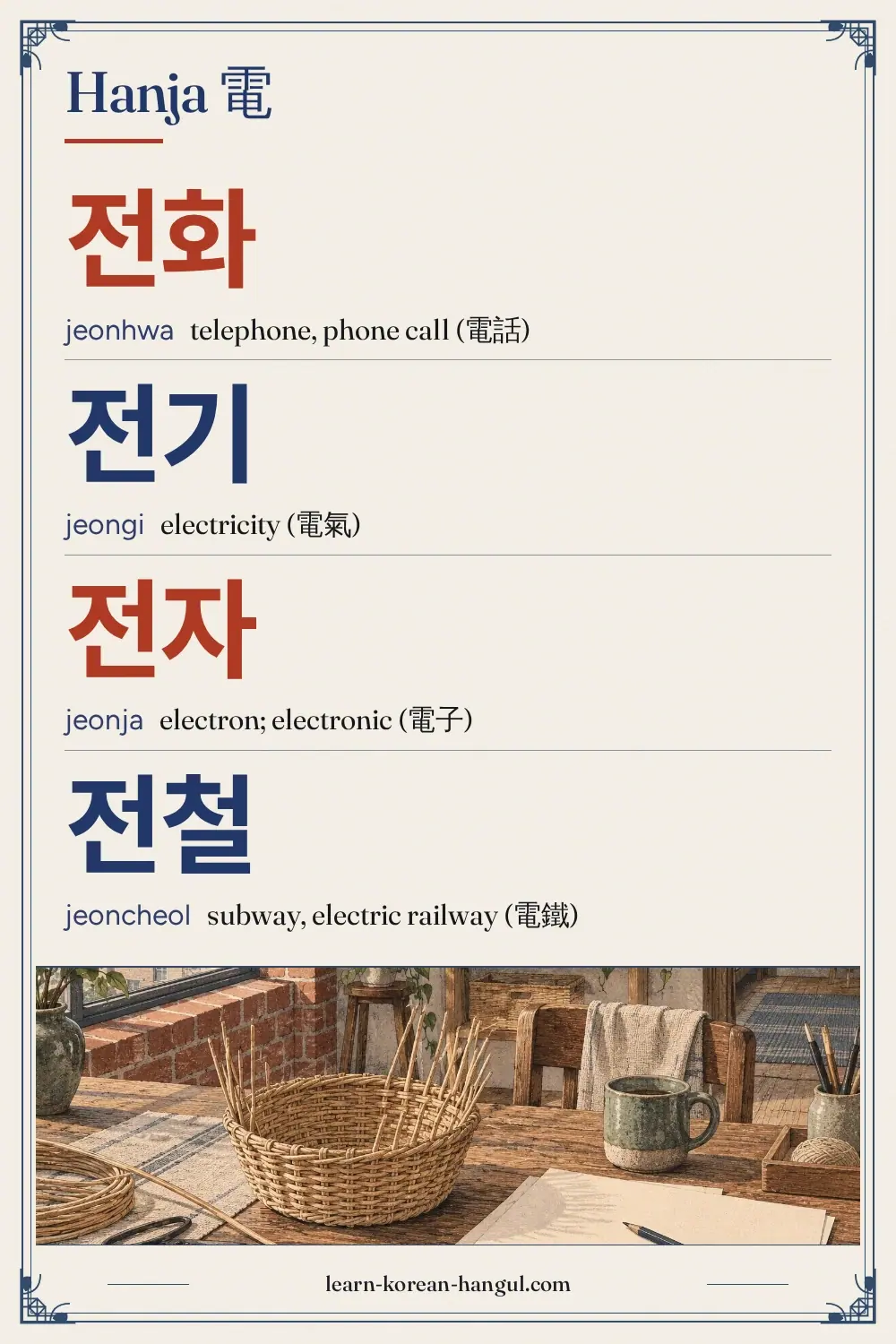
Hanja 電: the Essentials
Hanja 電 is the character behind the modern vocabulary of electricity and technology. Its 음훈 (the pair of the native meaning word and the Korean reading, as dictionaries list it) is 번개 전. The meaning word 번개 is the native noun for "lightning", and 전 is the sound the character has inside Sino-Korean words. The ancient meaning is lightning; the modern meaning, "electricity", developed because lightning was the first electricity people saw.
The character has the rain radical 雨 on top, because lightning comes from rain clouds, and a lower part, 申, that began as a picture of a lightning bolt. The picture helps you remember that 電 is about energy, not about rain, and that it is quite different from the rain character 雨 (비 우) used alone.
Because so many modern devices use electricity, this family produces a large part of the technology vocabulary: telephones, batteries, chargers and household appliances. The card below sums up the character.
| Item | Detail |
|---|---|
| Character | 電 |
| 음훈 | 번개 전 |
| Reading | 전 (jeon) |
| Core meaning | lightning; electricity; electric |
| Radical | 雨 (rain; Kangxi radical 173) |
| Strokes | 13 |
| Words on this page | 12 |
Because the radical 雨 sits on top of the character, 電 is filed with other weather characters such as 雪 (snow) and 雲 (cloud). The hanja radicals section explains how to look characters up by radical. Now the word list.
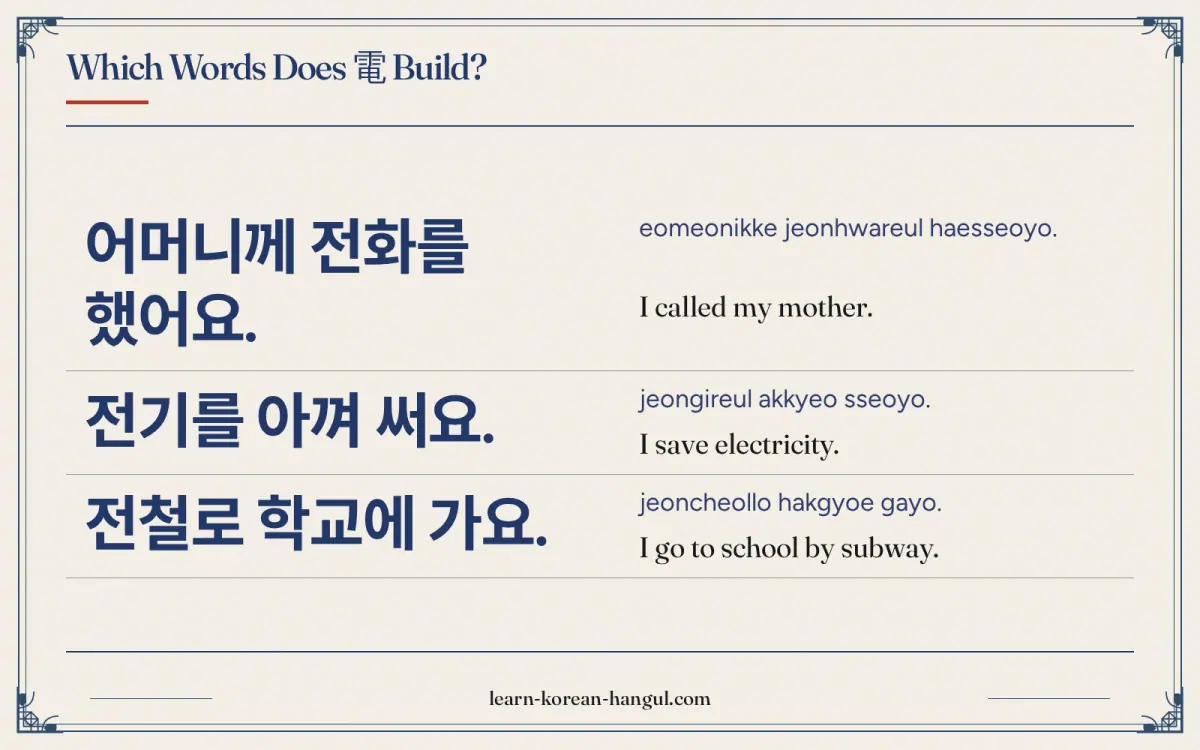
Which Words Does 電 Build?
These 12 words are the best ones to learn first. They cover communication, power, devices and transport. Revised Romanization (RR) appears only as a learning aid, and square brackets show the spoken form where it differs from the spelling.
| Word | Characters | RR | Meaning | How the characters add up |
|---|---|---|---|---|
| 전화 | 電話 | jeonhwa | telephone, phone call | 電 electricity + 話 talk |
| 전기 | 電氣 | jeongi | electricity | 電 electricity + 氣 energy |
| 전자 | 電子 | jeonja | electron; electronic | 電 electricity + 子 particle, child |
| 전철 | 電鐵 | jeoncheol | subway, electric railway | 電 electricity + 鐵 iron |
| 전력 [절력] | 電力 | jeollyeok | electric power | 電 electricity + 力 power |
| 정전 | 停電 | jeongjeon | power outage, blackout | 停 stop + 電 electricity |
| 전보 | 電報 | jeonbo | telegram | 電 electricity + 報 report |
| 전지 | 電池 | jeonji | battery (dry cell) | 電 electricity + 池 pond |
| 충전 | 充電 | chungjeon | charging (a battery or balance) | 充 fill + 電 electricity |
| 가전 | 家電 | gajeon | home appliances | 家 home + 電 electricity |
| 전산 | 電算 | jeonsan | computing, computer processing | 電 electricity + 算 calculate |
| 전차 | 電車 | jeoncha | tram, streetcar (older word) | 電 electricity + 車 vehicle |
The family has three layers. The first is communication: 전화, 전보. The second is the physics and engineering of electricity: 전기, 전자, 전력, 정전, 충전, 전지, 전산. The third is transport and home life: 전철, 전차 and 가전. When 電 comes first it means "electric", and when it comes last, as in 정전, 충전 and 가전, it means "electricity" itself.
Some useful words are made with 電 as a prefix: 전등 (electric light), 전선 (wire), 전동 (electric-powered) and 전원 (power supply). They are not in the list but follow the same logic.
The 12 Words One by One
전화 (電話, jeonhwa): telephone, phone call. "Electric talk", so the telephone or a call. 전화하다 means to call, 전화번호 is a phone number, 휴대전화 is a mobile phone and 전화를 받다 is to pick up. The word also appears in set phrases such as 전화 주세요 (please call me). The standard form keeps the ㅎ: [전화].
전기 (電氣, jeongi): electricity. Electricity as a general thing, and an adjective for anything electric: 전기 요금 (electricity bill), 전기차 (electric car), 전기밥솥 (electric rice cooker) and 전기를 아끼다 (to save electricity). When the power goes out you say 전기가 나갔어요. The pronunciation is plain [전기], with no tensing.
전자 (電子, jeonja): electron; electronic. In science, an electron. In daily life, the word for "electronic": 전자 제품 (electronic goods), 전자레인지 (microwave oven, a mix of 전자 and the loanword "range"), 전자 사전 (electronic dictionary) and 전자책 (e-book). The 子 here means a small particle, as in 분자 (molecule) and 원자 (atom).
전철 (電鐵, jeoncheol): subway, electric railway. The "electric iron road", so an electric train line. In the Seoul area, people use both 전철 and 지하철 (underground railway), and 전철 often suggests the overground lines that reach the suburbs. It takes 을 / 로: 전철을 타다 (to take the train), 전철로 가다 (to go by train).
전력 [절력] (電力, jeollyeok): electric power. Electricity as an amount of power: 전력 소비 (power consumption), 전력난 (power shortage), 전력 사용량 (power use). The ㄴ of 전 meets the ㄹ of 력, so the sound is [절력] and RR writes jeollyeok. The character 力 (power) has its own page, the 力 (력/역) family.
정전 (停電, jeongjeon): power outage, blackout. "Electricity stops": a blackout. 정전이 되다 (the power goes out), 정전이 나다 (a power cut happens) and 정전 사고 (an outage accident). The first syllable 정 is 停 (정지, stop), not the 전 of 電. After a blackout, the power returns with 전기가 들어오다 (electricity comes in).
전보 (電報, jeonbo): telegram. The old method of sending short messages by wire. Today it survives mainly as 축전 and 조전 (congratulatory or condolence telegram) and in history lessons. It is a good example of a word that is still understood but rarely used.
전지 (電池, jeonji): battery (dry cell). A "pond of electricity". The everyday word is 건전지 (dry cell, like an AA battery) and 충전지 (rechargeable battery); 태양 전지 means a solar cell. The loanword 배터리 is used for phones and cars, so 전지 sounds more technical or old-fashioned. Both words are normal.
충전 (充電, chungjeon): charging (a battery or balance). "Fill with electricity". 충전하다 means to charge, 충전기 is a charger and 충전 중 means charging now. The word is also used for topping up a card or an account, as in 교통카드 충전 (topping up a transport card). The 充 appears in 보충 (supplement) and 충분 (enough).
가전 (家電, gajeon): home appliances. Electric devices for the home, such as fridges and washing machines: 가전제품 (home appliances), 가전 매장 (appliance shop), 대형 가전 (large appliances). The 家 is explained on the family page for 家 (가).
전산 (電算, jeonsan): computing, computer processing. "Electric calculation", the older word for computing: 전산 시스템 (computer system), 전산 처리 (computer processing), 전산실 (computer room) and 전산 오류 (computer error). Office signs and official documents still use it. In everyday speech people say 컴퓨터.
전차 (電車, jeoncha): tram, streetcar (older word). An electric tram, of the kind that once ran in Seoul. The word is now mostly historical. The same sound 전차 also names a military tank (戰車, written with 戰), and in everyday speech a tank is often called 탱크. The 車 appears in 자동차 (car) and 기차 (train).
Sentences to Hear the Words in Use
Six of the words appear in short sentences. Listen to each one, then read it aloud. The brackets in the word table show how the words are said in connected speech.
어머니께 전화를 했어요.
eomeonikke jeonhwareul haesseoyo.
I called my mother.
전기를 아껴 써요.
jeongireul akkyeo sseoyo.
I save electricity.
전철로 학교에 가요.
jeoncheollo hakgyoe gayo.
I go to school by subway.
어젯밤에 정전이 됐어요.
eojetbame jeongjeoni dwaesseoyo.
The power went out last night.
휴대폰을 충전해야 해요.
hyudaeponeul chungjeonhaeya haeyo.
I have to charge my phone.
이 가게는 가전제품을 팔아요.
i gageneun gajeonjepumeul parayo.
This shop sells home appliances.
How Is 電 Read in Different Words?
The reading of 電 is the same in every word: 전. It has no second reading, and it does not fall under the initial-sound rule (두음법칙), because 전 does not begin with ㄹ or ㄴ.
Rule box: ㄴ before ㄹ. The only reading change in this family is in 전력. The ㄴ at the end of 전 meets the ㄹ at the start of 력, and the two sounds blend into a long ㄹ. So 전력 is said [절력], and RR writes jeollyeok. The same thing happens in 신라 [실라] and 연락 [열락]. For the general rule see consonant assimilation.
No tensing. In many Sino-Korean words a tense sound appears, but not here. The ㅈ in 전자, 전지 and 정전, the ㄱ in 전기, the ㅂ in 전보 and the ㅅ in 전산 all stay plain. So 전기 is [전기], never "jeonggi" or [전끼]. If you hear a tense sound after 전, it is probably a different word.
ㅎ after ㄴ. The standard pronunciation keeps the ㅎ in 전화: [전화]. In fast everyday speech the ㅎ after ㄴ is often weakened, so you will hear something close to [저놔], but aim for the full form when you speak carefully.
For the vowel, the ㅓ in 전 is an unrounded back vowel, and it is not like English "o" or "u". It is a sound made with the mouth open halfway and the lips relaxed, not rounded. Compare 정 (ㅓ + ㅇ), which differs only in the final consonant. The first syllables of 전화 and 정전 sound close, so listen to the audio for the final ㄴ versus ㅇ.
What Is Easy to Confuse with 電?
電 and 前. The character 前 (앞 전) is read 전 too, meaning "front" or "before". It is in 오전 (morning, "before noon"), 전에 (before) and 이전 (before). The Hangul is identical to the 전 of 전화. If the word is about time or position, it is 前. If it is about electricity, it is 電.
Other 전 characters. 全 (온전 전) appears in 전부 (all) and 전국 (nationwide). 傳 (전할 전) appears in 전달 (delivery) and 전통 (tradition). 轉 (구를 전) appears in 전학 (change of school) and 회전 (rotation). 戰 (싸울 전) appears in 전쟁 (war), and 錢 (돈 전) in 동전 (coin). Five different characters share the sound, which is why Sino-Korean vocabulary needs context.
전기 has more than one meaning. 전기 (電氣) is electricity. The same spelling can also mean a biography (傳記) or an earlier period (前期), as in 전기 대학 (earlier-term university). The sentence tells you which one is meant: 전기 요금 is always the electricity bill.
전기 versus 전력. 전기 is electricity as a thing, and 전력 is the power it supplies. You pay 전기 요금 (the electricity bill) but you measure 전력 소비 (power consumption). If you only learn one, learn 전기.
전철 versus 지하철. Both mean a train line in a city. 전철 stresses that the train is electric, and in the Seoul area it covers the overground lines too. 지하철 stresses that the train runs underground. Most people use both words, and either one is understood.
전화 versus 휴대폰. 전화 is the general word for "telephone" or "call". For a mobile phone, you can say 휴대전화 (formal), 휴대폰 (everyday) or 핸드폰 (loan-based). You say 전화하다 for any call, not 핸드폰하다.
Practice This Family
The 12 Words as Flashcards
The deck below has one card for each of the 12 words, with audio. The table shows the same cards, so you can study from either one.
| # | Korean | RR | Meaning | Character and note |
|---|---|---|---|---|
| 1 | 전화 | jeonhwa | telephone, phone call (電話) | 電 (번개 전) + 話 (말씀 화). 전화번호 = phone number. |
| 2 | 전기 | jeongi | electricity (電氣) | 電 + 氣 (기운 기). 전기차 = electric car. |
| 3 | 전자 | jeonja | electron; electronic (電子) | 電 + 子 (아들 자). 전자레인지 = microwave. |
| 4 | 전철 | jeoncheol | subway, electric railway (電鐵) | 電 + 鐵 (쇠 철). 전철을 타다 = to take the train. |
| 5 | 전력 [절력] | jeollyeok | electric power (電力) | 電 + 力 (힘 력). Said [절력]. Not 전기 (electricity itself). |
| 6 | 정전 | jeongjeon | power outage, blackout (停電) | 停 (머무를 정) + 電. 정전이 되다 = the power goes out. |
| 7 | 전보 | jeonbo | telegram (電報) | 電 + 報 (알릴 보). Old: telegram. |
| 8 | 전지 | jeonji | battery (dry cell) (電池) | 電 + 池 (못 지). 건전지 = dry cell battery. |
| 9 | 충전 | chungjeon | charging (a battery or balance) (充電) | 充 (채울 충) + 電. 충전기 = charger. |
| 10 | 가전 | gajeon | home appliances (家電) | 家 (집 가) + 電. 가전제품 = home appliances. |
| 11 | 전산 | jeonsan | computing, computer processing (電算) | 電 + 算 (셈 산). 전산 시스템 = computer system. |
| 12 | 전차 | jeoncha | tram, streetcar (older word) (電車) | 電 + 車 (수레 차). Old word; 기차 = train. |
Practice · 12
- 01전화
Show answer
jeonhwa
telephone, phone call (電話)
- 02전기
Show answer
jeongi
electricity (電氣)
- 03전자
Show answer
jeonja
electron; electronic (電子)
- 04전철
Show answer
jeoncheol
subway, electric railway (電鐵)
- 05전력
Show answer
jeollyeok
electric power (電力)
- 06정전
Show answer
jeongjeon
power outage, blackout (停電)
- 07전보
Show answer
jeonbo
telegram (電報)
- 08전지
Show answer
jeonji
battery (dry cell) (電池)
- 09충전
Show answer
chungjeon
charging (a battery or balance) (充電)
- 10가전
Show answer
gajeon
home appliances (家電)
- 11전산
Show answer
jeonsan
computing, computer processing (電算)
- 12전차
Show answer
jeoncha
tram, streetcar (older word) (電車)
Decode Three Unseen Words
電燈 전등 (jeondeung). 電 "electricity" + 燈 "lamp". An electric light: 전등을 켜다 (to turn on the light). Said [전등].
電線 전선 (jeonseon). 電 "electricity" + 線 "line". An electric wire or power line: 전선이 끊어지다 (the wire breaks). Said [전선].
電動 전동 (jeondong). 電 "electricity" + 動 "move". Electric-powered, as in 전동 킥보드 (an electric scooter) and 전동 칫솔 (an electric toothbrush). Said [전동].
Check Yourself
Each question asks you to decode a word or answer a question about 電. The answers are checked as you go.
Practice · 6
전화 is 電 "electricity" + 話 "talk". What does it mean?
Show answer
telephone
전화 (電話) is the telephone, or a phone call. A battery is 전지, a power cut is 정전 and a charger is 충전기.
How is 전력 (electric power) said in normal speech?
Show answer
[절력]
The ㄴ before ㄹ becomes ㄹ, so 전력 is [절력]. RR writes jeollyeok.
정전 is 停 "stop" + 電 "electricity". What does it mean?
Show answer
a power outage
정전 (停電) is a power outage. 停 is the first syllable, so it is not the 전 of 電, which comes second.
Which word means "home appliances"?
Show answer
가전
가전 (家電) means home appliances. 전산 is computing, 전보 is a telegram and 전차 is a tram.
충전 is 充 "fill" + 電. What do you do to a phone with 충전하다?
Show answer
charge it
충전하다 means to charge, to fill with electricity. The charger is the 충전기.
전기 is spelled 전기. How is it said?
Show answer
[전기]
There is no tensing after 전, so the word is plain [전기]. The word 전기 is also used for 傳記 (biography), which is spelled the same.
What to Learn Next
You now have 12 words and a clear map of the electricity family. A good next step is the family of 家 (가), because 가전 joins 家 and 電 in one word. See 家 (가) for the home and expert words. For another set of everyday modern words, go to 事 (사), which covers events, affairs and meals.
To see how this fits the whole section, return to the hanja word families page. The Sino-Korean vocabulary page lists similar words by topic, and the hanja hub places the family among the other character pages. For more single characters, see the 100 most useful hanja, and for a study routine, how to learn hanja.
Frequently Asked Questions
Why does 전화 contain 電?
The word 전화 (電話) literally means "electric talk": 電 for electricity and 話 for talk. The telephone transmits speech as an electric signal, and the Korean word kept that idea when the device arrived in Korea. The same 電 appears in other devices, such as 전보 (telegram) and 전자 (electronic).
What is the difference between 전기 and 전력?
전기 (電氣) is electricity as a general thing: 전기 요금, 전기차. 전력 (電力) is electric power, an amount that is measured and supplied: 전력 소비, 전력난. So you pay the 전기 요금, but the power company reports 전력 소비. The sound also differs: 전기 is [전기] and 전력 is [절력].
Is 電 a verb?
No. 電 is a noun-building character. To make verbs, add 하다 to a word that contains it: 전화하다 (to call), 충전하다 (to charge) and 정전되다 (to have a power outage). In everyday phrases the verbs are often 켜다 (turn on), 끄다 (turn off), 받다 (receive) and 나가다 (go out), as in 전기가 나가다.
How is 전철 different from 지하철?
전철 (電鐵) means an electric railway and 지하철 (地下鐵) means an underground railway. In the Seoul area the two overlap, because the same system includes underground and overground sections. People tend to say 지하철 for lines in the city and 전철 for lines that reach the suburbs, but both are understood. Neither is wrong.