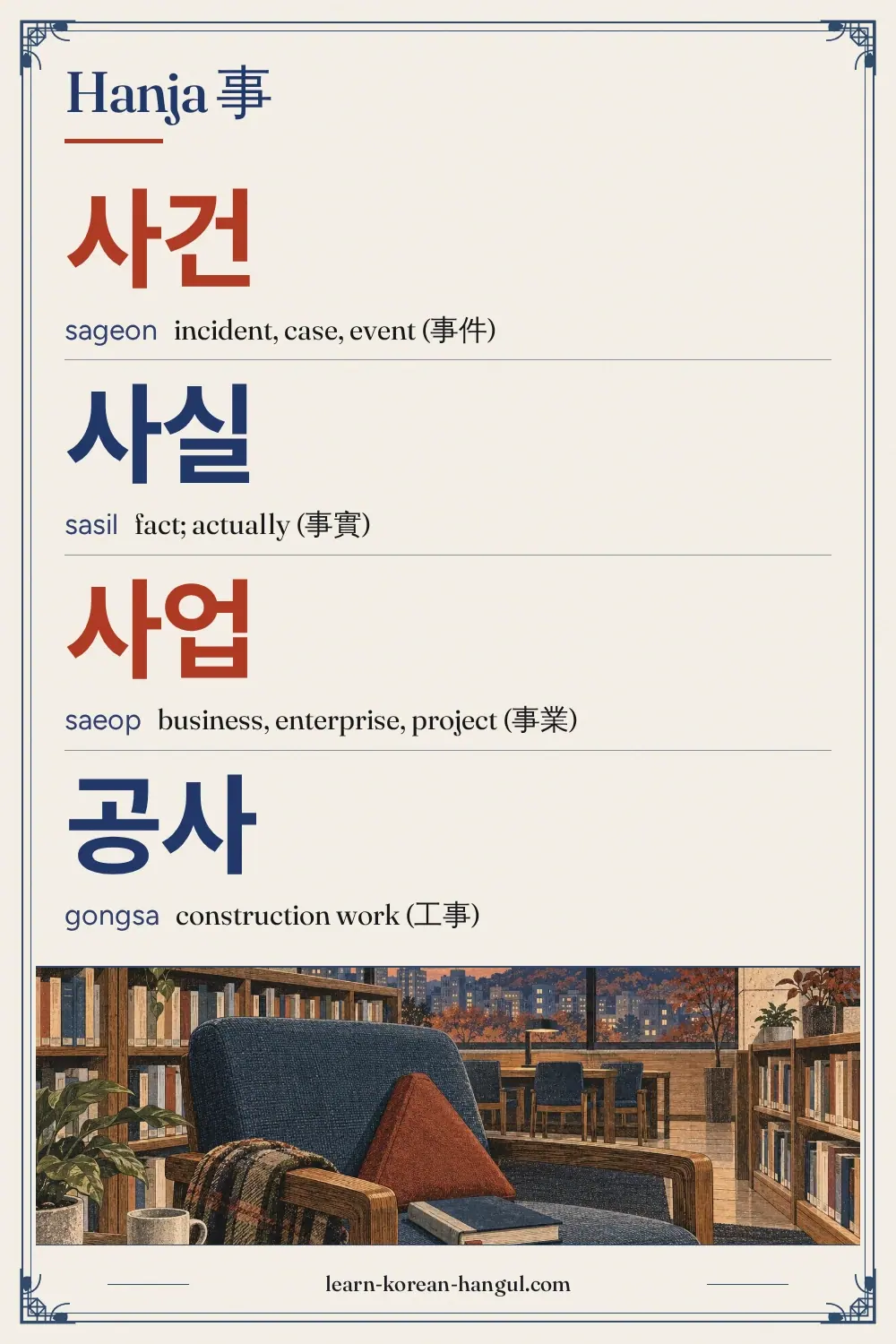
Hanja 事: the Essentials
Hanja 事 is the character for "matter" or "affair". Its 음훈 (the pair of the native meaning word and the Korean reading, as dictionaries list it) is 일 사. The meaning word 일 is the everyday native noun for "work", "task" or "matter" (일이 많아요, "I have a lot of work"), and 사 is the sound the character has inside Sino-Korean words. So 일 can stand alone, while 사 only works inside compounds.
The idea behind 事 is "a thing that is done or that happens". It covers a very wide range: incidents (사건), accidents (사고), events (행사), jobs (공사), and even a meal (식사), which is literally an "eating affair". Because the range is wide, 事 builds a large and varied family, and the second character in each word tells you which kind of matter you mean.
The card below sums up the character.
| Item | Detail |
|---|---|
| Character | 事 |
| 음훈 | 일 사 |
| Reading | 사 (sa) |
| Core meaning | matter; affair; work; business |
| Radical | 亅 (hook; Kangxi radical 6) |
| Strokes | 8 |
| Words on this page | 12 |
The radical 亅 is a single hooked stroke at the bottom of the character, and you may find it hard to see at first. The hanja radicals section explains how radicals work and why some of them are hard to spot. Now to the word list.
Which Words Does 事 Build?
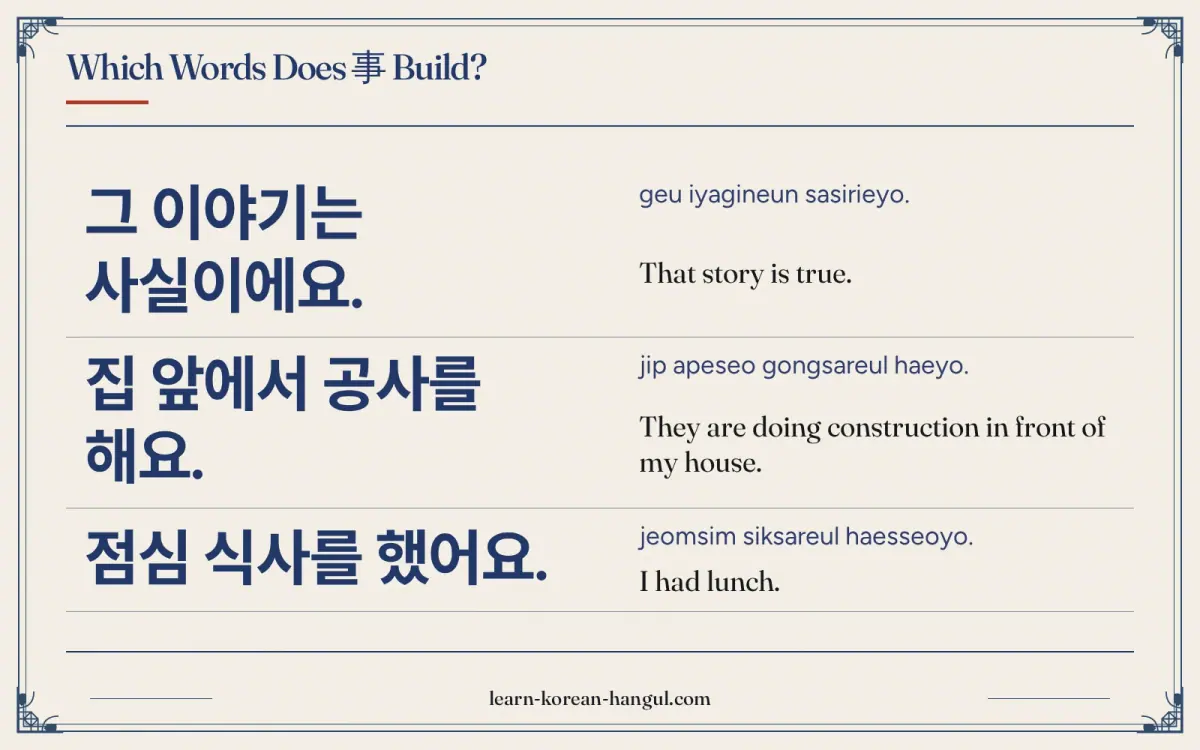
These 12 words are the best ones to learn first. They cover news, business, meals, the workplace and events. Revised Romanization (RR) appears only as a learning aid, and square brackets show the spoken form where it differs from the spelling.
| Word | Characters | RR | Meaning | How the characters add up |
|---|---|---|---|---|
| 사건 [사껀] | 事件 | sageon | incident, case, event | 事 matter + 件 item |
| 사실 | 事實 | sasil | fact; actually | 事 matter + 實 real |
| 사업 | 事業 | saeop | business, enterprise, project | 事 matter + 業 work |
| 공사 | 工事 | gongsa | construction work | 工 work + 事 matter |
| 식사 [식싸] | 食事 | siksa | meal; eating | 食 eat + 事 matter |
| 사무실 | 事務室 | samusil | office | 事 matter + 務 task + 室 room |
| 사고 | 事故 | sago | accident | 事 matter + 故 trouble |
| 인사 | 人事 | insa | greeting; personnel | 人 person + 事 matter |
| 사정 | 事情 | sajeong | circumstances, reasons | 事 matter + 情 feeling |
| 행사 | 行事 | haengsa | event, ceremony | 行 do + 事 matter |
| 사전 | 事前 | sajeon | in advance, beforehand | 事 matter + 前 before |
| 사례 | 事例 | sarye | case, example | 事 matter + 例 example |
The family splits into three groups by what the second character adds. Incidents and facts: 사건, 사실, 사고, 사례, 사정. Work and business: 사업, 공사, 사무실, 행사. Meals and people: 식사, 인사. In the compounds 사건, 사실, 사업, 사고, 사정, 사전, 사례 and 사무실, 事 comes first; in 공사, 식사, 인사 and 행사, it comes last.
As a second element, 事 often turns a noun into "the affair of X": 가사 (housework, from 家), 식사 (a meal, from 食), 인사 (affairs of people, from 人). You can see in these words how a single character holds a small family of related ideas.
The 12 Words One by One
사건 [사껀] (事件, sageon): incident, case, event. A notable thing that has happened, usually in the news, in a story or in history: 살인 사건 (murder case), 역사적 사건 (historical event), 사건이 발생하다 (an incident occurs). Unlike 사고, it is not necessarily an accident. Dictionaries give the ㄱ in 건 as tense, [사껀], even though the spelling shows a plain ㄱ.
사실 (事實, sasil): fact; actually. A "real matter", so a fact: 사실을 말하다 (to tell the facts), 사실이다 (it is true). As an adverb phrase, 사실은 or 사실 means "actually, to tell the truth": 사실은 저도 몰라요 (Actually, I do not know either). Compare 진실 (truth) and 거짓말 (lie).
사업 (事業, saeop): business, enterprise, project. A business venture or a large project: 사업을 시작하다 (to start a business), 사업가 (businessperson), 사업 계획 (business plan), 신규 사업 (a new project). The word is used for private business and for public projects such as 도로 사업 (road project). Learners write it saeop, not "saup".
공사 (工事, gongsa): construction work. Construction or repair work on a building, road or pipe: 공사 중 (under construction, a sign you see everywhere), 도로 공사 (road work), 공사장 (construction site). The ㅅ is plain after the nasal ㅇ, so the word is [공사], not "gongssa". The first character 工 appears in 공장 (factory) and 공부.
식사 [식싸] (食事, siksa): meal; eating. A meal, in a formal or polite register: 식사하다 (to have a meal), 식사 시간 (mealtime), 식사 중 (during a meal), 식사하셨어요? (Have you eaten? to an elder). The ㅅ after the final ㄱ is tense, [식싸]. For casual talk Koreans say 밥 (rice, meal) instead: 밥 먹었어요?
사무실 (事務室, samusil): office. A "room for affairs and tasks": the office where clerical work is done. 사무실에서 일하다 (to work in an office), 사무실 직원 (an office worker) and 사무용품 (office supplies) are typical. A closely related word is 사무직 (office job). In RR, a closed compound is written as one word, samusil.
사고 (事故, sago): accident. An unwanted thing that happens: 교통사고 (traffic accident), 사고가 나다 (an accident happens), 안전사고 (safety accident). It is always negative and unplanned, unlike 사건, which can be neutral. The 故 here means "trouble"; it also appears in 고장 (breakdown) and 고인 (the deceased).
인사 (人事, insa): greeting; personnel. A greeting and also personnel matters, covered in more detail on the family page for 人 (인). The 事 here is the "affairs" sense: the affairs of people. 인사하다 means to greet, and 인사팀 means the HR team.
사정 (事情, sajeong): circumstances, reasons. The reasons or conditions behind a situation, often used to explain why you cannot do something: 사정이 있어서 못 가요 (I have circumstances, so I cannot go). 개인 사정 (personal reasons) and 집안 사정 (family circumstances) are common polite excuses.
행사 (行事, haengsa): event, ceremony. An organised event: 학교 행사 (school event), 행사장 (event venue), 연례행사 (annual event). The word covers festivals, ceremonies and company events. Nothing tense happens after the nasal ㅇ, so it is [행사]. There is also a homophone 행사 (行使, exercise of a right), as in 권리를 행사하다.
사전 (事前, sajeon): in advance, beforehand. "Before the matter", so beforehand: 사전 예약 (advance booking), 사전 준비 (advance preparation), 사전에 연락하다 (to contact in advance). The opposite is 사후 (事後, afterwards). Careful: 사전 is also the dictionary (辭典), spelled and said the same.
사례 (事例, sarye): case, example. A concrete case that illustrates a point: 성공 사례 (a success story), 사례 연구 (a case study), 비슷한 사례 (a similar case). It is more formal than 예 (example). Note that 사례 is also a word for a payment or a reward (謝禮), a different word with the same sound.
Sentences to Hear the Words in Use
Six of the words appear in short sentences. Listen to each one, then read it aloud. The brackets in the word table show how the words are said in connected speech.
그 이야기는 사실이에요.
geu iyagineun sasirieyo.
That story is true.
집 앞에서 공사를 해요.
jip apeseo gongsareul haeyo.
They are doing construction in front of my house.
점심 식사를 했어요.
jeomsim siksareul haesseoyo.
I had lunch.
제 사무실은 3층에 있어요.
je samusireun samcheunge isseoyo.
My office is on the third floor.
어제 큰 사고가 났어요.
eoje keun sagoga nasseoyo.
A big accident happened yesterday.
이번 주에 학교 행사가 있어요.
ibeon jue hakgyo haengsaga isseoyo.
There is a school event this week.
How Is 事 Read in Different Words?
The reading of 事 is the same in every word: 사. It has no second reading, and it does not fall under the initial-sound rule (두음법칙), because 사 does not begin with ㄹ or ㄴ. The sound changes in this family come from neighbours.
Rule box: tensing after ㄱ. When 事 comes after a syllable ending in ㄱ, the ㅅ becomes tense: 식사 → [식싸]. Revised Romanization does not write tensing caused by a sound change, so it gives siksa. The same happens in 학생 [학쌩]. For the full rule see tensification after stop consonants.
Rule box: no tensing after a nasal. After ㅇ or ㄴ the ㅅ stays plain: 공사 → [공사], 행사 → [행사], 인사 → [인사]. A learner who says [공싸] is adding a tense sound that standard Korean does not have. This pair, 식사 [식싸] versus 공사 [공사], is the one to practise: the same character, a different sound, because of what comes before it.
Words where 事 comes first. In 사실 [사실], 사업 [사업], 사무실 [사무실], 사고 [사고], 사정 [사정], 사전 [사전] and 사례 [사례], 사 is the start of the word and nothing changes it. The one exception is 사건, whose dictionary pronunciation has a tense ㄱ, [사껀]. It is a word to memorise, since the spelling does not show it.
Finally, note the final ㅂ of 사업. It is unreleased when the word stands alone: [사업], with the lips closed at the end. Before a particle that starts with a vowel it links forward: 사업을 is [사어블], and 사업이 is [사어비]. RR writes saeop, saeobeul and saeobi.
What Is Easy to Confuse with 事?
Homophone alert: 사. The syllable 사 is one of the most overloaded sounds in Korean. Besides 事 (일 사), it is the reading of 四 (넉 사, four) in 사월 (April), 死 (죽을 사, death) in 사망 (death), 社 (모일 사, company) in 회사, 師 (스승 사, teacher) in 교사, 史 (사기 사, history) in 역사, 寫 (베낄 사, copy) in 사진 (photograph), 謝 (사례할 사, thanks) in 감사, 使 (부릴 사, use) in 사용 and 私 (사사 사, private) in 사립. In Hangul they are all just 사.
사고: accident or thought. 사고 (事故) is an accident. 사고 (思考) is thinking, as in 사고방식 (way of thinking). In news, 사고 is nearly always the accident. In essays on education, 사고력 (thinking ability) is the other one.
사건 versus 사고. Both are things that happen, but not in the same way. 사건 (事件) is an incident of interest: a crime, a court case, a historical event. 사고 (事故) is an unplanned accident with a negative result. A fire that burns a house is a 사고, and the later investigation of who started it is a 사건. A traffic accident is a 교통사고, never a 교통사건.
사실 versus 진실. 사실 (事實) is a fact, something that can be checked: 사실 확인 (fact check). 진실 (眞實) is the truth, often with moral weight: 진실을 말하다. For "actually", Koreans use 사실은 or 사실, not 진실은.
식사 versus 밥. Both can mean a meal. 식사 is polite and a little formal, used to ask elders (식사하셨어요?) and in announcements. 밥 is the plain word for rice and for a meal, used with friends and family (밥 먹었어?). Use 식사 with someone older or someone you do not know well.
事 versus the native 일. 일 is the everyday word for work, a task or a matter, and it can stand alone: 일이 많아요, 무슨 일이에요? (What is the matter?). 事 in the form 사 only works inside compounds. Compare 사무실 (a room for office affairs) and 일터 (a native word, a workplace). Use 일 in conversation.
Practice This Family
The 12 Words as Flashcards
The deck below has one card for each of the 12 words, with audio. The table shows the same cards, so you can study from either one.
| # | Korean | RR | Meaning | Character and note |
|---|---|---|---|---|
| 1 | 사건 [사껀] | sageon | incident, case, event (事件) | 事 (일 사) + 件 (물건 건). Said [사껀]. 역사적 사건 = historical event. |
| 2 | 사실 | sasil | fact; actually (事實) | 事 + 實 (열매 실). 사실은 = actually. |
| 3 | 사업 | saeop | business, enterprise, project (事業) | 事 + 業 (일 업). 사업가 = businessperson. |
| 4 | 공사 | gongsa | construction work (工事) | 工 (장인 공) + 事. 공사 중 = under construction. |
| 5 | 식사 [식싸] | siksa | meal; eating (食事) | 食 (먹을 식) + 事. Said [식싸]. Casual: 밥. |
| 6 | 사무실 | samusil | office (事務室) | 事 + 務 (힘쓸 무) + 室 (집 실). 사무직 = office job. |
| 7 | 사고 | sago | accident (事故) | 事 + 故 (연고 고). 교통사고 = traffic accident. |
| 8 | 인사 | insa | greeting; personnel (人事) | 人 (사람 인) + 事. Two meanings: greeting; personnel. |
| 9 | 사정 | sajeong | circumstances, reasons (事情) | 事 + 情 (뜻 정). 개인 사정 = personal reasons. |
| 10 | 행사 | haengsa | event, ceremony (行事) | 行 (다닐 행) + 事. 행사장 = event venue. |
| 11 | 사전 | sajeon | in advance, beforehand (事前) | 事 + 前 (앞 전). Opposite: 사후. Not 사전 (辭典, dictionary). |
| 12 | 사례 | sarye | case, example (事例) | 事 + 例 (법식 례). 성공 사례 = success case. |
Practice · 12
- 01사건
Show answer
sageon
incident, case, event (事件)
- 02사실
Show answer
sasil
fact; actually (事實)
- 03사업
Show answer
saeop
business, enterprise, project (事業)
- 04공사
Show answer
gongsa
construction work (工事)
- 05식사
Show answer
siksa
meal; eating (食事)
- 06사무실
Show answer
samusil
office (事務室)
- 07사고
Show answer
sago
accident (事故)
- 08인사
Show answer
insa
greeting; personnel (人事)
- 09사정
Show answer
sajeong
circumstances, reasons (事情)
- 10행사
Show answer
haengsa
event, ceremony (行事)
- 11사전
Show answer
sajeon
in advance, beforehand (事前)
- 12사례
Show answer
sarye
case, example (事例)
Decode Three Unseen Words
事後 사후 (sahu). 事 "matter" + 後 "after". Afterwards, after the event: 사후 처리 (handling after the event). It is the opposite of 사전, and it is said [사후].
事務職 사무직 (samujik). 事務 "office affairs" + 職 "job". An office job, as opposed to a 현장직 (on-site job). Said [사무직].
工事場 공사장 (gongsajang). 工事 "construction" + 場 "place". A construction site: 공사장 소음 (noise from a construction site). Said [공사장].
Check Yourself
Each question asks you to decode a word or answer a question about 事. The answers are checked as you go.
Practice · 6
식사 is 食 "eat" + 事. How is it said in normal speech?
Show answer
[식싸]
After the final ㄱ the ㅅ is tense, so 식사 is [식싸]. RR still writes siksa.
사실은 means "actually". Which character is 사 in 사실?
Show answer
事
사실 (事實) is "a real matter", a fact. The 사 is 事; 四 is four, 死 is death and 社 is company.
A car crash is a 교통___. Which word fits?
Show answer
사고
교통사고 (交通事故) is a traffic accident. 사고 is an unplanned accident, while 사건 is an incident of interest and 사업 is a business.
공사 중 is a sign you often see. What does it mean?
Show answer
under construction
공사 중 (工事 中) means under construction or work in progress. The 중 follows an activity noun and means "in the middle of".
사전 예약 is 事前 + 예약. What does 사전 예약 mean?
Show answer
an advance reservation
사전 (事前) means beforehand, so 사전 예약 is an advance reservation. The dictionary 사전 (辭典) is a different word with the same sound.
Which is the most natural way to ask an elder "Have you eaten?"
Show answer
식사하셨어요?
식사하셨어요? is polite and suitable for an elder. 밥 먹었어? is casual and used with friends; 사건 and 사업 are unrelated.
What to Learn Next
You now have 12 words and a clear view of how 事 builds the vocabulary of events, business and meals. A good next step is the family of 家 (가), because 가사 (housework) joins 家 and 事. See 家 (가) for the home and expert words. For the electricity words, go to 電 (전), and for 인사 see 人 (인).
To see how this fits the whole section, return to the hanja word families page. The Sino-Korean vocabulary page lists similar words by topic, and the hanja hub places the family among the other character pages. For more characters, see the 100 most useful hanja, and for a study routine, read how to learn hanja.
Frequently Asked Questions
How do I tell 事 from 四 and 死?
You cannot tell them apart from the Hangul, since all three are 사. You tell them apart by the word they appear in: 사월 (April) and 사계절 (four seasons) use 四, 사망 (death) uses 死, and 사건, 사실 and 식사 use 事. When you are reading in Hangul only, the topic of the sentence is the clue; when you want certainty, look up the word in a dictionary, which shows the characters.
What is 식사?
식사 (食事) is a meal, or the act of eating a meal, in a polite register. You use it as a noun (식사 시간, mealtime) and as a verb (식사하다, to have a meal), and you ask elders 식사하셨어요? to mean "Have you eaten?". It is said [식싸] with a tense ㅆ. For casual talk, use 밥 instead.
Is 事 pronounced 사?
Yes. 事 has one Korean reading, 사, in every Sino-Korean word. The 음훈 is 일 사, where 일 is the native meaning word. What changes is the sound of the syllable after a consonant: 식사 is [식싸], while 공사 is [공사]. The reading itself never changes, so 事 is easy to recognise once you know the meaning.
What is the difference between 사건 and 사고?
사건 (事件) is an incident or case that attracts attention, such as a crime, a court case or a historical event. 사고 (事故) is an unplanned accident with a negative result, such as a car crash or a safety accident. Both can be reported in the news, but only 사고 always means that something went wrong by accident.