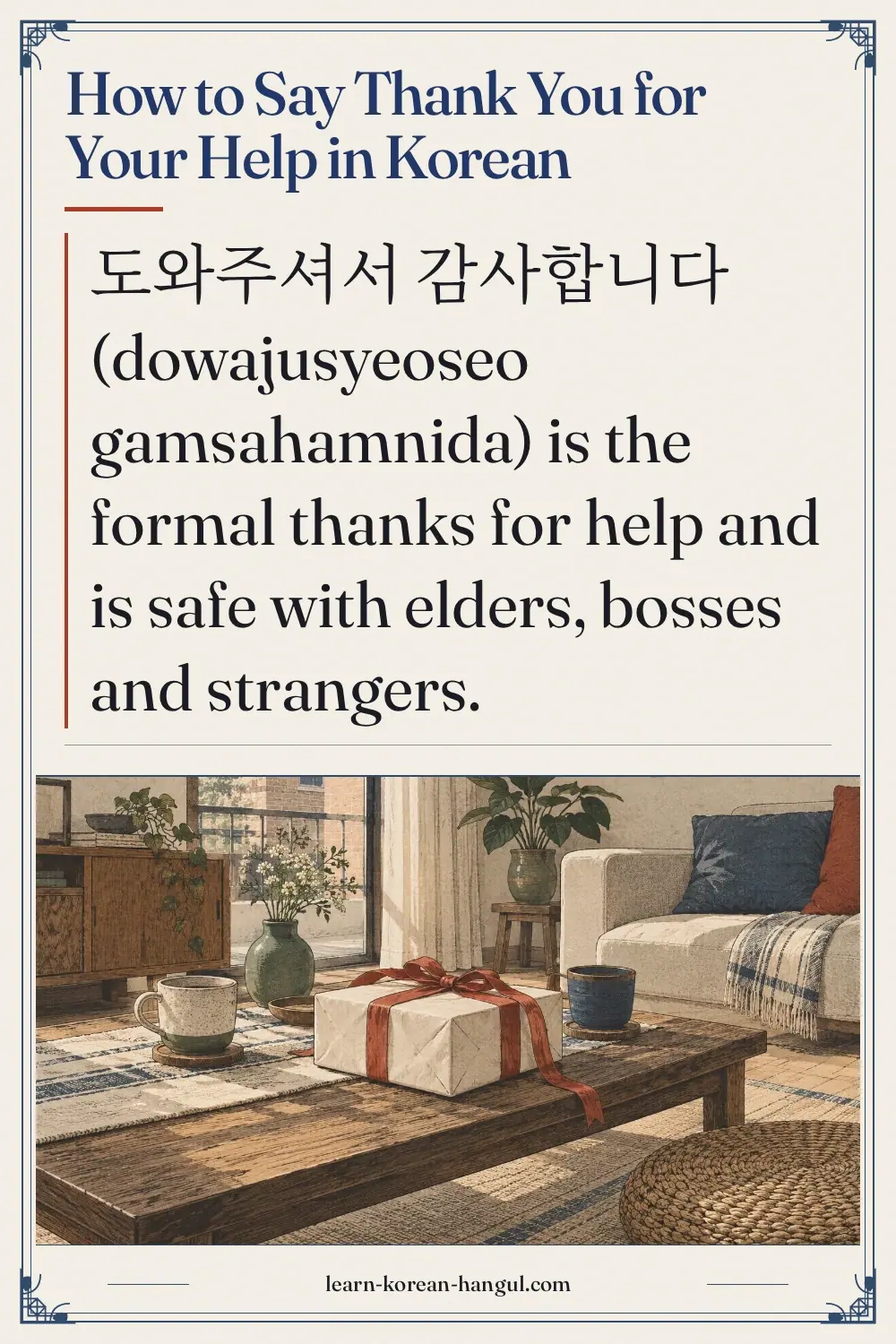
도와주셔서 감사합니다
도와주셔서 감사합니다
What you'll learn
- Say 도와주셔서 감사합니다 aloud as [도와주셔서 감사함니다].
- Choose between 도와주셔서 감사합니다, 도와줘서 고마워요 and 도와줘서 고마워 for a senior, a colleague and a friend.
- Understand the -(으)시- honorific in 주셔서 and when to drop it.
- Use 덕분이에요 (it's thanks to you) when someone's help led to a good result.
Before you start: you need to read Hangul; romanization is shown as an aid and can be hidden. Time: about 9 minutes. Audio plays only when you press a button.
How Do You Say Thank You for Your Help in Korean?
The best way to thank someone for helping you in Korean is 도와주셔서 감사합니다. It joins the verb 도와주다 (to help) to the reason ending -어서 (because) and the formal thanks. Four forms cover most situations.
| Form | Romanization | Register | Say it to |
|---|---|---|---|
| 도와주셔서 감사합니다 | dowajusyeoseo gamsahamnida | Formal (합쇼체), honorific | Bosses, teachers, elders, strangers, clients |
| 도와줘서 고마워요 | dowajwoseo gomawoyo | Polite (해요체) | Colleagues, acquaintances, friends of similar age |
| 도와줘서 고마워 | dowajwoseo gomawo | Casual (반말) | Close friends, siblings, partners, younger people |
| 덕분이에요 | deokbunieyo | Polite (해요체) | Anyone whose help led to a good result |
The table lists the choices. The next section shows each one in a sentence.
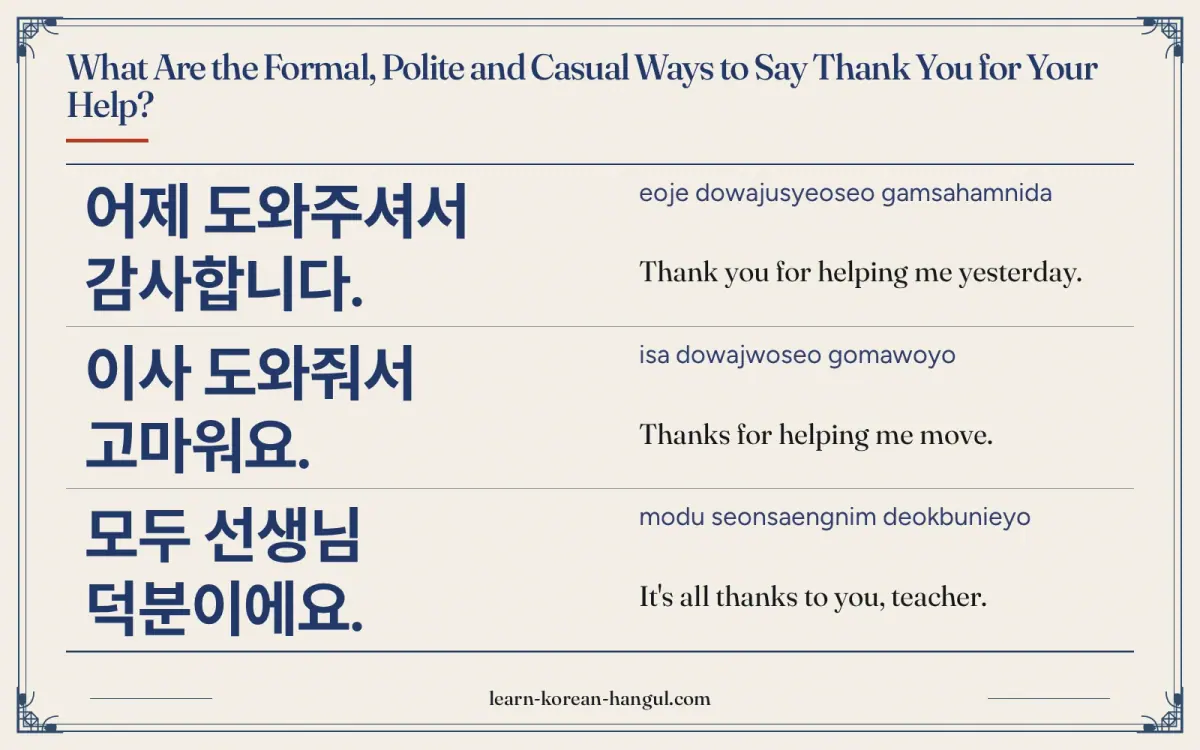
What Are the Formal, Polite and Casual Ways to Say Thank You for Your Help?
Korean changes the sentence ending to match the listener's age, status and closeness. These endings are called speech levels, and the guide to Korean speech levels explains them in full. The thanks keeps its meaning, while the honorific and the ending change.
Formal: 도와주셔서 감사합니다 (dowajusyeoseo gamsahamnida)
Formal · 합쇼체도와주셔서 감사합니다 has the honorific -(으)시- inside 주셔서, which raises the helper. It also uses the formal ending -ㅂ니다. This is the form for a manager, a teacher, a customer or any stranger who helped you.
어제 도와주셔서 감사합니다.
eoje dowajusyeoseo gamsahamnida
Thank you for helping me yesterday.
Polite: 도와줘서 고마워요 (dowajwoseo gomawoyo)
Polite · 해요체도와줘서 고마워요 drops the honorific and uses the polite 고마워요. It suits colleagues of your own age, neighbours and friends you speak politely to. With someone clearly senior, keep the honorific and say 도와주셔서 고마워요 instead.
이사 도와줘서 고마워요.
isa dowajwoseo gomawoyo
Thanks for helping me move.
Casual: 도와줘서 고마워 (dowajwoseo gomawo)
Casual · 반말도와줘서 고마워 drops both the honorific and the polite -요. It is 반말 (casual speech) for close friends, siblings, partners and younger people. It is the form behind "thanks for helping" among friends.
숙제 도와줘서 고마워. 덕분에 끝났어.
sukje dowajwoseo gomawo. deokbune kkeunnasseo
Thanks for helping with homework. It's done thanks to you.
Polite: 덕분이에요 (deokbunieyo)
Polite · 해요체덕분 means thanks to, or the benefit of someone's help. 덕분이에요 says "it's thanks to you", and 덕분에 gives the same idea inside a sentence. It does not replace the thanks, but it adds that the helper caused a good result.
모두 선생님 덕분이에요.
modu seonsaengnim deokbunieyo
It's all thanks to you, teacher.
Four phrases cover most favours. Saying the main one cleanly comes next.
How Do You Pronounce 도와주셔서 감사합니다?
도와주셔서 감사합니다 is pronounced [도와주셔서 감사함니다], dowajusyeoseo gamsahamnida, in ten syllables. Each syllable is open and clear, and only the end changes: the ㅂ in 합 sounds like ㅁ.
- 도 (do): a soft d and "oh".
- 와 (wa): "wah", glided from the o.
- 주 (ju): a soft j and "oo".
- 셔 (syeo): "shuh"; the y glide makes the s sound close to sh.
- 서 (seo): "suh".
- 감 (gam), 사 (sa): a soft g, then "sah".
- 함 (ham): written 합, said "hahm" with the lips closed.
- 니다 (ni-da): "nee-dah".
Sound Changes to Listen For
One main rule from the National Institute of Korean Language Standard Pronunciation (표준 발음법) applies, plus a spelling point.
- Nasalization in -ㅂ니다. ㅂ becomes ㅁ before ㄴ, so 감사합니다 is [감사함니다]. See ㅂ-to-ㅁ nasalization.
- Open syllables in 도와주셔서. There are no batchim in this verb, so every syllable stays open and separate. Do not add a final consonant to 와 or 주.
- Contraction. 도와주어서 is shortened to 도와줘서 in speech, and 도와주시어서 is shortened to 도와주셔서. The romanization follows spelling and is a reliable guide.
With the sounds in place, the next question is who should hear which form.
When Should You Use 도와주셔서 감사합니다, and When Should You Not?
Use 도와주셔서 감사합니다 whenever the helper is senior to you or you are not close. Use 고마워요 or 고마워 only when the relationship allows it.
Situations Where It Fits
- A manager or teacher helped you. 도와주셔서 감사합니다 is the right level.
- A stranger gave directions or lifted your bag. Add 정말 for emphasis: 정말 도와주셔서 감사합니다.
- A colleague of your age covered your shift. 도와줘서 고마워요 is friendly and fits.
- A friend helped with a move. 도와줘서 고마워, perhaps with 덕분에 and a promise to buy dinner.
Situations to Avoid
- Dropping the honorific for a teacher. 도와줘서 without -시- sounds too casual for a senior.
- Adding the honorific to your own help. You never say 도와주셔서 about yourself.
- Thanking and leaving it there for a big favour. Add 정말 or 덕분에 to show the weight of the help.
These choices are easier to feel in real exchanges, so here are three.
What Does Thank You for Your Help Sound Like in a Real Conversation?
A Korean thanks-for-help exchange is short. The thanker adds a result, and the helper waves the thanks away.
A Colleague Helps with a File
Sumi
도와주셔서 감사합니다. 덕분에 일찍 끝났어요.
dowajusyeoseo gamsahamnida. deokbune iljjik kkeunnasseoyo
Thank you for helping me. Thanks to you, I finished early.
Jun
아니에요. 별거 아니에요.
anieyo. byeolgeo anieyo
It's nothing. It's no big deal.
What to notice: Sumi adds the result with 덕분에, and Jun answers 아니에요, the usual reply to thanks.
A Friend Helps with a Move
Min
이사 도와줘서 고마워.
isa dowajwoseo gomawo
Thanks for helping me move.
Yuna
뭘. 당연하지.
mwol. dangyeonhaji
Don't mention it. Of course.
What to notice: Yuna answers 뭘, a casual way to wave the thanks away. Friends often follow with an offer to buy dinner.
A Student Thanks a Teacher
Student
선생님, 도와주셔서 감사합니다.
seonsaengnim, dowajusyeoseo gamsahamnida
Teacher, thank you for helping me.
Teacher
아니야, 열심히 해서 그래.
aniya, yeolsimhi haeseo geurae
No, it's because you worked hard.
What to notice: the teacher answers in casual speech and credits the student's effort. This habit points to the culture behind thanks for help.
What Should You Know about the Culture behind Thank You for Your Help?
Koreans often thank for help by crediting the helper and then returning the favour, so the words come with a small ritual.
- Say what the help did. Adding 덕분에 and a result, such as 일찍 끝났어요, makes the thanks specific.
- Offer to help back. 필요하면 말씀하세요 (please tell me if you need anything) is a common return offer.
- Offering help politely. 도와드릴까요? (dowadeurilkkayo) means "Shall I help you?" and uses the humble verb 드리다.
- Small treats. Thanking a colleague with coffee or a snack is common and does not need words.
An expert tip: 도와주세요 (please help me) and 도와주셔서 (because you helped me) look alike but do different jobs. The first asks for help, and the second thanks for help already given. This page covers everyday thanks. Formal written thanks, such as 도움에 감사드립니다 in emails, follow longer patterns that are not covered here.
What Mistakes Do Learners Make with Thank You for Your Help in Korean?
Most mistakes come from the honorific, the level or mixing the request and the thanks.
| Mistake | Why it is a problem | Fix |
|---|---|---|
| Saying 도와줘서 감사합니다 to a teacher | The formal ending is there, but the helping verb has no honorific | Use 도와주셔서 감사합니다 |
| Saying 도와주셔서 about your own help | The honorific raises only the listener | Use 도와드렸어요 for your own help |
| Saying 도와주세요 to thank someone | It means please help me | Use 도와주셔서 |
| Pronouncing 합 with a b | ㅂ becomes ㅁ before ㄴ | Say [감사함니다] |
| Saying 도와줘서 고마워 to a boss | Casual ending | Use 도와주셔서 감사합니다 |
Learners often think adding 정말 is enough to show respect. Respect comes from the honorific and the ending, so 정말 도와줘서 고마워 is still casual.
Is It the Same as Thank You for Helping?
Mostly yes. The short answers below cover the other ways people search for this phrase.
- Thank you for helping in Korean: 도와주셔서 감사합니다, the same phrase.
- Thanks for helping in Korean: 도와줘서 고마워 with friends, 도와줘서 고마워요 in polite speech.
- Thanks for your help in Korean: 도움 감사합니다 or 도움 주셔서 감사합니다, using the noun 도움 (help).
- I appreciate your help in Korean: 도움에 감사드립니다 (doume gamsadeurimnida) in emails and speeches.
Reading the forms is one thing; producing them on cue is another, so practise now.
Practice: Say It Aloud
Play the slow clip of 도와주셔서 감사합니다, repeat it three times, then try 도와줘서 고마워요. Then choose a form for each situation. Answers follow.
- Your manager stayed late to help you.
- Your friend helped you study.
- You want to say the result happened thanks to a coworker.
- What does the -시- in 주셔서 do?
Answers
- 도와주셔서 감사합니다.
- 도와줘서 고마워.
- 덕분이에요 or 덕분에 plus the result.
- It is the honorific; it raises the helper.
The phrase flashcards drill all four forms with audio.
Related Phrases to Learn Next
Thanking for help sits next to other thanks and polite phrases.
- Thank you in Korean: 감사합니다 and 고마워 for every situation.
- Thank you very much in Korean: stronger thanks for a big favour.
- You're welcome in Korean: how to reply when the thanks comes to you.
- Excuse me in Korean: getting someone's attention before asking for help.
This guide belongs to the polite Korean phrases collection. What this page does not cover: written thank-you emails and the full honorific system. Pick 도와주셔서 감사합니다 when in doubt, and you can say thank you for your help in Korean to almost anyone.
Frequently Asked Questions
What is the difference between 도와주셔서 감사합니다 and 도와줘서 고마워요?
Both thank someone for help. 도와주셔서 감사합니다 uses the honorific -시- and the formal ending, so it fits bosses, teachers and strangers. 도와줘서 고마워요 drops the honorific and uses the polite style, so it fits colleagues and friends of similar age.
Is 도와주셔서 감사합니다 formal or casual?
It is formal. The ending -ㅂ니다 belongs to the formal speech level (합쇼체), and the -시- adds honorific respect. With friends, drop both and say 도와줘서 고마워. For colleagues, 도와줘서 고마워요 sits in the middle. If you are unsure, the formal form is the safe choice.
Can I use 도와주셔서 감사합니다 with friends, elders and strangers?
Yes for elders and strangers, where it is the best choice. With close friends it sounds stiff, so use 도와줘서 고마워. The honorific is for the person helping you, so it fits anyone you want to show respect to, regardless of age.
How do you pronounce 도와주셔서 감사합니다?
It is pronounced [도와주셔서 감사함니다]. The ㅂ in 합 sounds like ㅁ. Keep every syllable of 도와주셔서 open and even: do, wa, ju, syeo, seo. Then say gam, sa, ham, ni, da with the lips closed on the m of ham. The slow clip lets you hear each syllable before you try full speed.
What is the most common mistake with thank you for your help in Korean?
The most common mistake is dropping the honorific with a senior, as in 도와줘서 감사합니다 to a teacher. The second is mixing up 도와주세요 (please help me) with 도와주셔서 (thank you for helping). Keep -시- for elders and bosses.