
정말 감사합니다
정말 감사합니다
What you'll learn
- Say 정말 감사합니다 aloud as [정말 감사함니다], with the m sound in 합.
- Choose between 정말 감사합니다, 대단히 감사합니다, 너무 고마워요, 진짜 고마워 and 감사드립니다.
- Boost thanks with 정말, 너무, 진짜 or 대단히 without sounding exaggerated.
- Avoid the English-style 많이 감사합니다, which sounds unnatural to most Korean speakers.
Before you start: you need to read Hangul; romanization is shown as an aid and can be hidden. Time: about 10 minutes. Audio plays only when you press a button.
How Do You Say Thank You Very Much in Korean?
Korean makes thank you very much by adding an intensifier to the ordinary thanks. The standard answer is 정말 감사합니다. Five forms cover everyday and formal needs, and the right one depends on the listener and how big the favour is.
| Form | Romanization | Register | Say it to |
|---|---|---|---|
| 정말 감사합니다 | jeongmal gamsahamnida | Formal (합쇼체) | Bosses, elders, strangers, staff |
| 대단히 감사합니다 | daedanhi gamsahamnida | Very formal (합쇼체) | Clients, officials, big favours, speeches |
| 너무 고마워요 | neomu gomawoyo | Polite (해요체) | Colleagues, acquaintances, friends of similar age |
| 진짜 고마워 | jinjja gomawo | Casual (반말) | Close friends, siblings, partners, younger people |
| 감사드립니다 | gamsadeurimnida | Humble formal (합쇼체) | Emails, speeches, customers, senior contacts |
The table lists the choices. The next section shows each one in a sentence.
What Are the Formal, Polite and Casual Ways to Say Thank You Very Much?
Korean changes the sentence ending to match the listener's age, status and closeness. These endings are called speech levels, and the guide to Korean speech levels explains them in full. For stronger thanks, the intensifier changes as well as the ending.
Formal: 정말 감사합니다 (jeongmal gamsahamnida)
Formal · 합쇼체정말 감사합니다 adds 정말 (really) to the standard formal thanks 감사합니다. It is the safe choice for most big thanks: a stranger who returned your wallet, a manager who helped you, a host who invited you.
정말 감사합니다. 큰 도움이 되었습니다.
jeongmal gamsahamnida. keun doumi doeeotseumnida
Thank you very much. It was a great help.
Very Formal: 대단히 감사합니다 (daedanhi gamsahamnida)
Formal · 합쇼체대단히 means greatly or extremely, and it sounds more formal and a little stiff compared with 정말. Speakers use it at ceremonies, in announcements and with officials. In daily talk with friends it would sound theatrical.
대단히 감사합니다. 잊지 않겠습니다.
daedanhi gamsahamnida. itji anketseumnida
Thank you very much indeed. I will not forget.
Polite: 너무 고마워요 (neomu gomawoyo)
Polite · 해요체너무 고마워요 combines 너무 (so, very) with the polite 고마워요. It is warm and common between adults who know each other. Traditionally 너무 meant too much, but in everyday speech Koreans use it as very, including in thanks.
진짜 너무 고마워요. 덕분에 살았어요.
jinjja neomu gomawoyo. deokbune sarasseoyo
Thanks so much. You saved me.
Casual: 진짜 고마워 (jinjja gomawo)
Casual · 반말진짜 고마워 uses 진짜 (really) and the casual 고마워. It is 반말 (casual speech) for close friends, siblings, partners and younger people. It is the form behind "thanks a lot" and "thanks so much" among friends.
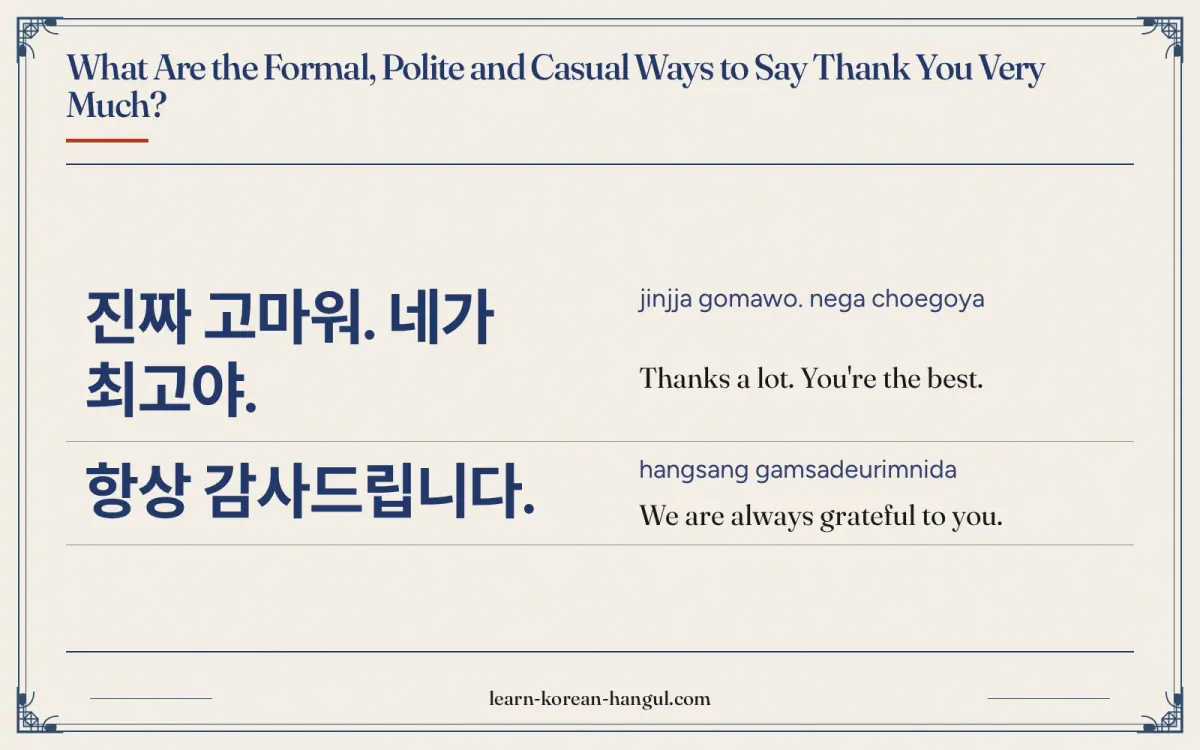
진짜 고마워. 네가 최고야.
jinjja gomawo. nega choegoya
Thanks a lot. You're the best.
Humble Formal: 감사드립니다 (gamsadeurimnida)
Formal · 합쇼체감사드립니다 uses the humble verb 드리다 (to give to a superior) instead of 하다. It lowers the speaker and raises the listener, so it appears in business emails, speeches and customer service. A typical use is 항상 감사드립니다 (we are always grateful).
항상 감사드립니다.
hangsang gamsadeurimnida
We are always grateful to you.
Five phrases cover the range. Saying the main one cleanly comes next.
How Do You Pronounce 정말 감사합니다?
정말 감사합니다 is pronounced [정말 감사함니다], jeongmal gamsahamnida, in seven syllables. Only one change matters: the ㅂ in 합 sounds like ㅁ.
- 정 (jeong): a soft j, "uh" and the nasal "ng".
- 말 (mal): "mahl" with a light l.
- 감 (gam): a soft g, "ah", and close the lips for m.
- 사 (sa): "sah".
- 함 (ham): written 합, said "hahm" with the lips closed.
- 니 (ni): "nee".
- 다 (da): "dah", with a soft d.
Sound Changes to Listen For
Three points matter here. The first is a rule of the National Institute of Korean Language Standard Pronunciation (표준 발음법).
- Nasalization in -ㅂ니다. ㅂ becomes ㅁ before ㄴ, so 감사합니다 is [감사함니다] and 감사드립니다 is [감사드림니다]. See ㅂ-to-ㅁ nasalization.
- Weak ㅎ in 대단히. The standard pronunciation is [대단히], with the ㅎ kept. After ㄴ, though, the ㅎ is often weak in fast speech, so 대단히 can sound close to "daedani". Aim for a light but audible h.
- Romanization follows spelling. Revised Romanization writes gamsahamnida, which already shows the m, so the romanized form is a reliable guide for these phrases.
With the sound set, the next question is who should hear which phrase.
When Should You Use 정말 감사합니다, and When Should You Not?
Use 정말 감사합니다 for real favours with anyone you address politely. Save 대단히 for formal or very large cases.
Situations Where It Fits
- A stranger returns your lost wallet. 정말 감사합니다 with a slight bow.
- A manager gives you extra time. 정말 감사합니다 or 대단히 감사합니다.
- A hotel or shop goes out of its way. 정말 감사합니다 and a small bow.
- Closing a business email. 감사드립니다 is the standard ending.
Situations to Avoid
- Small favours. Heavy thanks for a held door sounds odd; 감사합니다 is enough.
- Formal forms with close friends. 대단히 감사합니다 sounds like a joke between friends.
- Stacking intensifiers. 정말 너무 대단히 감사합니다 sounds nervous; pick one.
These choices are easier to feel in real exchanges, so here are three.
What Does Thank You Very Much Sound Like in a Real Conversation?
A Korean big-thanks exchange is short. The thanker adds an intensifier and often a result, and the helper deflects politely.
A Hotel Clerk Carries a Bag
Guest
정말 감사합니다.
jeongmal gamsahamnida
Thank you very much.
Clerk
아닙니다. 편안한 시간 보내세요.
animnida. pyeonanhan sigan bonaeseyo
Not at all. Have a comfortable stay.
What to notice: the clerk answers 아닙니다, the formal form of 아니에요, then adds a service wish.
After a Colleague Covers Your Shift
Sumi
진짜 너무 고마워요. 덕분에 살았어요.
jinjja neomu gomawoyo. deokbune sarasseoyo
Thanks so much. You saved me.
Jun
아니에요. 다음에 저도 부탁할게요.
anieyo. daeume jeodo butakalgeyo
It's nothing. I'll ask you next time.
What to notice: Jun answers with a promise to ask back, which keeps the favour balanced.
A Friend Lends Money
Min
진짜 고마워. 다음 주에 갚을게.
jinjja gomawo. daeum jue gapeulge
Thanks a lot. I'll pay you back next week.
Yuna
천천히 줘도 돼.
cheoncheonhi jwodo dwae
You can take your time.
What to notice: friends add a promise to return the favour, which leads to the culture behind big thanks.
What Should You Know about the Culture behind Thank You Very Much?
Strong thanks in Korean combines words, posture and a promise to return the favour. The words alone are only part of it.
- A bow. A slight bow goes with 정말 감사합니다, and the bow deepens with the other person's age or seniority.
- Two hands. Receive objects from elders with both hands while thanking.
- Return the favour. Saying 다음에 제가 도와드릴게요 (next time I'll help you) completes the thanks.
- Written thanks. Emails end with 감사합니다 or 감사드립니다, and formal letters add 깊이 (deeply): 깊이 감사드립니다.
- Small gifts. For a big favour, a small gift, a coffee or a meal is common.
An expert tip: learners often translate "thank you very much" word by word and say 많이 감사합니다. It is heard now and then, but it sounds unnatural to most speakers; the usual intensifiers are 정말, 너무, 진짜 and 대단히. This page covers spoken thanks. Formal written thanks, letters of gratitude and ceremonial thanks follow longer patterns that are not covered here.
What Mistakes Do Learners Make with Thank You Very Much in Korean?
Most mistakes with stronger thanks come from word choice, level or stacking.
| Mistake | Why it is a problem | Fix |
|---|---|---|
| Saying 많이 감사합니다 | A word-by-word calque that sounds unnatural to most speakers | Say 정말 감사합니다 |
| Saying 진짜 고마워 to a boss | Casual ending | Use 정말 감사합니다 |
| Saying 대단히 감사합니다 to a friend | Too stiff and ceremonial | Use 진짜 고마워 |
| Stacking 너무너무 in formal writing | Sounds childish in a formal register | Use one intensifier or 감사드립니다 |
| Pronouncing 합 with a b | ㅂ becomes ㅁ before ㄴ | Say [감사함니다] |
Learners often think a stronger word is always more polite. Politeness comes from the ending, so 진짜 고마워 is still casual even though 진짜 is strong.
Is It the Same as Thanks a Lot or Thank You so Much?
Mostly yes. The short answers below cover the other ways people search for this phrase.
- Thanks a lot in Korean: 정말 고마워요 or 진짜 고마워, depending on the listener.
- Thank you so much in Korean: 정말 감사합니다 or 너무 감사합니다.
- Many thanks in Korean: 감사드립니다 or 깊이 감사드립니다 in writing.
- Thanks so much in Korean: 너무 고마워요 or 진짜 고마워.
- Thank you very much formal in Korean: 정말 감사합니다 or 대단히 감사합니다.
Reading the forms is one thing; producing them on cue is another, so practise now.
Practice: Say It Aloud
Play the slow clip of 정말 감사합니다, repeat it three times, then try 너무 고마워요 and 진짜 고마워. Then choose a form for each situation. Answers follow.
- A stranger finds your lost phone.
- Your close friend helps you move.
- You are ending a business email to a client.
- Why should you avoid 많이 감사합니다?
Answers
- 정말 감사합니다.
- 진짜 고마워.
- 감사드립니다.
- It is a word-by-word calque from English; Korean uses 정말, 너무, 진짜 or 대단히.
The phrase flashcards drill all five forms with audio.
Related Phrases to Learn Next
Strong thanks sits near the other polite phrases learners need early.
- Thank you in Korean: 감사합니다 and 고마워 for everyday thanks.
- You're welcome in Korean: how to reply to thanks.
- Thank you for your help in Korean: thanks for a specific favour.
- Sorry in Korean: 죄송합니다 and 미안해요 for apologies.
This guide belongs to the polite Korean phrases collection. What this page does not cover: formal letters of gratitude and ceremonial speeches. Pick 정말 감사합니다 when in doubt, and you can say thank you very much in Korean to almost anyone.
Frequently Asked Questions
What is the difference between 정말 감사합니다 and 대단히 감사합니다?
Both mean thank you very much. 정말 감사합니다 is the everyday strong thanks and works with bosses, elders and strangers. 대단히 감사합니다 is more formal and a little stiff, so it fits ceremonies, officials and very large favours. Use 정말 unless the occasion is formal.
Is 정말 감사합니다 formal or casual?
It is formal. The ending -ㅂ니다 belongs to the formal speech level (합쇼체), and 정말 adds strength. For colleagues use 너무 고마워요, and for close friends use 진짜 고마워. For emails and speeches, 감사드립니다 is more humble. Politeness comes from the ending, not from the intensifier.
Can I use 정말 감사합니다 with friends, elders and strangers?
Yes for elders and strangers, where it is the best choice. With close friends it can sound stiff, so use 진짜 고마워. For small favours between friends, even 고마워 is enough, and heavy thanks can feel distant. Save the stiffer 대단히 감사합니다 for formal occasions or very large favours.
What does 감사드립니다 mean and when do you use it?
감사드립니다 means I offer my thanks. It uses the humble verb 드리다, which lowers the speaker. Koreans use it in emails, speeches, customer service and letters to seniors, often as 항상 감사드립니다. It is more formal than 감사합니다, and it is pronounced [감사드림니다] because ㅂ turns into ㅁ before ㄴ.
What is the most common mistake with thank you very much in Korean?
The most common mistake is saying 많이 감사합니다, a word-by-word translation. Use 정말, 너무, 진짜 or 대단히 instead. The second mistake is using a strong word with the wrong ending, such as 진짜 고마워 to a boss. Match the ending to the listener.