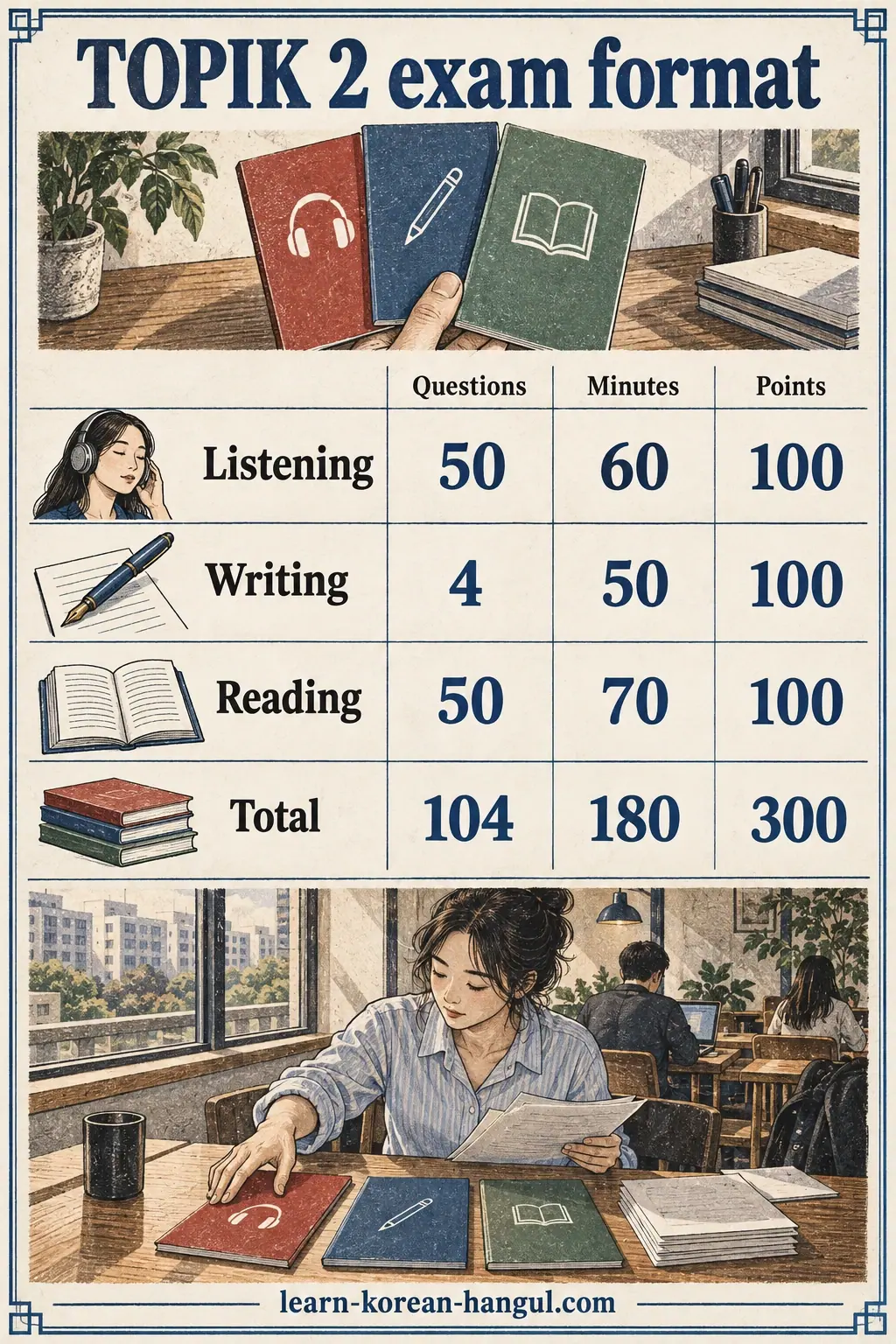
The TOPIK 2 exam format has three sections: listening with 50 questions in 60 minutes, writing with 4 questions in 50 minutes and reading with 50 questions in 70 minutes. Each section is worth 100 points, so the paper-based TOPIK II has 104 questions, 180 minutes of test time and 300 points, which decide Levels 3 to 6.
What Is the TOPIK 2 Exam Format?
The TOPIK 2 exam format is the fixed structure of TOPIK II, the intermediate-to-advanced paper of the Test of Proficiency in Korean: three timed sections in two periods, each section scored out of 100. The table is the master view of the paper-based test (PBT), as described in the official guide that the National Institute for International Education (NIIED, 국립국제교육원) publishes on topik.go.kr. NIIED can change the format, so confirm it in the current guide before you register.
| Period (교시) | Section | Question numbers | Questions | Minutes | Points | Answer type |
|---|---|---|---|---|---|---|
| 1 | Listening (듣기) | 1-50 | 50 | 60 | 100 | 4-option multiple choice |
| 1 | Writing (쓰기) | 51-54 | 4 | 50 | 100 | written answers |
| Break | ||||||
| 2 | Reading (읽기) | 1-50 | 50 | 70 | 100 | 4-option multiple choice |
| Total | 104 | 180 | 300 |
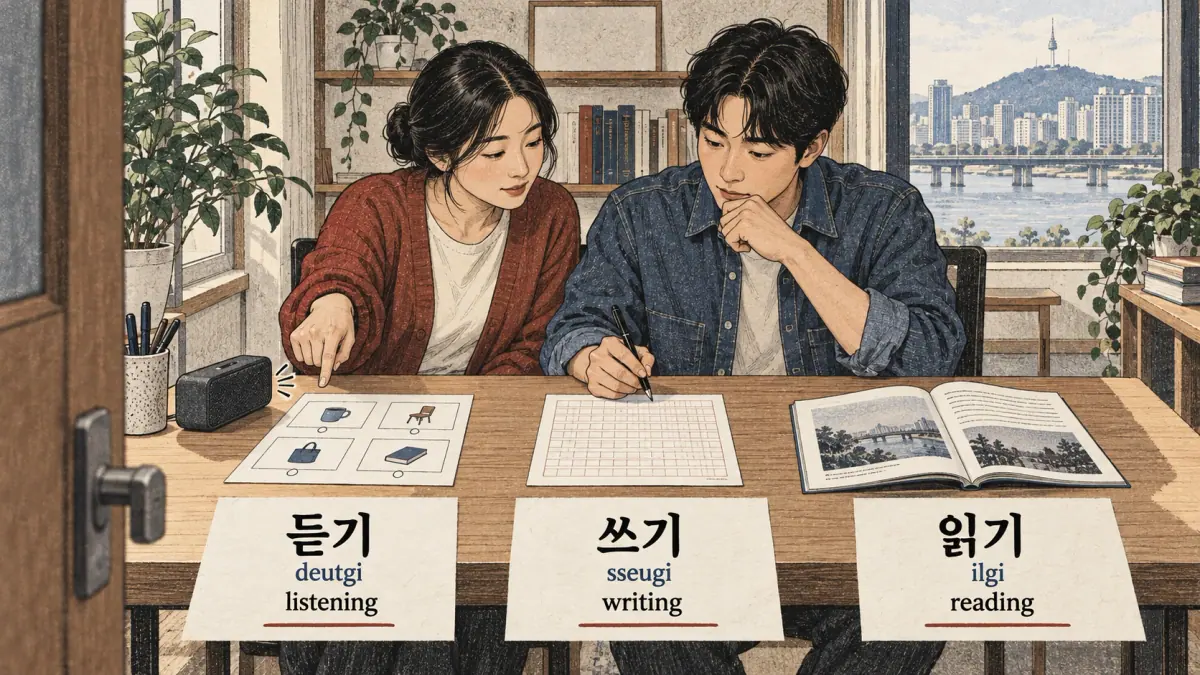
The three section names are printed on the booklets and answer sheets, so learn to recognise them by sight and sound.
듣기 (deutgi) is listening, 쓰기 (sseugi) is writing and 읽기 (ilgi, said [일끼]) is reading. A period is a 교시 (gyosi), so the first period is 1교시 and the second is 2교시.
Three points in the table matter more than they first appear:
- Writing has the same weight as reading. Four writing questions are worth 100 points, the same as 50 reading questions. Question 54 alone is worth 50 points, half the writing section and one-sixth of the whole test.
- Question numbers restart. Listening and writing share one booklet numbered 1 to 54. Reading comes in a new booklet numbered 1 to 50 again.
- The level comes from the total. Under the current rules there is no minimum per section, so a strong section can make up for a weak one.
TOPIK II is a separate test from TOPIK I, with its own registration; the TOPIK exam format page compares both papers. The table shows the order on paper; the next section shows how that order plays out on the day.
How Does the TOPIK 2 Test Day Run?
The TOPIK 2 test day runs in two periods: listening and writing together in period 1 (110 minutes), a break, then reading in period 2 (70 minutes). The clock times are printed on your admission ticket (수험표) and differ between test centres in Korea and overseas, so treat this as the order of events, not the timetable.
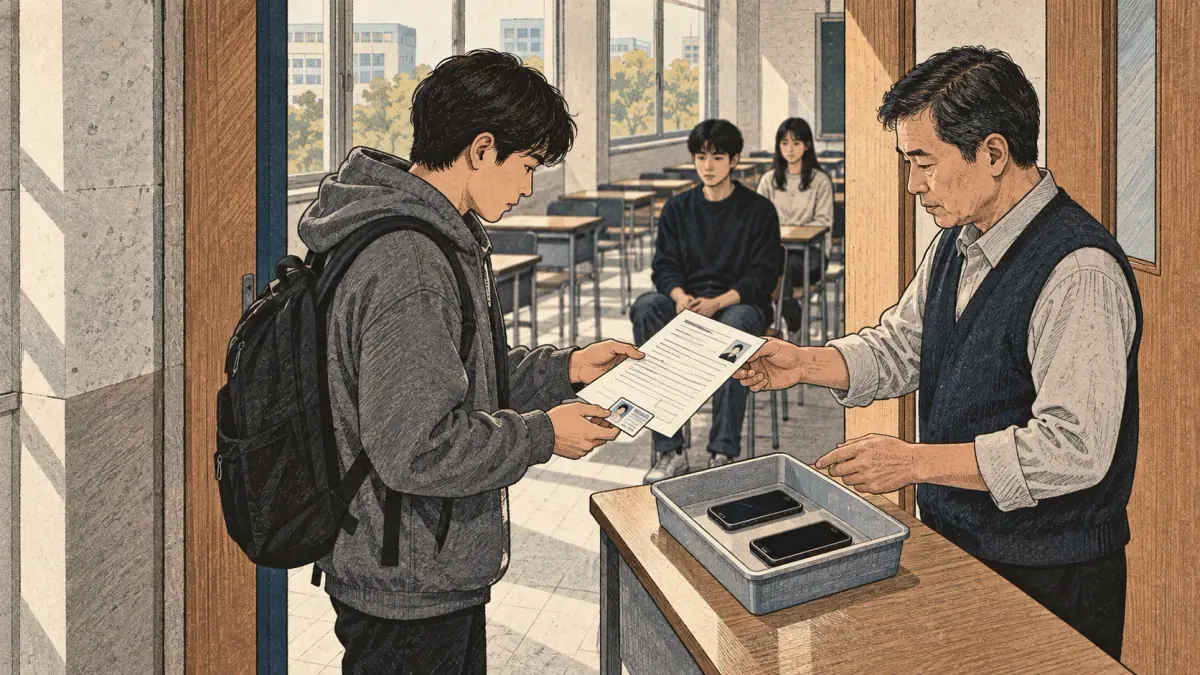
- Arrive before the entry deadline. Late arrivals are not admitted once the room closes. Bring your admission ticket and an accepted photo ID, as listed in the official guide.
- Store your devices. Phones, smartwatches and earphones must be switched off and handed in or stored as the proctor instructs.
- Fill in the answer sheets. Write your name and candidate number and mark the test type in the boxes. Errors here can delay or void a result.
- Sit period 1: listening, then writing. The listening audio runs for about 60 minutes and cannot be paused. When it ends, the rest of the 110-minute period is for writing questions 51 to 54.
- Take the break. Follow the centre's rules on leaving the room and on what you may read.
- Sit period 2: reading. You have 70 minutes for 50 questions.
- Hand in all papers. Booklets and notes stay in the room unless the centre says otherwise.
The practical consequence is that writing comes straight after an hour of concentrated listening. Plan your writing time before test day: a common split is about 10 minutes for questions 51 and 52, 15 for question 53 and 25 for question 54. With the day mapped, the next sections open each part of the paper, starting with listening.
What Is in the Listening Section?
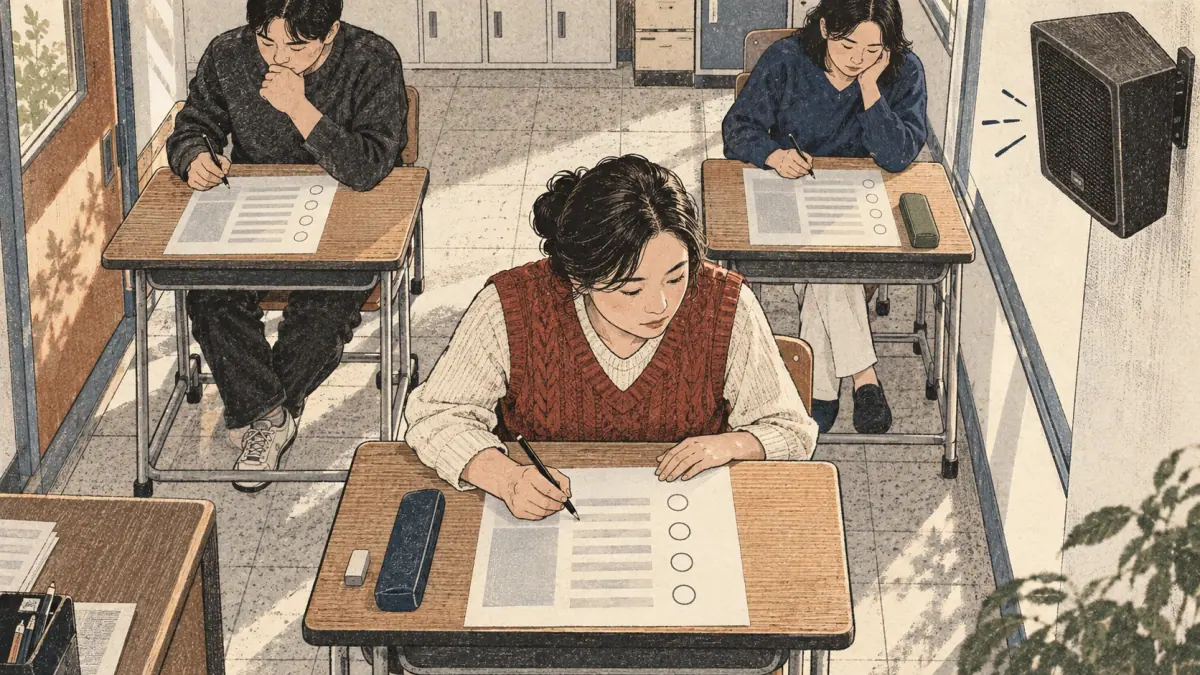
The TOPIK 2 listening section has 50 four-option questions in 60 minutes, played from one continuous recording that you cannot pause or replay. Recordings grow from short dialogues to interviews, news reports, lectures, documentaries and debates. How many times a recording plays depends on the item type and the instructions for your session, so treat every recording as one hearing and take brief notes.
The table shows the typical order of question types in recent paper-based papers. It is a guide to the pattern, not an official specification; numbering can shift between papers.
| Questions (typical) | Task | Recording type |
|---|---|---|
| 1-3 | Choose the picture or graph that matches | short dialogue or news item |
| 4-8 | Choose the most natural next line | short two-person dialogue |
| 9-12 | Choose what the speaker will do next | short dialogue |
| 13-16 | Choose the statement that matches the content | dialogue, announcement or news |
| 17-20 | Choose the man's main idea | dialogue or short interview |
| 21-50 | Two questions per recording: main idea, detail, attitude, purpose or what came before | conversations, interviews, lectures, documentaries and debates |
Questions 21 to 50 make up 30 of the 50 items, all in pairs. That is why the second half of listening decides most Level 4 to Level 6 results: a missed detail in one long recording can cost two answers.
Instruction Phrases to Recognise
Every task is introduced by a Korean instruction, and the booklet prints it once for each group of questions. Recognising the instruction at a glance saves seconds you need for reading the options.
다음을 듣고 알맞은 그림을 고르십시오.
daeumeul deutgo almajeun geurimeul goreusipsio.
Listen and choose the correct picture.
Other instructions follow the same frame with a different target: 이어질 수 있는 말 ("what can come next"), 남자의 중심 생각 ("the man's main idea") or 들은 내용과 같은 것 ("the statement that matches what you heard"). The site's TOPIK listening guide trains each type. Listening ends, but period 1 does not; the writing section follows immediately.
What Is in the Writing Section?

The TOPIK 2 writing section has four questions, numbered 51 to 54, worth 100 points together. They move from completing two short texts to writing a full opinion essay. The table follows the breakdown commonly published from the official guide; check the current guide before your test.
| Question | Task | Length | Points |
|---|---|---|---|
| 51 | Fill two blanks in a practical text, such as a notice, invitation or message | one sentence per blank | 10 |
| 52 | Fill two blanks in a short explanatory paragraph | one sentence per blank | 10 |
| 53 | Describe information from a chart, graph or survey in one paragraph | 200-300 characters | 30 |
| 54 | Write an essay giving and supporting an opinion on a set topic | 600-700 characters | 50 |
On the paper test, all four answers are handwritten on a separate answer sheet. Questions 53 and 54 use manuscript grid paper, 원고지 (wongoji), where each square holds one Hangul syllable, one punctuation mark or a space. That is why lengths are counted in characters, not words. The TOPIK writing guide covers grid-paper rules and strategy for all four questions.
Questions 51 and 52: Completing a Text
Questions 51 and 52 each give a short text with two blanks, marked ㉠ and ㉡, and you write the sentence that fits each blank. Question 51 is a practical text such as a lost-property notice; question 52 is a short explanatory paragraph. Grammar and register must match the surrounding text, so a notice that opens with the formal style below needs formal endings in the blanks too.
잃어버린 지갑을 찾습니다.
ireobeorin jigabeul chatseumnida.
Looking for a lost wallet. (notice style)
Question 53: Describing a Graph
Question 53 gives survey results, a chart or a process, and you describe it in one paragraph of 200 to 300 characters. The task is to report, not to give your opinion. Report language is formulaic, which makes it trainable: phrases for "according to the survey", "increased", "decreased" and "the reason is" appear in almost every answer. The TOPIK question 53 guide lists them.
조사 결과에 따르면 혼자 사는 사람이 꾸준히 증가한 것으로 나타났다.
josa gyeolgwae ttareumyeon honja saneun sarami kkujunhi jeunggahan geoseuro natanatda.
According to the survey, the number of people living alone has risen steadily.
Question 54: the Opinion Essay
Question 54 gives a social or abstract topic, usually with two or three guiding questions, and you write an essay of 600 to 700 characters that answers all of them. A clear plan helps: introduction, two body paragraphs that answer the guiding questions, and a conclusion. Essays that skip a guiding question usually lose content points. The TOPIK 54 essay guide shows a full plan.
현대 사회에서 개인 정보 보호는 점점 더 중요해지고 있다.
hyeondae sahoeeseo gaein jeongbo bohoneun jeomjeom deo jungyohaejigo itda.
In modern society, protecting personal information is becoming ever more important.
The style rule catches many learners. Questions 53 and 54 expect the written plain style (한다체), which ends sentences in -다, as in both examples above, not the polite -요 endings of conversation. A -요 ending does not change the meaning, but it is the wrong register for a report or an essay, and raters expect the written style. After the writing section, period 1 ends and the break begins; the second period is reading.
What Is in the Reading Section?
The TOPIK 2 reading section has 50 four-option questions in 70 minutes, and the texts grow longer and harder through the paper. Early items are single sentences and notices; the last items are editorials, literary extracts and academic passages with two or three questions each.
The table shows the typical order of question types in recent paper-based papers. As with listening, it is a guide to the pattern, not an official specification.
| Questions (typical) | Task | Text type |
|---|---|---|
| 1-2 | Choose the grammar pattern that fits the blank | one sentence |
| 3-4 | Choose the expression closest in meaning to the underlined part | one sentence |
| 5-8 | Identify what an advert, notice or slogan is about | very short text |
| 9-12 | Choose the statement that matches the text | notice, graph or short article |
| 13-15 | Put sentences in the right order | four short sentences |
| 16-18 | Choose what fills the blank | short paragraph |
| 19-24 | Two questions per text: blank, detail or the writer's feeling | short article or essay |
| 25-27 | Choose the best explanation of a newspaper headline | headline |
| 28-31 | Choose what fills the blank | explanatory paragraph |
| 32-34 | Choose the statement that matches the text | explanatory paragraph |
| 35-38 | Choose the main idea or topic | opinion or explanatory text |
| 39-41 | Choose where a given sentence fits best | paragraph with marked gaps |
| 42-50 | Two or three questions per text: feeling, purpose, attitude, blank or detail | literary extracts, reviews, editorials and academic passages |
Headline items (25-27) are a TOPIK II speciality. Korean headlines drop particles and endings, so a headline such as 물가 '들썩' (prices "jumping") must be expanded into a full sentence in your head. The site's TOPIK reading guide covers each type with tactics.
다음 글의 주제로 가장 알맞은 것을 고르십시오.
daeum geurui jujero gajang almajeun geoseul goreusipsio.
Choose the most suitable topic for the following text.
The reading section has the most questions per minute of reading text, which makes pacing the next thing to plan.
How Should You Pace Each Section?
Pace TOPIK 2 by question blocks: about 72 seconds per listening question (audio included), about 84 seconds per reading question, and fixed minutes for each writing question. Listening is paced by the recording, so your real pacing decisions are in writing and reading. The budgets below are editorial suggestions built from the official timings, not official rules.
| Section | Total time | Average per question | Suggested split |
|---|---|---|---|
| Listening | 60 minutes | about 72 seconds, audio included | read the options for the next item while the current one ends |
| Writing | 50 minutes | not comparable | about 10 for 51-52, 15 for 53, 25 for 54 |
| Reading | 70 minutes | 84 seconds | about 20 for questions 1-20, 45 for 21-50, 5 to check the answer sheet |
The reading split reflects the paper's shape: the first 20 questions are short, while questions 21-50 include every long text. Spending the full 84 seconds on question 1 leaves too little for question 46.
A Worked Pacing Example
A candidate reaches reading question 30 after 40 minutes. That leaves 30 minutes for 20 questions, or 90 seconds each, which is workable. If the same candidate reaches question 30 after 55 minutes, only 15 minutes remain for 20 questions, or 45 seconds each, which is too little for the final passages.
The fix is a checkpoint set before the test, such as "question 20 by minute 20, question 35 by minute 45". When you miss a checkpoint, mark your best guess and move on. Three habits support the plan:
- Transfer answers as you go. On paper, leaving the answer sheet to the end risks a full booklet and an empty sheet.
- Never leave a multiple-choice item blank. A blank and a wrong answer both score zero, so a guess can only help.
- Outline question 54 first. Two minutes listing an introduction, two body points and a conclusion saves rewriting on grid paper.
Pacing protects points you already have; scoring decides what those points are worth.
How Is TOPIK 2 Scored?
TOPIK 2 is scored out of 300: up to 100 points each for listening, writing and reading, and the total decides the level. Listening and reading are marked by machine from the answer sheet. Writing is marked by trained raters against published criteria, which the official guide groups into content and task completion, organisation, and language use.
| Level | Cut score | Score range | Band |
|---|---|---|---|
| No level | below 120 | 0-119 | |
| Level 3 | 120 | 120-149 | 중급 (intermediate) |
| Level 4 | 150 | 150-189 | 중급 (intermediate) |
| Level 5 | 190 | 190-229 | 고급 (advanced) |
| Level 6 | 230 | 230-300 | 고급 (advanced) |
Three scoring facts shape strategy:
- There is no negative marking. A wrong answer scores zero, the same as a blank, so always answer.
- Each multiple-choice item is worth 2 points. On TOPIK II, 50 listening or reading questions make 100 points. Writing is rated rather than counted, so a level still cannot be turned into a fixed number of correct answers.
- Writing points are uneven. Questions 53 and 54 carry 80 of the 100 writing points, so a short but careful answer to question 54 can earn more than a perfect question 51.
The TOPIK score page explains how results are reported, and the TOPIK levels page describes what each level means. Knowing how points work leads to the question of what content the test draws on.
TOPIK 2 Syllabus: Topics, Vocabulary and Grammar
TOPIK II has no published word list or fixed syllabus, but its topics follow the level descriptions NIIED publishes for Levels 3 to 6. Level 3 and 4 items stay close to social life and familiar social topics; Level 5 and 6 items move to politics, economy, science, culture and academic subjects.
In practice, three kinds of content recur across past papers:
- Abstract Sino-Korean vocabulary, such as 현상 (phenomenon), 영향 (influence) and 증가 (increase). The TOPIK 2 vocabulary list groups these words by topic and word family.
- Written grammar patterns, such as -(으)ㅁ에 따라 (as) and -는 반면에 (whereas), which are rare in conversation but common in articles.
- Idioms and set expressions, such as 발이 넓다 (to know many people), which appear in dialogues and literary extracts. The TOPIK idioms page lists the common ones.
Past papers released by NIIED are the best evidence of what the test actually contains, and the TOPIK past papers page explains where to find them. The same content appears whether you sit the paper or the computer version, but the delivery differs.
Paper and Internet Versions of TOPIK 2

TOPIK II is offered as the paper-based test (PBT) described on this page and, in some countries, as an internet-based test (IBT) taken on a computer at an approved centre. Both award the same Levels 3 to 6, but the IBT is not a scanned copy of the paper.
| Feature | PBT (paper) | IBT (computer, at a centre) |
|---|---|---|
| Levels | 3-6 | 3-6 |
| Answering | pen on answer sheets | on screen |
| Writing | handwritten on 원고지 | typed on a Korean keyboard |
| Question counts and minutes | as in the master table | different; check the IBT guide |
| Periods and break | two periods with a break | per the IBT guide |
The biggest practical difference is typing. If you choose the IBT, practise typing Korean on the standard 2-beolsik layout until a 600-character essay fits comfortably in your time. The TOPIK IBT page explains the computer version in detail. Whichever version you sit, the same few misreadings of the format cost candidates points.
Common Misreadings of the TOPIK 2 Format
Learners often assume writing is a small section because it has only four questions. Actually, writing is worth 100 points, a third of the total, because each section carries equal weight. Skipping question 54 gives away up to 50 points, as much as 25 reading questions.
Learners also assume the 110-minute first period can be split freely. Actually, the listening audio runs on a fixed schedule for about 60 minutes, so only the time after it ends is yours for writing.
A third assumption is that reading question 1 and listening question 1 are the same "question 1". They are not, because reading restarts its numbering in period 2. When teachers say "question 54", they always mean the essay.
A fourth misreading is that a beginner should sit TOPIK II to "start at the bottom". Actually, a total below 120 gives no level at all. A learner whose mock totals are below 120 usually gets a better result from TOPIK I, which can award Level 2.
What This Page Covers and Does Not
This page describes the structure of the TOPIK 2 exam format: sections, question counts, numbering, timing, points and the test-day order for the paper-based test. It does not cover registration, fees or exam dates, which change every year, or detailed strategies for each writing question. The figures follow the official guide published by NIIED on topik.go.kr; if the official guide differs from this page, the official guide is right.
Frequently Asked Questions
Is There a Break between TOPIK 2 Sessions?
Yes. On the paper-based TOPIK II, period 1 (listening and writing, 110 minutes) and period 2 (reading, 70 minutes) are separated by a break. You may usually leave the room under the centre's rules, but you may not consult study notes if the proctor forbids it. The admission ticket and the official guide give the exact times.
Is TOPIK 2 Writing Handwritten?
On the paper-based test, yes. Questions 51 to 54 are handwritten on a separate answer sheet, with questions 53 and 54 on manuscript grid paper (원고지) where each square holds one syllable, punctuation mark or space. On the internet-based test, writing is typed on a Korean keyboard, so practise the version you will sit.
Can I Leave TOPIK 2 Early?
Do not plan to. Rules on leaving the room during a timed period are set in the official guide and announced by the proctor, and in many centres a candidate who leaves cannot return to that period. Listening audio also runs on a fixed schedule. If you might need to leave, read the current guide on topik.go.kr first.
How Long Is the TOPIK 2 Exam in Total?
The paper-based TOPIK II has 180 minutes of test time: 110 minutes for listening and writing in period 1, and 70 minutes for reading in period 2. Check-in, instructions and the break between periods add to that, so plan on being at the test centre for well over three hours.
Does TOPIK 2 Have a Speaking Section?
No. TOPIK II tests listening, writing and reading only, in both the paper and the computer versions. Speaking is assessed by a separate exam, the TOPIK speaking test, which has its own registration and scale. If an employer needs evidence of speaking, check whether it accepts that separate test.
What to Read Next
The TOPIK 2 exam format becomes useful once you train against it, and every TOPIK II page is listed in the TOPIK II guide. Build the vocabulary the reading and writing sections rely on with the TOPIK 2 vocabulary list, then follow the 16-week plan in how to pass TOPIK 2, which schedules writing and timed mocks around the structure on this page.