How to Pass TOPIK 2: before You Start
How to pass TOPIK 2 depends first on what "pass" means. TOPIK II has no pass or fail: your total from listening, writing and reading decides whether you receive Level 3, 4, 5 or 6, or no level below 120. Passing therefore means reaching your target level's cut score, with a margin.
Before you start
- Time: 16 weeks, 6 days a week, 60-90 minutes a day, or about 96-144 hours in total.
- Difficulty: moderate to hard; the jump is largest for learners coming from TOPIK I.
- Typical cost: past papers released by NIIED are free on topik.go.kr; the test fee varies by country and session.
- Materials: 7 full past papers with audio, a notebook or spreadsheet for the error log, manuscript grid paper (원고지) or a Korean keyboard, and a timer.
- Prerequisites: fluent Hangul reading, the polite and plain speech styles, and the beginner grammar set. A TOPIK I Level 2 or a diagnostic TOPIK II score near 100 is a realistic starting point.
- 01
Weeks 1-4: Target, Words and Grammar
Diagnostic score, target level, about 600 new words and 40-50 grammar patterns
TOPIK 2 Vocabulary ListWords by topic and Sino-Korean family.
- 02
Weeks 5-8: Reading, Listening and Writing
Reading at about 84 seconds a question; 8 practice answers for question 53 and 4 for question 54
TOPIK 2 Exam FormatEvery section, question type and timing.
- 03
Weeks 9-12: Writing and First Mocks
8 more question 53 answers, 4 more question 54 essays, mocks in weeks 9 and 11
TOPIK Mock TestHow to sit, score and review a full paper.
- 04
Weeks 13-16: Weekly Mocks and Repair
Four timed mocks with totals at least 10 points above the target cut
TOPIK Common MistakesThe errors that cost the most points.
The five steps below follow one pattern: the action, exactly how to do it, a checkpoint and the common mistake at that step. The first step sets the number every later step works towards.
Step 1: Set Your Target Level and Date

Choose the level you need and book a test date about 16 weeks away, then sit one timed past paper to measure your starting point. The gap between that diagnostic score and your target cut decides how hard the next 16 weeks must be.
Use section targets, not only a total. The table shows one balanced way to reach each cut; your own split will lean towards your strongest section.
| Target | Cut score | Example target: listening / writing / reading | Total |
|---|---|---|---|
| Level 3 | 120 | 50 / 25 / 45 | 120 |
| Level 4 | 150 | 60 / 35 / 55 | 150 |
| Level 5 | 190 | 75 / 45 / 70 | 190 |
| Level 6 | 230 | 85 / 60 / 85 | 230 |
On mocks, aim about 10-15 points above the cut, because test-day nerves and a harder paper can cost that much. The TOPIK score page explains how sections are marked, and TOPIK levels explains what each level means.
You'll know this step worked when you have a test date, a diagnostic total and three section targets written down. The common mistake is to skip the diagnostic because "I'm not ready yet". A low first score is useful data; without it you cannot tell which section to fix first.
Step 2: Build Vocabulary and Grammar (weeks 1-4)

Spend weeks 1-4 on the words and grammar that TOPIK II reading and listening assume, at about 25 new words and 2 new grammar patterns a day. Over 24 study days that adds about 600 words and about 40 to 50 patterns.
- Vocabulary, 30-40 minutes a day. Learn by topic and by Sino-Korean family, using the TOPIK 2 vocabulary list. Review with spaced repetition, so each day starts with yesterday's words.
- Grammar, 20-30 minutes a day. Focus on intermediate connectors and written patterns, such as -는 반면에 (whereas) and -(으)ㅁ에 따라 (as). Write one sentence for each new pattern, using the TOPIK 2 grammar list as your checklist.
- Listening, 15-20 minutes a day. Keep your ear active with one short news clip or podcast segment, even in this phase.
You'll know this step worked when you can read a TOPIK II reading item from questions 1-20 and understand most words without a dictionary. The common mistake is to learn words as single translations. TOPIK II tests words in sentences, so learn each one inside a phrase.
Step 3: Train Reading and Listening (weeks 5-8)

From week 5, move the focus to timed reading and listening, with a reading target of about 84 seconds per question: 50 questions in 70 minutes. Speed matters as much as understanding, because the last reading passages are long.
- Timed reading blocks, 30 minutes a day. Do 15-20 reading questions from a past paper against the clock. Record the time per block.
- Listening by item type, 20 minutes a day. Work through the paired items (questions 21-50) one recording at a time. Before each recording, read both questions so you know what to listen for.
- Review the transcript. After each listening block, read the transcript and mark every word or ending you missed by ear.
You'll know this step worked when a 20-question reading block takes under 28 minutes with at least 70% correct. The common mistake is reading every text twice "to be safe". If you need a second reading, the problem is vocabulary or grammar, so log it rather than hiding it with extra time. The TOPIK 2 exam format page lists every item type in order.
Step 4: Practise Writing Questions 51-54 (weeks 5-12)

From week 5 to week 12, write two question 53 answers and one question 54 essay every week, plus questions 51 and 52 from one past paper. Over 8 weeks that is 16 graph descriptions and 8 essays, enough to make the formats automatic.
The section-weight arithmetic explains why writing gets this much time. Writing is worth 100 of the 300 points, a third of the total, and question 54 alone is worth 50. A candidate who leaves question 54 blank gives away up to one-sixth of the whole test.
- Questions 51 and 52 (10 points each): write the missing sentence for each blank, matching the register of the text.
- Question 53 (30 points): describe the graph in 200-300 characters using report phrases, without adding your opinion.
- Question 54 (50 points): plan for 2-3 minutes, then write 600-700 characters with an introduction, two body paragraphs that answer the guiding questions, and a conclusion.
Learn a small set of essay frame sentences in the written plain style. They save planning time and keep the register right.
이러한 문제가 발생하는 원인은 크게 두 가지로 볼 수 있다.
ireohan munjega balsaenghaneun wonineun keuge du gajiro bol su itda.
The causes of this problem can be divided into two main ones.
따라서 개인과 사회가 함께 노력해야 한다.
ttaraseo gaeingwa sahoega hamkke noryeokaeya handa.
Therefore individuals and society must make an effort together.
You'll know this step worked when you can finish questions 51-54 inside 50 minutes, with question 54 at 600 characters or more. The common mistake is writing in the polite -요 style. Compare the spoken 중요해요 with the written form raters expect:
중요하다 (jungyohada, "is important") is the plain written form. Feedback from a teacher, or a careful self-check against model answers, is what turns practice into points. The TOPIK 54 essay guide shows a complete essay plan.
Step 5: Take Timed Mocks (weeks 9-16)

From week 9, sit full past papers under real timing: one in week 9, one in week 11, and then one every week from week 13 to week 16. With the diagnostic in week 1, that is seven full papers over the 16 weeks.
Each mock follows the same routine:
- Sit the paper in two periods. Listening and writing in 110 minutes, a short break, then reading in 70 minutes.
- Score listening and reading from the official answers, and score writing against model answers and the published criteria.
- Fill in the error log for every lost point. A simple table is enough:
| Paper | Section and question | Item type | Why the point was lost | Fix |
|---|---|---|---|---|
| Past paper A | Reading 46 | insert a sentence | read the passage twice, ran out of time | timed blocks of 39-41 and 46 |
| Past paper A | Listening 33 | speaker's attitude | missed 오히려 (on the contrary) | collect attitude words |
| Past paper A | Writing 54 | essay | answered 2 of 3 guiding questions | plan with one line per question |
- Spend the days until the next mock on the two most frequent error types. Repairing patterns is faster than reviewing everything.
You'll know this step worked when your last three mock totals sit at least 10 points above the target cut. The common mistake is sitting mock after mock without the log. A mock only measures; the log is what improves the next score. The TOPIK mock test page explains how to sit and review a paper, and TOPIK past papers explains where to find official papers.
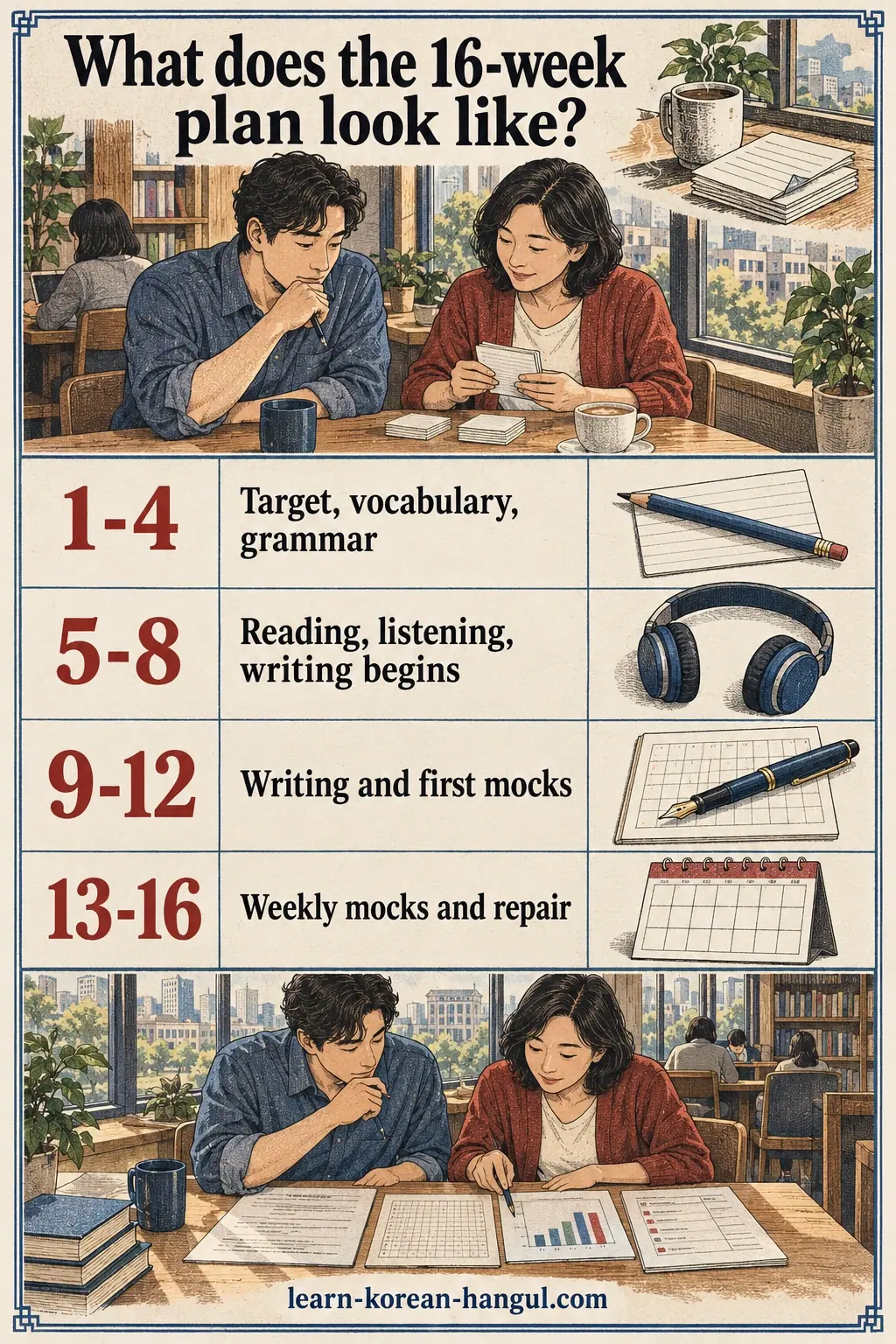
What Does the 16-Week Plan Look Like?

The 16-week plan has four 4-week phases, each with a measurable output. The table summarises the daily work and the checkpoint for each phase.
| Weeks | Main focus | Daily work (60-90 minutes) | Output by the end of the phase |
|---|---|---|---|
| 1-4 | Target, vocabulary, grammar | diagnostic in week 1; 30-40 min words, 20-30 min grammar, 15-20 min listening | about 600 words and 40-50 patterns; section targets set |
| 5-8 | Reading, listening, writing begins | 30 min timed reading, 20 min listening, writing on 3 days a week | reading at about 84 seconds a question; 8 answers to 53, 4 essays for 54 |
| 9-12 | Writing and first mocks | writing on 3 days a week, timed reading and listening on the rest; mocks in weeks 9 and 11 | 8 more answers to 53, 4 more essays; two mock totals with error logs |
| 13-16 | Weekly mocks and repair | one full mock a week; 60 minutes a day on the top two error types | four mocks at least 10 points above the cut |
Mock days take about four hours with scoring, so on those days the mock replaces the daily session. Keep the final mock at least five days before the real test, so the last week is for light review and rest.
What Mistakes Cost Marks?
The mistakes that cost the most TOPIK 2 marks are in writing and in time management, not in rare vocabulary. Six failure modes recur, each with a fix:
- Leaving question 54 short or blank. Fix: write question 54 before polishing question 53 if time is tight. A 500-character essay that answers every guiding question earns far more than nothing.
- Using the -요 style in questions 53 and 54. Fix: rewrite every practice answer in -다 endings until the plain style is automatic.
- Copying the question 53 prompt. Fix: report the graph in your own sentences; copied wording does not show language ability.
- Running out of time in reading. Fix: set checkpoints, such as question 20 by minute 20, and guess and move on when you miss one.
- Leaving multiple-choice answers blank. Fix: answer everything; TOPIK has no negative marking.
- Mismarking the answer sheet. Fix: transfer answers after each page, not at the end.
The TOPIK common mistakes page covers test-day errors in more detail. Some learners need a different version of the plan altogether.
Variations for Different Situations
The 16-week plan assumes a learner with a diagnostic score within about 30 points of the target cut. Three common situations need adjustments.
- Moving up from TOPIK I. Learners with Level 2 often score below 100 on a first TOPIK II paper. Extend weeks 1-4 to six weeks and start writing questions 51-52 in week 3, because the written style is new.
- Aiming at Level 5 or Level 6. Keep the plan but write one question 54 essay every week from week 1, and replace part of the grammar time with daily reading of editorials. TOPIK level 5 and TOPIK level 6 describe the abilities each level expects.
- Sitting the internet-based test. Practise every writing answer on a keyboard from week 5, and check the IBT question counts and timing on the TOPIK IBT page, because they differ from the paper test.
With the plan adjusted to your starting point, the remaining question is whether 16 weeks is enough.
How Long Does It Really Take?
Sixteen weeks is usually enough for one TOPIK level step only when the diagnostic score is already close to the target. Typical time for one level step at about one hour a day is 4-8 months from Level 2 to Level 3, 6-12 months from Level 3 to Level 4, 9-18 months from Level 4 to Level 5, and 12 months or more from Level 5 to Level 6. These are editorial estimates, not official figures.
The 16-week plan is therefore the final stretch before a test, not the whole journey. If your diagnostic is 50 points below the cut, either choose a later test date or a lower target. The general TOPIK study plan uses the same 60-90 minutes a day over 12 weeks for any level; this page adds four weeks, mainly for TOPIK II writing. The page on how long to study for TOPIK shows how the estimates are built.
Which Section Should I Improve First for TOPIK 2?
Improve writing first in most cases, because each writing question carries far more points than a multiple-choice item and many candidates leave easy points there. The exception is a section score below 40 in listening or reading: below that level, gaps in basic understanding are costing points everywhere, so fix vocabulary and listening first.
Frequently Asked Questions
Can I Pass TOPIK 2 without Classes?
Yes. Many candidates reach their target level by self-study with past papers, a vocabulary system and timed mocks. The hardest part to do alone is writing, because you need feedback on questions 53 and 54. Compare your answers with model answers, or pay for occasional corrections from a teacher, even if the rest of your study is solo.
How Many Hours a Day Should I Study for TOPIK 2?
For the 16-week plan, 60-90 minutes a day on six days a week is enough, about 96-144 hours in total, plus extra time on mock days. Less than 45 minutes a day makes the plan too slow for most learners. Consistency matters more than long weekend sessions, because vocabulary needs daily review.
How Do I Avoid Failing Writing?
TOPIK has no pass mark per section, but a weak writing score can pull your total below your target. Answer all four questions, write questions 53 and 54 in the plain -다 style, cover every guiding question in question 54, and reach the minimum length. Practising one essay a week for eight weeks is a realistic minimum.
What Is the Minimum Score for Level 3?
TOPIK II Level 3 needs 120 out of 300 points, the lowest score that earns any level on TOPIK II. A total of 119 or less gives no level. A balanced route is about 50 in listening, 25 in writing and 45 in reading, but any split works because only the total counts.
The Bottom Line on How to Pass TOPIK 2
How to pass TOPIK 2 comes down to three habits: set section targets from a real diagnostic score, give writing a third of your effort because it is a third of the points, and sit timed mocks with an error log from week 9. Follow the 16 weeks with those habits and your mock totals will show you, week by week, whether your target level is in reach. Every other TOPIK II page is listed in the TOPIK II guide.