TOPIK 2 Grammar List: the Essentials
The TOPIK 2 grammar list rests on one fact: TOPIK II tests grammar through meaning, not through rule names. A reading gap-fill, a listening reply or a writing blank only works if you know what a connector or ending adds to the sentence. TOPIK II has no separate grammar section; the patterns live inside listening, writing and reading, the three sections described on the TOPIK exam format page.
| Group | Patterns | What the group lets you do | Main lesson hub |
|---|---|---|---|
| 1. Cause and reason | 4 | Explain why something happened, including bad surprises and worries | cause and reason connectors |
| 2. Contrast, concession and condition | 5 | Give background, say "even if", "if only" and warn | contrast and concession |
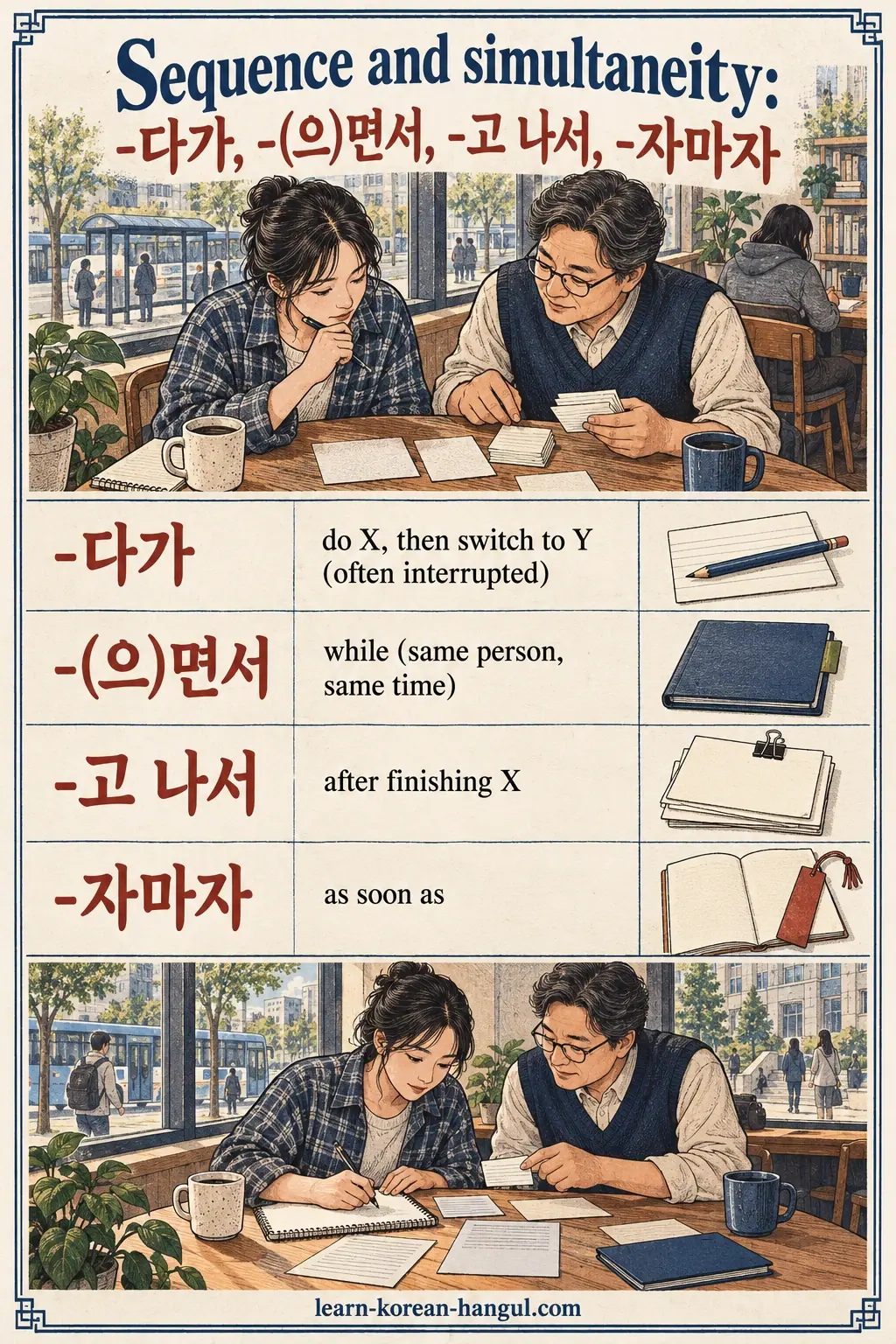
| 3. Sequence and simultaneity | 4 | Order actions in time or run them together | time and sequence connectors |
| 4. Reported speech | 4 | Pass on what someone said, asked, ordered or suggested | Korean reported speech |
| 5. Passive, causative and nominalisation | 5 | Shift focus away from the doer and turn verbs into nouns | Korean passive and causative |
The five groups follow the order most intermediate courses use. A connector is an ending attached to a verb or adjective stem that links two clauses, such as -는데 (background) or -다가 (switching actions). Most TOPIK II core grammar is connectors, so the Korean connectors hub is the best companion to this page. For the test itself, start from the TOPIK 2 hub.
How Are the Patterns Grouped?

The patterns are grouped by function, so each group answers one communication need. Every table uses the same columns: the pattern, its job in plain English, one example, where it is useful on the test, and the lesson link.
Cause and Reason: -기 때문에, -는 바람에, -(으)ㄹ까 봐, -거든요
| Pattern | Job | Example | Test use | Lesson |
|---|---|---|---|---|
| -기 때문에 | because (neutral, emphasises the reason) | 길이 막히기 때문에 지하철을 타요. (Because the roads are jammed, I take the subway.) | all sections; -기 때문이다 in Q53-54 | -기 때문에 |
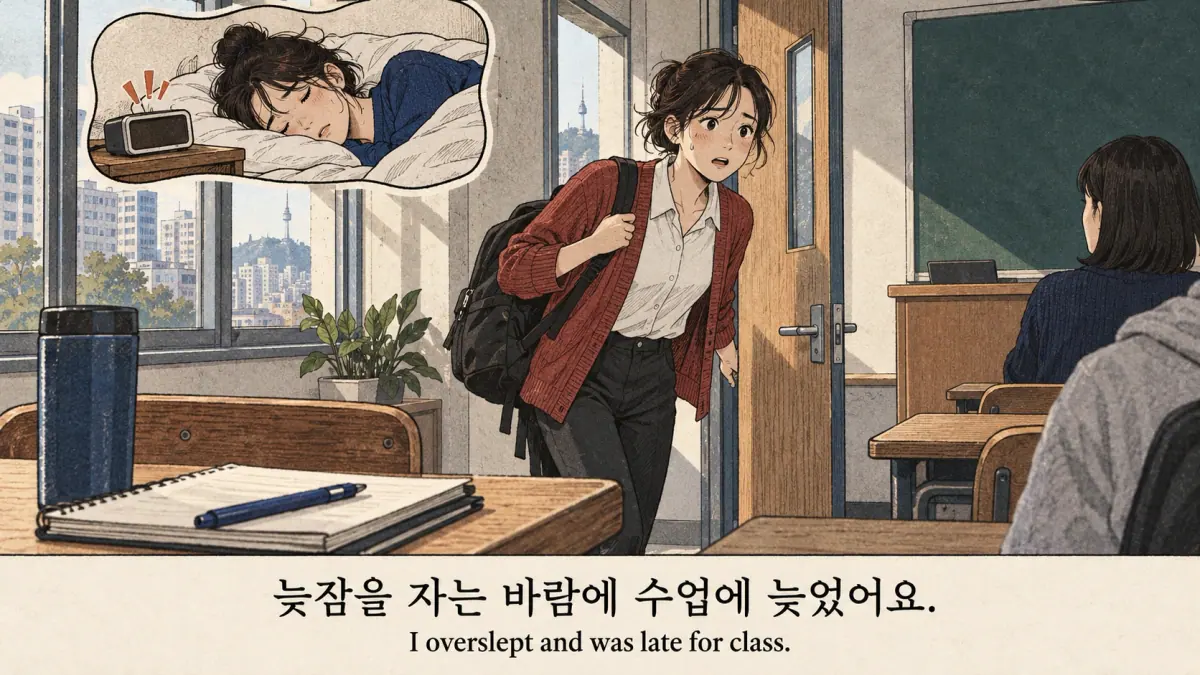
| -는 바람에 | because of an unexpected event, usually with a bad result | 늦잠을 자는 바람에 수업에 늦었어요. (I overslept and was late for class.) | listening, reading | -는 바람에 |
| -(으)ㄹ까 봐 | worried that something might happen | 비가 올까 봐 우산을 가져왔어요. (I brought an umbrella in case it rained.) | listening | -(으)ㄹ까 봐 |
| -거든요 | because, you see (spoken, sentence-final) | 오늘은 못 가요. 약속이 있거든요. (I can't go today. I have plans, you see.) | listening only | -거든요 |
늦잠을 자는 바람에 수업에 늦었어요.
neutjameul janeun barame sueobe neujeosseoyo.
I overslept and ended up late for class.
-거든요 is the clearest case of a spoken-only pattern. In a Q54 essay you would write the reason as -기 때문이다 instead, as in 약속이 있기 때문이다.
Contrast and Condition: -(으)ㄴ/는데, -더라도, -다면, -다가는, -(으)ㄹ 텐데
| Pattern | Job | Example | Test use | Lesson |
|---|---|---|---|---|
| -(으)ㄴ/는데 | background or contrast ("and/but", "so") | 밖에 비가 오는데 우산 있어요? (It's raining outside. Do you have an umbrella?) | all sections | -(으)ㄴ/는데 |
| -더라도 | even if | 시간이 없더라도 아침은 꼭 먹어요. (Even if I have no time, I always eat breakfast.) | reading, Q54 | -더라도 |
| -(ㄴ/는)다면 | if (hypothetical, less likely) | 복권에 당첨된다면 세계 여행을 할 거예요. (If I won the lottery, I would travel the world.) | reading, Q54 | -(ㄴ/는)다면 |
| -다가는 | if you keep doing X, something bad will happen | 그렇게 놀다가는 시험에 떨어질 거예요. (If you keep playing like that, you'll fail the exam.) | listening | -다가는 |
| -(으)ㄹ 텐데 | it will probably be X, so (expectation as background) | 지금 출발하면 늦을 텐데 택시를 타세요. (You'll probably be late if you leave now, so take a taxi.) | listening | -(으)ㄹ 텐데 |
시간이 없더라도 아침은 꼭 먹어요.
sigani eopdeorado achimeun kkok meogeoyo.
Even if I have no time, I always eat breakfast.
-(으)ㄴ/는데 is the most frequent pattern in this group and the hardest to translate, because it can mean "and", "but" or "so" depending on what follows. Read the second clause before you decide.
Sequence and Simultaneity: -다가, -(으)면서, -고 나서, -자마자
| Pattern | Job | Example | Test use | Lesson |
|---|---|---|---|---|
| -다가 | do X, then switch to Y (often interrupted) | 집에 가다가 친구를 만났어요. (On my way home, I met a friend.) | listening, reading | -다가 |
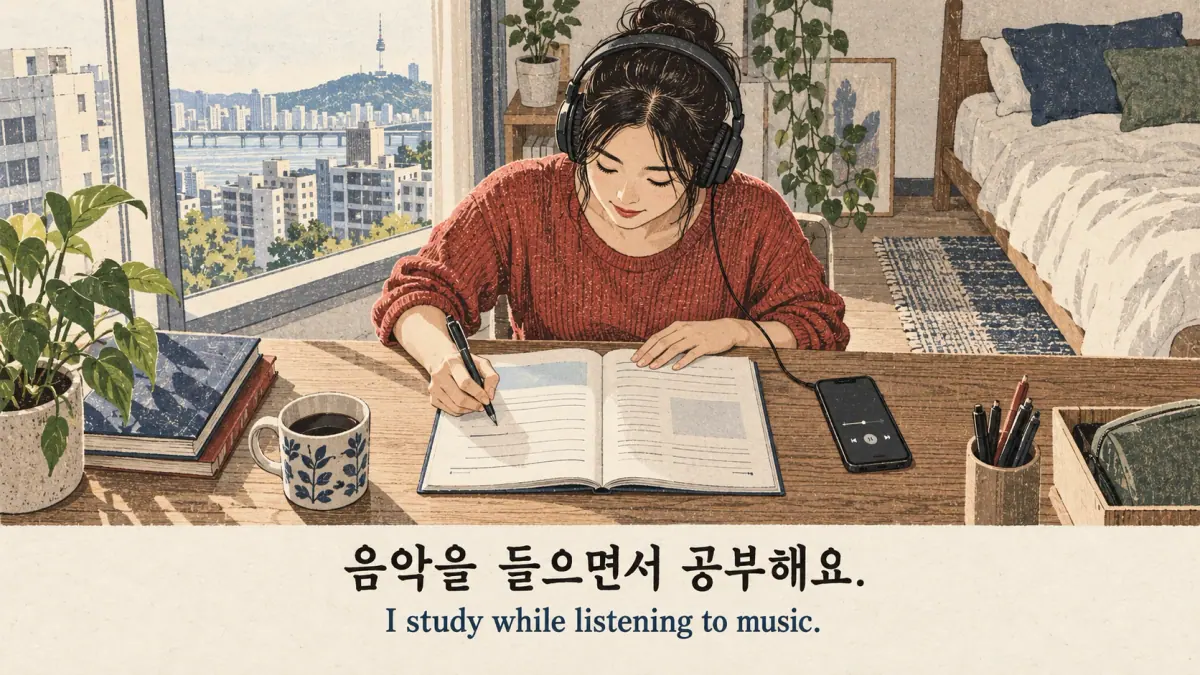
| -(으)면서 | while (same person, same time) | 음악을 들으면서 공부해요. (I study while listening to music.) | all sections | -(으)면서 |
| -고 나서 | after finishing X | 숙제를 하고 나서 게임을 해요. (I play games after doing my homework.) | listening, reading | -고 나서 |
| -자마자 | as soon as | 집에 도착하자마자 잤어요. (I fell asleep as soon as I got home.) | listening, reading | -자마자 |
집에 가다가 친구를 만났어요.
jibe gadaga chingureul mannasseoyo.
On my way home, I ran into a friend.
-다가 and -(으)면서 are a common pair of wrong options. -다가 means the first action stops or is interrupted, while -(으)면서 means both actions run at once. The full contrast is on -다가 vs -(으)면서.
Reported Speech: -다고 하다, -냐고 하다, -(으)라고 하다, -자고 하다
| Pattern | Job | Example | Test use | Lesson |
|---|---|---|---|---|
| -다고 하다 | reports a statement | 민수 씨가 내일 바쁘다고 했어요. (Minsu said he is busy tomorrow.) | all sections | -다고 하다 |
| -냐고 하다 | reports a question | 선생님이 숙제를 했냐고 물어보셨어요. (The teacher asked whether I had done my homework.) | listening | -냐고 하다 |
| -(으)라고 하다 | reports a command or request | 의사가 푹 쉬라고 했어요. (The doctor told me to get some rest.) | listening | -(으)라고 하다 |
| -자고 하다 | reports a suggestion | 친구가 같이 영화를 보자고 했어요. (My friend suggested we watch a film together.) | listening | -자고 하다 |
민수 씨가 내일 바쁘다고 했어요.
minsu ssiga naeil bappeudago haesseoyo.
Minsu said he is busy tomorrow.
In conversation these forms usually contract: 바쁘다고 해요 becomes 바쁘대요, and 쉬라고 해요 becomes 쉬래요. Listening dialogues use the contracted forms, so learn both shapes together.
내일 비가 온대요.
naeil biga ondaeyo.
They say it will rain tomorrow.
Passive, Causative and Nominalisation: 피동, 사동, -기, -(으)ㅁ
| Pattern | Job | Example | Test use | Lesson |
|---|---|---|---|---|
| Passive suffixes -이/히/리/기- | the subject receives the action | 바람 때문에 창문이 열렸어요. (The window opened because of the wind.) | reading, Q53 | passive suffixes |
| -아/어지다 | becomes done; passive for verbs without a suffix | 이 건물은 백 년 전에 지어졌어요. (This building was built 100 years ago.) | reading, Q53-54 | -아/어지다 |
| Causative suffixes -이/히/리/기/우/구/추- | make someone do something | 엄마가 아이에게 밥을 먹여요. (The mother feeds the child.) | reading | causative suffixes |
| -기 | turns a verb into a noun ("doing") | 저는 요리하기를 좋아해요. (I like cooking.) | all sections | -기 nominaliser |
| -(으)ㅁ | turns a clause into a noun; memo style | 오늘 회의 없음. (No meeting today.) | reading (notices) | -(으)ㅁ nominaliser |
바람 때문에 창문이 열렸어요.
baram ttaemune changmuni yeollyeosseoyo.
The window opened because of the wind.
Passives matter most in reading and in question 53, where survey results are reported as 조사되었다 (was surveyed) and 나타났다 (turned out). The Korean nominalization hub compares -기, -(으)ㅁ and -는 것 in full. With the five groups mapped, the next step is to see how three look-alike reason patterns differ.
Near-Synonyms: -아/어서, -기 때문에 and -는 바람에
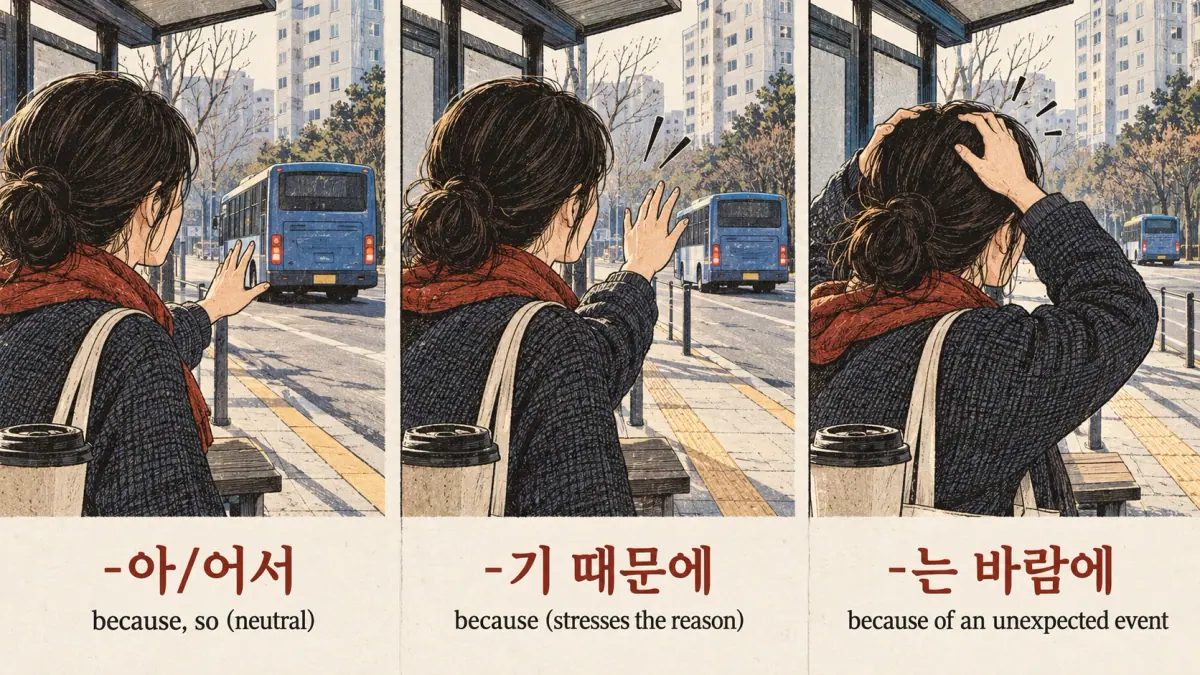
All three patterns give a reason, and TOPIK II reading items often offer two of them as options. The table shows where they part ways.
| Feature | -아/어서 | -기 때문에 | -는 바람에 |
|---|---|---|---|
| Core meaning | because, so (neutral) | because (stresses the reason) | because of an unexpected event |
| Typical result | any | any | usually unwanted |
| Past tense on the first verb | no (-았어서 is wrong) | yes (-았기 때문에) | no; past goes in the main clause |
| Before a command or suggestion | no | no | no |
| Register | speech and writing | speech and writing; -기 때문이다 in essays | speech and writing |
| Same sentence | 버스를 놓쳐서 늦었어요. | 버스를 놓쳤기 때문에 늦었어요. | 버스를 놓치는 바람에 늦었어요. |
The three sentences all mean "I was late because I missed the bus", but the third adds that missing the bus was an unlucky surprise. For a reason before a command, switch to -(으)니까, as in 늦었으니까 택시를 타세요. The fuller comparison is on -기 때문에 vs -아/어서.
버스를 놓치는 바람에 늦었어요.
beoseureul nochineun barame neujeosseoyo.
I missed the bus and ended up late.
Register is the other dividing line on this list, and it decides which patterns you should write.
Which Patterns Belong in Writing?

The patterns that belong in writing are the ones that sound natural in the plain written style (-다), because questions 52, 53 and 54 expect that style. Question 51 follows the polite style of its own text instead. The split below is a rule of thumb for the 22 core patterns.
- Safe in Q52-Q54: -기 때문이다, -(으)ㄴ/는데 (background), -더라도, -(ㄴ/는)다면, -(으)면서, passive forms such as 증가한 것으로 나타났다, -기 and reported -다고 한다.
- Spoken, avoid in essays: -거든요, -(으)ㄹ까 봐 in its chatty sense, contracted reported speech such as -대요 and -래요, and -다가는 warnings.
- Notices and memos only: -(으)ㅁ endings such as 회의 없음, which appear in reading items but not in an essay.
For example, the spoken 시간이 없거든요 becomes 시간이 없기 때문이다 in a Q54 essay. The writing questions themselves are explained on TOPIK question 53 and its sister pages. Knowing where each pattern belongs leads to the question of when to learn it.
In What Order Should You Study Them?

Study the groups in the order of the tables, but begin hearing reported speech early, because listening uses it from the first dialogues. A practical order for most learners is:
- -(으)ㄴ/는데, -(으)면서, -고 나서 and -기 때문에. These four connect most sentences in TOPIK II reading.
- -다고 하다 and its contracted forms (-대요, -래요). Listening depends on them.
- -다가, -자마자, -는 바람에 and -(으)ㄹ까 봐. These carry the plot of short listening stories.
- Passive suffixes, -아/어지다 and -기. Reading and question 53 rely on them.
- -더라도, -(ㄴ/는)다면, -다가는, -(으)ㄹ 텐데 and -거든요, then causatives and -(으)ㅁ.
Steps 1-3 roughly match Level 3, and steps 4-5 complete Level 4. Build each step on the TOPIK 1 grammar list, because every TOPIK II pattern assumes the beginner particles and endings.
Which of These Patterns Are Tested in Listening?
Listening tests the spoken patterns most: -거든요, -(으)ㄴ/는데, -(으)ㄹ 텐데, -다가는, -는 바람에 and contracted reported speech. A typical item asks why a speaker did something, and the answer sits in a -거든요 or -는 바람에 clause. Written patterns such as -(으)ㅁ appear mostly in reading.
Check Yourself: 10 Fill-in Items
Each item gives the meaning in English and one blank. Pick the only option that fits both the meaning and the grammar.
Practice · 10
I overslept, so (unexpectedly) I was late for the meeting. 늦잠을 ___ 회의에 늦었어요.
Show answer
자는 바람에
-는 바람에 gives an unexpected cause with an unwanted result. The other endings mean "in order to", "so that" and "the more".
I packed an umbrella in case it rained. 비가 ___ 우산을 챙겼어요.
Show answer
올까 봐
-(으)ㄹ까 봐 means "worried that something might happen", so you act in advance.
I study while listening to music. 음악을 ___ 공부해요.
Show answer
들으면서
-(으)면서 joins two actions done at the same time by the same person. 듣다 is ㄷ-irregular, so it becomes 들으면서.
Minsu said he is busy tomorrow. 민수 씨가 내일 ___ 했어요.
Show answer
바쁘다고
A reported statement with an adjective takes -다고 하다. -냐고 reports a question, and -자고 and -라고 report suggestions and commands, which adjectives do not take.
As soon as I got home, I fell asleep. 집에 ___ 잤어요.
Show answer
도착하자마자
-자마자 means "as soon as". The others mean "even if", "because, you see" (sentence-final only) and "if".
Even if I am busy, I always eat breakfast. ___ 아침은 꼭 먹어요.
Show answer
바쁘더라도
-더라도 means "even if". -자마자, -고 나서 and -다가 describe the timing of actions and do not fit an adjective like 바쁘다 here.
The window opened because of the wind. 바람 때문에 창문이 ___.
Show answer
열렸어요
창문이 is the subject and nobody opens it on purpose, so the passive 열리다 is needed: 열렸어요.
The doctor told me to get some rest. 의사가 푹 ___ 했어요.
Show answer
쉬라고
A reported command takes -(으)라고 하다. -자고 reports a suggestion, -냐고 a question and -ㄴ다고 a statement.
If you keep playing like that, you will fail the exam. 그렇게 ___ 시험에 떨어질 거예요.
Show answer
놀다가는
-다가는 warns that continuing an action will lead to a bad result.
I like cooking. 저는 요리___ 좋아해요.
Show answer
하기를
The nominaliser -기 turns 요리하다 into a noun phrase that can take the object particle: 요리하기를 좋아해요.
Answers: 1 자는 바람에, 2 올까 봐, 3 들으면서, 4 바쁘다고, 5 도착하자마자, 6 바쁘더라도, 7 열렸어요, 8 쉬라고, 9 놀다가는, 10 하기를.
What Does This List Not Cover?
This TOPIK 2 grammar list is deliberately short: 22 patterns, not a full intermediate syllabus. It leaves out many patterns that intermediate courses teach, such as -느라고, -(으)ㄴ/는 김에 and -는 대로. The level labels are editorial and based on common course-book placement, not on an official TOPIK document. For every intermediate connector and ending with its own lesson, use intermediate Korean grammar. For the formal written patterns of levels 5 and 6, continue with TOPIK 2 grammar advanced, and for all TOPIK grammar pages see the TOPIK grammar hub.
Frequently Asked Questions
How Many Grammar Points Are on TOPIK 2?
No official number exists, because TOPIK publishes no grammar syllabus for candidates, and course books count patterns differently. This list keeps 22 core patterns for levels 3 and 4. Intermediate course books teach many more, so treat these 22 as the minimum and add the patterns your textbook teaches as you meet them in past papers.
Which Patterns Are for Writing Only?
None of the 22 core patterns is strictly writing-only, but some sound bookish in conversation. The -(으)ㅁ nominaliser appears mainly in notes, notices and memos, and -기 때문이다 at the end of a sentence is typical of explanations and essays. For the formal written patterns of levels 5 and 6, see the advanced list.
Is Reported Speech Tested?
Yes, constantly, though never by name. Listening dialogues use the contracted forms, such as 비가 온대요 for 비가 온다고 해요 (they say it will rain). Reading passages and charts use the full forms, as in 조사되었다고 한다. If you cannot hear -대요, -래요 and -냬요 as reported speech, you will misread who said what.
What Is the Difference between 바람에 and 때문에?
-기 때문에 gives any reason in a neutral way and suits both speech and writing. -는 바람에 says that an unexpected event caused a result, usually an unwanted one, as in 늦잠을 자는 바람에 늦었어요. Neither can come before a command or suggestion. Use -(으)니까 for that.
Is There a TOPIK 2 Grammar List PDF?
No official PDF exists, because TOPIK does not publish a grammar list. You can print this page: the five group tables print as a compact list of the 22 patterns with examples. For the patterns tested at levels 5 and 6, print the advanced list as well and keep both next to your error log.