What you will be able to do after this page
- Say what 15 or more A1 verbs mean and give their polite present forms.
- Use a verb with the right particle in a short sentence, such as 밥을 먹어요.
- Recognise the first irregular verbs: 듣다, 걷다, 쓰다, 모르다 and the ㄹ verbs.
- Follow a ten-line conversation built only from A1 words.
Before you start: read how Korean conjugation works, because every verb below is shown in the polite present. Time: about two hours spread over four weeks. Level: A1.
Which Korean Verbs for Beginners Are on the A1 List?
The list holds all 129 A1 entries in the site's verb list: 65 verbs (including 있다 and the copula 이다) and 64 adjectives. The verbs are grouped by situation in the next six sections, and the adjectives follow in one table. A group is small enough to learn in a few days and large enough to build sentences from.
The selection is editorial: it follows learner need, and it is not a frequency list from a corpus. The A1 level means a word you are likely to need in your first months, using the CEFR-style labels explained in Korean verbs by level.
Each table has four columns. The polite present is the 해요체 form you would say to a stranger. The type column says whether the verb is regular, a 하다 verb or irregular, so you meet the exceptions in context. Dictionary pages are linked for each verb. A themed top list of 100 verbs, with a different grouping, is 100 Korean verbs. The first group is the one you will use on day one.
Greeting and Meeting Verbs
These verbs let you meet someone, talk and show feelings. Most are 하다 verbs: you can add 하다 to a noun, as in 인사 (a greeting) + 하다.
| Verb | Meaning | Polite present | Type |
|---|---|---|---|
| 만나다 (mannada) | to meet | 만나요 | regular |
| 인사하다 (insahada) | to greet | 인사해요 | 하다 |
| 소개하다 (sogaehada) | to introduce | 소개해요 | 하다 |
| 말하다 (malhada) | to speak | 말해요 | 하다 |
| 이야기하다 (iyagihada) | talk, chat | 이야기해요 | 하다 |
| 감사하다 (gamsahada) | to thank | 감사해요 | 하다 |
| 전화하다 (jeonhwahada) | to phone | 전화해요 | 하다 |
| 웃다 (utda) | to laugh/smile | 웃어요 | regular |
| 울다 (ulda) | to cry | 울어요 | ㄹ irregular |
| 좋아하다 (joahada) | to like | 좋아해요 | 하다 |
| 싫어하다 (sireohada) | to dislike | 싫어해요 | 하다 |
| 사랑하다 (saranghada) | to love | 사랑해요 | 하다 |
Example: 친구를 만나요. (I meet a friend.) uses 만나요, the polite present of 만나다. The next group covers food and money.
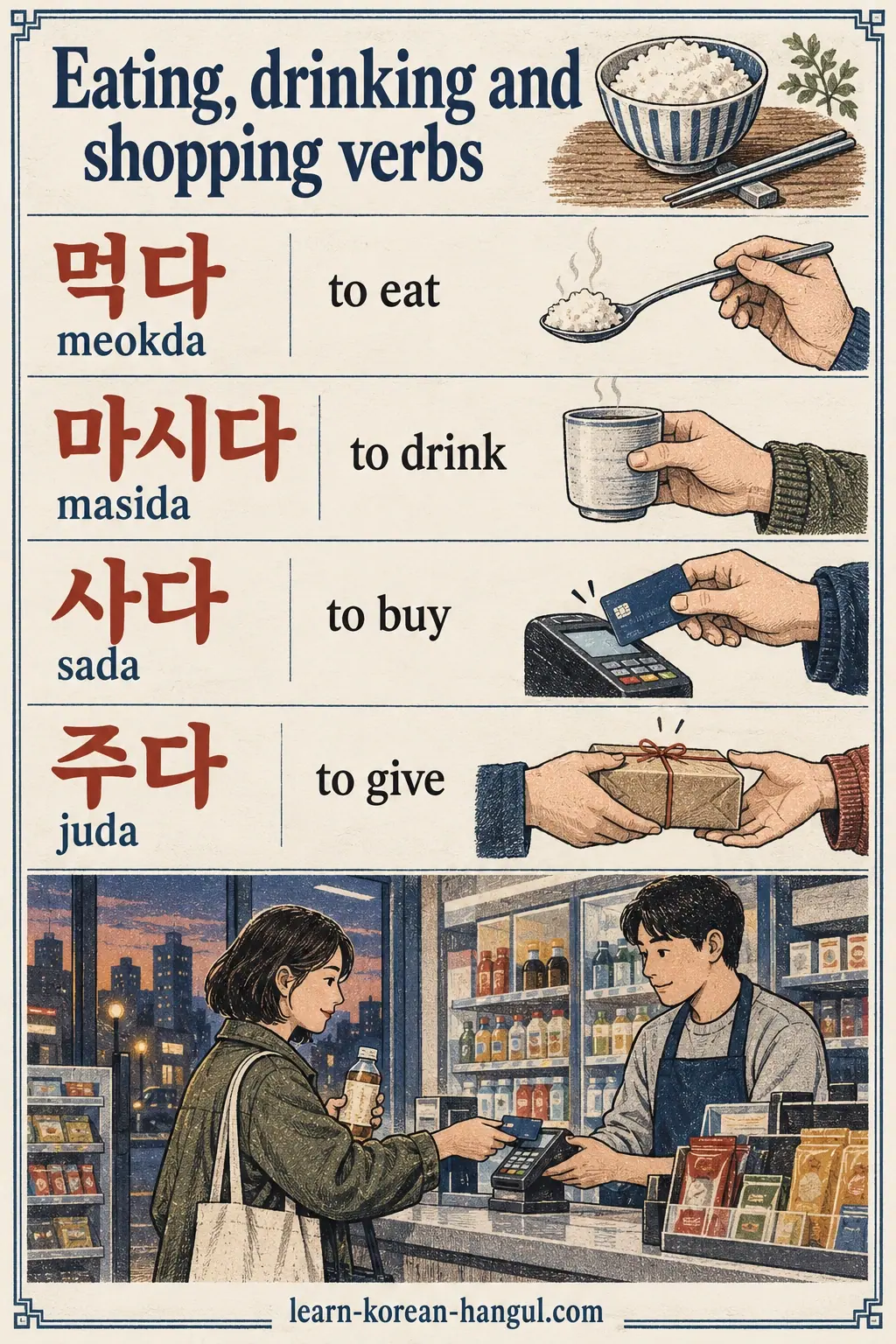
Eating, Drinking and Shopping Verbs

These verbs cover meals, buying and giving. Nouns such as 밥 (cooked rice, a meal) and 커피 (coffee) go before them with the object particle 을/를.
| Verb | Meaning | Polite present | Type |
|---|---|---|---|
| 먹다 (meokda) | to eat | 먹어요 | regular |
| 마시다 (masida) | to drink | 마셔요 | regular |
| 사다 (sada) | to buy | 사요 | regular |
| 팔다 (palda) | sell | 팔아요 | ㄹ irregular |
| 주다 (juda) | to give | 줘요 | regular |
| 받다 (batda) | to receive | 받아요 | regular |
| 쇼핑하다 (syopinghada) | to shop | 쇼핑해요 | 하다 |
| 만들다 (mandeulda) | to make | 만들어요 | ㄹ irregular |
| 입다 (ipda) | wear (clothes) | 입어요 | regular |
| 찾다 (chatda) | to find/look for | 찾아요 | regular |
| 보내다 (bonaeda) | send; spend (time) | 보내요 | regular |
Example: 커피를 마셔요. (I drink coffee.) Notice that 마시다 contracts to 마셔요, and 입다 (to wear clothes) is regular: 입어요. The next group moves you around.
Going Places Verbs
These verbs move you from place to place. With 가다 and 오다, the place takes the particle 에: 학교에 가요 (I go to school).
| Verb | Meaning | Polite present | Type |
|---|---|---|---|
| 가다 (gada) | to go | 가요 | regular |
| 오다 (oda) | to come | 와요 | regular |
| 들어가다 (deureogada) | to enter | 들어가요 | regular |
| 들어오다 (deureooda) | to come in | 들어와요 | regular |
| 나가다 (nagada) | to go out | 나가요 | regular |
| 나오다 (naoda) | to come out | 나와요 | regular |
| 타다 (tada) | ride | 타요 | regular |
| 걷다 (geotda) | to walk | 걸어요 | ㄷ irregular |
| 기다리다 (gidarida) | to wait | 기다려요 | regular |
| 서다 (seoda) | to stand | 서요 | regular |
| 앉다 (anda) | to sit | 앉아요 | regular |
Example: 집에 들어가요. (I go into the house.) The compounds of 가다 and 오다 are the start of a larger family, taught in full on the page about Korean movement verbs. 걷다 is a ㄷ-irregular verb (걸어요). Next come study and work.
Study and Work Verbs
These verbs cover school, work and the mind. 보다 and 듣다 appear here because you use them to learn: you watch and listen.
| Verb | Meaning | Polite present | Type |
|---|---|---|---|
| 공부하다 (gongbuhada) | to study | 공부해요 | 하다 |
| 일하다 (ilhada) | to work | 일해요 | 하다 |
| 배우다 (baeuda) | to learn | 배워요 | regular |
| 읽다 (ikda) | to read | 읽어요 | regular |
| 쓰다 (sseuda) | write; use; wear (a hat) | 써요 | ㅡ irregular |
| 듣다 (deutda) | to listen/hear | 들어요 | ㄷ irregular |
| 보다 (boda) | to see/watch | 봐요 | regular |
| 알다 (alda) | know | 알아요 | ㄹ irregular |
| 모르다 (moreuda) | not know | 몰라요 | 르 irregular |
| 생각하다 (saenggakada) | to think | 생각해요 | 하다 |
| 연습하다 (yeonseupada) | to practice | 연습해요 | 하다 |
| 시작하다 (sijakada) | to start | 시작해요 | 하다 |
| 끝나다 (kkeunnada) | to end | 끝나요 | regular |
| 잘하다 (jalhada) | to be good at; to do well | 잘해요 | 하다 |
| 못하다 (motada) | to be unable to; to be poor at | 못해요 | 하다 |
Example: 한국어를 공부해요. (I study Korean.) 모르다 is a 르-irregular verb (몰라요), and 쓰다 drops its ㅡ (써요). The fourth group is the routine of the day.
Daily Routine Verbs
These verbs describe a day from waking to sleeping. Many are ㄹ-ending verbs (살다, 열다, 놀다), which drop the ㄹ before certain endings.
| Verb | Meaning | Polite present | Type |
|---|---|---|---|
| 자다 (jada) | to sleep | 자요 | regular |
| 일어나다 (ireonada) | to wake up/get up | 일어나요 | regular |
| 씻다 (ssitda) | to wash | 씻어요 | regular |
| 샤워하다 (syawohada) | to shower | 샤워해요 | 하다 |
| 청소하다 (cheongsohada) | to clean | 청소해요 | 하다 |
| 열다 (yeolda) | open | 열어요 | ㄹ irregular |
| 닫다 (datda) | close | 닫아요 | regular |
| 쉬다 (swida) | to rest | 쉬어요 | regular |
| 놀다 (nolda) | to play | 놀아요 | ㄹ irregular |
| 노래하다 (noraehada) | to sing | 노래해요 | 하다 |
| 운동하다 (undonghada) | to exercise | 운동해요 | 하다 |
| 살다 (salda) | live | 살아요 | ㄹ irregular |
Example: 일곱 시에 일어나요. (I get up at seven.) The time uses the particle 에. The last group holds four verbs that appear in almost every sentence.
Core Verbs That Appear Everywhere
These four words work as building blocks. 하다 forms hundreds of compound verbs, 되다 means "become", 있다 means "exist" or "have", and 이다 links a noun to a description.
| Verb | Meaning | Polite present | Type |
|---|---|---|---|
| 하다 (hada) | to do | 해요 | 하다 |
| 되다 (doeda) | to become | 돼요 | regular |
| 있다 (itda) | exist, have | 있어요 | special |
| 이다 (ida) | be (copula) | 이에요 / 예요 | copula |
Example: 저는 학생이에요. (I am a student.) uses 이에요, the polite present of 이다. See 이다 conjugation for all forms. Describing words come next.
Which Adjectives Complete the A1 List?
The 64 A1 adjectives describe size, taste, feelings and weather, and they conjugate with the same endings as verbs. Korean adjectives are verbs of state, so 좋다 means "to be good" and not just "good". Each polite present below ends in 요 like a verb.
| Adjective | Meaning | Polite present | Type |
|---|---|---|---|
| 없다 | to not exist/not have | 없어요 | special |
| 아니다 | to not be | 아니에요 | copula |
| 피곤하다 | tired | 피곤해요 | 하다 |
| 아프다 | sick; painful | 아파요 | ㅡ irregular |
| 좋다 | good | 좋아요 | regular |
| 나쁘다 | bad | 나빠요 | ㅡ irregular |
| 크다 | big | 커요 | ㅡ irregular |
| 작다 | small | 작아요 | regular |
| 많다 | many/much | 많아요 | regular |
| 길다 | long | 길어요 | ㄹ irregular |
| 짧다 | short | 짧아요 | regular |
| 높다 | high | 높아요 | regular |
| 빠르다 | fast | 빨라요 | 르 irregular |
| 느리다 | slow | 느려요 | regular |
| 늦다 | late | 늦어요 | regular |
| 쉽다 | easy | 쉬워요 | ㅂ irregular |
| 어렵다 | difficult | 어려워요 | ㅂ irregular |
| 재미있다 | fun/interesting | 재미있어요 | regular |
| 재미없다 | boring | 재미없어요 | regular |
| 맛있다 | delicious | 맛있어요 | regular |
| 맛없다 | not tasty | 맛없어요 | regular |
| 달다 | sweet | 달아요 | ㄹ irregular |
| 짜다 | salty | 짜요 | regular |
| 맵다 | spicy | 매워요 | ㅂ irregular |
| 뜨겁다 | hot (to touch, water) | 뜨거워요 | ㅂ irregular |
| 차갑다 | cold (to touch) | 차가워요 | ㅂ irregular |
| 덥다 | hot (weather) | 더워요 | ㅂ irregular |
| 춥다 | cold (weather) | 추워요 | ㅂ irregular |
| 따뜻하다 | warm | 따뜻해요 | 하다 |
| 시원하다 | cool/refreshing | 시원해요 | 하다 |
| 예쁘다 | pretty | 예뻐요 | ㅡ irregular |
| 귀엽다 | cute | 귀여워요 | ㅂ irregular |
| 멋있다 | cool/stylish | 멋있어요 | regular |
| 깨끗하다 | clean | 깨끗해요 | 하다 |
| 조용하다 | quiet | 조용해요 | 하다 |
| 편하다 | comfortable | 편해요 | 하다 |
| 다르다 | different | 달라요 | 르 irregular |
| 같다 | same | 같아요 | regular |
| 행복하다 | happy | 행복해요 | 하다 |
| 슬프다 | sad | 슬퍼요 | ㅡ irregular |
| 무섭다 | scary | 무서워요 | ㅂ irregular |
| 배고프다 | hungry | 배고파요 | ㅡ irregular |
| 배부르다 | full | 배불러요 | 르 irregular |
| 바쁘다 | busy | 바빠요 | ㅡ irregular |
| 괜찮다 | okay | 괜찮아요 | regular |
| 싫다 | disliked | 싫어요 | regular |
| 고맙다 | grateful | 고마워요 | ㅂ irregular |
| 미안하다 | sorry | 미안해요 | 하다 |
| 죄송하다 | sorry (formal) | 죄송해요 | 하다 |
| 반갑다 | glad to meet | 반가워요 | ㅂ irregular |
| 보고 싶다 | to miss (someone) | 보고 싶어요 | regular |
| 멀다 | far | 멀어요 | ㄹ irregular |
| 가깝다 | near | 가까워요 | ㅂ irregular |
| 비싸다 | expensive | 비싸요 | regular |
| 싸다 | cheap | 싸요 | regular |
| 힘들다 | hard/tiring | 힘들어요 | ㄹ irregular |
| 그렇다 | to be so; to be like that | 그래요 | ㅎ irregular |
| 이렇다 | to be like this | 이래요 | ㅎ irregular |
| 어떻다 | to be how | 어때요 | ㅎ irregular |
| 빨갛다 | to be red | 빨개요 | ㅎ irregular |
| 노랗다 | to be yellow | 노래요 | ㅎ irregular |
| 파랗다 | to be blue | 파래요 | ㅎ irregular |
| 하얗다 | to be white | 하얘요 | ㅎ irregular |
| 까맣다 | to be black | 까매요 | ㅎ irregular |
Eight adjectives in the table, such as 그렇다, 빨갛다 and 노랗다, are ㅎ-irregular, and several (덥다, 춥다, 쉽다) are ㅂ-irregular. The difference between verbs and adjectives is covered in verbs versus adjectives. Now that you have the words, the next question is how they fit into sentences.
Which Five Sentence Patterns Use These Verbs?
Five patterns cover almost every A1 sentence, and each pattern pairs a particle (a small marker after a noun) with a verb. Learn the verb together with its particle and you will use both correctly.
| Pattern | What it means | Example with A1 verbs |
|---|---|---|
| 이/가 + verb | the noun does the action | 친구가 와요. (A friend comes.) |
| 을/를 + verb | the noun receives the action | 밥을 먹어요. (I eat a meal.) 책을 읽어요. (I read a book.) |
| 에 + 가다/오다 | going or coming to a place | 학교에 가요. (I go to school.) 집에 와요. (I come home.) |
| 에서 + action | the place where the action happens | 도서관에서 공부해요. (I study in the library.) 카페에서 만나요. (We meet at a cafe.) |
| noun + 하다 | the noun becomes a verb | 운동해요. (I exercise.) 전화해요. (I phone.) |
The particles are taught in Korean particles. A ten-line conversation puts the patterns to work.
Can You Follow a Conversation Made Only of A1 Verbs?
You can, and the conversation below uses only A1 verbs and adjectives, with the patterns from the previous section. Read the Korean, check the English, then play each line.
| Speaker | Korean | English |
|---|---|---|
| A | 어디 가요? | Where are you going? |
| B | 학교에 가요. 한국어를 공부해요. | I am going to school. I study Korean. |
| A | 몇 시에 일어나요? | What time do you get up? |
| B | 일곱 시에 일어나요. | I get up at seven. |
| A | 아침에 뭐 먹어요? | What do you eat in the morning? |
| B | 빵을 먹어요. 커피도 마셔요. | I eat bread. I also drink coffee. |
| A | 저녁에 뭐 해요? | What do you do in the evening? |
| B | 친구를 만나요. | I meet a friend. |
| B | 같이 영화를 봐요. | We watch a movie together. |
| A | 좋아요! | Great! |
The words 빵 (bread), 커피 (coffee) and 영화 (movie) are nouns, and 몇 시 means "what time". Notice that the polite present does the work of statements, questions and plans, with no change in the verb. Greeting phrases that use these verbs are in Korean greetings.
Which Beginner Verbs Are Irregular?
11 of the 65 A1 verbs are irregular, and they fall into four classes: ㄷ, ㅡ, 르 and ㄹ. They are on the list because you need them in the first weeks, so it helps to meet them early.
| Verb | Class | Polite present | Polite past | Formal present |
|---|---|---|---|---|
| 울다 | ㄹ | 울어요 | 울었어요 | 웁니다 |
| 팔다 | ㄹ | 팔아요 | 팔았어요 | 팝니다 |
| 만들다 | ㄹ | 만들어요 | 만들었어요 | 만듭니다 |
| 걷다 | ㄷ | 걸어요 | 걸었어요 | 걷습니다 |
| 쓰다 | ㅡ | 써요 | 썼어요 | 씁니다 |
| 듣다 | ㄷ | 들어요 | 들었어요 | 듣습니다 |
| 알다 | ㄹ | 알아요 | 알았어요 | 압니다 |
| 모르다 | 르 | 몰라요 | 몰랐어요 | 모릅니다 |
| 열다 | ㄹ | 열어요 | 열었어요 | 엽니다 |
| 놀다 | ㄹ | 놀아요 | 놀았어요 | 놉니다 |
| 살다 | ㄹ | 살아요 | 살았어요 | 삽니다 |
Three rules explain the table:
- ㄷ becomes ㄹ before a vowel. 듣다 gives 들어요, and 걷다 gives 걸어요.
- ㅡ drops. 쓰다 gives 써요. With 쓰다, remember that the same word also means "to use", "to wear" (a hat) and "to spend" (money).
- 르 splits and ㄹ drops. 모르다 gives 몰라요. The ㄹ verbs keep their ㄹ before 아/어 (살아요) and lose it before endings that start with ㄴ, ㅂ or ㅅ (사는, 삽니다, 사세요).
The full rules are in Korean irregular verbs. Three pairs of verbs trip up English speakers, so the next section compares them.
Which Beginner Verbs Are Easy to Confuse?
Three groups are easy to confuse because English and Korean divide the meanings differently. The table shows what separates them.
| English word | Korean choices | How to choose |
|---|---|---|
| study / learn | 공부하다, 배우다 | 공부하다 means to study a subject, often on your own. 배우다 means to learn, usually from a teacher or by practice: 한국어를 공부해요 and 태권도를 배워요. 한국어를 배워요 is also natural. |
| wear | 입다, 쓰다 | 입다 is for clothes. 쓰다 is for a hat or glasses. Shoes use 신다, which is taught at A2. |
| see / watch / look | 보다 | 보다 covers all of them: 영화를 봐요 (I watch a movie) and 친구를 봐요 (I see a friend). |
Wrong choices are understood, but they sound odd, so it pays to learn the verb with its usual noun. Now, how long does all of this take?
What Is a Good Four-Week Study Plan?
A good plan spreads the 65 verbs over four weeks, with about 16 new verbs per week. This is an estimate, not a measured result, and you should adjust it to your pace. Three or four new verbs a day, with one review day each week, usually works.
| Week | Groups | New verbs | Daily task |
|---|---|---|---|
| 1 | Core verbs and greeting and meeting | 16 | Say each verb with its particle; read the table aloud |
| 2 | Eating, drinking and shopping; going places | 22 | Play the audio; write one sentence per verb |
| 3 | Study and work | 15 | Use the flashcard deck below; add the particle every time |
| 4 | Daily routine and irregular verbs | 12 | Retell the starter conversation with your own details |
Use the flashcard deck to review. It holds twelve of the most useful verbs, and each card shows the polite present and past on the back. For more decks, see vocabulary flashcards.
Practice · 12
- 01가다
Show answer
gada
to go
- 02먹다
Show answer
meokda
to eat
- 03보다
Show answer
boda
to see/watch
- 04듣다
Show answer
deutda
to listen/hear
- 05만나다
Show answer
mannada
to meet
- 06공부하다
Show answer
gongbuhada
to study
- 07일어나다
Show answer
ireonada
to wake up/get up
- 08마시다
Show answer
masida
to drink
- 09모르다
Show answer
moreuda
not know
- 10쓰다
Show answer
sseuda
write; use; wear (a hat)
- 11살다
Show answer
salda
live
- 12좋아하다
Show answer
joahada
to like
To turn the verbs into correct forms, use the present tense recipe. This page does not teach how to build forms from scratch, and it does not cover verbs above A1.
What to Learn Next
Now that you know the Korean verbs for beginners, the next list is elementary Korean verbs. It adds the A2 verbs for travel, shopping, feelings, work and housework, with 하다 verbs and the first transitive and intransitive pairs. If you want a different cut of the same material, 100 Korean verbs groups the most useful verbs by theme. For the section overview, return to Korean verbs by level.
Frequently Asked Questions
What verbs should a beginner learn first? Start with the core verbs 하다, 되다, 있다 and 이다, then the greeting and movement verbs 만나다, 가다 and 오다. Add 먹다, 마시다, 보다 and 공부하다 next. These cover meals, places and study, so you can build sentences such as 밥을 먹어요 and 학교에 가요 within the first week.
How many verbs are in the A1 list? The A1 list on this site has 129 entries: 65 verbs, counting 있다 and the copula 이다, and 64 adjectives. The page covers all of them. The count may grow as the site's verb list grows.
Are irregular verbs included in the beginner list? Yes. The list includes the common irregular verbs 듣다 (들어요), 걷다 (걸어요), 쓰다 (써요), 모르다 (몰라요) and the ㄹ verbs 살다, 알다, 팔다, 열다 and 만들다. Each is marked in the Type column and shown in the irregular table with its past and formal forms.
Is there a flashcard deck for Korean beginner verbs? Yes. A twelve-card deck on this page covers verbs such as 가다, 먹다, 듣다 and 모르다. Each card shows the dictionary form, the meaning and audio, and the back shows the polite present and past. Larger vocabulary decks are listed in the vocabulary flashcards section.