Korean Words 401 to 500 at a Glance
Korean words 401 to 500 are the last block of the Top 500 Korean Words list. The earlier blocks give you the objects, people and places of daily life. This block moves to what you read in the news, what you say at work and what you need on a trip, and it adds the abstract nouns that let you give a result, a purpose or a reason.
The list holds nouns, adverbs and connectors. Of the 100 words, 77 are Sino-Korean (built from Chinese-derived syllables), 18 are native Korean and 5 are loanwords from English. That is a higher share of Sino-Korean words than the first block, and it is the pattern you should expect as vocabulary grows: the more formal and abstract the word, the more likely it is Sino-Korean. The origin column in every table marks each word. The first column is a suggested study order for an A2 learner, an editorial judgement and not a frequency count.
| Group | Words | What it lets you do |
|---|---|---|
| Society and news | 20 | Follow headlines and talk about public life |
| Work and business | 20 | Talk about a job, an office, a salary and a shop |
| Travel and hotels | 20 | Book, travel, check in and find your way |
| Abstract nouns | 20 | Give a result, a purpose, a plan or a difference |
| Time order and connectors | 20 | Put events in order and link sentences |
These tables assume you can read Hangul. If you cannot yet, start with reading Hangul. The next section says where to begin.
Which Words Ranked 401 to 500 Should You Learn First?
Learn 여행, 예약, 호텔, 여권 and 표 first if you are about to travel, and 직업, 사무실 and 회의 first if you are about to work in Korea. The two lists share one rule: learn the words you will meet this month before the ones you might meet next year. For most learners the connectors in the last group, 하지만, 그러면 and 그래도, are the best first target, because they make short sentences into a conversation.
- If you travel soon. 여행, 관광, 여권, 비자, 비행기, 예약, 호텔, 체크인 and 열쇠.
- If you work or study here. 직업, 사무실, 회의, 출근, 퇴근, 월급 and 면접.
- If you follow the news. 사회, 뉴스, 정부, 경제, 사건 and 사고.
- If you want longer sentences. 하지만, 그러면, 그래도, 결국, 갑자기, 요즘 and 때.
- If you prepare for TOPIK I. Study the abstract nouns 결과, 목적, 계획 and 방법, which appear often in reading passages. The official exam information is on topik.go.kr, and the TOPIK guide here explains the format.
At 20 words a day the list takes five days, and at 10 words a day it takes ten. Add a review day after each group.
Society and News
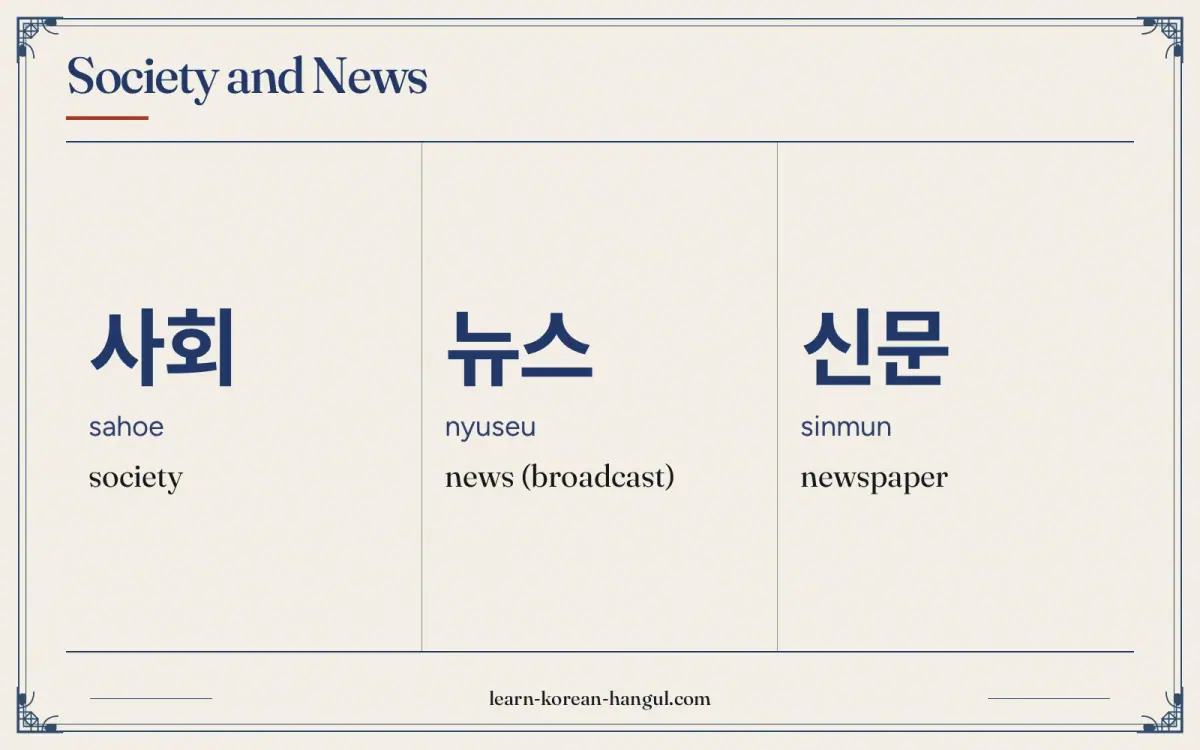
Society and news words are mostly Sino-Korean, which is why headlines look dense. 사회 (society) is the broad word, and the rest narrow it down: 정부 (government), 정치 (politics), 선거 (election), 경제 (economy) and 법 (law). The media words 뉴스, 신문, 방송 and 기자 name the way you hear about all of this.
| No. | Hangul | Revised Romanization | Origin | Meaning | Example sentence | Audio assetId |
|---|---|---|---|---|---|---|
| 401 | 사회 | sahoe | Sino-Korean | society | 사회는 계속 변해요. (Society keeps changing.) | au-pg-vocabulary-core-words-top-500-401-500-1; example: au-pg-vocabulary-core-words-top-500-401-500-101 |
| 402 | 뉴스 | nyuseu | loanword | news (broadcast) | 저녁에 뉴스를 봐요. (I watch the news in the evening.) | au-pg-vocabulary-core-words-top-500-401-500-2; example: au-pg-vocabulary-core-words-top-500-401-500-102 |
| 403 | 신문 | sinmun | Sino-Korean | newspaper | 아버지는 신문을 읽으세요. (My father reads the newspaper.) | au-pg-vocabulary-core-words-top-500-401-500-3; example: au-pg-vocabulary-core-words-top-500-401-500-103 |
| 404 | 소식 | sosik | Sino-Korean | news; word (of someone) | 좋은 소식이 있어요. (I have good news.) | au-pg-vocabulary-core-words-top-500-401-500-4; example: au-pg-vocabulary-core-words-top-500-401-500-104 |
| 405 | 정보 | jeongbo | Sino-Korean | information | 인터넷에서 정보를 찾아요. (I look for information on the internet.) | au-pg-vocabulary-core-words-top-500-401-500-5; example: au-pg-vocabulary-core-words-top-500-401-500-105 |
| 406 | 방송 | bangsong | Sino-Korean | broadcast | 방송이 아홉 시에 시작해요. (The broadcast starts at nine.) | au-pg-vocabulary-core-words-top-500-401-500-6; example: au-pg-vocabulary-core-words-top-500-401-500-106 |
| 407 | 기자 | gija | Sino-Korean | reporter; journalist | 기자가 질문을 해요. (The reporter asks a question.) | au-pg-vocabulary-core-words-top-500-401-500-7; example: au-pg-vocabulary-core-words-top-500-401-500-107 |
| 408 | 인터넷 | inteonet | loanword | internet | 인터넷이 빨라요. (The internet is fast.) | au-pg-vocabulary-core-words-top-500-401-500-8; example: au-pg-vocabulary-core-words-top-500-401-500-108 |
| 409 | 정부 | jeongbu | Sino-Korean | government | 정부가 새 계획을 발표해요. (The government announces a new plan.) | au-pg-vocabulary-core-words-top-500-401-500-9; example: au-pg-vocabulary-core-words-top-500-401-500-109 |
| 410 | 대통령 | daetongnyeong | Sino-Korean | president (of a country) | 대통령이 뉴스에 나와요. (The president appears on the news.) | au-pg-vocabulary-core-words-top-500-401-500-10; example: au-pg-vocabulary-core-words-top-500-401-500-110 |
| 411 | 정치 | jeongchi | Sino-Korean | politics | 정치에 관심이 있어요. (I am interested in politics.) | au-pg-vocabulary-core-words-top-500-401-500-11; example: au-pg-vocabulary-core-words-top-500-401-500-111 |
| 412 | 선거 | seongeo | Sino-Korean | election | 선거가 다음 달에 있어요. (The election is next month.) | au-pg-vocabulary-core-words-top-500-401-500-12; example: au-pg-vocabulary-core-words-top-500-401-500-112 |
| 413 | 경제 | gyeongje | Sino-Korean | economy | 경제 뉴스를 봐요. (I watch economic news.) | au-pg-vocabulary-core-words-top-500-401-500-13; example: au-pg-vocabulary-core-words-top-500-401-500-113 |
| 414 | 법 | beop | Sino-Korean | law | 법을 지켜요. (I obey the law.) | au-pg-vocabulary-core-words-top-500-401-500-14; example: au-pg-vocabulary-core-words-top-500-401-500-114 |
| 415 | 경찰 | gyeongchal | Sino-Korean | police | 경찰이 길을 알려 줘요. (The police officer shows me the way.) | au-pg-vocabulary-core-words-top-500-401-500-15; example: au-pg-vocabulary-core-words-top-500-401-500-115 |
| 416 | 사건 | sageon | Sino-Korean | incident; case | 어제 큰 사건이 있었어요. (A big incident happened yesterday.) | au-pg-vocabulary-core-words-top-500-401-500-16; example: au-pg-vocabulary-core-words-top-500-401-500-116 |
| 417 | 사고 | sago | Sino-Korean | accident | 길에서 사고가 났어요. (An accident happened on the road.) | au-pg-vocabulary-core-words-top-500-401-500-17; example: au-pg-vocabulary-core-words-top-500-401-500-117 |
| 418 | 안전 | anjeon | Sino-Korean | safety | 안전이 제일 중요해요. (Safety is the most important thing.) | au-pg-vocabulary-core-words-top-500-401-500-18; example: au-pg-vocabulary-core-words-top-500-401-500-118 |
| 419 | 환경 | hwangyeong | Sino-Korean | environment | 환경을 지켜요. (We protect the environment.) | au-pg-vocabulary-core-words-top-500-401-500-19; example: au-pg-vocabulary-core-words-top-500-401-500-119 |
| 420 | 국민 | gungmin | Sino-Korean | citizens; the people of a nation | 국민이 투표해요. (The citizens vote.) | au-pg-vocabulary-core-words-top-500-401-500-20; example: au-pg-vocabulary-core-words-top-500-401-500-120 |
Two loanwords sit in this group. 뉴스 is the broadcast news you watch, while 신문 is the printed newspaper you read, and 소식 is a piece of news about a person, as in 좋은 소식 (good news). 인터넷 is borrowed from English and is written as it sounds. Notice the pairing 사건 (an incident or a case) and 사고 (an accident): 교통사고 is a traffic accident, and 사건 can also mean a legal case.
The news and media vocabulary page and the politics and government vocabulary page go deeper. The single-word pages for society in Korean and economy in Korean answer the quick lookup. The next group is about work.
Example Sentences
Each example is a short polite sentence. Most follow the pattern noun + 이/가 + 있어요 or noun + 을/를 + verb. Say each sentence aloud, then swap the first noun. Replace 뉴스 in 저녁에 뉴스를 봐요 with 신문 and you get 저녁에 신문을 봐요, which is also natural. The particles 이/가 and 을/를 are explained in the Korean particles guide.
How Do You Say Work and Business in Korean?
Work words describe a job, a place and a rhythm. 직업 is the kind of work you do, 직원 is a person employed by a company, and 사장 is the head of a company. The daily rhythm is 출근 (going to work) and 퇴근 (leaving work). The shop words 가게, 가격, 주문, 영수증 and 할인 are the ones you use as a customer.
| No. | Hangul | Revised Romanization | Origin | Meaning | Example sentence | Audio assetId |
|---|---|---|---|---|---|---|
| 421 | 직업 | jigeop | Sino-Korean | occupation | 직업이 뭐예요? (What is your occupation?) | au-pg-vocabulary-core-words-top-500-401-500-21; example: au-pg-vocabulary-core-words-top-500-401-500-121 |
| 422 | 직원 | jigwon | Sino-Korean | employee; staff | 이 회사는 직원이 많아요. (This company has many employees.) | au-pg-vocabulary-core-words-top-500-401-500-22; example: au-pg-vocabulary-core-words-top-500-401-500-122 |
| 423 | 사장 | sajang | Sino-Korean | company president; boss | 사장님은 지금 안 계세요. (The boss is not here right now.) | au-pg-vocabulary-core-words-top-500-401-500-23; example: au-pg-vocabulary-core-words-top-500-401-500-123 |
| 424 | 사무실 | samusil | Sino-Korean | office | 사무실은 삼 층에 있어요. (The office is on the third floor.) | au-pg-vocabulary-core-words-top-500-401-500-24; example: au-pg-vocabulary-core-words-top-500-401-500-124 |
| 425 | 회의 | hoeui | Sino-Korean | meeting | 오후에 회의가 있어요. (There is a meeting in the afternoon.) | au-pg-vocabulary-core-words-top-500-401-500-25; example: au-pg-vocabulary-core-words-top-500-401-500-125 |
| 426 | 출근 | chulgeun | Sino-Korean | going to work | 출근은 아홉 시까지예요. (Work starts at nine.) | au-pg-vocabulary-core-words-top-500-401-500-26; example: au-pg-vocabulary-core-words-top-500-401-500-126 |
| 427 | 퇴근 | toegeun | Sino-Korean | leaving work | 여섯 시에 퇴근해요. (I leave work at six.) | au-pg-vocabulary-core-words-top-500-401-500-27; example: au-pg-vocabulary-core-words-top-500-401-500-127 |
| 428 | 월급 | wolgeup | Sino-Korean | monthly salary | 월급을 받아요. (I receive my salary.) | au-pg-vocabulary-core-words-top-500-401-500-28; example: au-pg-vocabulary-core-words-top-500-401-500-128 |
| 429 | 휴가 | hyuga | Sino-Korean | leave; holiday from work | 다음 주에 휴가예요. (I am on leave next week.) | au-pg-vocabulary-core-words-top-500-401-500-29; example: au-pg-vocabulary-core-words-top-500-401-500-129 |
| 430 | 계약 | gyeyak | Sino-Korean | contract | 계약을 해요. (We make a contract.) | au-pg-vocabulary-core-words-top-500-401-500-30; example: au-pg-vocabulary-core-words-top-500-401-500-130 |
| 431 | 사업 | saeop | Sino-Korean | business (enterprise) | 형은 사업을 해요. (My older brother runs a business.) | au-pg-vocabulary-core-words-top-500-401-500-31; example: au-pg-vocabulary-core-words-top-500-401-500-131 |
| 432 | 면접 | myeonjeop | Sino-Korean | interview | 내일 면접이 있어요. (I have an interview tomorrow.) | au-pg-vocabulary-core-words-top-500-401-500-32; example: au-pg-vocabulary-core-words-top-500-401-500-132 |
| 433 | 이력서 | iryeokseo | Sino-Korean | résumé; CV | 이력서를 써요. (I write a résumé.) | au-pg-vocabulary-core-words-top-500-401-500-33; example: au-pg-vocabulary-core-words-top-500-401-500-133 |
| 434 | 경험 | gyeongheom | Sino-Korean | experience | 경험이 많아요. (I have a lot of experience.) | au-pg-vocabulary-core-words-top-500-401-500-34; example: au-pg-vocabulary-core-words-top-500-401-500-134 |
| 435 | 가게 | gage | native | shop; store | 가게에서 과일을 사요. (I buy fruit at the shop.) | au-pg-vocabulary-core-words-top-500-401-500-35; example: au-pg-vocabulary-core-words-top-500-401-500-135 |
| 436 | 가격 | gagyeok | Sino-Korean | price | 가격이 비싸요. (The price is high.) | au-pg-vocabulary-core-words-top-500-401-500-36; example: au-pg-vocabulary-core-words-top-500-401-500-136 |
| 437 | 주문 | jumun | Sino-Korean | order (for goods or food) | 여기서 주문해요. (I order here.) | au-pg-vocabulary-core-words-top-500-401-500-37; example: au-pg-vocabulary-core-words-top-500-401-500-137 |
| 438 | 영수증 | yeongsujeung | Sino-Korean | receipt | 영수증을 주세요. (Please give me a receipt.) | au-pg-vocabulary-core-words-top-500-401-500-38; example: au-pg-vocabulary-core-words-top-500-401-500-138 |
| 439 | 할인 | harin | Sino-Korean | discount | 오늘 할인이 있어요. (There is a discount today.) | au-pg-vocabulary-core-words-top-500-401-500-39; example: au-pg-vocabulary-core-words-top-500-401-500-139 |
| 440 | 광고 | gwanggo | Sino-Korean | advertisement | 광고가 재미있어요. (The advertisement is fun.) | au-pg-vocabulary-core-words-top-500-401-500-40; example: au-pg-vocabulary-core-words-top-500-401-500-140 |
Four words are worth a closer look. 사장 means the president of a company, and 사장님 is also the polite way to address the owner of a shop or restaurant, whatever the size. 직업 asks what you do for a living, while 일 (work, job, task) is the general word from the first 100 words. 휴가 is time off from a job, and 방학 is a school vacation. 휴가 is also used for military leave. Finally, 출근 and 퇴근 are nouns, and 출근하다 and 퇴근하다 are the verbs.
The office and business vocabulary page and the office in Korean page extend this group. The next group covers the trip itself.
Travel and Hotels
Travel words follow a trip in order: 여행 (the trip), 여권 and 비자 (the documents), 비행기 or 기차 (the transport), 예약 (the booking), 호텔 and 체크인 (the stay), and 기념품 (what you bring home). Most are Sino-Korean, and 호텔, 비자 and 체크인 are loanwords written in Hangul.
| No. | Hangul | Revised Romanization | Origin | Meaning | Example sentence | Audio assetId |
|---|---|---|---|---|---|---|
| 441 | 여행 | yeohaeng | Sino-Korean | trip; travel | 다음 달에 여행을 가요. (I am going on a trip next month.) | au-pg-vocabulary-core-words-top-500-401-500-41; example: au-pg-vocabulary-core-words-top-500-401-500-141 |
| 442 | 관광 | gwangwang | Sino-Korean | sightseeing | 관광을 좋아해요. (I like sightseeing.) | au-pg-vocabulary-core-words-top-500-401-500-42; example: au-pg-vocabulary-core-words-top-500-401-500-142 |
| 443 | 관광객 | gwangwanggaek | Sino-Korean | tourist | 관광객이 많아요. (There are many tourists.) | au-pg-vocabulary-core-words-top-500-401-500-43; example: au-pg-vocabulary-core-words-top-500-401-500-143 |
| 444 | 여권 | yeogwon | Sino-Korean | passport | 여권을 보여 주세요. (Please show me your passport.) | au-pg-vocabulary-core-words-top-500-401-500-44; example: au-pg-vocabulary-core-words-top-500-401-500-144 |
| 445 | 비자 | bija | loanword | visa | 비자가 필요해요. (A visa is needed.) | au-pg-vocabulary-core-words-top-500-401-500-45; example: au-pg-vocabulary-core-words-top-500-401-500-145 |
| 446 | 비행기 | bihaenggi | Sino-Korean | airplane | 비행기가 한 시에 떠나요. (The plane leaves at one.) | au-pg-vocabulary-core-words-top-500-401-500-46; example: au-pg-vocabulary-core-words-top-500-401-500-146 |
| 447 | 기차 | gicha | Sino-Korean | train | 기차를 타요. (I take the train.) | au-pg-vocabulary-core-words-top-500-401-500-47; example: au-pg-vocabulary-core-words-top-500-401-500-147 |
| 448 | 지하철 | jihacheol | Sino-Korean | subway | 지하철이 빨라요. (The subway is fast.) | au-pg-vocabulary-core-words-top-500-401-500-48; example: au-pg-vocabulary-core-words-top-500-401-500-148 |
| 449 | 표 | pyo | Sino-Korean | ticket | 표를 사요. (I buy a ticket.) | au-pg-vocabulary-core-words-top-500-401-500-49; example: au-pg-vocabulary-core-words-top-500-401-500-149 |
| 450 | 짐 | jim | native | luggage; load | 짐이 무거워요. (The luggage is heavy.) | au-pg-vocabulary-core-words-top-500-401-500-50; example: au-pg-vocabulary-core-words-top-500-401-500-150 |
| 451 | 출발 | chulbal | Sino-Korean | departure | 출발은 아침 여덟 시예요. (Departure is at eight in the morning.) | au-pg-vocabulary-core-words-top-500-401-500-51; example: au-pg-vocabulary-core-words-top-500-401-500-151 |
| 452 | 도착 | dochak | Sino-Korean | arrival | 도착은 열두 시예요. (Arrival is at twelve.) | au-pg-vocabulary-core-words-top-500-401-500-52; example: au-pg-vocabulary-core-words-top-500-401-500-152 |
| 453 | 예약 | yeyak | Sino-Korean | reservation | 예약을 했어요. (I made a reservation.) | au-pg-vocabulary-core-words-top-500-401-500-53; example: au-pg-vocabulary-core-words-top-500-401-500-153 |
| 454 | 호텔 | hotel | loanword | hotel | 호텔이 깨끗해요. (The hotel is clean.) | au-pg-vocabulary-core-words-top-500-401-500-54; example: au-pg-vocabulary-core-words-top-500-401-500-154 |
| 455 | 숙소 | sukso | Sino-Korean | lodging; place to stay | 숙소는 역 앞에 있어요. (The lodging is in front of the station.) | au-pg-vocabulary-core-words-top-500-401-500-55; example: au-pg-vocabulary-core-words-top-500-401-500-155 |
| 456 | 체크인 | chekeuin | loanword | check-in | 세 시에 체크인해요. (I check in at three.) | au-pg-vocabulary-core-words-top-500-401-500-56; example: au-pg-vocabulary-core-words-top-500-401-500-156 |
| 457 | 침대 | chimdae | Sino-Korean | bed | 침대가 편해요. (The bed is comfortable.) | au-pg-vocabulary-core-words-top-500-401-500-57; example: au-pg-vocabulary-core-words-top-500-401-500-157 |
| 458 | 열쇠 | yeolsoe | native | key | 열쇠를 잃어버렸어요. (I lost my key.) | au-pg-vocabulary-core-words-top-500-401-500-58; example: au-pg-vocabulary-core-words-top-500-401-500-158 |
| 459 | 지도 | jido | Sino-Korean | map | 지도를 봐요. (I look at the map.) | au-pg-vocabulary-core-words-top-500-401-500-59; example: au-pg-vocabulary-core-words-top-500-401-500-159 |
| 460 | 기념품 | ginyeompum | Sino-Korean | souvenir | 기념품을 사요. (I buy a souvenir.) | au-pg-vocabulary-core-words-top-500-401-500-60; example: au-pg-vocabulary-core-words-top-500-401-500-160 |
Tickets and vehicles take counters. A ticket is counted with 장 (표 두 장, two tickets), and a plane is counted with 대 (비행기 한 대). Learn the counter with the noun rather than on its own. The jang counter and the dae counter pages explain both.
The word 도착 (arrival) pairs with 출발 (departure) the way 퇴근 pairs with 출근. Use the pair to remember them. Both become verbs with 하다: 도착하다 and 출발하다. The travel and airport vocabulary and hotel vocabulary pages list more words, and the hotel phrases page shows full sentences. The next group is the most abstract.
How Do You Say Abstract Nouns in Korean?
Abstract nouns name ideas: 결과 (result), 목적 (purpose), 계획 (plan), 방법 (method) and 의미 (meaning). Nearly all are Sino-Korean, and each is made of two syllables with their own meaning. Knowing the syllables lets you read new words. For example, 결 (result or knot) appears in 결과 and 결정.
| No. | Hangul | Revised Romanization | Origin | Meaning | Example sentence | Audio assetId |
|---|---|---|---|---|---|---|
| 461 | 결과 | gyeolgwa | Sino-Korean | result | 결과가 좋아요. (The result is good.) | au-pg-vocabulary-core-words-top-500-401-500-61; example: au-pg-vocabulary-core-words-top-500-401-500-161 |
| 462 | 목적 | mokjeok | Sino-Korean | purpose | 여행의 목적이 뭐예요? (What is the purpose of your trip?) | au-pg-vocabulary-core-words-top-500-401-500-62; example: au-pg-vocabulary-core-words-top-500-401-500-162 |
| 463 | 목표 | mokpyo | Sino-Korean | goal; target | 제 목표는 한국어 공부예요. (My goal is to study Korean.) | au-pg-vocabulary-core-words-top-500-401-500-63; example: au-pg-vocabulary-core-words-top-500-401-500-163 |
| 464 | 계획 | gyehoek | Sino-Korean | plan | 여행 계획을 세워요. (I make a travel plan.) | au-pg-vocabulary-core-words-top-500-401-500-64; example: au-pg-vocabulary-core-words-top-500-401-500-164 |
| 465 | 방법 | bangbeop | Sino-Korean | method; way | 좋은 방법이 있어요. (There is a good way.) | au-pg-vocabulary-core-words-top-500-401-500-65; example: au-pg-vocabulary-core-words-top-500-401-500-165 |
| 466 | 기회 | gihoe | Sino-Korean | chance; opportunity | 기회가 왔어요. (A chance has come.) | au-pg-vocabulary-core-words-top-500-401-500-66; example: au-pg-vocabulary-core-words-top-500-401-500-166 |
| 467 | 선택 | seontaek | Sino-Korean | choice | 선택은 쉽지 않아요. (Choosing is not easy.) | au-pg-vocabulary-core-words-top-500-401-500-67; example: au-pg-vocabulary-core-words-top-500-401-500-167 |
| 468 | 결정 | gyeoljeong | Sino-Korean | decision | 결정은 내일 해요. (I will decide tomorrow.) | au-pg-vocabulary-core-words-top-500-401-500-68; example: au-pg-vocabulary-core-words-top-500-401-500-168 |
| 469 | 변화 | byeonhwa | Sino-Korean | change | 큰 변화가 있어요. (There is a big change.) | au-pg-vocabulary-core-words-top-500-401-500-69; example: au-pg-vocabulary-core-words-top-500-401-500-169 |
| 470 | 차이 | chai | Sino-Korean | difference | 두 단어의 차이를 알아요. (I know the difference between the two words.) | au-pg-vocabulary-core-words-top-500-401-500-70; example: au-pg-vocabulary-core-words-top-500-401-500-170 |
| 471 | 관계 | gwangye | Sino-Korean | relationship; connection | 친구 관계가 좋아요. (The friendship is good.) | au-pg-vocabulary-core-words-top-500-401-500-71; example: au-pg-vocabulary-core-words-top-500-401-500-171 |
| 472 | 도움 | doum | native | help | 도움이 필요해요. (I need help.) | au-pg-vocabulary-core-words-top-500-401-500-72; example: au-pg-vocabulary-core-words-top-500-401-500-172 |
| 473 | 필요 | piryo | Sino-Korean | need; necessity | 지금은 필요 없어요. (I do not need it now.) | au-pg-vocabulary-core-words-top-500-401-500-73; example: au-pg-vocabulary-core-words-top-500-401-500-173 |
| 474 | 의미 | uimi | Sino-Korean | meaning | 이 단어의 의미를 알아요. (I know the meaning of this word.) | au-pg-vocabulary-core-words-top-500-401-500-74; example: au-pg-vocabulary-core-words-top-500-401-500-174 |
| 475 | 경우 | gyeongu | Sino-Korean | case; occasion | 이런 경우에는 전화하세요. (In a case like this, please call.) | au-pg-vocabulary-core-words-top-500-401-500-75; example: au-pg-vocabulary-core-words-top-500-401-500-175 |
| 476 | 상황 | sanghwang | Sino-Korean | situation | 상황이 어려워요. (The situation is difficult.) | au-pg-vocabulary-core-words-top-500-401-500-76; example: au-pg-vocabulary-core-words-top-500-401-500-176 |
| 477 | 습관 | seupgwan | Sino-Korean | habit | 운동은 좋은 습관이에요. (Exercise is a good habit.) | au-pg-vocabulary-core-words-top-500-401-500-77; example: au-pg-vocabulary-core-words-top-500-401-500-177 |
| 478 | 노력 | noryeok | Sino-Korean | effort | 노력이 중요해요. (Effort is important.) | au-pg-vocabulary-core-words-top-500-401-500-78; example: au-pg-vocabulary-core-words-top-500-401-500-178 |
| 479 | 성공 | seonggong | Sino-Korean | success | 사업에 성공했어요. (I succeeded in business.) | au-pg-vocabulary-core-words-top-500-401-500-79; example: au-pg-vocabulary-core-words-top-500-401-500-179 |
| 480 | 실패 | silpae | Sino-Korean | failure | 실패에서 배워요. (I learn from failure.) | au-pg-vocabulary-core-words-top-500-401-500-80; example: au-pg-vocabulary-core-words-top-500-401-500-180 |
Many abstract nouns attach to 하다 to make verbs: 결정하다 (to decide), 선택하다 (to choose), 성공하다 (to succeed) and 노력하다 (to make an effort). That is why they are worth learning early. Learn the noun, and you have the verb for free.
Notice also the word 경우, which means case or occasion and almost always follows a modifier: 이런 경우 (a case like this), 그럴 경우 (in that case). And 도움 is a native word, so it sits among the Sino-Korean ones. The last group links all these nouns into sentences.
Time Order and Connectors
Time words put events in order, and connectors link sentences. 처음, 다음, 나중 and 마지막 give the order: first, next, later, last. 그러나, 하지만, 그러면 and 그래도 link one sentence to another. Both kinds of word turn short sentences into connected speech.
| No. | Hangul | Revised Romanization | Origin | Meaning | Example sentence | Audio assetId |
|---|---|---|---|---|---|---|
| 481 | 처음 | cheoeum | native | first time; beginning | 처음 만났어요. (We met for the first time.) | au-pg-vocabulary-core-words-top-500-401-500-81; example: au-pg-vocabulary-core-words-top-500-401-500-181 |
| 482 | 마지막 | majimak | native | last; end | 마지막 수업이에요. (It is the last class.) | au-pg-vocabulary-core-words-top-500-401-500-82; example: au-pg-vocabulary-core-words-top-500-401-500-182 |
| 483 | 다음 | daeum | native | next | 다음 주에 만나요. (Let's meet next week.) | au-pg-vocabulary-core-words-top-500-401-500-83; example: au-pg-vocabulary-core-words-top-500-401-500-183 |
| 484 | 나중 | najung | native | later | 나중에 만나요. (See you later.) | au-pg-vocabulary-core-words-top-500-401-500-84; example: au-pg-vocabulary-core-words-top-500-401-500-184 |
| 485 | 이전 | ijeon | Sino-Korean | before; previous | 이전 수업은 쉬웠어요. (The previous class was easy.) | au-pg-vocabulary-core-words-top-500-401-500-85; example: au-pg-vocabulary-core-words-top-500-401-500-185 |
| 486 | 이후 | ihu | Sino-Korean | after; since then | 그 이후에 연락이 없어요. (There has been no contact since then.) | au-pg-vocabulary-core-words-top-500-401-500-86; example: au-pg-vocabulary-core-words-top-500-401-500-186 |
| 487 | 동안 | dongan | native | during; for (a period) | 방학 동안 여행했어요. (I travelled during the vacation.) | au-pg-vocabulary-core-words-top-500-401-500-87; example: au-pg-vocabulary-core-words-top-500-401-500-187 |
| 488 | 사이 | sai | native | between; gap | 두 집 사이에 길이 있어요. (There is a road between the two houses.) | au-pg-vocabulary-core-words-top-500-401-500-88; example: au-pg-vocabulary-core-words-top-500-401-500-188 |
| 489 | 때 | ttae | native | time; when | 어릴 때 시골에 살았어요. (I lived in the countryside when I was young.) | au-pg-vocabulary-core-words-top-500-401-500-89; example: au-pg-vocabulary-core-words-top-500-401-500-189 |
| 490 | 요즘 | yojeum | native | these days | 요즘 바빠요. (I am busy these days.) | au-pg-vocabulary-core-words-top-500-401-500-90; example: au-pg-vocabulary-core-words-top-500-401-500-190 |
| 491 | 최근 | choegeun | Sino-Korean | recently | 최근에 이사했어요. (I moved recently.) | au-pg-vocabulary-core-words-top-500-401-500-91; example: au-pg-vocabulary-core-words-top-500-401-500-191 |
| 492 | 옛날 | yennal | native | old times; long ago | 옛날에는 달랐어요. (It was different long ago.) | au-pg-vocabulary-core-words-top-500-401-500-92; example: au-pg-vocabulary-core-words-top-500-401-500-192 |
| 493 | 미래 | mirae | Sino-Korean | future | 미래가 기대돼요. (I look forward to the future.) | au-pg-vocabulary-core-words-top-500-401-500-93; example: au-pg-vocabulary-core-words-top-500-401-500-193 |
| 494 | 순서 | sunseo | Sino-Korean | order; sequence | 순서대로 앉아요. (We sit in order.) | au-pg-vocabulary-core-words-top-500-401-500-94; example: au-pg-vocabulary-core-words-top-500-401-500-194 |
| 495 | 그러나 | geureona | native | but; however (formal) | 어려워요. 그러나 재미있어요. (It is hard. However, it is fun.) | au-pg-vocabulary-core-words-top-500-401-500-95; example: au-pg-vocabulary-core-words-top-500-401-500-195 |
| 496 | 하지만 | hajiman | native | but | 비싸요. 하지만 맛있어요. (It is expensive. But it is delicious.) | au-pg-vocabulary-core-words-top-500-401-500-96; example: au-pg-vocabulary-core-words-top-500-401-500-196 |
| 497 | 그러면 | geureomyeon | native | then; in that case | 그러면 내일 만나요. (Then let's meet tomorrow.) | au-pg-vocabulary-core-words-top-500-401-500-97; example: au-pg-vocabulary-core-words-top-500-401-500-197 |
| 498 | 그래도 | geuraedo | native | even so; still | 피곤해요. 그래도 가요. (I am tired. Even so, I go.) | au-pg-vocabulary-core-words-top-500-401-500-98; example: au-pg-vocabulary-core-words-top-500-401-500-198 |
| 499 | 결국 | gyeolguk | Sino-Korean | in the end; after all | 결국 집에 갔어요. (In the end I went home.) | au-pg-vocabulary-core-words-top-500-401-500-99; example: au-pg-vocabulary-core-words-top-500-401-500-199 |
| 500 | 갑자기 | gapjagi | native | suddenly | 갑자기 비가 와요. (It suddenly starts to rain.) | au-pg-vocabulary-core-words-top-500-401-500-100; example: au-pg-vocabulary-core-words-top-500-401-500-200 |
The connectors are the part of this list with the biggest payoff. 하지만 and 그러나 both mean but. 그러나 is the more formal of the two and fits writing and speeches, while 하지만 is the everyday choice. 그러면 means then, as in then let's meet tomorrow, and 그래도 means even so. Compare these with 그리고, 그런데 and 그래서 from the first 100 words, which mean and, by the way and so.
The word 때 is also one to watch: it means time or when, and it follows a modifier, as in 어릴 때 (when I was young). For the clock time, use 시간. The conjunctions vocabulary page has more connectors.
How Do You Check Your Progress after 500 Words?
This is a 500-word checkpoint you can run in about 20 minutes. Take the five blocks of the list: the first 100 words, words 101 to 200, words 201 to 300, words 301 to 400 and this page. From each block, pick 10 words at random, which gives you 50 words. Cover the English column, say each Korean word aloud and give its meaning. Score one point for each correct meaning.
| Score out of 50 | What it means | What to review |
|---|---|---|
| Below 30 | Your recall of the early blocks is still shaky. | Redo the flashcard decks for the block where you missed the most words. |
| 30 to 40 | Solid base with gaps. | Review only the words you missed, then retest those words in two days. |
| Above 40 | You know the Top 500 well. | Move on to the Top 1000 Korean Words page. |
The bands are a guide that this page sets for self-testing. They are not an official level. A score above 40 does not mean you pass an exam, because TOPIK tests reading and listening in context, and the official criteria are on topik.go.kr.
Beyond the first 500 words, vocabulary usually leans further towards Sino-Korean words and abstract ideas, with fewer concrete objects. That means the syllable-building habit from this block, such as 결 in 결과 and 결정, will pay off more and more.
How Do You Pronounce These Words?
Most of these words follow the spelling, but several undergo sound changes between consonants. The table shows eight that learners often get wrong.
| Spelling | Pronunciation | What happens |
|---|---|---|
| 대통령 | [대통녕] | ㄹ after a final ㅇ becomes ㄴ |
| 직업 | [지겁] | The final ㄱ links to the vowel of the next syllable |
| 직원 | [지권] | The final ㄱ links to the vowel of the next syllable |
| 사건 | [사껀] | ㄱ is said as a tense sound in this Sino-Korean word (dictionary pronunciation) |
| 여권 | [여꿘] | ㄱ is said as a tense sound in this Sino-Korean word (dictionary pronunciation) |
| 결정 | [결쩡] | ㅈ after a final ㄹ is said as a tense sound |
| 출근 | [출근] | No tensing: after ㄹ, only ㄷ, ㅅ and ㅈ are tensed in Sino-Korean words |
| 옛날 | [옌날] | The final ㅅ is said as ㄷ, and ㄷ before ㄴ becomes ㄴ |
The rules come from the Standard Pronunciation rules (표준 발음법) of the 국립국어원. Revised Romanization does not show tensing caused by a neighbouring sound, so it writes 사건 as sageon and 결정 as gyeoljeong even though they are said [사껀] and [결쩡]. It does show the sound changes of 대통령 (daetongnyeong) and 옛날 (yennal).
Audio and Slow Playback
Each word has a normal clip, and 5 key words also have a slow clip at 0.8 times the speed: 사회, 경제, 대통령, 직업 and 옛날. Nothing plays until you press a button.
Listen to 대통령 first. The ending sounds like 녕, not 령, so the word is said close to 대통녕. Then listen to 경제. The first vowel, ㅕ, begins with a y glide, and the final ㅇ in 경 is the nasal sound at the back of the mouth.
What Mistakes Do Learners Make with Words Ranked 401 to 500?
- Learning 표 and 비행기 without their counters. Tickets are counted with 장 and planes with 대, so say 표 두 장 and 비행기 한 대.
- Using 그러나 in casual speech. It reads as formal or written, so use 하지만 with friends and 그러나 in essays and speeches.
- Treating 사고 as only an accident. The same spelling is also the -고 form of 사다 (to buy), as in 사고 먹어요 (buy and eat), so context decides.
- Reading 경우 and 때 as plain nouns. Both follow a modifier, as in 이런 경우 (a case like this) and 어릴 때 (when young).
- Saying 대통령 as daetong-ryeong. The ㄹ becomes ㄴ after ㅇ, so it is [대통녕].
- Calling every manager 사장. 사장 is the head of a company, and a department head has a different title, which the company ranks page explains.
Of these, the counters are the point that most often changes the meaning of a sentence. The next section turns the list into practice.
Practice: Flashcards and Worksheet
Drill these words with the vocabulary flashcard decks. A printable worksheet for these words (word list, matching, writing practice, fill-in-the-blank exercises and answer key) is available in A4 and US Letter from the download card on this page. Progress in the decks is saved only in your browser.
Korean Words 401 to 500 Worksheet
Try this five-question check, then run the 500-word checkpoint above.
Practice · 5
What does 정치 mean?
Show answer
politics
정치 (jeongchi) means politics.
What does 사업 mean?
Show answer
business (enterprise)
사업 (saeop) means business (enterprise).
What does 출발 mean?
Show answer
departure
출발 (chulbal) means departure.
What does 관계 mean?
Show answer
relationship; connection
관계 (gwangye) means relationship; connection.
What does 최근 mean?
Show answer
recently
최근 (choegeun) means recently.
Where to Go Next
This block closes Top 500 Korean Words. Go back to Korean words 301 to 400 if you need to review, or continue with the Top 1000 Korean Words page, which starts at word 501. For work and travel words in more depth, open the office and business vocabulary or the travel and airport vocabulary.
Frequently Asked Questions
How Do You Say Society in Korean?
Society is 사회 (sahoe). It is a Sino-Korean noun used for society as a whole, as in 사회는 계속 변해요 (Society keeps changing). It also appears in 사회생활 (social life) and 사회 수업 (social studies). In the second syllable 회, most speakers say the vowel ㅚ like we, so the word sounds close to sa-hwe.
How Do You Pronounce 경제 (gyeongje)?
경제 is said gyeong-je. The first syllable starts with a y glide, and the final ㅇ is the nasal sound at the back of your mouth, like ng in sing. The second syllable 제 has no change. Say the two syllables smoothly together and compare with the audio.
How Many Words Ranked 401 to 500 Should I Learn First?
Learn about 30 first. Choose the 10 words for your most urgent need, such as travel (여행, 여권, 예약) or work (직업, 회의, 출근). Add the 5 linking words 하지만, 그러면, 그래도, 결국 and 갑자기, then 15 of the abstract nouns, starting with 결과, 목적, 목표, 계획 and 방법, which you meet in reading.
Where Can I Practise Words Ranked 401 to 500 with Flashcards?
Use the vocabulary flashcard decks, which list every deck with audio. A deck for this block is planned. Progress stays in your browser. Until then, copy the five tables above onto cards: Hangul on one side, English on the other.
Is the Romanization on This Page Official?
It follows the Revised Romanization of Korean, which South Korea officially adopted on 7 July 2000 and whose rules the National Institute of Korean Language (국립국어원) publishes. It is a learning aid that does not show tensing caused by a neighbouring sound, so learn the Hangul and use the audio.
Is There a Printable Worksheet for Words Ranked 401 to 500?
A printable worksheet for these words (word list, matching, writing practice, fill-in-the-blank exercises and answer key) is available in A4 and US Letter from the download card on this page. For practice, write the Hangul from memory, cover the English column and check your answers against the tables.