
Advanced Korean Grammar Flashcards: Study the 25 Cards
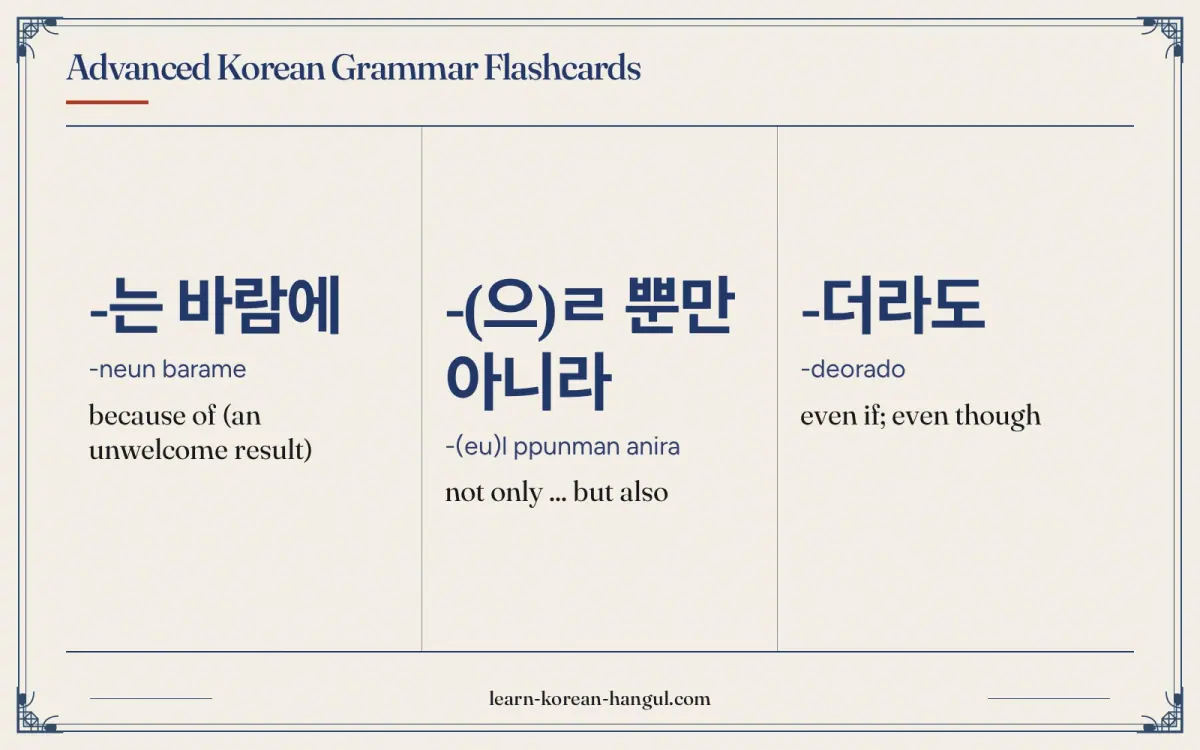
A grammar card works like a vocabulary card, with one difference: the front shows a pattern, and the audio plays an example sentence that contains it. The cards run in groups. Cards 1 to 7 are reasons and additions (-는 바람에, -(으)ㄹ 뿐만 아니라, -더라도, -(으)ㄴ/는 셈이다, -느라고, -(으)ㄹ 테니까, -거든요), cards 8 to 14 are necessity, degree, addition and exchange, cards 15 to 19 are guesses, results and strong denials, and cards 20 to 25 are pretending, appearances, timing, duty and general truths.
How Do I Use These Flashcards?
Use the deck above in four steps. It works with tap, click or keyboard, and nothing plays until you press an audio button.
- Choose a mode. Start with recognition (Hangul to meaning). Switch to recall (meaning to Hangul) or listening (audio to meaning) once recognition feels easy.
- Show the answer. Say the example sentence aloud before you look at the answer, then change one word, such as the verb or the object, and say it again. Then press Show answer (or Space). Turn on the romanization toggle only if you need it; the table below always shows it.
- Grade yourself. Press Got it if you answered correctly without help, or Not yet if you hesitated or guessed.
- Finish the session. A session holds up to 20 cards (you can set 10, 20 or 40). With 25 cards, a first-time learner should expect about 3 days at the default limit of 10 new cards a day, with review sessions on top.
What Do the Three Modes Do?
Recognition shows the Hangul and asks for the meaning, so with the first card it shows -는 바람에 and you answer "because of (an unwelcome result)". Recall reverses this: it shows the meaning and asks for the Hangul, and you may type the answer with your Hangul keyboard or just say it in your head. Listening plays a clip and hides the letters, which trains the ear. Listening mode suits this deck well, because the clip plays a whole sentence and you must hear which pattern it contains. The pronunciation audio is generated with text-to-speech and a Korean teacher approves it before it is switched on. Listening mode only uses cards whose audio is approved, and cards without approved audio are skipped in that mode with a note.
What Do Got It and Not yet Do?
Got it moves a card up one Leitner box, so it comes back later. Not yet sends the card back to box 1, so it returns in the same session or within 10 minutes. The grades are your own judgement; the deck does not score you or claim fluency.
Deck Scope: What Is and Is Not Covered
The deck covers 25 patterns of the kind that advanced textbooks teach for the upper-intermediate level: reasons (-는 바람에, -느라고, -(으)ㄹ 테니까, -거든요), additions (-(으)ㄹ 뿐만 아니라, -(으)ㄴ/는 데다가), concession (-더라도, -아/어 봤자), degree and comparison (-(으)ㄹ수록, -(으)ㄹ 만큼, -대로), alternatives (-(으)ㄴ/는 대신(에)), guesses and denials (-(으)ㄹ지도 모르다, -(으)ㄹ 리가 없다, -(으)ㄴ/는 듯하다), results (-고 말다, -(으)ㄴ/는 셈이다, -(으)ㄹ 수밖에 없다) and a few more. Meanings are short glosses; fine nuance and limits on style need a grammar book. The deck does not repeat the intermediate connectors such as -(으)니까 and -(으)면서.
What Is Left out of This Deck?
The intermediate connectors are in the intermediate korean grammar flashcards, and the basic particles are in the korean particles flashcards. Patterns for the second TOPIK level, such as reported speech and passives, are in the TOPIK 2 grammar flashcards. The lessons behind these cards are on the advanced Korean grammar page, and every grammar deck is listed on the Korean grammar flashcards page.
All 25 Cards in One Table
All 25 cards appear below in deck order. The table is plain HTML, so you can use it as a drill without the deck: cover the Meaning column, say each item aloud, then uncover it.
| # | Hangul | Revised Romanization | Meaning | Note | Lesson | Audio assetId |
|---|---|---|---|---|---|---|
| 1 | -는 바람에 | -neun barame | because of (an unwelcome result) | Example: 갑자기 비가 오는 바람에 약속에 늦었어요. (gapjagi biga oneun barame yaksoge neujeosseoyo.) Because it suddenly rained, I was late for the appointment. Reports an unwelcome result. It cannot be followed by a command or a suggestion. | -는 바람에 lesson | au-pg-flashcards-advanced-grammar-flashcards-1; slow: au-pg-flashcards-advanced-grammar-flashcards-26 |
| 2 | -(으)ㄹ 뿐만 아니라 | -(eu)l ppunman anira | not only ... but also | Example: 이 식당은 맛있을 뿐만 아니라 값도 싸요. (i sikdangeun masisseul ppunman anira gapdo ssayo.) This restaurant is not only tasty but also cheap. Adds a second point that goes further than the first. | -(으)ㄹ 뿐만 아니라 lesson | au-pg-flashcards-advanced-grammar-flashcards-2 |
| 3 | -더라도 | -deorado | even if; even though | Example: 비가 오더라도 갈 거예요. (biga odeorado gal geoyeyo.) I will go even if it rains. Sounds more formal than -아/어도 and is stronger in speeches and writing. | -더라도 lesson | au-pg-flashcards-advanced-grammar-flashcards-3 |
| 4 | -(으)ㄴ/는 셈이다 | -(eu)n/neun semida | it amounts to; so to speak | Example: 일이 거의 다 끝난 셈이에요. (iri geoui da kkeunnan semieyo.) The work is practically done. Sums up a situation as being "in effect" something. | -(으)ㄴ/는 셈이다 lesson | au-pg-flashcards-advanced-grammar-flashcards-4 |
| 5 | -느라고 | -neurago | because I am busy doing | Example: 숙제를 하느라고 못 잤어요. (sukjereul haneurago mot jasseoyo.) I could not sleep because I was doing homework. Needs the same subject in both clauses, and the first action must take time or effort. | -느라고 lesson | au-pg-flashcards-advanced-grammar-flashcards-5; slow: au-pg-flashcards-advanced-grammar-flashcards-27 |
| 6 | -(으)ㄹ 테니까 | -(eu)l tenikka | since I will; since it will probably | Example: 제가 할 테니까 쉬세요. (jega hal tenikka swiseyo.) I will do it, so please rest. Mixes your will or a guess with a reason, so a command can follow. | -(으)ㄹ 테니까 lesson | au-pg-flashcards-advanced-grammar-flashcards-6 |
| 7 | -거든요 | -geodeunyo | you see; the thing is | Example: 오늘은 못 가요. 약속이 있거든요. (oneureun mot gayo. yaksogi itgeodeunyo.) I cannot go today. I have an appointment, you see. Ends a polite sentence to give a reason or background, usually after the result. | -거든요 lesson | au-pg-flashcards-advanced-grammar-flashcards-7 |
| 8 | -(으)ㄹ 수밖에 없다 | -(eu)l subakke eopda | have no choice but to | Example: 비가 와서 취소할 수밖에 없어요. (biga waseo chwisohal subakke eopseoyo.) It is raining, so we have no choice but to cancel. Says that there is only one possible way. | -(으)ㄹ 수밖에 없다 lesson | au-pg-flashcards-advanced-grammar-flashcards-8 |
| 9 | -(으)ㄹ수록 | -(eu)lsurok | the more ..., the more | Example: 배울수록 재미있어요. (baeulsurok jaemiisseoyo.) The more I learn, the more fun it is. The same verb or adjective repeats its direction in the second part. | -(으)ㄹ수록 lesson | au-pg-flashcards-advanced-grammar-flashcards-9 |
| 10 | -나 마나 | -na mana | no use doing | Example: 입어 보나 마나 작을 거예요. (ibeo bona mana jageul geoyeyo.) There is no use trying it on; it will be too small. Says that the result is clear without doing it. | – | au-pg-flashcards-advanced-grammar-flashcards-10 |
| 11 | -(으)ㄴ/는 데다가 | -(eu)n/neun dedaga | on top of that | Example: 이 집은 넓은 데다가 깨끗해요. (i jibeun neolbeun dedaga kkaekkeutaeyo.) This house is spacious and, on top of that, clean. Adds a second point of the same kind, both good or both bad. | -(으)ㄴ/는 데다가 lesson | au-pg-flashcards-advanced-grammar-flashcards-11 |
| 12 | -대로 | -daero | as; just as | Example: 제가 말한 대로 하세요. (jega malhan daero haseyo.) Do as I said. After a modifier such as 말한 it is a separate word. After a noun it attaches, as in 규칙대로. | -대로 lesson | au-pg-flashcards-advanced-grammar-flashcards-12 |
| 13 | -(으)ㄴ/는 대신(에) | -(eu)n/neun daesin(e) | instead of; in return for | Example: 고기를 안 먹는 대신 생선을 먹어요. (gogireul an meongneun daesin saengseoneul meogeoyo.) Instead of meat, I eat fish. Names a replacement or a trade-off. | – | au-pg-flashcards-advanced-grammar-flashcards-13 |
| 14 | -(으)ㄹ 만큼 | -(eu)l mankeum | enough to; as much as | Example: 배가 터질 만큼 먹었어요. (baega teojil mankeum meogeosseoyo.) I ate so much that my stomach could burst. Shows a degree that matches another action. | -(으)ㄹ 만큼 lesson | au-pg-flashcards-advanced-grammar-flashcards-14 |
| 15 | -(으)ㄹ지도 모르다 | -(eu)ljido moreuda | might | Example: 내일은 비가 올지도 몰라요. (naeireun biga oljido mollayo.) It might rain tomorrow. A cautious guess that something may be true. | -(으)ㄹ지도 모르다 lesson | au-pg-flashcards-advanced-grammar-flashcards-15 |
| 16 | -고 말다 | -go malda | end up; finally do | Example: 결국 울고 말았어요. (gyeolguk ulgo marasseoyo.) In the end I burst into tears. Shows a result that is complete or unwanted. | -고 말다 lesson | au-pg-flashcards-advanced-grammar-flashcards-16 |
| 17 | -아/어 봤자 | -a/eo bwatja | even if you try; it is no use | Example: 아무리 설명해 봤자 소용없어요. (amuri seolmyeonghae bwatja soyongeopseoyo.) No matter how much I explain, it is no use. The result will not change, however hard you try. | -아/어 봤자 lesson | au-pg-flashcards-advanced-grammar-flashcards-17 |
| 18 | -(으)ㄹ 리가 없다 | -(eu)l riga eopda | there is no way that | Example: 그 사람이 거짓말을 할 리가 없어요. (geu sarami geojinmareul hal riga eopseoyo.) There is no way that person would lie. A strong feeling that something cannot be true. | -(으)ㄹ 리가 없다 lesson | au-pg-flashcards-advanced-grammar-flashcards-18 |
| 19 | -기는커녕 / -은커녕 | -gineunkeonyeong / -eunkeonyeong | far from; let alone | Example: 칭찬은커녕 야단만 맞았어요. (chingchaneunkeonyeong yadanman majasseoyo.) Far from being praised, I was only scolded. The first thing is not true, and the second is even worse or smaller than expected. -기는커녕 follows a verb, -은/는커녕 follows a noun. | – | au-pg-flashcards-advanced-grammar-flashcards-19 |
| 20 | -(으)ㄴ 척하다 | -(eu)n cheokada | pretend to | Example: 알면서도 모르는 척했어요. (almyeonseodo moreuneun cheokaesseoyo.) I pretended not to know even though I did. The form before 척 follows the tense: -는 for present, -(으)ㄴ for past. | -(으)ㄴ 척하다 lesson | au-pg-flashcards-advanced-grammar-flashcards-20 |
| 21 | -(으)ㄴ/는 듯하다 | -(eu)n/neun deutada | it seems that | Example: 비가 온 듯해요. (biga on deutaeyo.) It seems that it rained. A written-style guess from what you see or hear. | -(으)ㄴ/는 듯하다 lesson | au-pg-flashcards-advanced-grammar-flashcards-21 |
| 22 | -다시피 | -dasipi | as you know; almost | Example: 아시다시피 오늘은 휴일이에요. (asidasipi oneureun hyuirieyo.) As you know, today is a holiday. Fixed with verbs of knowing and seeing, such as 아시다시피 and 보시다시피. | – | au-pg-flashcards-advanced-grammar-flashcards-22 |
| 23 | -(으)려던 참이다 | -(eu)ryeodeon chamida | was just about to | Example: 지금 막 나가려던 참이에요. (jigeum mak nagaryeodeon chamieyo.) I was just about to leave. Describes the moment right before an action. | -(으)려던 참이다 lesson | au-pg-flashcards-advanced-grammar-flashcards-23 |
| 24 | -(으)ㄴ 이상 | -(eu)n isang | since; now that | Example: 약속한 이상 지켜야 해요. (yaksokan isang jikyeoya haeyo.) Now that you have promised, you must keep it. Gives a fixed fact as the reason for a duty or a decision. | -(으)ㄴ 이상 lesson | au-pg-flashcards-advanced-grammar-flashcards-24 |
| 25 | -기 마련이다 | -gi maryeonida | be bound to | Example: 누구나 실수하기 마련이에요. (nuguna silsuhagi maryeonieyo.) Everyone is bound to make mistakes. States what naturally happens as a general truth. | – | au-pg-flashcards-advanced-grammar-flashcards-25; slow: au-pg-flashcards-advanced-grammar-flashcards-28 |
How Do I Read the Table?
Hangul is the pattern, and a leading hyphen shows that it attaches to a verb or adjective stem. Revised Romanization (RR) is a learning aid, so try to read the Hangul first. The Meaning column gives a short English gloss. The Note column gives an example sentence with its RR and meaning, plus a use hint. The Lesson column links to the lesson that explains the pattern when it is published; where no lesson exists yet, the cell shows a dash. The last column lists the audio assetId, and the clip says the example sentence, not the bare pattern. A second ID marks a slow clip (0.8x).
Usage Notes for These Cards
-는 바람에 reports an unwelcome result. It cannot be followed by a command or a suggestion, and it cannot say "because I was happy". For a good result, use -(으)ㄴ 덕분에.
-느라고 needs the same subject twice. The first action must take time or effort, so 청소하느라고 못 갔어요 (I could not go because I was cleaning) works, but 비가 오느라고 does not, because rain is not something a person does. When the subjects differ, use -아/어서.
-더라도 and -아/어도 both mean "even if". -더라도 sounds more formal and is stronger in speeches and written Korean, while -아/어도 is the everyday choice.
-거든요 gives a reason or background. It sits at the end of a sentence, usually after you have just said the result, not before it: 오늘은 못 가요. 약속이 있거든요.
-(으)ㄹ 테니까 mixes will or a guess with a reason. Because the speaker's will is in it, a command can follow: 제가 할 테니까 쉬세요.
Spacing needs care. 대로 is a separate word after a modifier (말한 대로) and attaches after a noun (규칙대로). 만큼 works the same way.
Which Sounds Do Not Match the Spelling?
Several of these patterns sound different from the way they are spelled.
뿐만 아니라 is said [뿐마나니라]. The final ㄴ of 만 moves onto the empty ㅇ of 아, so you hear 마 + 나. This is liaison. RR writes ppunman anira.
배울수록 is said [배울쑤록]. After the final ㄹ, the ㅅ of 수 becomes a tense sound. This is tensification, and RR writes baeulsurok.
할 수밖에 없다 is said [할쑤바께 업따]. The ㅅ of 수 is tense after the ending -ㄹ, and the bound noun joins the word before it. 밖에 links as [바께], and 없다 is said [업따], with the cluster ㅄ reduced to ㅂ and the ㄷ made tense. RR writes hal subakke eopda.
What Mistakes Do Learners Make with Advanced Grammar?
- Using -는 바람에 for a good result, as in 친구가 도와주는 바람에 합격했어요. Use -(으)ㄴ 덕분에: 친구가 도와준 덕분에 합격했어요.
- Using -느라고 with different subjects, as in 아이가 우느라고 제가 못 잤어요. Use -아/어서: 아이가 울어서 못 잤어요.
- Leaving the 요 off -거든요 in polite speech. Plain -거든 is casual, for friends. With a teacher or a stranger, say -거든요.
- Writing 말한대로 as one word. After a modifier, 대로 is spaced: 말한 대로.
Cause and reason patterns cause the most slips, so give cards 1, 5, 6 and 7 extra passes in recall mode.
How Does the Review Schedule Work?
The deck uses a simplified Leitner system with five boxes. A new card starts in box 1. Each Got it moves it up one box, and each Not yet returns it to box 1. The box sets how long the card waits before it is due again.
| Box | Wait until the next review |
|---|---|
| 1 | same session or 10 minutes |
| 2 | 1 day |
| 3 | 3 days |
| 4 | 7 days |
| 5 | 21 days |
Each session shows due cards first, oldest due first, then up to 10 new cards a day by default. A deck of 25 cards is introduced over 3 days at 10 new cards a day. If you want a faster pass, add a daily 10-minute session over cards in boxes 1 and 2 first, and leave the long gaps for later. Progress is saved only in this browser, so clearing site data deletes it. Use the export button to save a small file with card IDs, boxes and due dates, and import it on another device. No account is needed.
Cultural and Practical Context
Advanced patterns often carry attitude, such as regret, blame or understatement, which is why they stand out in the speech of fluent speakers. A speaker who says -는 바람에 is also saying that the result was not welcome, and one who says -기는커녕 is expressing disappointment. Writers and speakers use -(으)ㄹ 뿐만 아니라 and -(으)ㄹ 수밖에 없다 in argumentation. Memorize each pattern with a whole sentence and say it aloud, because a pattern alone is hard to recall when you meet it inside a conversation.
Limits of This Deck
The deck is a study aid made by this site. It holds 25 cards and one example per pattern, so it shows the main use of each pattern, not every nuance or every restriction on style. Patterns with several uses, such as -(으)ㄹ 만큼 and -대로, are simplified; the lessons explain the rest. Where a card has no published lesson yet, the table marks it. All Korean text is generated and was reviewed and signed off by Min-ji Park on 15 October 2026, and each audio clip is checked by a Korean teacher before publication.
Next Steps after This Deck
After these advanced korean grammar flashcards, go back to the intermediate korean grammar flashcards if a connector feels shaky, or move on to the TOPIK 2 grammar flashcards for reported speech and passives. Build your own sentences with the korean sentence builder. The Korean grammar flashcards page lists every grammar deck, and the Korean flashcards hub lists all topics.
Frequently Asked Questions
How Do I Choose between -는 바람에 and -느라고?
Both give a cause, but -는 바람에 reports an unwelcome result that the subject did not choose, as in 비가 오는 바람에 늦었어요. -느라고 needs the same subject in both clauses and an action that takes time or effort, as in 숙제를 하느라고 못 잤어요. If the subjects differ and the cause is not an effort, use -는 바람에 or -아/어서.
What Does -거든요 Add to a Sentence?
It adds a reason or background that the listener may not know. You usually say the result first and then explain with -거든요: 오늘은 못 가요. 약속이 있거든요. It sounds natural in conversation, and it can also introduce a topic, as in 제가 어제 영화를 봤거든요 (you see, I watched a movie yesterday).
Which of These Can I Use in Writing?
Patterns such as -(으)ㄹ 뿐만 아니라, -(으)ㄹ 수밖에 없다, -(으)ㄴ 이상 and -더라도 suit essays, reports and speeches. Others, such as -거든요, -(으)ㄹ 테니까 and -(으)려던 참이다, are mostly spoken and sound out of place in formal writing.
How Is -더라도 Different from -아/어도?
Both mean "even if" or "even though". -아/어도 is the everyday choice. -더라도 sounds more formal and stronger, and it is common in speeches and written Korean, as in 비가 오더라도 갈 거예요 (I will go even if it rains).
Is My Progress Saved If I Close the Page?
Yes, in the same browser on the same device. Card boxes and due dates are stored locally and nothing is sent to a server. Clearing site data, using a private window or switching browsers removes them, so use the export button to keep a backup file. No account is needed.