
What you'll learn
- Say the full ㅢ sound, a quick glide from ㅡ into ㅣ.
- Choose the correct pronunciation of ㅢ in any position: [의], [이] or [에].
- Read 의사, 희망, 무늬, 회의 and 우리의 aloud.
- Write ㅢ in a mixed-vowel block and type it on a Korean keyboard.
Before you start: you need the vowel ㅡ and the vowel ㅣ, because ㅢ is built from both. Time: about 25 minutes.
Key facts about ㅢ
- Build: ㅡ + ㅣ; the only compound vowel based on ㅡ.
- Word-initial: [의], as in 의사 "doctor".
- After a consonant: always [이], as in 희망 [히망] "hope".
- Non-first syllable: [의] or [이], as in 주의 [주의/주이] "caution".
- Particle 의: [의] or [에], as in 우리의 [우리에] "our".
- Romanization: always "ui", even when it sounds [이].
What Sound Does ㅢ Make?
ㅢ in its full form makes a quick glide from ㅡ (eu) into ㅣ (i): the tongue starts high and back with spread lips, then moves forward to the "ee" position. The lips stay spread throughout, because both ㅡ and ㅣ are unrounded. This full sound is what you hear in 의 at the start of a word.
The Standard Pronunciation rules (표준 발음법), published by the National Institute of Korean Language, list ㅢ among the diphthongs in Article 5. The same article then adds two exceptions that change how ㅢ is pronounced in certain positions. Those exceptions are why ㅢ has three pronunciations, and they are the core of this lesson.
How Is ㅢ Built from Simpler Vowels?
ㅢ is ㅡ and ㅣ written together in one block. Because ㅡ is horizontal and ㅣ is vertical, ㅢ uses both directions at once and wraps around the consonant. Textbooks call this a mixed vowel.
| Part | Letter | Position in the block | Sound role |
|---|---|---|---|
| First | ㅡ | under the consonant | start of the glide |
| Second | ㅣ | down the right side | end of the glide |
ㅢ is the only compound vowel built on ㅡ. The others start from ㅏ, ㅑ, ㅓ, ㅕ, ㅗ or ㅜ. If you already know ㅡ and ㅣ, you know both halves of ㅢ.
The full glide is the starting point; the next section shows how to produce it and when to use it.
How to Pronounce the Korean Vowel ㅢ Step by Step
You pronounce the full Korean vowel ㅢ in four steps:
- Spread your lips slightly, as for a small smile. They stay this way to the end.
- Start on ㅡ: tongue high and pulled back. Hold it only for an instant.
- Slide the tongue forward to the ㅣ position, high behind the lower front teeth.
- End on ㅣ, holding it a little longer than the ㅡ start.
You'll know it worked when 의 sounds like one syllable that starts dark and ends bright, not like two syllables "eu-ee". The common mistake is rounding the lips at the start, which turns the glide into something like the English "we". Keep your lips spread.
Then apply the position test. Ask three questions, in this order:
- Is there a consonant (other than silent ㅇ) before ㅢ in the same block? If yes, say [이]. Example: 희 → [히].
- Is this 의 the possessive particle "of / 's"? If yes, you may say [에]. Example: 우리의 → [우리에].
- Is this 의 the first syllable of the word? If yes, say [의]. If not, you may say [의] or [이]. Examples: 의사 [의사]; 회의 [회의/회이].
This test follows Article 5, exceptions 3 and 4, of the Standard Pronunciation rules. Exception 3 says ㅢ in a syllable that starts with a consonant is pronounced [ㅣ]. Exception 4 says 의 outside the first syllable may be pronounced [이], and the particle 의 may be pronounced [에].
| Position | Rule type | Pronunciation | Example | Meaning |
|---|---|---|---|---|
| First syllable, no consonant | standard | [의] | 의사 [의사] | doctor |
| After a consonant | required | [이] | 희망 [히망], 무늬 [무니] | hope; pattern |
| Non-first syllable, no consonant | optional | [의] or [이] | 주의 [주의/주이] | caution |
| Possessive particle | optional | [의] or [에] | 우리의 [우리의/우리에] | our |
Expert insight: only the consonant rule is compulsory. The other two are permissions. If you are unsure, saying the full [의] is never wrong for a no-consonant 의; it may just sound careful.
With the test in hand, you can decode real words step by step.
Worked Example: Reading 의사, 의자 and 희망
Three words show the three most common outcomes for a beginner.
의사 (uisa) "doctor"
- 의: silent ㅇ in the corner, ㅡ underneath, ㅣ on the right.
- Test: no consonant before ㅢ; not a particle; first syllable → full [의].
- 사 = ㅅ + ㅏ → "sa".
- Together: [의사]. Do not reduce to [이사], which is a different word, 이사 "moving house".
의자 (uija) "chair"
- 의: same as above, full [의].
- 자 = ㅈ + ㅏ → "ja".
- Together: [의자].
희망 (huimang) "hope"
- 희: the consonant ㅎ fills the corner, with ㅡ underneath and ㅣ on the right.
- Test: there is a consonant before ㅢ → compulsory [이]. 희 sounds [히].
- 망 = ㅁ + ㅏ + final ㅇ → "mang".
- Together: [히망].
The romanization of 희망 is "huimang", even though it sounds [히망]. Revised Romanization has a specific note on this: ㅢ is written "ui" even when it is pronounced [ㅣ]. So romanized "ui" does not always tell you how to say a word.
Because ㅢ wraps around the consonant, it follows the layout taught in mixed-vowel blocks. The general rules for placing vowels are in how syllable blocks are shaped.
More ㅢ Words Sorted by Rule
Sorting new words by rule is the fastest way to make the test automatic. Here are common words a beginner meets in the first months, grouped by the pronunciation they take.
| Rule | Word | RR | Meaning | Pronounced |
|---|---|---|---|---|
| First syllable | 의미 | uimi | meaning | [의미] |
| First syllable | 의견 | uigyeon | opinion | [의견] |
| After a consonant | 흰색 | huinsaek | white (colour) | [힌색] |
| After a consonant | 띄어쓰기 | ttuieosseugi | word spacing | [띠어쓰기] |
| Non-first syllable | 동의 | dongui | agreement | [동의] or [동이] |
| Non-first syllable | 예의 | yeui | manners | [예의] or [예이] |
| Non-first syllable | 강의 | gangui | lecture | [강의] or [강이] |
Notice that 의 in the middle or at the end of a word is very common in Sino-Korean vocabulary, so the optional [이] is what you will hear most in conversation. The compulsory [이] after a consonant is rarer, because only a few syllables such as 희, 늬 and 띄 put a consonant before ㅢ.
How to Write and Type ㅢ
ㅢ takes two strokes: first ㅡ from left to right, then ㅣ from top to bottom. In a block, the consonant is written first in the top-left corner, then ㅡ underneath it, then ㅣ down the right side. A final consonant, if there is one, goes at the very bottom.
Practise on Paper
- ㅡ then ㅣ
On the standard 2-beolsik keyboard, type ㅡ (the M key) and then ㅣ (the L key). The input system combines them into ㅢ automatically, so 의 is typed D (ㅇ), M, L.
The worked words show ㅢ against its parts; the next section puts the sounds side by side.
ㅢ vs ㅡ vs ㅣ: Comparing the Sounds
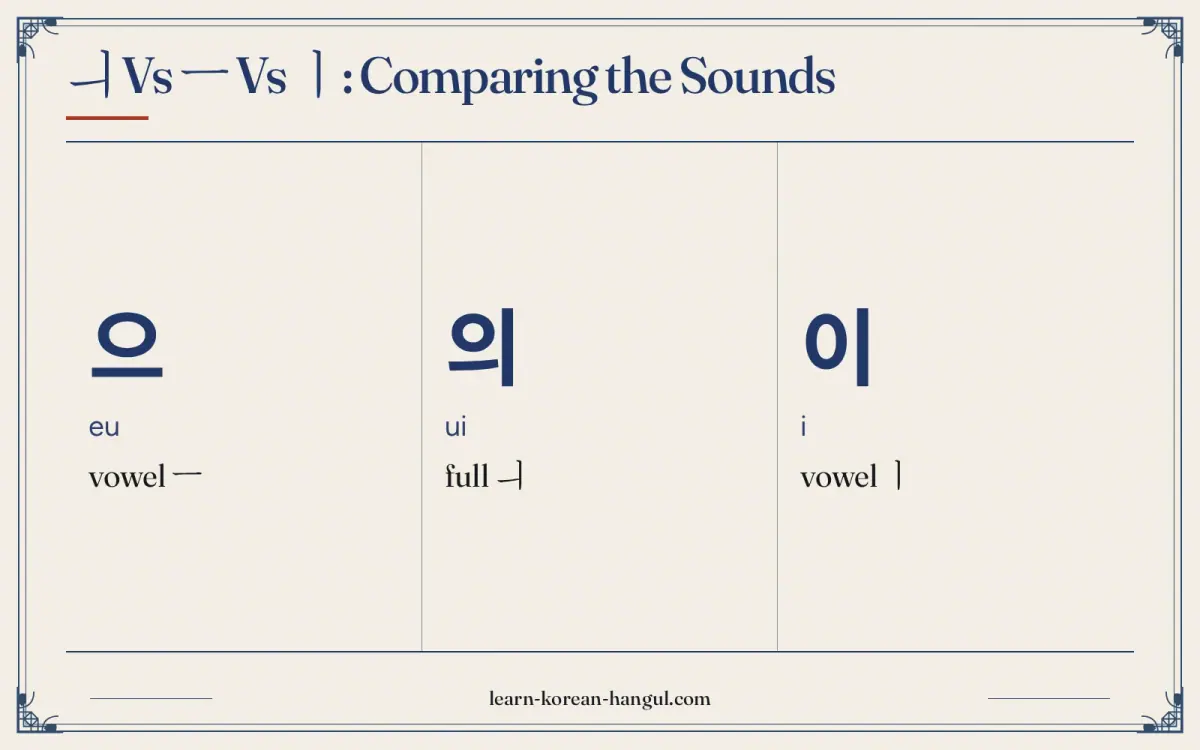
ㅢ is easiest to learn next to its two parts and next to ㅔ, the sound used for the particle. Listen to each, then to the words that use each pronunciation.
Start Dark, End Bright; Lips Spread
| Korean | Romanization | Meaning | Sound |
|---|---|---|---|
| 으 | eu | vowel ㅡ | |
| 의 | ui | full ㅢ | |
| 이 | i | vowel ㅣ |
Three Positions, Three Pronunciations
| Korean | Romanization | Meaning | Sound |
|---|---|---|---|
| 의사 | uisa | doctor [의] | |
| 희망 | huimang | hope [이] | |
| 우리의 | uriui | our [에] |
| Sound | Where you hear it | Example | Written |
|---|---|---|---|
| [의] | first syllable, no consonant | [의사] | 의사 |
| [이] | after a consonant; optional in later syllables | [히망], [회이] | 희망, 회의 |
| [에] | optional for the particle 의 | [우리에] | 우리의 |
The particle pronunciation has a history you can see in everyday words. 나의 "my" is pronounced [나의] or [나에], and the contracted form 내 "my" comes from the same combination. Spoken [나에] and written 내 are close relatives. The grammar of 의 as "of" or "'s" is covered in the possessive particle 의.
For mouth positions of all three vowels, compare this lesson with the Korean vowel pronunciation guide. These contrasts explain where learners go wrong.
What Mistakes Do Learners Make with ㅢ?
Most mistakes with ㅢ come from applying one pronunciation everywhere.
Saying [의] after a consonant. Learners often assume 희 is "huee". Actually ㅢ after a consonant is always [이], because Article 5, exception 3, makes it compulsory. Fix: when you see a consonant in the corner, say ㅣ: 희망 [히망], 무늬 [무니], 띄어쓰기 [띠어쓰기].
Reducing word-initial 의 to [이]. Learners who learn the [이] rule sometimes say 의사 as [이사]. Actually the first-syllable 의 keeps the full glide, because the reduction rules apply only after a consonant or outside the first syllable. Fix: practise the pair 의사/이사 until you hear the difference.
Reading the particle as [의] in every sentence. Learners often assume the particle must sound like its spelling. Actually [에] is accepted and is what most people say, because the standard allows it. Fix: say 우리의 as [우리에] in conversation; keep [의] for formal reading.
Trusting romanization. Learners often read "huimang" as "hoo-ee-mang". Actually it is [히망], because romanization writes ㅢ as "ui" in every position. Fix: read the Hangul and apply the test.
Rounding the lips. Learners often start ㅢ with rounded lips, producing a "w" sound. Actually both halves of ㅢ are unrounded. Fix: watch your lips in a mirror; they should not move forward.
Use the exercises below to check each rule.
Practice: Read, Hear and Write
Answers follow the exercises.
Practice · 8
How is 희망 (hope) pronounced?
Show answer
[히망]
ㅢ after a consonant in the same syllable is always [이], so 희망 is said [히망].
How is 의사 (doctor) pronounced in standard Korean?
Show answer
[의사], with the full glide
A first-syllable 의 with no consonant before it keeps the full glide; [이사] would be heard as 이사, moving house.
Which pronunciations are standard for the particle in 우리의 (our)?
Show answer
[우리의] or [우리에]
For the possessive particle 의, [의] is standard and [에] is also accepted.
Which pronunciations are standard for 회의 (meeting)?
Show answer
[회의] or [회이]
For 의 outside the first syllable, both [의] and [이] are accepted.
What is ㅢ built from?
Show answer
ㅡ + ㅣ
ㅢ is ㅡ and ㅣ written together; it is the only compound vowel built on ㅡ.
How does Revised Romanization write 희망?
Show answer
huimang
Revised Romanization writes ㅢ as "ui" even when it is pronounced [ㅣ], so 희망 is huimang.
Which of these must be pronounced with [이], with no other option?
Show answer
무늬
In 무늬 the consonant ㄴ comes before ㅢ, so [무니] is compulsory; the other two have optional pronunciations.
Which stroke of ㅢ do you draw first?
Show answer
ㅡ, from left to right
ㅢ takes two strokes: ㅡ first, then ㅣ down the right side.
Exercise 1: Which pronunciation? Choose [의], [이] or [에] (or two options where both are standard): (a) 의자, (b) 무늬, (c) 회의, (d) 우리의, (e) 희다 "to be white".
Exercise 2: Read aloud. Read 의사, 희망, 무늬, 회의 and 우리의, then check with the audio.
Exercise 3: Write from the sound. You hear [히망] and [무니]. Write the standard spellings.
Exercise 4 (challenge): read the phrase 민주주의의 의의 "the significance of democracy". It contains ㅢ in three different jobs.
Answers
- Exercise 1: (a) [의]: first syllable. (b) [이]: consonant ㄴ before ㅢ. (c) [의] or [이]: non-first syllable. (d) [의] or [에]: particle. (e) [이]: consonant ㅎ, so 희다 is [히다].
- Exercise 2: [의사], [히망], [무니], [회의] or [회이], [우리에] or [우리의].
- Exercise 3: 희망 and 무늬. The sound [이] after a consonant is written ㅢ in these words; you have to know the spelling.
- Exercise 4: 민주주의 ends in a non-first-syllable 의 → [의] or [이]. The next 의 is the particle → [의] or [에]. 의의 starts with a first-syllable 의 → [의], and its second 의 is non-first → [의] or [이]. A natural everyday reading is [민주주이에 의이]; a careful reading keeps every [의].
Review ㅢ in the Hangul flashcard decks, test the three pronunciations in the Hangul quizzes, and build 의, 희 and 늬 in the Hangul syllable builder. The interactive Hangul alphabet plays ㅢ on tap.
What to Learn Next after the Korean Vowel ㅢ
After the Korean vowel ㅢ, you have seen every type of vowel shape: vertical, horizontal and mixed. Next, practise placing mixed vowels inside blocks in mixed-vowel blocks. To review ㅢ alongside its relatives, return to Korean compound vowels.
What this lesson covers and doesn't: this page teaches the build, the full sound, the three standard pronunciations and the writing of ㅢ. It does not teach the grammar of the particle 의 in depth, regional pronunciations, or optional reductions in very fast speech beyond the standard rules. Where the standard allows two pronunciations, this page shows both and labels the everyday one.
Frequently Asked Questions about ㅢ
Is 의사 pronounced "uisa" or "isa"? The standard pronunciation is [의사], with the full glide from ㅡ to ㅣ, because 의 is the first syllable and has no consonant before it. "Isa" would be heard as 이사, which means "moving house" or "company director". In fast casual speech the glide can be short, but aim for a clear 의 in this word.
Why does 회의 sound like 회이? In 회의 "meeting", the 의 is not the first syllable of the word. For 의 in a non-first syllable, the Standard Pronunciation rules accept both [의] and [이], so [회의] and [회이] are both correct. Most speakers use the easier [이] in normal speech. The spelling stays 회의 either way.
Is it wrong to pronounce the particle 의 as 의? No. For the possessive particle 의, the standard pronunciation is [의] and [에] is also accepted. In everyday speech [에] is far more natural, so 우리의 "our" is usually heard as [우리에]. Saying [의] is correct but sounds careful or formal, as in a speech or a news report.
How do I write ㅢ in a block? ㅢ wraps around the consonant. Write the consonant in the top-left corner, then draw ㅡ underneath it, then draw ㅣ down the right side. In 의 the silent ㅇ fills the corner; in 희 it is ㅎ. If there is a final consonant, it goes at the bottom, under both parts of the vowel.
Why is 희 pronounced like 히? Whenever ㅢ follows a real consonant in the same syllable, the Standard Pronunciation rules say it is pronounced [ㅣ]. 희 starts with the consonant ㅎ, so 희망 "hope" is said [히망]. This is a requirement, not an option, which makes it the easiest of the three ㅢ rules to apply: consonant plus ㅢ always sounds like ㅣ.