
What you'll learn
- Pronounce ㅐ and ㅔ as one steady [e]-like vowel.
- Write ㅐ and ㅔ in 3 strokes each without mixing up the shapes.
- Choose the correct spelling in 10 high-frequency words, such as 개/게, 내/네 and 새/세.
- Explain why casual Korean says 니가 for "you".
Before you start: know the vowel ㅏ, the vowel ㅓ, and the vowel ㅣ. Time: about 25 minutes, including practice.
Key facts about ㅐ and ㅔ
- Build: ㅐ = ㅏ + ㅣ; ㅔ = ㅓ + ㅣ.
- Standard: Standard Pronunciation Article 4 lists them as two of the ten monophthongs (single vowels).
- Everyday sound: most Seoul speakers merge them into one vowel, close to "e" in "bed".
- Romanization: ㅐ = "ae", ㅔ = "e".
- Alone: 애 and 에.
- Keyboard: ㅐ is the O key, ㅔ is the P key on the standard 2-beolsik layout.
What Sound Do ㅐ and ㅔ Make?
ㅐ and ㅔ both make a single, steady front vowel close to the "e" in "bed" or "get", for most speakers today. The lips are relaxed and slightly spread, the jaw is half open, and the tongue is forward in the mouth. There is no glide: the sound does not slide toward "ay" as in "day".
The official description is more precise. The Standard Pronunciation rules (표준 발음법), published by the National Institute of Korean Language (국립국어원), list ㅐ and ㅔ separately among the ten monophthongs in Article 4. In careful standard speech, ㅐ is a little more open, roughly [ɛ] as in "bed", and ㅔ a little more closed, roughly [e] as in French "été". In everyday Seoul speech, especially among people under middle age, this difference has largely disappeared. Linguists call this a vowel merger: two sounds that once differed are now pronounced alike.
How Are ㅐ and ㅔ Built from Simpler Vowels?
ㅐ and ㅔ are built by adding the vowel ㅣ to two basic vowels. This construction is your best memory hook for the shapes.
| Letter | Built from | Visual check | Romanization |
|---|---|---|---|
| ㅐ | ㅏ + ㅣ | short stroke points inward, between two verticals | ae |
| ㅔ | ㅓ + ㅣ | short stroke points outward, to the left of both verticals | e |
The Hunminjeongeum Haerye (1446) describes such letters as combined vowels. When they were created, they were real two-part sounds, roughly "a-i" and "eo-i". Over the following centuries each one fused into a single vowel, which is why the shape shows two parts but the sound has one.
Now that you know the sound and the build, here is how to produce it reliably.
How to Pronounce the Korean Vowel ㅐ Step by Step
You pronounce the Korean vowel ㅐ, and ㅔ, in four steps. These steps give the merged everyday sound that most learners should aim for.
- Open the jaw halfway, about the opening for English "eh".
- Spread the lips slightly, as if starting a small smile. Do not round them.
- Push the tongue forward, with its tip resting behind the lower front teeth.
- Hold the vowel steady. Do not let it rise into "ay" at the end.
You'll know it worked when 애 sounds like a short, clean "eh" with no tail. The most common mistake at step 4 is gliding into "ay", which makes 게 sound like the English word "gay". Keep the tongue still from start to finish.
Expert insight: do not try to invent a difference you cannot hear. Learners who force ㅐ toward the "a" of "cat" sound foreign, because even in careful standard speech ㅐ is only slightly more open than ㅔ. One clean "e" for both letters is closer to real speech.
What Did ㅐ and ㅔ Sound Like Originally?
In 15th-century Korean, ㅐ and ㅔ were diphthongs, gliding vowels roughly like "ai" and "eoi". Their shapes record those two parts. Later they became single vowels with two distinct qualities, which the 1988 standard still describes. In the past few decades those two qualities have merged for most speakers. The spelling has stayed the same throughout, so modern Korean spelling preserves a sound difference that most people no longer make.
Knowing how to say the vowel prepares you to read whole words, letter by letter.
Worked Example: Reading 개 and 게
Reading 개 and 게 shows both the shared sound and the spelling difference.
개 (gae) "dog"
- Find the consonant: ㄱ on the left.
- Find the vowel: ㅐ on the right. The short stroke sits between the two verticals.
- Say ㄱ + the "e" vowel: 개.
게 (ge) "crab"
- Find the consonant: ㄱ on the left.
- Find the vowel: ㅔ on the right. The short stroke sits to the left of both verticals.
- Say ㄱ + the same "e" vowel: 게.
Both blocks sound the same for most speakers. The spelling carries the meaning. Like all vertical vowels, ㅐ and ㅔ sit to the right of the consonant, as explained in how syllable blocks are shaped.
How to Write ㅐ and ㅔ
Each letter takes three strokes, top to bottom and left to right:
| Stroke | ㅐ (ae) | ㅔ (e) |
|---|---|---|
| 1 | left vertical, top to bottom | short horizontal, left to right |
| 2 | short horizontal from the left vertical, to the right | left vertical, top to bottom |
| 3 | right vertical, top to bottom | right vertical, top to bottom |
Practise on Paper Practise on Paper
On the standard Korean keyboard (2-beolsik), ㅐ is the O key and ㅔ is the P key. Hold Shift with them to get ㅒ and ㅖ.
Because the sound no longer tells you which letter to use, the next section looks at what still separates them.
ㅐ vs ㅔ: Can You Hear a Difference?
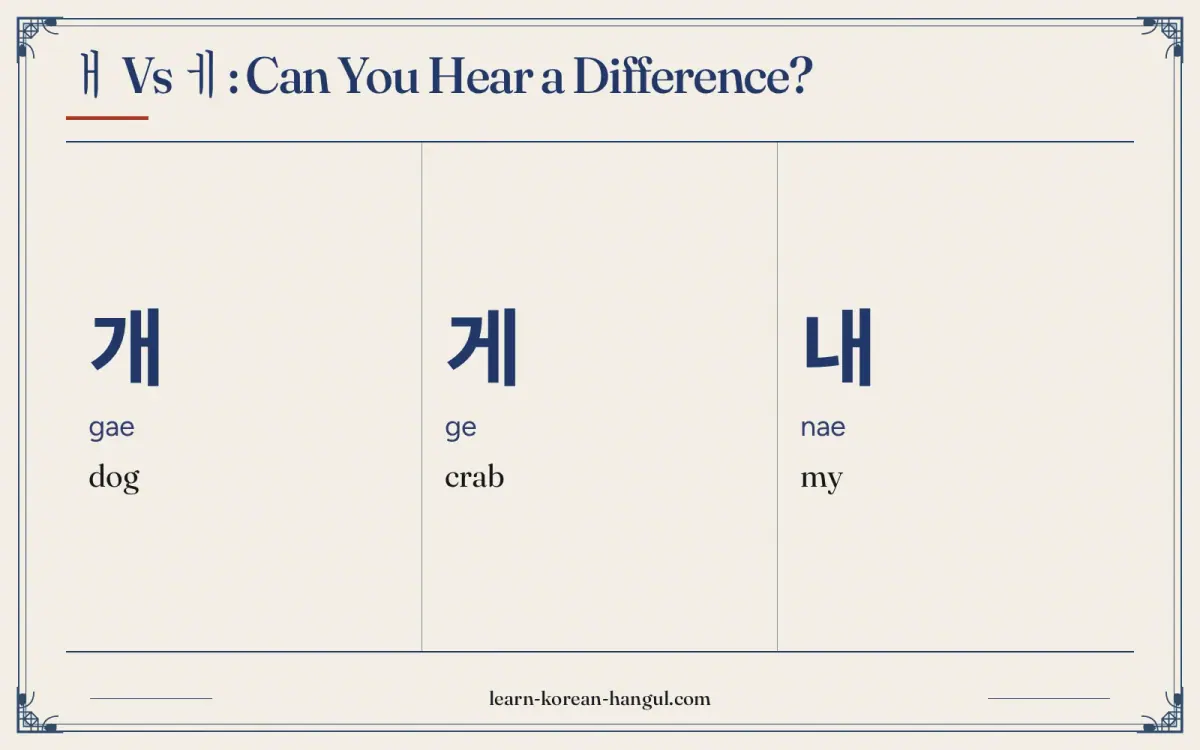
For most present-day Seoul speakers, no: ㅐ and ㅔ sound the same in normal speech. You may hear a small difference from some older speakers, trained broadcasters and speakers of some regional varieties, who keep ㅐ slightly more open than ㅔ. Listen to the pairs below. The recordings use everyday pronunciation, so expect them to sound alike.
Same Sound for Most Speakers; Meaning Decides
| Korean | Romanization | Meaning | Sound |
|---|---|---|---|
| 개 | gae | dog | |
| 게 | ge | crab |
Same Sound for Most Speakers; Meaning Decides
| Korean | Romanization | Meaning | Sound |
|---|---|---|---|
| 내 | nae | my | |
| 네 | ne | yes; your |
Same Sound for Most Speakers; Meaning Decides
| Korean | Romanization | Meaning | Sound |
|---|---|---|---|
| 새 | sae | bird; new | |
| 세 | se | three (before a counter) |
Since your ear cannot decide, your memory must. The table below lists ten high-frequency words and the spelling to memorise.
| Word | Letter | RR | Meaning | Memory hook |
|---|---|---|---|---|
| 개 | ㅐ | gae | dog | the common pet takes the common shape |
| 게 | ㅔ | ge | crab | seafood dishes: 게장, 꽃게 |
| 내 | ㅐ | nae | my (casual) | short for 나의, from 나 "I" (ㅏ → ㅐ) |
| 네 | ㅔ | ne | yes; your (casual) | "your" is short for 너의, from 너 "you" (ㅓ → ㅔ) |
| 새 | ㅐ | sae | bird; new | 새해 "new year" |
| 세 | ㅔ | se | three (before a counter) | 세 개 "three items" |
| 배 | ㅐ | bae | pear; stomach; boat | three meanings, one spelling |
| 노래 | ㅐ | norae | song | 노래방 "karaoke room" |
| 카메라 | ㅔ | kamera | camera | English "e" in loanwords usually becomes ㅔ |
| 세계 | ㅔ | segye | world | both syllables use the ㅔ shape |
Two of these hooks follow a real pattern. 내 "my" comes from 나 "I" plus the old possessive ending, so it keeps the ㅏ shape inside ㅐ. 네 "your" comes from 너 "you", so it keeps the ㅓ shape inside ㅔ. If you know the pronoun, you know the letter.
The merger has one well-known effect on everyday speech. In casual Korean, 내가 means "I" (as a subject) and 네가 means "you" (as a subject). Spoken aloud, they sound identical. To avoid confusion, many speakers say 니가 for "you" in casual conversation. 니가 is a spoken form; standard writing keeps 네가.
A Spelling Clue in English Loanwords
English loanwords give you a reliable clue. Korean loanword spelling rules (외래어 표기법) write the English "a" of "cat" with ㅐ and the English "e" of "bed" with ㅔ. So if you know the English source word, you can usually predict the letter:
- "a" as in "cat" → ㅐ: 택시 "taxi", 캠프 "camp", 팬 "fan".
- "e" as in "bed" → ㅔ: 메뉴 "menu", 호텔 "hotel", 카메라 "camera".
The clue fails for native Korean words, which have no English source, so treat it as a help for loanwords only.
A three-way merger of the same kind affects ㅙ, ㅚ and ㅞ, so the spelling strategy you build here will help again later. With the sound settled, the remaining problems are about expectations and spelling.
What Mistakes Do Learners Make with ㅐ and ㅔ?
The main mistakes with ㅐ and ㅔ come from expecting the romanization or the textbook to match everyday speech.
Saying ㅐ like "a" in "cat". Learners often assume "ae" means the English "a" in "cat". Actually ㅐ is an "e" sound, because "ae" is a romanization label for ㅏ + ㅣ, not a pronunciation guide. Fix: read 개 as "geh", not "gat" without the t.
Gliding to "ay". Learners often assume 게 sounds like English "gay". Actually ㅔ has no glide, because Korean monophthongs hold one tongue position. Fix: stop the vowel cleanly; imagine cutting it short.
Trying to hear the spelling. Learners often assume they can learn ㅐ vs ㅔ by ear. Actually most speakers make no difference, because the two sounds have merged. Fix: learn spelling with meaning, as in the table above, and check new words in a dictionary.
Swapping the shapes in writing. Learners often draw ㅔ when they mean ㅐ. Actually the position of the short stroke decides: inward between the lines for ㅐ, outward on the left for ㅔ. Fix: think "ㅏ + ㅣ" and "ㅓ + ㅣ" as you write.
Expert insight: native speakers also misspell ㅐ/ㅔ words, because they face the same merger you do; they simply memorised more spellings. Expect to look words up for months. That is normal, not a sign of a bad ear.
Practice is the place to check that these fixes work.
Practice: Read, Hear and Write
Do these three exercises. Answers are below.
Practice · 8
How do most present-day Seoul speakers pronounce ㅐ and ㅔ?
Show answer
As one vowel, close to the "e" in "bed"
ㅐ and ㅔ have merged for most speakers into one steady vowel close to the "e" in "bed".
Which word means "dog"?
Show answer
개
개 (ㅐ) means dog; 게 (ㅔ) means crab. The spelling, not the sound, carries the meaning.
What is ㅔ built from?
Show answer
ㅓ + ㅣ
ㅔ = ㅓ + ㅣ, with the short stroke pointing outward; ㅐ = ㅏ + ㅣ.
Which word means "my" (casual)?
Show answer
내
내 comes from 나 "I", so it keeps the ㅏ shape inside ㅐ; 네 comes from 너 "you".
An English loanword with the "e" of "bed", such as 메뉴 (menu), is usually written with which vowel?
Show answer
ㅔ
Loanword spelling writes the "e" of "bed" with ㅔ (메뉴, 호텔) and the "a" of "cat" with ㅐ (택시).
In standard writing, which form means "you" as a casual subject?
Show answer
네가
Standard writing keeps 네가; 니가 is a spoken form, and 내가 means "I".
How many strokes does ㅐ take to write?
Show answer
3
ㅐ is three strokes: left vertical, short horizontal, then right vertical.
What does the romanization "ae" for ㅐ show?
Show answer
The letter is built from ㅏ + ㅣ
Revised Romanization follows the letter: "ae" labels ㅏ + ㅣ and is not a pronunciation guide.
Exercise 1: Pick by meaning. You hear a sentence. Choose the spelling that fits.
(a) Is the word 개 or 게?
(b) Is the word 개 or 게?
Exercise 2: Read aloud. Read these words with one steady "e" vowel each: 새, 세, 노래, 카메라, 세계.
Exercise 3: Write the word. Write the Korean for: (a) dog, (b) my, (c) yes, (d) song, (e) three items (세 + 개).
Answers
- Exercise 1: (a) 개가 있어요 "There is a dog", so 개. (b) 게를 먹어요 "I eat crab", so 게. The meaning, not the sound, chose the spelling.
- Exercise 2: every word has the same "e" vowel. 세계 has two: 세 and the ㅖ of 계, which many speakers also say as "e".
- Exercise 3: (a) 개, (b) 내, (c) 네, (d) 노래, (e) 세 개.
Spelling choices like 개 vs 게 are trained further in Korean dictation practice. Review both letters in the Hangul flashcard decks, test yourself in the Hangul quizzes, or build 개, 게, 내 and 네 in the Hangul syllable builder. The interactive Hangul alphabet plays every vowel on tap.
What to Learn Next after ㅐ and ㅔ
After the Korean vowel ㅐ and its twin ㅔ, continue to the vowels ㅒ and ㅖ. They are ㅐ and ㅔ with one extra stroke and a "y" glide, and they show the same merger. For the full family of vowels built by combining letters, see Korean compound vowels. For mouth positions across all vowels, compare this lesson with the Korean vowel pronunciation guide.
What this lesson covers and doesn't: this page teaches the sound, shapes, spelling strategy and the 니가 effect for ㅐ and ㅔ. It does not teach the careful broadcast distinction in detail, regional pronunciations, or the full grammar of 내가 and 네가. The merger statement describes typical present-day Seoul speech; individual speakers vary, and the standard rules have not been changed.
Frequently Asked Questions about ㅐ and ㅔ
Should I learn to pronounce ㅐ and ㅔ differently? No, not as a beginner. Most Seoul speakers under middle age say both as one vowel close to the "e" in "bed", and you will be understood if you do the same. Focus on spelling instead: learn each word with its correct letter. You can study the careful standard distinction later if you train as an announcer or teacher.
How do Koreans tell 개 and 게 apart? Mostly through context. 개 "dog" and 게 "crab" rarely appear in the same sentence, so the meaning decides. When there is real doubt, speakers add a word or spell it out, for example saying "the ㅐ in 개" or naming the animal more fully. In writing there is no problem, because the spellings differ.
Why is ㅐ romanized "ae"? Revised Romanization (2000) follows the letter, not the modern sound. ㅐ is built from ㅏ (a) and ㅣ, so it is written "ae", and ㅔ is built from ㅓ (eo) and ㅣ, so it is written "e". The spelling "ae" does not mean the English "a" in "cat". It keeps the two letters distinct in place names such as Daegu.
Is ㅐ a compound vowel or a simple vowel? Both, depending on what you look at. In writing, ㅐ is a compound letter made from ㅏ plus ㅣ. In sound, it is a single steady vowel with no glide, and the Standard Pronunciation rules list it among the ten monophthongs. Textbooks usually teach it with the compound vowels because of its shape.
Why do Koreans say 니가 for "you"? The standard form is 네가, "you" as a subject in casual speech. Because ㅐ and ㅔ sound the same for most speakers, 네가 "you" and 내가 "I" became hard to tell apart. Many speakers therefore say 니가 for "you" in casual conversation. 니가 is spoken usage; in writing and formal speech use 네가.