
What you'll learn
- Pronounce ㅖ and ㅒ as one "ye" sound, [je].
- Apply the rule that ㅖ after most consonants may sound like ㅔ: 시계 [시계/시게].
- Name the two syllables that always keep the glide: 예 and 례.
- Read 예, 예쁘다, 얘기 and 시계 aloud and write ㅒ and ㅖ in 4 strokes.
Before you start: learn ㅐ and ㅔ first, because ㅒ and ㅖ are those vowels with a y-glide. Time: about 20 minutes.
Key facts about ㅒ and ㅖ
- Build: ㅒ = ㅑ + ㅣ; ㅖ = ㅕ + ㅣ.
- Type: diphthongs, listed among the 11 in Standard Pronunciation Article 5.
- Sound: "ye" as in "yes" for both letters, for most speakers.
- Rule: except in 예 and 례, ㅖ may also be said as [ㅔ].
- Frequency: ㅒ appears mainly in 얘, 걔, 쟤 and 얘기.
- Romanization: ㅒ = "yae", ㅖ = "ye".
What Sound Do ㅒ and ㅖ Make?
ㅒ and ㅖ make the sound "ye" as in "yes": a short y-glide followed by the "e" vowel of ㅐ and ㅔ. Linguists write it [je]. A diphthong is a vowel that changes quality as you say it, and here the change is from a "y" position into "e". For most present-day speakers the two letters sound identical; compare 얘 and 예 with the buttons at the top of this lesson.
The Standard Pronunciation rules (표준 발음법) of the National Institute of Korean Language list ㅒ and ㅖ among the 11 diphthongs in Article 5. In a careful standard description, ㅒ glides into the slightly more open ㅐ and ㅖ into the slightly closer ㅔ. Because ㅐ and ㅔ have merged for most speakers, ㅒ and ㅖ have merged too.
How Are ㅒ and ㅖ Built from Simpler Vowels?
ㅒ and ㅖ are built by adding ㅣ to the y-vowels ㅑ and ㅕ. Each one is also ㅐ or ㅔ with one extra short stroke, and that extra stroke is the "y".
| Letter | Built from | Compare with | Extra stroke means | RR |
|---|---|---|---|---|
| ㅒ | ㅑ + ㅣ | ㅐ | y-glide | yae |
| ㅖ | ㅕ + ㅣ | ㅔ | y-glide | ye |
This logic runs through Hangul: a second short stroke on ㅏ makes ㅑ, and one on ㅓ makes the vowel ㅕ. Here the same doubled stroke turns ㅐ into ㅒ and ㅔ into ㅖ.
The build tells you what to do with your mouth, which the next section turns into steps.
How to Pronounce the Korean Vowel ㅖ Step by Step
You pronounce the Korean vowel ㅖ, and ㅒ, in four steps:
- Start with the tongue high and forward, as for the vowel ㅣ (ee).
- Glide quickly down and slightly back, as you do at the start of "yes".
- Land on the "e" vowel of ㅔ, jaw half open, lips relaxed.
- Hold the "e" steadily. The glide is short; the vowel is the main part.
You'll know it worked when 예 sounds like the first part of "yes" without the s. The most common mistake is making the glide too long, which sounds like "ee-eh" in two syllables. Keep the "y" brief.
What Is 예 Compared with 네?
예 is a polite, slightly formal "yes"; 네 is the everyday polite "yes". Both are correct in polite speech. 예 sounds more deferential and is common when answering a teacher, a senior colleague or a customer. 네 is what you hear most in shops, on the phone and among colleagues. Both words appear in polite Korean phrases.
With the sound in place, you can decode whole words.
Worked Example: Reading 예쁘다 and 얘기
Two words show both letters in use: 예쁘다 for ㅖ and 얘기 for ㅒ.
예쁘다 (yeppeuda) "to be pretty"
- 예 = silent ㅇ + ㅖ → "ye". The ㅇ only fills the consonant slot.
- 쁘 = ㅃ (tense p) + ㅡ → "ppeu".
- 다 = ㄷ + ㅏ → "da".
- Together: 예쁘다. The 예 keeps its glide: it is one of the two exception syllables.
얘기 (yaegi) "story, talk"
- 얘 = silent ㅇ + ㅒ → "yae", which sounds like "ye".
- 기 = ㄱ + ㅣ → "gi".
- Together: 얘기, a shortened form of 이야기 "story". 이야 contracts to 얘.
ㅒ and ㅖ sit to the right of the consonant, like all vertical vowels; see how syllable blocks are shaped.
Where ㅒ Actually Appears
ㅒ is rare. Nearly every word you will meet with ㅒ is a contraction:
| Word | Full form | Meaning |
|---|---|---|
| 얘 | 이 아이 | this person, this kid (casual) |
| 걔 | 그 아이 | that person (near you, or already mentioned) |
| 쟤 | 저 아이 | that person over there |
| 얘기 | 이야기 | story, talk |
Learn these four and you will recognise almost every ㅒ in beginner material. ㅖ is far more common, especially in Sino-Korean words (words built from Chinese characters) such as 계산, 세계 and 예약.
How to Write ㅒ and ㅖ
Each letter takes four strokes, top to bottom and left to right:
| Stroke | ㅒ (yae) | ㅖ (ye) |
|---|---|---|
| 1 | left vertical | upper short horizontal |
| 2 | upper short horizontal, to the right | lower short horizontal |
| 3 | lower short horizontal, to the right | left vertical |
| 4 | right vertical | right vertical |
Practise on Paper Practise on Paper
On the standard 2-beolsik keyboard, type ㅒ with Shift + O and ㅖ with Shift + P, the shifted keys of ㅐ and ㅔ.
Reading 예 is easy because it keeps its glide; most other ㅖ syllables follow a looser rule.
ㅖ vs ㅔ after a Consonant
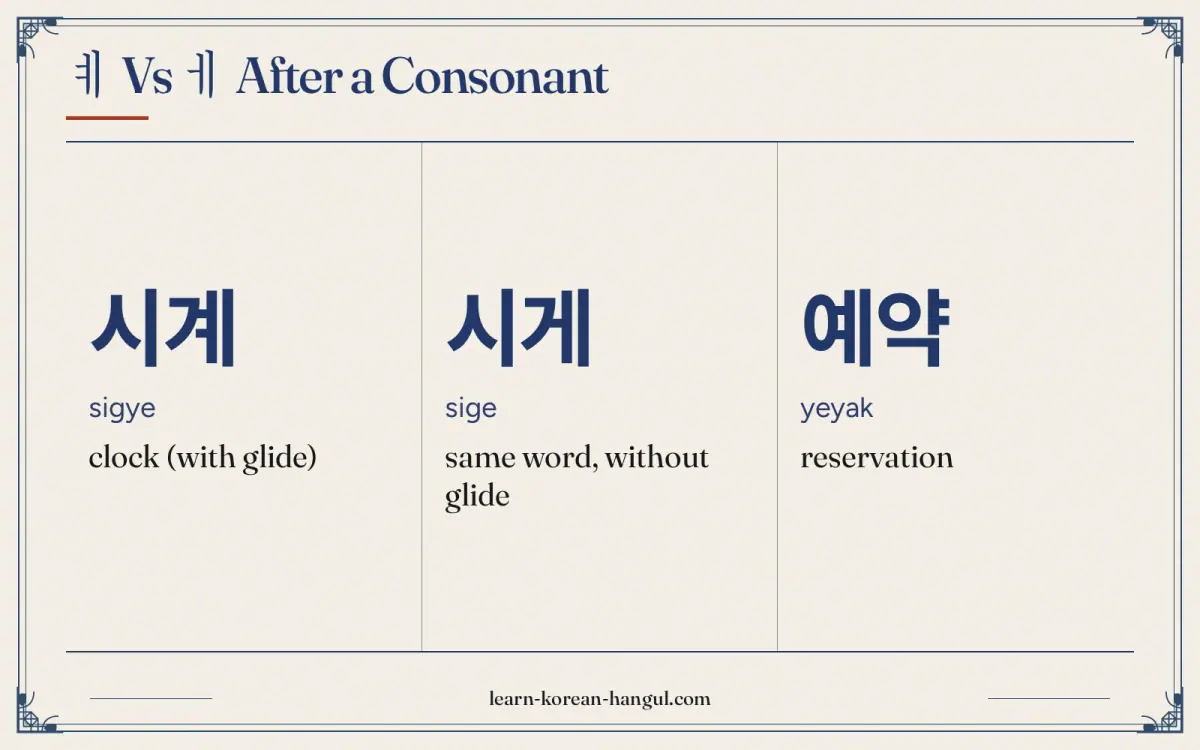
After most consonants, ㅖ may be pronounced either with its glide or as plain ㅔ. The Standard Pronunciation rules, Article 5, exception 2, state that ㅖ in syllables other than 예 and 례 may also be pronounced [ㅔ]. Both pronunciations are standard.
Both Accepted; Spelling Stays 시계
| Korean | Romanization | Meaning | Sound |
|---|---|---|---|
| 시계 | sigye | clock (with glide) | |
| 시게 | sige | same word, without glide |
예 and 례 Keep the Glide
| Korean | Romanization | Meaning | Sound |
|---|---|---|---|
| 예약 | yeyak | reservation | |
| 차례 | charye | turn, order |
| Written | Accepted pronunciations | Meaning | Keeps the glide? |
|---|---|---|---|
| 시계 | [시계] or [시게] | clock, watch | optional |
| 계산 | [계산] or [게산] | calculation; the bill | optional |
| 혜택 | [혜택] or [헤택] | benefit | optional |
| 예약 | [예약] | reservation | yes: 예 |
| 차례 | [차례] | turn, order | yes: 례 |
| 실례 | [실례] | rudeness (실례합니다 "excuse me") | yes: 례 |
A common explanation is ease of speech. After a consonant such as ㄱ, ㅅ or ㅎ, the quick "y" is hard to hear and easy to drop, so speakers drop it. In 예, there is no consonant before the glide, so the "y" is the only thing that makes the syllable different from 에; dropping it would change the word. 례 is the other syllable the rule names.
More ㅖ Words You Will Meet Early
ㅖ is common in Sino-Korean vocabulary, so the rule above applies to many beginner words. Use this list to practise deciding, word by word, whether the glide is optional.
| Word | RR | Meaning | Glide |
|---|---|---|---|
| 계속 | gyesok | continuously; continuation | optional: [계속/게속] |
| 계단 | gyedan | stairs | optional |
| 세계 | segye | world | optional in 계 |
| 지혜 | jihye | wisdom | optional: [지혜/지헤] |
| 예술 | yesul | art | kept: 예 |
| 예정 | yejeong | plan, schedule | kept: 예 |
| 사례 | sarye | example, case | kept: 례 |
Two patterns stand out. Every word that starts with 예 keeps the glide, because 예 is a named exception. Every 례 keeps it too, which matters in common words such as 차례, 실례 and 사례. For all other ㅖ syllables, such as 계, 혜 and 폐, both pronunciations are standard.
How Romanization Handles ㅖ
Revised Romanization writes ㅖ as "ye" in every position, whether or not a speaker pronounces the glide. 시계 is "sigye", 계산 is "gyesan" and 세계 is "segye". This follows the rule that romanization shows the standard form rather than every optional pronunciation. ㅒ is written "yae", so 얘기 is "yaegi", even though it sounds the same as "ye". If you see "ye" or "yae" in romanization, read both as the "ye" of "yes".
Expert insight: for listening, expect [게] for 계 in fast speech. For writing, never follow the sound: 시계 is always spelled with ㅖ. Writing 시게 for 시계 after hearing [시게] is a typical beginner slip with this vowel.
Knowing the rule makes the typical mistakes easy to predict.
What Mistakes Do Learners Make with ㅒ and ㅖ?
Most mistakes with ㅒ and ㅖ come from treating the spelling as an exact sound guide, or the sound as an exact spelling guide.
Over-studying ㅒ. Learners often assume ㅒ is as common as ㅖ. Actually ㅒ appears in only a handful of everyday words, because most of them are contractions of 이 아이, 그 아이, 저 아이 and 이야기. Fix: learn 얘, 걔, 쟤 and 얘기, then move on.
Forcing the glide everywhere. Learners often assume every ㅖ must sound "ye". Actually ㅖ after a consonant may be plain [ㅔ], because the standard allows both. Fix: say 시계 as [시게] in normal speech if that is easier; both are correct.
Dropping the glide in 예 and 례. Learners who learn the rule sometimes over-apply it. Actually 예 and 례 always keep the glide, because they are the named exceptions. Fix: 예약 is [예약], never [에약]; 차례 is [차례].
Reading "yae" as "yay". Learners often read the romanization "yae" in 얘기 (yaegi) as the English "yay", with a glide at the end. Actually ㅒ is "ye" with a steady vowel, because the romanization only labels the letters ㅑ + ㅣ. Fix: read 얘기 as "ye-gi", the same vowel as in 예.
Spelling by ear. Learners often write 시게 after hearing [시게]. Actually the spelling is fixed as 시계, because Korean spelling records the word's form, not every variant of its sound. Fix: learn ㅖ words with their spelling.
Short drills below check each point.
Practice: Read, Hear and Write
Answers follow the exercises.
Practice · 8
For most present-day speakers, how do ㅒ and ㅖ compare in sound?
Show answer
They sound the same, "ye" as in "yes"
Because ㅐ and ㅔ have merged for most speakers, ㅒ and ㅖ have merged too: both are [je].
Which two syllables always keep the y-glide of ㅖ?
Show answer
예 and 례
Standard Pronunciation Article 5 lets ㅖ be said as [ㅔ] except in the syllables 예 and 례.
Which pronunciations of 시계 (clock) are standard?
Show answer
Both [시계] and [시게]
ㅖ after a consonant may keep or drop its glide, so both [시계] and [시게] are standard.
How is 예약 (reservation) pronounced?
Show answer
[예약]
예 is a named exception and always keeps its glide, so 예약 is [예약], never [에약].
How do you spell the word for "clock" after hearing [시게]?
Show answer
시계
The spelling is fixed as 시계 with ㅖ, whichever way the word is pronounced.
얘기 (story, talk) is a shortened form of which word?
Show answer
이야기
이야 contracts to 얘, so 얘기 is short for 이야기.
What is ㅖ built from?
Show answer
ㅕ + ㅣ
ㅖ = ㅕ + ㅣ (ㅔ with an extra y-stroke); ㅒ = ㅑ + ㅣ.
Which pair sounds different for most present-day speakers?
Show answer
예 and 에
예 keeps its glide, so it never sounds like 에; 예/얘 have merged and 계 may drop its glide.
Exercise 1: Keep or drop? Read each word and mark whether the ㅖ syllable must keep the "y" glide or may drop it: (a) 시계, (b) 계산, (c) 차례, (d) 예약.
Exercise 2: Read aloud. Read 예, 예쁘다, 얘기, 시계 and 세계, then compare with the audio.
Exercise 3: Write from dictation. Play the clips for 시계, 얘기 and 차례 above and write each word in Hangul without looking.
Exercise 4: Same or different? For most present-day speakers, which pairs sound the same in normal speech? (a) 예 and 얘, (b) 계 and 게, (c) 예 and 에, (d) 례 and 레.
Answers
- Exercise 1: (a) may drop: [시계/시게]. (b) may drop: [계산/게산]. (c) must keep: 례. (d) must keep: 예.
- Exercise 2: 세계 "world" has ㅔ in the first syllable and ㅖ in the second; many speakers say both as "e": [세게], which the standard also accepts.
- Exercise 3: 시계, 얘기, 차례. If you wrote 시게, the sound misled you; the spelling keeps ㅖ.
- Exercise 4: (a) same: ㅒ and ㅖ have merged. (b) usually the same, because 계 may drop its glide. (c) different: 예 keeps the glide, so it never sounds like 에. (d) different: 례 also keeps the glide. Pairs (c) and (d) are exactly the two exceptions named in Article 5.
Review ㅒ and ㅖ with the other vowels in the Hangul flashcard decks, test whether you can pick them out by sound in the Hangul quizzes, and build 예, 계 and 얘 in the Hangul syllable builder. The interactive Hangul alphabet plays each vowel on tap.
What to Learn Next after ㅖ and ㅒ
After the Korean vowel ㅖ and its twin ㅒ, you have finished the y-vowels. Next, continue with the vowel ㅘ (wa), the first of the w-vowels. To see how ㅒ and ㅖ fit their family, return to Korean y-vowels. For mouth positions across all vowels, compare this lesson with the Korean vowel pronunciation guide.
What this lesson covers and doesn't: this page teaches the sound, shapes and the main pronunciation rule for ㅒ and ㅖ, plus 예 vs 네. It does not cover long-vowel marks in dictionaries, regional speech, or the full politeness system. The merger of ㅒ and ㅖ describes typical present-day speech; the written standard still keeps them as separate letters.
Frequently Asked Questions about ㅒ and ㅖ
Is 시계 pronounced 시게? It can be. The Standard Pronunciation rules give 시계 "clock, watch" two accepted pronunciations: [시계] with the y-glide and [시게] without it. Both are correct, and most speakers in casual speech say [시게]. The spelling never changes: you always write 시계, whichever way you say it.
What is the difference between 예 and 네? Both mean "yes" and both are polite. 예 sounds more formal and deferential, so it suits answering a teacher, a senior colleague or a customer. 네 is the everyday polite "yes" and is far more common in conversation. A beginner can use 네 almost everywhere and will hear 예 in formal settings.
Why does 차례 keep the y sound? The rule that lets ㅖ drop its y-glide names two exceptions: the syllables 예 and 례. 차례 "turn, order" ends in 례, so the standard pronunciation is [차례] with the glide. The same applies to 실례 "rudeness" in 실례합니다 "excuse me". Think of 례 and 예 as the syllables that keep their y.
Do I need to pronounce ㅒ and ㅖ differently? No. For most present-day speakers ㅒ and ㅖ sound the same, a "ye" as in "yes", just as ㅐ and ㅔ sound the same. Learn which letter each word uses, but use one sound for both. Words with ㅒ are few, so memorising them is quick: 얘, 걔, 쟤 and 얘기 cover most cases.
What does 얘 mean? 얘 is the casual short form of 이 아이, literally "this child", and it means "this person" or "this kid" in casual talk. Its partners are 걔 (그 아이, that person near the listener or already mentioned) and 쟤 (저 아이, that person over there). Use them only with friends or about people younger than you.