
What you will learn in about 15 minutes
- Say ㅠ as [ju] and tell it apart from ㅜ and ㅛ by ear.
- Write ㅠ in three strokes and place it under its consonant.
- Read 우유, 휴지, 유리, 뉴스 and 컴퓨터 aloud.
- Explain what ㅠㅠ means in a text message.
Before you start: learn the vowel ㅜ, because ㅠ uses the same lip shape with a quick y-glide in front.
What Sound Does ㅠ Make?
ㅠ makes the sound [ju], which English spellers write “yu”. Say the English word “you” briskly and keep the lips rounded and pushed forward. The sound has two parts: a very short “y”, then a relaxed rounded “u” like the “oo” in “moon”, but shorter.
Listen to three words that contain ㅠ, and repeat them.
Revised Romanization, the government system for writing Korean in Latin letters, spells ㅠ as “yu”. This is one of the more reliable romanizations. The Hangul orthography rules (한글 맞춤법) list ㅠ among the ten basic vowel letters.
How Is ㅠ Built from Simpler Vowels?
ㅠ is ㅜ with a second short stroke. ㅜ has a long horizontal line with one short vertical stroke hanging below it. ㅠ keeps the line and gives it two short strokes hanging below. The extra stroke marks the y-glide, just as it does in ㅑ, ㅕ and ㅛ.
| Plain vowel | Y-vowel | Sound change | Short strokes |
|---|---|---|---|
| ㅏ [a] | ㅑ [ja] | adds a y at the start | 1 → 2, pointing right |
| ㅓ [ʌ] | ㅕ [jʌ] | adds a y at the start | 1 → 2, pointing left |
| ㅗ [o] | ㅛ [jo] | adds a y at the start | 1 → 2, pointing up |
| ㅜ [u] | ㅠ [ju] | adds a y at the start | 1 → 2, pointing down |
The Korean y-vowels overview shows the full pattern. ㅠ is the last of the four basic y-vowels, so once you know it the pattern is complete.
With the sound and the design clear, the next step is to put the letter on paper.
Writing ㅠ: Stroke Order and Typing
Write ㅠ in three strokes: one long horizontal line, then two short vertical strokes hanging below it, left one first. The rule is top before bottom and left before right, so the line goes down first and the two short strokes follow. Keep them parallel, the same length, and evenly spaced.
Practise on Paper
- Draw the long horizontal line from left to right.
- Draw the left short vertical stroke downward from the line.
- Draw the right short vertical stroke downward, parallel to the first.
- Draw the long horizontal line from left to right.
- Draw the left short vertical stroke downward from the line.
- Draw the right short vertical stroke downward, parallel to the first.
You will know it worked when the two short strokes are the same length and hang straight down from the line. A common mistake is spreading them too far apart, which makes the letter look wide and unbalanced. Another is making them point up, which gives ㅛ.
Guides differ slightly on stroke order for some letters. The Hangul stroke order lesson explains the convention used on this site.
To type ㅠ on a computer with the standard Korean keyboard, press the B key without Shift. To type 유, press D for the silent ㅇ, then B. The how to type in Korean guide shows the whole layout. Because ㅠ is a horizontal vowel, the consonant always sits above it, as in 휴 and 규.
Knowing the shape, the next question is how to produce the sound.
How to Pronounce the Korean Vowel ㅠ Step by Step
To pronounce the Korean vowel ㅠ, start from the “ee” tongue position, then round and push your lips forward into a relaxed “oo”. The lips do the main work. Follow these steps with a mirror.
- Smile slightly and touch the tip of your tongue behind your lower front teeth, as for “ee”.
- Start voicing a very short “y” with the front of the tongue raised.
- At once, round and push your lips forward into a small circle.
- Let the tongue body move back toward the “oo” position.
- Hold the rounded “oo” briefly, then stop.
You will know it worked when your lips end clearly rounded and the sound matches the clip above. The first part is a glide, a very short vowel-like sound that leads into the main vowel.
What Does the Y-Glide Feel Like?
The y-glide is a quick slide of the tongue from the high front of the mouth, with the lips preparing to round. In ㅠ, the tongue starts at the same high-front place as ㅣ and then moves back as the lips close into a circle. A two-step check works well: say 이 (the vowel ㅣ) and then 우 (ㅜ), then try to join them into 유 in one smooth movement. The result is ㅠ.
The next question is where else you will see this letter outside normal words.
Why Do Texts Use ㅠㅠ?
ㅠㅠ is a text-message emoticon for crying: the two ㅠ letters look like two eyes with tears running down. It is one of the few places where Koreans use a single letter, a jamo, outside a syllable block. The same idea gives ㅜㅜ, a slightly smaller crying face, and ㅋㅋ for laughter.
When you see ㅠㅠ at the end of a message, read it as an emotion, not as a sound. For example, “시험 끝났어요 ㅠㅠ” could mean “The exam is over, and I am crying (from relief or exhaustion)”. This is informal usage and fits friendly texts and comments, not formal writing.
Recognising it is a real reading win, because you can now read part of the internet that learners usually skip. Next, look at how ㅠ appears in English loanwords.
Which English Loanwords Use ㅠ?
Korean writes the English sounds “yoo” and “ew” after a consonant with ㅠ. That is why “computer” is 컴퓨터: the “pyoo” becomes 퓨. The same logic gives “news” as 뉴스 and “YouTube” as 유튜브. Spotting the English “yoo” sound lets you predict the spelling.
| English word | Korean spelling | Sound | Why ㅠ |
|---|---|---|---|
| news | 뉴스 | [뉴스] | “nyoo” sound |
| computer | 컴퓨터 | [컴퓨터] | “pyoo” sound |
| YouTube | 유튜브 | [유튜브] | “yoo” and “tyoo” |
| menu | 메뉴 | [메뉴] | “nyoo” at the end |
| uniform | 유니폼 | [유니폼] | “yoo” at the start |
A practical tip: when you meet a long, unfamiliar Korean word on a sign or menu, sound it out slowly and listen for an English word hiding inside. With 컴퓨터 and 메뉴, saying the blocks aloud is usually enough to reveal “computer” and “menu”.
Loanword spellings follow the official foreign-word rules (외래어 표기법), maintained by the National Institute of Korean Language. A few of these spellings have more than one form in everyday use, so check a dictionary when in doubt.
Worked Example: Reading Words with ㅠ
Reading a block means asking three questions: what is the first consonant, which vowel is it, and is there a final consonant. Here is 우유 (milk), decoded step by step.
- The first block is 우: silent ㅇ on top, ㅜ underneath. You hear [u].
- The second block is 유: silent ㅇ on top, ㅠ underneath. You hear [ju].
- Together: [u-ju]. The word means “milk”. It is a handy drill because it has ㅜ and ㅠ side by side.
Next, 휴지 (tissue, toilet paper). The first block 휴 is ㅎ plus ㅠ. ㅎ sounds like an English “h”. The second block 지 is ㅈ plus ㅣ. Together it reads hyu-ji, [hjudʒi].
Here are more words to read aloud.
| Word | Sound | Meaning | Block parts |
|---|---|---|---|
| 우유 | [우유] | milk | 우 + 유 |
| 휴지 | [휴지] | tissue | 휴 + 지 |
| 유리 | [유리] | glass | 유 + 리 |
| 규칙 | [규칙] | rule | 규 + 칙 |
| 귤 | [귤] | tangerine | ㄱ + ㅠ + ㄹ |
| 유명 | [유명] | famous | 유 + 명 |
| 휴일 | [휴일] | holiday | 휴 + 일 |
Because ㅠ is a horizontal vowel, it sits below the consonant in every one of these blocks. The page on how syllable blocks are shaped shows all six layouts.
How Does ㅠ Sound after Different Consonants?
ㅠ keeps its y-glide after most consonants, but after ㅅ it merges into an English-like “sh”. In 슈, the onset is [ɕ], so 슈 sounds like “shoo” rather than “s-yoo”. Compare it with 수, which has a plain “s”. The same palatal “sh” appeared with 샤 in the ㅑ lesson.
| Block | Sound | Example | What to notice |
|---|---|---|---|
| 규 | [kju] | 규칙 (rule) | “g” then glide |
| 뉴 | [nju] | 뉴스 (news) | “n” then glide |
| 휴 | [hju] | 휴일 (holiday) | “h” then glide |
| 수 | [su] | 수영 (swimming) | plain “s” |
| 슈 | [ɕu] | 슈크림 (cream puff) | “sh” |
A second pattern is worth knowing. Native Korean words use ㅜ far more than ㅠ, while ㅠ is frequent in words built from Chinese roots, called Sino-Korean words, such as 규칙, 휴일 and 유명, and in loanwords. If a word has a y-sound before “oo” and sounds learned or foreign, expect ㅠ.
Honest limit: this is a tendency, not a rule, and everyday words can hide their origin: 우유 (milk, from 牛乳) and 귤 (tangerine, from 橘) feel native but are Sino-Korean. Treat the pattern as a guess to check against the audio, never as a way to skip it.
ㅠ vs ㅜ vs ㅛ
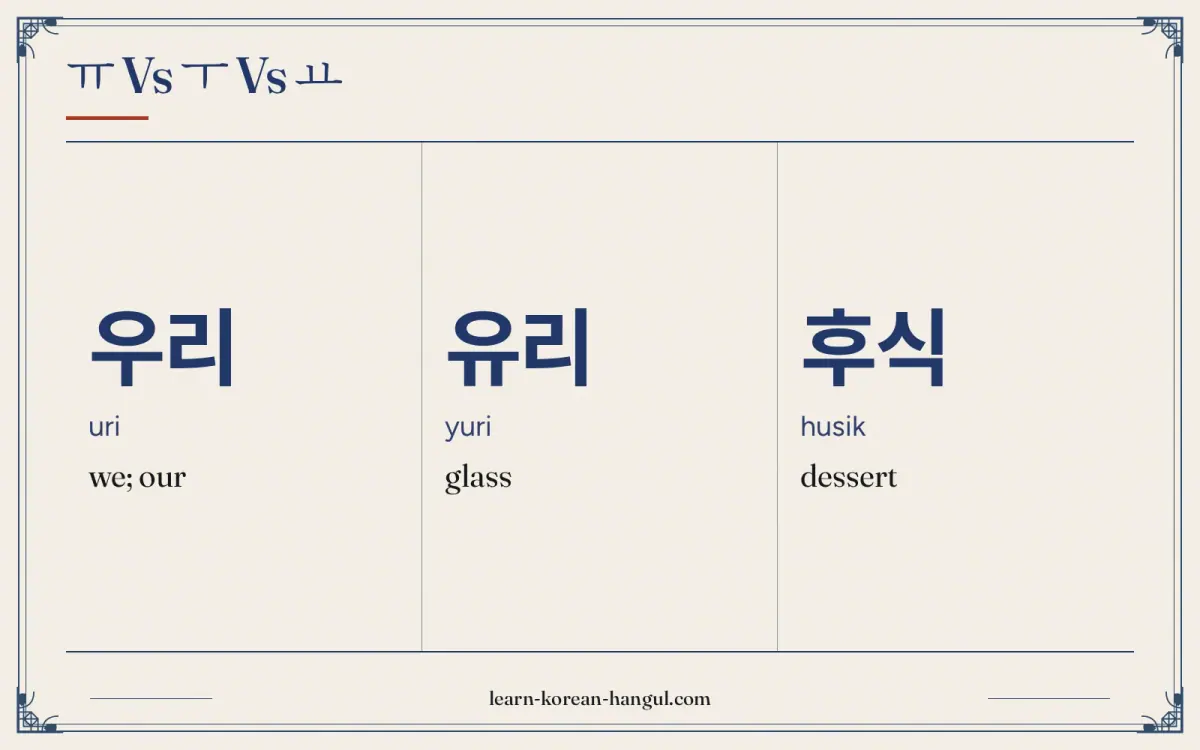
ㅠ is [ju], ㅜ is plain [u], and ㅛ is [jo]. The three look almost the same, so train both eye and ear. The table pairs each lookalike with a real word.
| Pair | Sound difference | Example words | Visual cue |
|---|---|---|---|
| 우 / 유 | [u] vs [ju] | 우리 (we, our) / 유리 (glass) | one leg vs two legs |
| 후 / 휴 | [hu] vs [hju] | 후식 (dessert) / 휴식 (rest) | one leg vs two legs |
| 유 / 요 | [ju] vs [jo] | 유리 (glass) / 요리 (cooking) | legs down vs legs up |
| 규 / 교 | [kju] vs [kjo] | 규칙 (rule) / 교실 (classroom) | legs down vs legs up |
One Leg vs Two Legs
| Korean | Romanization | Meaning | Sound |
|---|---|---|---|
| 우리 | uri | we; our | |
| 유리 | yuri | glass |
One Leg vs Two Legs
| Korean | Romanization | Meaning | Sound |
|---|---|---|---|
| 후식 | husik | dessert | |
| 휴식 | hyusik | rest |
Legs down vs Legs Up
| Korean | Romanization | Meaning | Sound |
|---|---|---|---|
| 유리 | yuri | glass | |
| 요리 | yori | cooking |
Legs down vs Legs Up
| Korean | Romanization | Meaning | Sound |
|---|---|---|---|
| 규칙 | gyuchik | rule | |
| 교실 | gyosil | classroom |
The visual cue for ㅠ against ㅛ is direction: ㅠ hangs down, ㅛ stands up. The ㅛ lesson has the matching drill.
How Can You Remember ㅠ?
The easiest way to remember ㅠ is to link its shape to its direction and its sound. Two legs hang down, and the sound has two parts. Three cues work for most learners.
- Count the marks: ㅜ has one leg and ㅠ has two, so the y-vowel has the extra mark.
- Legs down or up: ㅠ hangs, ㅛ stands.
- Anchor a word: 우유 contains both ㅜ and ㅠ, so picture a carton of milk.
Example Sentences with ㅠ
Short sentences help the vowel stick, because you hear it in a natural rhythm. Each line uses a word from this lesson.
- 우유 주세요. (Uyu juseyo.) Milk, please.
- 휴지 있어요? (Hyuji isseoyo?) Do you have tissues?
- 뉴스를 봐요. (Nyuseureul bwayo.) I watch the news.
- 컴퓨터가 있어요. (Keompyuteoga isseoyo.) I have a computer.
The romanization in brackets is only a guide. Notice that ㅠ keeps its glide in every one of these sentences.
Common Mistakes Learners Make with ㅠ
Learners often assume ㅠ is just a long English “you”, but the Korean vowel is shorter and the lips never relax early. Keep the lips rounded to the end, whether you say it slowly or at natural speed.
- Mistake: dropping the y. Saying 우 when you mean 유 changes the word, as in 우리 versus 유리. Fix: use the “ee-then-oo” two-step check.
- Mistake: lips not pushed forward. English “you” is often said with only light rounding. Fix: look in a mirror for a small circle.
- Mistake: ticks pointing up. That is ㅛ. Fix: say “ㅠ hangs, ㅛ stands”.
- Mistake: reading ㅠㅠ as a word. It is an emoticon. Fix: read it as a crying face.
- Mistake: tensing the throat. English “you” can sound tight and drawn out, while Korean ㅠ is relaxed and quick. Fix: say it as if you were whispering a short “yoo” to a friend sitting next to you.
- Mistake: guessing loanword spellings. Some English words use ㅜ or ㅠ differently from what you expect. Fix: check a dictionary.
Practice: Read, Hear and Write
Try all three exercises, then check the answers at the end.
Practice · 8
Which vowel is ㅜ with a second short stroke?
Show answer
ㅠ
ㅠ keeps the line of ㅜ and gives it two short strokes hanging below. The extra stroke marks the y-glide.
What does ㅠㅠ mean in a text message?
Show answer
A crying face
The two ㅠ letters look like eyes with tears running down. Laughter is ㅋㅋ.
What does 우유 mean?
Show answer
milk
우유 is 우 plus 유 and means milk. Glass is 유리, tissue is 휴지 and rule is 규칙.
Why does the loanword 컴퓨터 (computer) use ㅠ?
Show answer
Korean writes the English "yoo" sound after a consonant with ㅠ
The "pyoo" in "computer" becomes 퓨, just as "news" becomes 뉴스.
How does 슈 sound?
Show answer
Like "shoo"
After ㅅ, ㅠ merges into an "sh" sound, so 슈 is [ɕu]. 수 has a plain "s".
Which word means "glass"?
Show answer
유리
유리 starts with ㅠ. 우리 (we, our) starts with ㅜ, 요리 (cooking) with ㅛ, and 휴지 is tissue.
Which vowel has two short strokes hanging below a horizontal line?
Show answer
ㅠ
ㅠ hangs and ㅛ stands. ㅜ has only one short stroke below the line.
Which pair differs only by ㅜ versus ㅠ?
Show answer
후식 / 휴식
후식 (dessert) has ㅜ and 휴식 (rest) has ㅠ. The other pairs contrast ㅠ with ㅛ.
Exercise 1: pick by sound. Does each clip contain ㅜ or ㅠ?
Exercise 2: read aloud. 우유, 휴지, 유리, 규칙, 귤, 뉴스, 컴퓨터. Then say what ㅠㅠ means.
Exercise 3: write from dictation. Listen and write each syllable or word.
Exercise 4: two-step check. Say 이, then 우, then join them into 유 in one smooth movement. Record yourself and compare with the clip.
Answers. Exercise 1: Clips B and D contain ㅠ (유, 휴). Clips A and C contain ㅜ (우, 후). Exercise 2: milk, tissue, glass, rule, tangerine, news, computer; ㅠㅠ is a crying face. Exercise 3: 유, 규, 우유, 뉴스; check that each ㅠ has a long line with two short legs hanging down, and that the consonant sits above it.
What to Learn Next
You can now say and write the Korean vowel ㅠ, and you can read the crying face ㅠㅠ. The next lesson is ㅐ and ㅔ, the first compound vowels. You can also return to the Korean y-vowels overview, or compare with the vowel ㅛ.
Review ㅠ with the Hangul flashcard decks, test your ear in the Hangul quizzes, and build blocks in the Hangul Syllable Builder. The interactive Hangul alphabet plays every letter. For mouth positions across all vowels, read the Korean vowel pronunciation guide.
This lesson does not cover loanword rules in depth, texting slang beyond ㅠㅠ, or sound-change rules. Those topics have their own sections.
Frequently Asked Questions
Frequently Asked Questions
Is ㅠ the same as English “you”?
Very close. Say “you”, shorten it, and keep your lips pushed forward and rounded from start to finish. English “you” tends to be longer and tenser. Korean ㅠ is a quick “y” followed by a short, relaxed “u”, like the “ew” in “few” said briskly.
What does ㅠㅠ mean in a message?
ㅠㅠ is a crying face. The two ㅠ letters look like eyes with tears running down. Koreans use it in texts and comments to show sadness, disappointment or being moved. A similar ㅜㅜ is used the same way. It is an emoticon, not a word, so it has no sound.
How is 우유 pronounced?
우유 is two blocks: 우 and 유. Each starts with a silent ㅇ. The first is a plain [u], and the second adds a quick y-glide, [ju]. Together they are said [우유], with even rhythm. The word means “milk”, and it is a good drill for ㅜ versus ㅠ.
Do the short strokes of ㅠ point up or down?
The two short strokes of ㅠ point down, hanging underneath the long horizontal line. In ㅛ they point up and stand on the line. A quick memory aid: ㅠ looks like a small table with two legs, while ㅛ looks like a small fence standing on a floor.
How do I type ㅠ?
On the standard two-set (2-beolsik) Korean keyboard, ㅠ is the B key with no Shift. To type 유, press D for the silent ㅇ and then B. The input method joins them into one syllable block automatically. Use N for the plain vowel ㅜ.