What Is TOPIK Level 4?
TOPIK level 4 is the upper-intermediate grade of the Test of Proficiency in Korean (TOPIK), the exam run by the National Institute for International Education (NIIED, 국립국제교육원) for people whose first language is not Korean. It is the second step of TOPIK II, the paper that awards Levels 3 to 6.
In Korean, a level is a 급 (geup), so Level 4 is 4급 (sageup). Koreans usually say the exam name as 토픽 (topik).
You will meet the phrase 4급 이상 (sageup isang), "Level 4 or above", more often than any other TOPIK phrase in Korean admission notices, graduation rules and job adverts. That is the practical meaning of Level 4: it is the level that most often appears as a requirement.
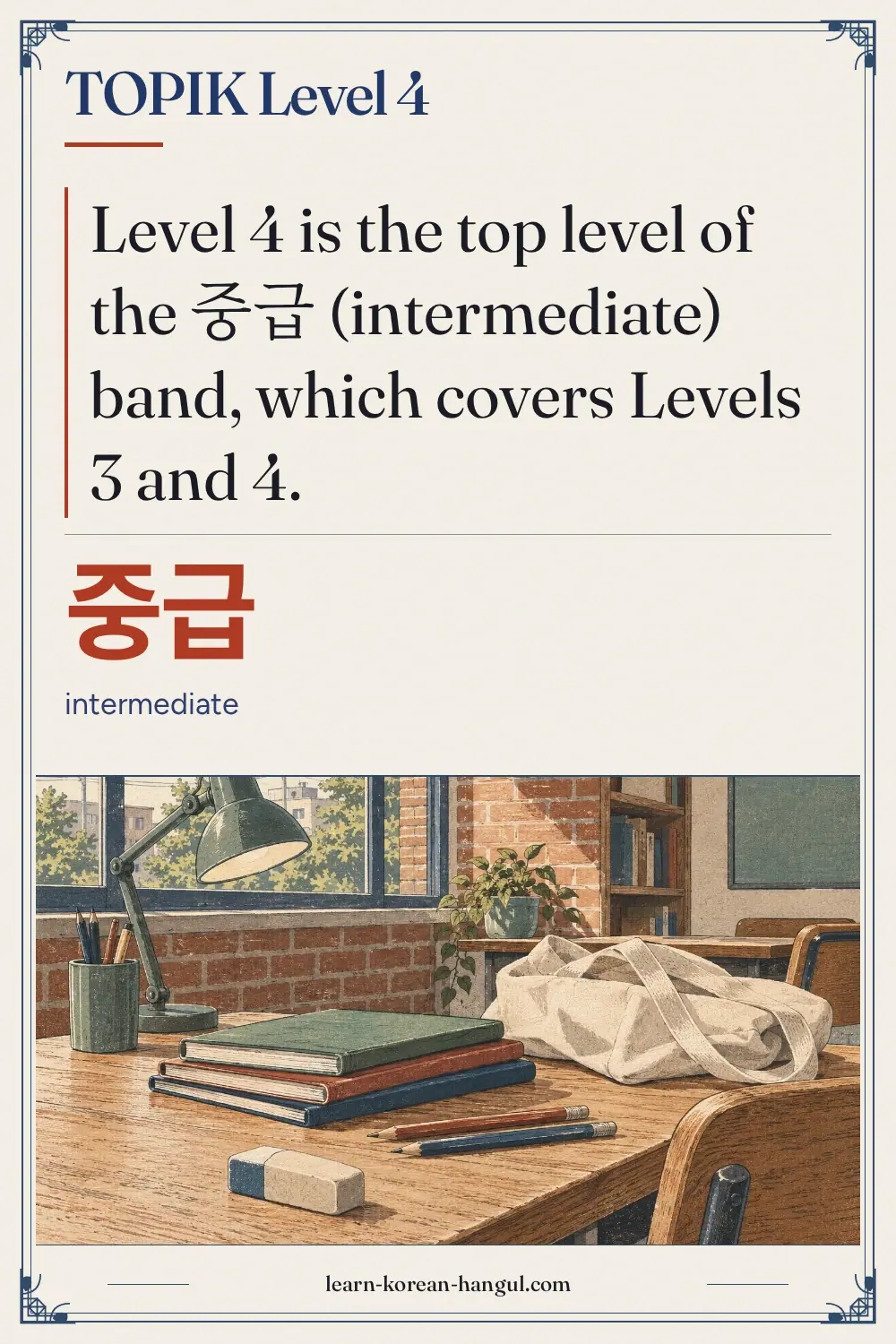
Levels 3 and 4 together form the 중급 (junggeup) band, "intermediate", so Level 4 marks the end of intermediate Korean. A class labelled 중급 2 at a university language institute is aimed at roughly this level. If you want the whole six-level system first, the TOPIK levels page explains it. The next question is the exact number that gives Level 4.
What Score Do You Need for TOPIK Level 4?
You need 150 or more out of 300 points on TOPIK II to get Level 4. A total from 150 to 189 gives Level 4, a total from 120 to 149 gives Level 3, and 190 or more gives Level 5. The cut scores are published by NIIED on the official TOPIK website (topik.go.kr); they have been stable for years, but confirm them in the test guide for your session.
| Level | Test | Cut score | Score range | Share of the test maximum |
|---|---|---|---|---|
| Level 1 | TOPIK I | 80 / 200 | 80-139 | 40% |
| Level 2 | TOPIK I | 140 / 200 | 140-200 | 70% |
| Level 3 | TOPIK II | 120 / 300 | 120-149 | 40% |
| Level 4 | TOPIK II | 150 / 300 | 150-189 | 50% |
| Level 5 | TOPIK II | 190 / 300 | 190-229 | about 63% |
| Level 6 | TOPIK II | 230 / 300 | 230-300 | about 77% |
Level 4 needs exactly half of the TOPIK II maximum. Put simply, an average of 50 points in each of the three sections is enough. That sounds modest, but the easy early questions in each section are not enough to get there: you need points from the longer listening and reading items and a usable essay.
How the 150 Points Add Up
TOPIK II has three sections, listening, writing and reading, each scored out of 100, and the level comes from the total. On the paper test, listening has 50 questions in 60 minutes, writing has 4 questions in 50 minutes, and reading has 50 questions in 70 minutes. The TOPIK exam format page shows each question type.
Three worked totals show how the rule plays out:
- Balanced: 58 in listening + 40 in writing + 55 in reading = 153. The result is Level 4.
- Uneven: 65 in listening + 30 in writing + 55 in reading = 150. The result is still Level 4, exactly on the cut score.
- Close miss: 55 in listening + 38 in writing + 52 in reading = 145. The result is Level 3, five points short.
The close miss is the most common Level 4 story. Five points is one more correct answer to a short writing question and one or two more reading items. Writing questions carry far more points each than reading questions: the four writing questions are worth 100 points between them, the same as the 50 reading questions. The TOPIK score page explains how sections are marked and reported. Once the number is clear, the more useful question is what that number says about your Korean.
What Can You Do at TOPIK Level 4?
A TOPIK level 4 learner can use Korean for social life, simple news and basic work tasks. NIIED's level description for Level 4, paraphrased here in plain English, covers these abilities, with the vocabulary size added as a common estimate:
- Public life and basic work: use the public facilities and keep up the social relationships you need, and carry out some everyday work tasks in Korean.
- News: understand easy news broadcasts and newspaper articles.
- Social and abstract topics: understand general social topics and abstract subjects fairly accurately and talk about them.
- Idioms and culture: understand frequently used idiomatic expressions and widely known features of Korean culture, and use them in context.
- Vocabulary: a range commonly estimated at about 5,000 words (a rough estimate, not an official figure).
The sections below turn each ability into real sentences. Each one follows the same order: the situation, what a Level 4 learner can say or understand, and what is still out of reach.
Following the News
At Level 3, news is a stream of familiar words with the point lost. At Level 4, you can follow a short, clear report and say what happened.
정부는 내년부터 대중교통 요금을 인상하기로 했습니다.
jeongbuneun naenyeonbuteo daejunggyotong yogeumeul insanghagiro haetseumnida.
The government has decided to raise public transport fares from next year.
Words such as 정부 (government), 대중교통 (public transport) and 인상 (a rise in price) are typical of the Sino-Korean vocabulary that grows between Levels 3 and 4. The Korean news and media vocabulary page collects many of them. Still out of reach: fast panel discussions and editorials full of specialist terms.
Discussing Abstract Topics
Level 4 learners can weigh two sides of a question, not only state a preference. Formal speech with -(스)ㅂ니다 sounds natural in a class discussion or an interview.
개인의 자유도 중요하지만 공동체의 이익도 고려해야 한다고 생각합니다.
gaeinui jayudo jungyohajiman gongdongcheui iikdo goryeohaeya handago saenggakamnida.
Individual freedom is important, but I think we must also consider the interests of the community.
생각합니다 is said [생가캄니다], and 이익도 is said [이익또]. Still out of reach: building a long argument with evidence and counter-evidence in real time.
Basic Work Tasks
At work, a Level 4 learner can handle routine emails, follow a meeting on a familiar subject and promise a follow-up in polite, humble language.
회의 자료를 내일 오전까지 메일로 보내 드리겠습니다.
hoeui jaryoreul naeil ojeonkkaji meillo bonae deurigetseumnida.
I will email you the meeting materials by tomorrow morning.
The humble 보내 드리다 ("send for you") replaces plain 보내다 when the receiver is a senior or a client. Still out of reach: negotiating, writing reports and reading contracts, which belong to Level 5 and above.
Idioms and Culture
Level 4 is the first level whose description mentions idiomatic expressions. TOPIK II reading and listening use common idioms, and a Level 4 candidate is expected to understand them from context.
제 친구는 발이 넓어서 모르는 사람이 없어요.
je chinguneun bari neolbeoseo moreuneun sarami eopseoyo.
My friend knows everybody. (literally: has wide feet)
발이 넓다 means "to know a lot of people". 넓어서 is said [널버서], and 없어요 is said [업써요]. Still out of reach: proverbs and four-character Sino-Korean idioms in fast speech, which appear more at Levels 5 and 6.
Writing an Essay Conclusion
Level 4 usually needs a real attempt at question 54, the 600-700 character essay. That means organising an argument and closing it in the written plain style.
그러므로 청소년의 스마트폰 사용 시간을 줄이기 위한 노력이 필요하다.
geureomeuro cheongsonyeonui seumateupon sayong siganeul jurigi wihan noryeogi piryohada.
Therefore, efforts are needed to reduce the time teenagers spend on smartphones.
그러므로 ("therefore") and -기 위한 ("in order to") are typical essay connectors. Still out of reach: an essay that is accurate, varied and natural from start to finish, which is what Levels 5 and 6 reward. The TOPIK writing section explains each writing question. With the abilities mapped, the next step is to see the words and grammar behind them.
What Vocabulary and Grammar Does Level 4 Need?
Level 4 needs a vocabulary commonly estimated at about 5,000 words, much of it Sino-Korean, and grammar that lets you connect ideas in formal and written Korean. TOPIK publishes no official syllabus, word list or grammar list for candidates, so every figure below is an estimate.
| Attribute | Level 3 | Level 4 | Level 5 |
|---|---|---|---|
| Test | TOPIK II | TOPIK II | TOPIK II |
| Cut score | 120 / 300 | 150 / 300 | 190 / 300 |
| Vocabulary (common estimate) | about 3,000 words | about 5,000 words | more; estimates vary widely |
| Typical topics | relationships, familiar social topics | plus news, society, abstract topics | plus politics, economics, culture and professional fields |
| Idioms | a few common ones | frequently used idioms | a wider range, including proverbs |
| Writing | short paragraphs, chart description | structured essay attempted | organised essay with precise vocabulary |
| Approximate CEFR | B1 | B2 (some sources say B1+) | C1 (some sources say B2+) |
The CEFR row is an approximation used by schools and learners, and sources disagree more at Level 4 than at Level 3. If an institution outside Korea asks for "B2 in Korean", ask which TOPIK level it accepts. The how many words you need for TOPIK page explains why word-count estimates vary.
What a "TOPIK Level 4 Syllabus" Usually Means
Because no official syllabus exists, "TOPIK level 4 syllabus" usually means the content of the second intermediate book in a university language institute series, or a teacher's list. Most such lists share these grammar families:
- Formal connectors: -(으)며, -고서, -(으)ㄴ/는 반면에 ("whereas").
- Cause and reason in writing: -(으)므로, -기 때문에, -(으)ㄴ/는 탓에 ("because of", negative).
- Condition and concession: -더라도 ("even if"), -(으)ㄹ지라도, -는다면.
- Reported and indirect speech: full -다고/-냐고/-라고/-자고 forms and their short forms.
- Purpose and result: -도록, -기 위한, -(으)ㄴ/는 셈이다 ("amounts to").
- Written plain style: -ㄴ/는다, -았/었다 and the noun forms -(으)ㅁ and -기 used in essays.
The intermediate Korean grammar section teaches many of these patterns one at a time. The TOPIK 2 grammar list narrows them to 22 core patterns for levels 3 and 4, each with an example. Knowing the content is one thing; how hard the test feels on the day is another.
How Hard Is TOPIK Level 4?
TOPIK level 4 is hard for most learners because it is the first level where the difficult half of the paper matters. Level 3 can be reached on the early questions plus short writing; Level 4 needs points from the long items too. Three things make it harder than the 50% figure suggests:
- The second half of each section. Later listening items are interviews, lectures and debates, often with two questions per recording. Later reading items are opinion pieces and explanatory passages that ask for the writer's purpose or attitude. Level 4 candidates must win points here.
- Question 54. The essay is worth 50 points, half the writing section. A candidate who writes nothing for it gives up a sixth of the whole test. A short but organised essay in the right style earns real points.
- Reading time. Seventy minutes for 50 questions is 84 seconds a question on average, and the last 20 passages take longer. Slow readers run out of time before the items they could answer.
A useful rule of thumb: if your timed mock scores sit between 140 and 150, the fastest points are usually in writing questions 53 and 54, not in more vocabulary. The is TOPIK hard page compares every level and section, and the TOPIK reading tips and TOPIK listening tips pages cover pacing. With difficulty understood, the next section turns it into a plan.
How Do You Reach TOPIK Level 4?
You reach TOPIK level 4 by adding news and abstract vocabulary to Level 3 skills, writing essays regularly with feedback, and training the long listening and reading items until your mock totals sit at about 160. A typical route has six steps.
- 01
Confirm a Stable Level 3
Timed mocks at 130 or more
TOPIK Level 3What the first intermediate level covers.
- 02
Read and Listen to the News Daily
Short reports summarised in two sentences
Korean News and Media VocabularyCore words for reports and articles.
- 03
Build Sino-Korean Vocabulary
New words guessed from known roots
How Many Words You Need for TOPIKEstimates by level and how to plan them.
- 04
Write Questions 53 and 54 Weekly
A full chart paragraph and a 600-character essay in time
TOPIK WritingThe four writing questions explained.
- 05
Take a Timed TOPIK II Mock
A real score for each section
Timed TOPIK Mock TestHow to take, score and review one.
- 06
- Confirm a stable Level 3. Take a timed mock first. If you score below about 130, finish Level 3 skills before you aim higher.
- Read and listen to the news daily. Twenty to thirty minutes of short news items a day builds the topics and vocabulary of Level 4. You'll know it worked when you can summarise a one-minute report in two sentences.
- Build Sino-Korean vocabulary. Learn common roots, such as 인 ("person") or 정 ("government, politics"), so you can guess new words. You do not need to write Chinese characters.
- Write questions 53 and 54 every week. Get feedback from a teacher, tutor or language partner, because errors you cannot see do not improve. You'll know it worked when you can write a 600-character essay with an introduction, two body points and a conclusion in 30 minutes.
- Take a timed mock. Sit a full paper from the official TOPIK past papers, then score it. A timed TOPIK mock test shows where the points are lost.
- Fix the long items. Spend two to four weeks on the last 20 reading questions, the paired listening items and the essay, then take another mock.
The common mistake at this level is to keep learning word lists without writing. The writing section is a third of the total, and question 54 alone is worth half of it. A full 16-week plan for TOPIK II is in how to pass TOPIK 2.
How Long Does It Take to Reach Level 4?
From Level 3, reaching TOPIK level 4 typically takes about 6-12 months at one hour of study a day, or 4-8 months at two hours a day. From zero, the total is roughly 1.5-2.5 years at an hour a day. These are editorial estimates for a learner with no special advantage, such as a related first language. The how long to study for TOPIK page shows the same estimates for every level. Once you have the level, it is worth knowing what it opens.
What Is TOPIK Level 4 Useful For?
TOPIK level 4 is useful because it is the level most often written into requirements. Many universities ask for it to graduate from a Korean-taught degree, reading-heavy majors and graduate schools often ask for it on entry, and many office jobs in Korean-speaking teams ask for Level 4 or 5.
| Goal | Is Level 4 usually enough? | What to check |
|---|---|---|
| Korean-taught undergraduate admission | Yes, with a margin above the common Level 3 minimum | The university's admissions notice |
| Graduating from a Korean-taught degree | Often; Level 4 is a common rule | The university's academic rules |
| Korean-taught graduate admission | Often; some fields ask for more | The graduate school's notice |
| Office job in a Korean-speaking team | Sometimes; Level 4-5 is typical | The job advert |
| Language-focused jobs, such as translation | Usually not; Level 5-6 is typical | The job advert and any test |
| Visa or residency points that count TOPIK | Often counts, rules vary | The current official notice |
Every row is typical, not a rule. Each university, programme, employer and agency sets its own level, and rules change. The TOPIK requirements page goes through study, work and visa goals one at a time.
A result is valid for two years from the results announcement date. If you need Level 4 for graduation in three years, the result you have today will have expired by then, so check whether the rule asks for a valid result. Saying you have the level in Korean is simple:
토픽 4급을 땄어요 (topik sageubeul ttasseoyo) means "I got TOPIK Level 4." The next section looks beyond Level 4.
What Comes after TOPIK Level 4?
After TOPIK level 4 comes Level 5, the first level of the 고급 (gogeup), "advanced", band. It needs 190 out of 300 on the same TOPIK II test, so the step is 40 points, against 30 between Level 3 and Level 4. Three gaps usually stand between Level 4 and Level 5:
- Professional-field language. Level 5 descriptions mention using Korean for research or work in a professional field to some degree, and understanding less familiar topics in politics, economics and culture.
- Longer formal writing. A Level 5 essay is not only complete but well organised, with precise Sino-Korean vocabulary and varied connectors.
- Formal and informal range. Level 5 learners switch style to match the situation, from a job interview to a chat with friends.
A safe rule: once your mocks sit comfortably above 170, start reading opinion columns and writing a full essay every week. The TOPIK level 5 page explains that step in the same format, and TOPIK levels compares all six levels. Before you plan around Level 4, one honest limitation is worth stating.
What TOPIK Level 4 Does Not Show
TOPIK level 4 measures listening, reading and writing on one test day. It says nothing official about speaking, because TOPIK II has no speaking section. That is why many employers who ask for Level 4 still interview candidates in Korean.
The band is also wide. A candidate with 151 and a candidate with 188 both receive Level 4, although the second is close to Level 5. If you are applying somewhere that cares about your actual ability, your section scores say more than the level, and the certificate shows them.
TOPIK Level 4: the Bottom Line
TOPIK level 4 means 150 or more out of 300 on TOPIK II, the top of the intermediate band, roughly B2. The two decision points are these. First, Level 4 is the right target if you need a common graduation or office-work requirement, and the safe target if a notice says Level 3 is the minimum. Second, the points between Level 3 and Level 4 are usually won in writing questions 53 and 54 and in the long items at the end of each section.
To see where Level 4 sits among the TOPIK II pages, return to the TOPIK II guide. If you are not yet at Level 3, start with TOPIK level 3.
Frequently Asked Questions
Is TOPIK Level 4 Good?
Yes. TOPIK level 4 is upper-intermediate Korean and the level many universities and employers treat as the working threshold. It shows that you can follow news and social topics and use Korean at a basic level at work. Many Korean-taught degrees ask for it to graduate, and many office jobs ask for Level 4 or 5.
How Long Does It Take to Reach TOPIK Level 4?
From Level 3, reaching TOPIK level 4 typically takes about 6-12 months at one hour of study a day, or 4-8 months at two hours a day. From zero, that adds up to roughly 1.5-2.5 years at an hour a day. These are editorial estimates; writing questions 53 and 54 are usually the main time cost.
Is TOPIK Level 4 Fluent?
Partly. TOPIK level 4 is roughly B2 on the European scale, so you can take part in most everyday and social conversations and follow simple news. Most people still find fast debate, specialist work language and formal writing hard at this level, and many reserve the word fluent for Level 5 or Level 6.
What Jobs or Programmes Ask for Level 4?
Level 4 is a common graduation requirement for Korean-taught degrees and a common admission level for reading-heavy majors and graduate schools. Many office jobs in Korean-speaking teams ask for Level 4 or 5. Rules differ by university, employer and agency, and they change, so read the current notice.
Is TOPIK Level 4 Hard?
Yes, for most learners it is a real step up from Level 3. You need 150 of 300 points, half the maximum, so you must score in the second half of the listening and reading sections and write a usable answer to questions 53 and 54. Writing is usually the gap, not vocabulary alone.