TOPIK level 1 is awarded for 80 to 139 points out of 200 on TOPIK I, the beginner paper. A Level 1 learner can greet people, introduce themselves, order and buy simple things, and understand very short everyday texts. It is the first of six TOPIK levels and is often compared with CEFR A1.
What Is TOPIK Level 1?
TOPIK level 1 is the lowest certificate level of the Test of Proficiency in Korean, awarded on TOPIK I to candidates who reach the 80-point cut score. It confirms basic, survival-level Korean in listening and reading. In Korean it is written 1급 (ilgeup, "grade 1").
Level 1 sits in the beginner band, called 초급 (chogeup), together with Level 2. The National Institute for International Education (NIIED, 국립국제교육원), which runs TOPIK, publishes the levels, cut scores and level descriptions on topik.go.kr.
| Level | Test | Korean band | Meaning in brief |
|---|---|---|---|
| Level 1 | TOPIK I | 초급 (beginner) | survival Korean on very familiar topics |
| Level 2 | TOPIK I | 초급 (beginner) | everyday Korean in public places |
| Levels 3-4 | TOPIK II | 중급 (intermediate) | independent daily life, then work and study basics |
| Levels 5-6 | TOPIK II | 고급 (advanced) | professional and academic Korean |
A Level 1 result tells an institution that you have moved past the alphabet and can use Korean for simple real tasks. It does not cover writing or speaking, because TOPIK I tests only listening and reading. The full six-level picture is on TOPIK levels. The definition depends on one number, which comes next.
What Score Do You Need for TOPIK Level 1?
You need at least 80 out of 200 points on TOPIK I for Level 1. Any total from 80 to 139 is Level 1; 140 or more is Level 2; 79 or less earns no level. There is no minimum per section, so your listening and reading scores are simply added.
| TOPIK I total | Result | Share of 200 |
|---|---|---|
| 0-79 | no level | under 40% |
| 80-139 | Level 1 | 40-69% |
| 140-200 | Level 2 | 70% and above |
Three worked examples show how the totals fall:
- Listening 45 + reading 35 = 80. Level 1, exactly at the cut score.
- Listening 62 + reading 70 = 132. Level 1, only 8 points from Level 2.
- Listening 40 + reading 36 = 76. No level, 4 points short, despite answering many questions correctly.
80 points is 40% of the marks, so Level 1 does not need a perfect paper. A candidate can miss more than half the questions and still reach it. Wrong answers do not subtract points, which means every guess helps. How the points are spread across questions and sections is explained on TOPIK score, and the cut scores should always be confirmed in the current official guide.
Can You Get Level 1 on TOPIK II?
No. TOPIK II awards only Levels 3 to 6, and a TOPIK II total below 120 out of 300 earns no level at all. A beginner who sits TOPIK II hoping for Level 1 or 2 will leave without a certificate level. If your goal is Level 1, register for TOPIK I. The choice between the two papers is covered on the difference between TOPIK 1 and 2 page. A number on a report means little until it is turned into real abilities.
What Can You Do at TOPIK Level 1?
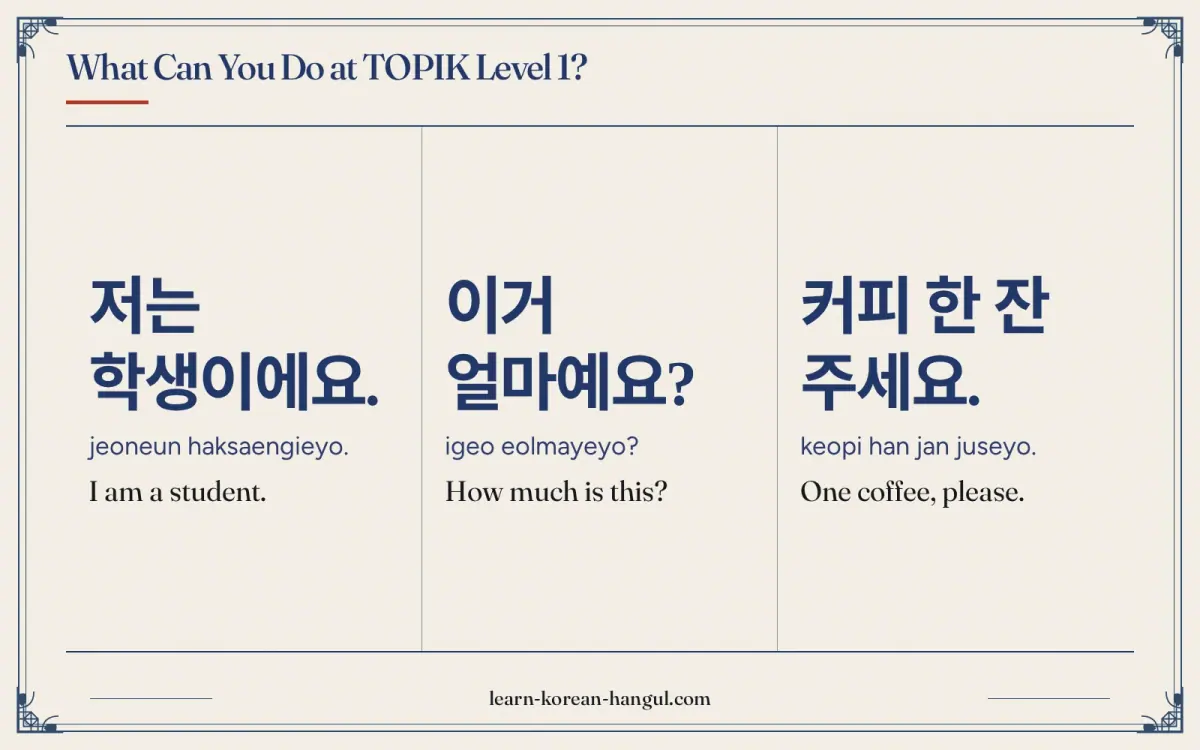
At TOPIK level 1 you can handle the basic tasks of daily life in short, simple sentences: introduce yourself, buy things, order food, ask where something is and talk about very familiar topics such as family, hobbies and the weather. The descriptions below paraphrase NIIED's level description in plain English.
Each example below is a sentence a Level 1 learner should understand when heard and read, and be able to use. Listen, then say each one aloud.
Introduce yourself:
저는 학생이에요.
jeoneun haksaengieyo.
I am a student.
Buy things and ask the price:
이거 얼마예요?
igeo eolmayeyo?
How much is this?
Order food or drinks:
커피 한 잔 주세요.
keopi han jan juseyo.
One coffee, please.
Make simple plans:
몇 시에 만나요?
myeot sie mannayo?
What time shall we meet?
Ask where something is:
화장실이 어디예요?
hwajangsiri eodiyeyo?
Where is the bathroom?
Two pronunciation notes matter for listening. 몇 시에 is said [멷씨에]: the final ㅊ of 몇 is pronounced as a stop, and the ㅅ after it becomes tense. 예요 in 얼마예요 and 어디예요 is said [예요] in careful speech and often [에요] in everyday speech.
In test terms, Level 1 means you can usually answer the early listening items (natural replies, places, topics) and the short reading items (topics, notices, simple blanks), and get some of the longer paired questions right. The longer texts at the end of the paper are where Level 2 candidates pull ahead.
A Self-Check for TOPIK Level 1
Use this checklist to judge whether you are near Level 1. It is an editorial tool based on the level description, not an official test.
| I can… | Yes / not yet |
|---|---|
| read any Hangul syllable aloud without sounding out each letter | |
| introduce myself in two or three polite sentences | |
| say and understand prices, times and dates | |
| understand a two-line dialogue in a shop, café or station | |
| read a short notice, such as opening hours, and find one detail | |
| recognise about 800 everyday words on familiar topics | |
| use 은/는, 이/가, 을/를 and the polite -아요/어요 ending correctly in simple sentences |
If you can tick five or more, sit a timed past paper to confirm. If you tick fewer than four, build the basics first. The language behind these tasks is the next thing to measure.
Vocabulary and Grammar for TOPIK Level 1
TOPIK level 1 needs a core of everyday vocabulary, often estimated at about 800 words, and the first layer of Korean grammar. TOPIK publishes no official word list or grammar syllabus for the test, so the vocabulary figures below are estimates commonly cited by teachers and textbooks, and the grammar list is typical rather than official.
| Area | Typical Level 1 range | Examples |
|---|---|---|
| Vocabulary | about 800 everyday words (estimate) | family words, food, places, numbers, time, days, weather |
| Particles | topic, subject, object, place and time particles | 은/는, 이/가, 을/를, 에, 에서 |
| Endings | polite present and past, formal -습니다 for reading | -아요/어요, -았어요/었어요, -습니다 |
| Connectors | simple linking | -고 ("and"), -지만 ("but") |
| Requests | polite request and suggestion | -(으)세요, -(으)ㄹ까요? |
| Text types | dialogues, notices, signs, short messages | a café menu, a bus timetable |
The range for Level 2 is usually estimated at about 1,500 to 2,000 words, with more past and future forms and longer connected sentences. A topic-by-topic word list is on the TOPIK 1 vocabulary list, and the grammar patterns with examples on the TOPIK 1 grammar list. The structure of the paper itself, question by question, is on TOPIK 1 exam format.
TOPIK Level 1 and the CEFR
TOPIK level 1 is usually compared with CEFR A1, the first level of the Common European Framework of Reference for Languages. NIIED does not publish an official CEFR table, so the match is an approximation used by schools and learners.
The comparison is useful but imperfect. CEFR A1 describes speaking and writing as well as listening and reading, while TOPIK I tests only listening and reading. A Level 1 candidate may understand A1 Korean well and still speak it hesitantly. If an institution outside Korea asks for "A1 in Korean", ask whether it accepts TOPIK Level 1 as evidence rather than assuming it does.
How Hard Is TOPIK Level 1?
TOPIK level 1 is reachable for a learner with a few months of steady study, because it needs only 40% of the marks on a beginner paper. It is not trivial, though: the instructions are in Korean only, the listening runs at a fixed pace, and reading 40 questions in 60 minutes needs fluent Hangul reading.
| What makes Level 1 manageable | What makes it harder than it looks |
|---|---|
| only 80 of 200 points needed | Korean-only instructions from question 1 |
| four-option multiple choice, no writing | audio cannot be paused or replayed |
| no penalty for wrong answers | slow Hangul reading leaves the last texts unread |
| familiar everyday topics | a 100-minute single period with no break |
The most common reason capable beginners miss Level 1 is time, not knowledge: they decode Hangul too slowly or never practise under real timing. A detailed difficulty comparison across all levels is on the TOPIK levels page, and practical fixes come in the next section.
How to Reach TOPIK Level 1
Reach TOPIK level 1 by combining core vocabulary, basic grammar and daily listening and reading practice, then proving it with timed past papers. A learner who already reads Hangul can usually prepare in about eight weeks of 30-45 minute daily sessions.
- Take a baseline paper. Sit one official past paper untimed and mark it, so you know your starting point.
- Build vocabulary by topic. Work towards the 800-word core with spaced repetition and audio.
- Learn the first grammar layer. Particles, polite endings, past tense, -고 and -지만, each with a model sentence.
- Practise listening and reading daily. 10-15 minutes of past-paper audio and one short timed reading text each day.
- Sit timed mocks. At least two full papers under the real 40 + 60 minute limits, aiming 10-15 points above 80.
The week-by-week version, with checkpoints and a score tracker, is on how to pass TOPIK 1. Free official papers with audio are listed on TOPIK past papers. Once you have the level, the question becomes what it is good for.
TOPIK Level 1 Practice Tests and PDFs
The most reliable TOPIK level 1 practice tests are the official TOPIK I past papers that NIIED releases on topik.go.kr as PDF booklets, with listening audio files and answer keys. There is no separate "Level 1 paper": every TOPIK I paper serves both Level 1 and Level 2, and your total decides which you would reach.
Use a past paper as a Level 1 practice test in four steps:
- Print the booklet and an answer sheet. Working on paper copies the real conditions better than a screen.
- Time it exactly. 40 minutes for listening with the official audio, then 60 minutes for reading, with no break.
- Mark it with the official key. Add the points printed next to each question, then compare the total with 80 and 140.
- Log every error. Note whether each wrong answer came from vocabulary, grammar, a misread instruction or time.
Be careful with unofficial "TOPIK level 1 PDF" files shared online. Some are genuine past papers, but others are old formats, incomplete scans or copies without the audio, and a few mix TOPIK I and TOPIK II items. Download from the official site where possible, and check that the paper has 70 questions numbered 1 to 70. Where to find each released session, and how to space them across a study plan, is on TOPIK past papers.
Uses of a TOPIK Level 1 Certificate
A TOPIK level 1 certificate is mainly a personal milestone and a basic proof of beginner Korean. It is rarely enough for formal requirements, which mostly start at Level 3.
- Personal progress. An official, dated result shows that self-study worked and gives a fixed point to measure the next level against.
- Applications that credit any Korean. Some scholarships, exchange programmes and Korean language courses give credit for any TOPIK level.
- CVs for jobs that value basic Korean. Customer-facing roles in tourism or retail may treat Level 1 as a plus, even when they do not require it.
- Not usually for Korean-taught degrees. Admission notices commonly ask for Level 3 or 4, which only TOPIK II can award.
Each institution sets its own rule, so read the exact wording of the notice. The TOPIK requirements page explains how to find and check it. Also keep validity in mind: a result is valid for two years from its results date, as explained on how long a TOPIK result stays valid.
What Comes after TOPIK Level 1?
After TOPIK level 1 comes Level 2, which needs 140 out of 200 on the same TOPIK I paper. The gap is 60 points, and it is closed mainly by longer reading, faster listening and more grammar.
| Skill | Level 1 | Level 2 |
|---|---|---|
| Score | 80-139 / 200 | 140-200 / 200 |
| Typical tasks | introduce yourself, buy things, order food | phone calls, favours, post office and bank |
| Sentences | short, simple | longer, linked with connectors |
| Reading | notices and two-line texts | short paragraphs and messages read quickly |
| Vocabulary (estimate) | about 800 words | about 1,500-2,000 words |
The most useful next step is to read more: Level 2 candidates finish the long reading texts at the end of the paper, while Level 1 candidates often guess them. The full description, with a self-check, is on TOPIK level 2.
Common Misconceptions about TOPIK Level 1
Learners often assume Level 1 means they failed. Actually, Level 1 is a real certificate level with its own cut score; "no level" is the result below 80.
Learners also assume TOPIK II gives Level 1 to weaker candidates. Actually, TOPIK II starts at Level 3, and a total below 120 earns nothing.
A third assumption is that Level 1 proves speaking ability. Actually, TOPIK I tests only listening and reading.
A fourth assumption is that Level 1 lasts forever for applications. Actually, institutions usually accept a result for two years from its results date.
What This Page Covers and Does Not
This page explains TOPIK level 1: the cut score, what it means, what a Level 1 learner can do, the language it needs, its approximate CEFR match and how to reach and move beyond it. It does not cover registration, fees or dates, which change by session and country. Vocabulary sizes and CEFR matches are estimates; cut scores and level descriptions come from NIIED on topik.go.kr, and the official guide is right if it differs from this page.
Frequently Asked Questions
Is TOPIK level 1 good? TOPIK level 1 is a good first result: it is official proof that you can handle basic everyday Korean, and it shows real progress for a self-taught learner. It is not enough for most Korean-taught degrees or office jobs, which usually ask for Level 3 or higher, so treat it as a first milestone.
How long does it take to reach TOPIK level 1? Many learners who study a few hours a week reach TOPIK level 1 in roughly three to six months from zero. These are editorial estimates, not official figures. A learner who already reads Hangul and knows basic polite sentences can often prepare in about eight weeks of short daily sessions with past papers.
Is TOPIK level 1 fluent? No. TOPIK level 1 means basic survival Korean: short sentences on very familiar topics. Fluency, in the sense most people mean, is closer to Level 5 or 6. Level 1 also does not test speaking, so a Level 1 certificate says nothing official about conversation, only about listening and reading.
What jobs or programmes ask for TOPIK level 1? Few ask for exactly Level 1. It can help where any Korean ability earns credit, such as some scholarships, exchange programmes, Korean language courses or customer-facing jobs that value basic Korean. Most formal requirements start at Level 3. Always read the exact wording of the notice, because each institution sets its own rule.
Does TOPIK level 1 expire? The level itself never changes, but a TOPIK result is valid for two years from its results announcement date, according to the official TOPIK website. After that, institutions that ask for TOPIK usually want a new result. Many learners take TOPIK I again anyway, aiming for Level 2 within that time.
The Bottom Line on TOPIK Level 1
TOPIK level 1 means 80 to 139 points out of 200 on TOPIK I: basic survival Korean for introductions, shopping, ordering and very familiar topics, roughly comparable with CEFR A1. Two nuances matter most: only TOPIK I can award it, and it is a first milestone rather than a requirement most institutions accept. Prepare with core vocabulary, basic grammar and timed past papers, then aim for the next 60 points on TOPIK level 2: score, meaning and what you can do.