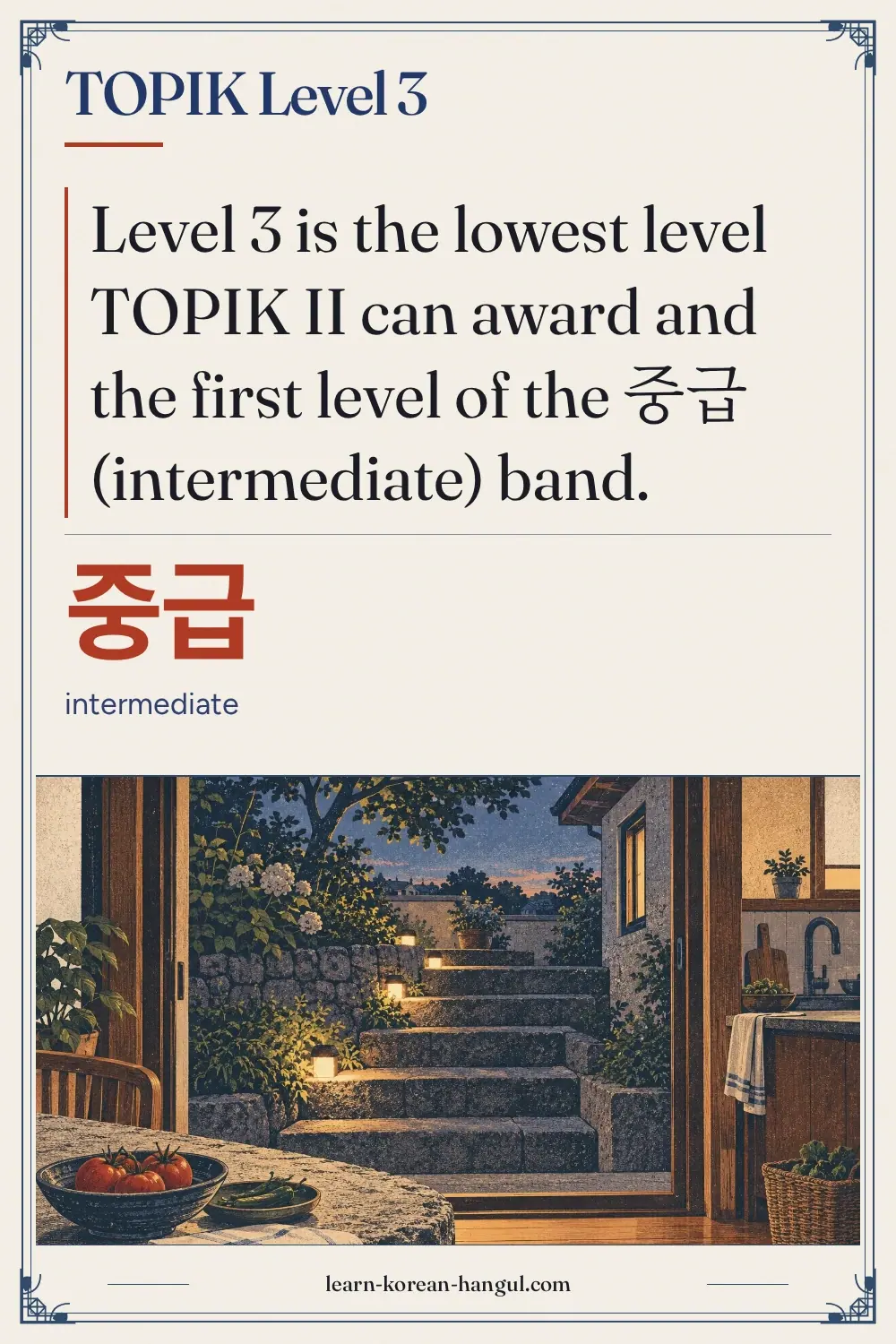
What Is TOPIK Level 3?
TOPIK level 3 is the lower-intermediate grade of the Test of Proficiency in Korean (TOPIK), the exam run by the National Institute for International Education (NIIED, 국립국제교육원) for people whose first language is not Korean. It is the bottom step of TOPIK II, the second of the two papers, which awards Levels 3 to 6.
In Korean, a level is a 급 (geup), so Level 3 is 3급 (samgeup). Admission notices write it as "TOPIK 3급" or "TOPIK 3급 이상" (Level 3 or above). Koreans usually say the exam name as 토픽 (topik).
Levels 3 and 4 together form the 중급 (junggeup) band, which means "intermediate". Korean course books and university language institutes use the same word, so a class labelled 중급 1 is aimed at roughly Level 3.
A level is a score band, not a pass mark. Your TOPIK II total falls into one of five outcomes: no level, Level 3, Level 4, Level 5 or Level 6. Level 3 tells a school, an employer or yourself that you have left the beginner stage and can use Korean on your own in everyday life. If you want the whole six-level system first, the TOPIK levels page explains it. The next question is the exact number that gives Level 3.
What Score Do You Need for TOPIK Level 3?
You need 120 or more out of 300 points on TOPIK II to get Level 3. A total from 120 to 149 gives Level 3, and anything below 120 gives no level at all, even if you are well past beginner. The cut scores are published by NIIED on the official TOPIK website (topik.go.kr); they have been stable for years, but confirm them in the test guide for your session.
| Level | Test | Cut score | Score range | Share of the test maximum |
|---|---|---|---|---|
| Level 1 | TOPIK I | 80 / 200 | 80-139 | 40% |
| Level 2 | TOPIK I | 140 / 200 | 140-200 | 70% |
| No level | TOPIK II | below 120 | 0-119 | under 40% |
| Level 3 | TOPIK II | 120 / 300 | 120-149 | 40% |
| Level 4 | TOPIK II | 150 / 300 | 150-189 | 50% |
| Level 5 | TOPIK II | 190 / 300 | 190-229 | about 63% |
| Level 6 | TOPIK II | 230 / 300 | 230-300 | about 77% |
The table shows why the numbers confuse people. The Level 3 cut (120) is lower than the Level 2 cut (140), but Level 3 is the higher level. The two cut scores come from different tests with different maximums. TOPIK II is longer, harder and includes writing, so 120 out of 300 there is a bigger result than 140 out of 200 on TOPIK I. Compare percentages within one test, never raw numbers across the two.
How the 120 Points Add Up
TOPIK II has three sections, listening, writing and reading, each scored out of 100. The level comes from the total, so a strong section can carry a weaker one. On the paper test, listening has 50 questions in 60 minutes, writing has 4 questions in 50 minutes, and reading has 50 questions in 70 minutes. The TOPIK exam format page shows each question type.
Three worked totals show how the rule plays out:
- Balanced: 50 in listening + 25 in writing + 47 in reading = 122. The result is Level 3.
- Uneven: 60 in listening + 15 in writing + 45 in reading = 120. The result is still Level 3, exactly on the cut score.
- Close miss: 45 in listening + 20 in writing + 50 in reading = 115. The result is no level, five points short.
The third case is the one to fear. On TOPIK I, a weak day still leaves you with a level; on TOPIK II, missing 120 leaves you with nothing on the certificate. That is why the difference between TOPIK 1 and 2 matters so much for learners near this border. The TOPIK score page explains how sections are marked and reported. Once the number is clear, the more useful question is what it says about your Korean.
What Can You Do at TOPIK Level 3?
A TOPIK level 3 learner can live independently in Korean for everyday purposes. NIIED's level description for Level 3, paraphrased here in plain English, covers these abilities, with the vocabulary size added as a common estimate:
- Daily life without much difficulty: handle routine tasks and use a range of public facilities, such as shops, banks, hospitals and offices, mostly without help.
- Social relationships: keep up friendships and everyday relationships with colleagues or classmates.
- Familiar social topics: understand and talk about familiar concrete topics and well-known social topics, such as the environment or work-life balance, in simple terms.
- Paragraphs: understand and write connected paragraphs, not only single sentences.
- Written and spoken Korean: tell the basic features of written style and spoken style apart and use each in the right place.
- Vocabulary: a range commonly estimated at about 3,000 words (a rough estimate, not an official figure).
The sections below turn each ability into real sentences. Each one follows the same order: the situation, what a Level 3 learner can say, and what is still out of reach.
Handling Public Places on Your Own
At Level 2, you can ask for something simple. At Level 3, you can handle a small problem, such as exchanging an item, and follow the clerk's reply about receipts or stock.
이 옷을 다른 사이즈로 교환할 수 있어요?
i oseul dareun saijeuro gyohwanhal su isseoyo?
Can I exchange these clothes for another size?
The phrase 교환할 수 있어요 is spoken [교환할쑤 이써요], with a tense ㅆ after the -ㄹ ending. Still out of reach: arguing a complaint or reading a contract in detail.
Keeping up Relationships
Friendships run on small apologies, thanks and catch-ups. A Level 3 learner can explain why they have been out of touch and apologise naturally.
요즘 일이 많아서 자주 연락을 못 했어요. 미안해요.
yojeum iri manaseo jaju yeollageul mot haesseoyo. mianhaeyo.
I've been busy with work lately, so I couldn't keep in touch often. Sorry.
Two sound changes appear here. 연락 is said [열락], and 못 했어요 is said [모태써요]. Still out of reach: following fast, joking group talk full of slang.
Talking about Familiar Social Topics
This is the new ability that separates Level 3 from Level 2. You can give a simple opinion on a topic everybody discusses, with a reason.
환경을 위해서 일회용 컵을 덜 쓰는 게 좋다고 생각해요.
hwangyeongeul wihaeseo ilhoeyong keobeul deol sseuneun ge jotago saenggakaeyo.
I think it's better to use fewer disposable cups for the environment.
The pattern -다고 생각해요 ("I think that ...") is one of the most useful intermediate tools, because it turns any statement into an opinion. Still out of reach: defending the opinion against counter-arguments, which is a Level 4-5 skill.
Linking Sentences into a Paragraph
Level 3 learners connect clauses with contrast and condition, so their speech and writing sound like paragraphs rather than lists.
주말에는 보통 집에서 쉬지만, 날씨가 좋으면 친구들과 한강 공원에 가요.
jumareneun botong jibeseo swijiman, nalssiga joeumyeon chingudeulgwa hangang gongwone gayo.
On weekends I usually rest at home, but if the weather is nice, I go to a park by the Han River with friends.
Here -지만 means "but" and -(으)면 means "if". Still out of reach: long, well-organised texts with an introduction and a conclusion.
Telling Written Style from Spoken Style
TOPIK II writing expects the written plain style, which ends sentences in -다 instead of the polite -요. A Level 3 learner can describe simple survey results in that style, as question 53 asks.
조사 결과 '운동'이라고 응답한 사람이 가장 많았다.
josa gyeolgwa 'undong'irago eungdapan sarami gajang manatda.
The survey found that the largest number of people answered 'exercise'.
The same idea in conversation would end in 많았어요. Still out of reach: a 600-character argumentative essay in fully natural written style. The TOPIK writing section explains each writing question. With the abilities mapped, the next step is to see the words and grammar behind them.
What Vocabulary and Grammar Does Level 3 Need?
Level 3 needs a vocabulary commonly estimated at about 3,000 words, and the core intermediate grammar: connectors, reported speech and the written plain style. TOPIK publishes no official word list or grammar list for candidates, so every figure below is an estimate, and sources disagree more at this level than at Levels 1-2.
| Attribute | Level 2 | Level 3 | Level 4 |
|---|---|---|---|
| Test | TOPIK I | TOPIK II | TOPIK II |
| Cut score | 140 / 200 | 120 / 300 | 150 / 300 |
| Vocabulary (common estimate) | about 1,500-2,000 words | about 3,000 words | about 5,000 words |
| Typical topics | self, public places, plans, phone calls | plus relationships and familiar social topics | plus news, society and abstract topics |
| Sentence range | short connected paragraphs | paragraphs with contrast, cause and condition | structured texts with an argument |
| Speech styles | polite, formal recognised | polite, formal, written plain style begun | written plain style used with control |
| Writing tested | no | yes | yes |
| Approximate CEFR | A2 | B1 | B2 (some sources say B1+) |
The CEFR (Common European Framework of Reference for Languages) row is an approximation used by schools and learners. NIIED does not publish an official CEFR table. The how many words you need for TOPIK page explains why word-count estimates vary so much.
Grammar a Level 3 Learner Usually Knows
On top of the full beginner set, Level 3 learners typically use these intermediate patterns:
- Background and contrast: -는데 / -(으)ㄴ데 ("and, but, so" as background), -지만, -(으)ㄴ/는데도 ("even though").
- Cause and purpose: -기 때문에 ("because"), -기 위해서 ("in order to"), -(으)니까.
- Reported speech: -다고 하다 and -다고 생각하다, as in the opinion example above.
- Change and result: -게 되다 ("come to"), -아/어지다 ("become").
- Guessing: -(으)ㄴ/는 것 같다 ("it seems that").
- Written endings: the plain -ㄴ/는다 and -았/었다 forms used in questions 53 and 54.
The intermediate Korean grammar section teaches these patterns one by one. The TOPIK 2 grammar list narrows them to 22 core patterns for levels 3 and 4, each with an example. Knowing the content is one thing; how hard the test feels on the day is another.
How Hard Is TOPIK Level 3?
TOPIK level 3 is the hardest single jump in the TOPIK system for many learners, because it is also the switch from TOPIK I to TOPIK II. The cut score is only 40% of the maximum, but the test around it is much longer and harder. Three things cause most of the difficulty:
- Writing appears for the first time. Many Level 2 learners have never written a timed paragraph. Writing is worth 100 points, a third of the total, and a near-empty writing section leaves the other two sections to carry everything.
- The audio and texts get longer. TOPIK II listening includes interviews, short lectures and news-style reports, and the later reading passages are opinion pieces and explanatory articles. Level 3 candidates usually lose most points in the second half of each section.
- Stamina. TOPIK II takes 180 minutes on paper, split into two periods, against 100 minutes for TOPIK I. Concentration in the last 20 reading questions matters.
The good news is that Level 3 does not need the hard questions. A candidate who answers the first half of listening and reading well and writes solid answers to questions 51 to 53 can reach 120 without finishing question 54 well. The is TOPIK hard page compares every level and section. With difficulty understood, the next section turns it into a plan.
How Do You Reach TOPIK Level 3?
You reach TOPIK level 3 by finishing beginner Korean, adding the core intermediate grammar and topic words, and starting writing practice early, then training all three sections under timed conditions until your mock totals sit above about 130. A typical route has six steps.
- 01
Secure Level 2 Skills
Beginner grammar and about 1,500-2,000 words are solid
TOPIK Level 2What the beginner top level covers.
- 02
Add Intermediate Grammar
Connectors, reported speech and -게 되다 used in your own sentences
Intermediate Korean GrammarPatterns one lesson at a time.
- 03
Grow Topic Vocabulary
Words for work, health, environment and relationships
How Many Words You Need for TOPIKEstimates by level and how to plan them.
- 04
Start Writing Questions 51-53
Two blanks completed and a 200-300 character chart paragraph in the plain style
TOPIK WritingThe four writing questions explained.
- 05
Take a Timed TOPIK II Mock
A real score for each section
Timed TOPIK Mock TestHow to take, score and review one.
- 06
Fix the Weakest Section
Mock totals of about 130 or more
TOPIK past PapersWhere to find official papers.
- Secure Level 2 skills. Beginner grammar and about 1,500-2,000 words should feel automatic. You'll know it worked when a TOPIK I reading paragraph is easy to follow.
- Add intermediate grammar. Learn the patterns in the list above and use each one in your own sentences. You'll know it worked when you can explain the difference between -아서 and -(으)니까.
- Grow topic vocabulary. Add words for work, health, the environment, technology and relationships, the familiar social topics of Level 3.
- Start writing early. Practise questions 51 and 52 weekly, then question 53 chart descriptions in the plain -다 style. You'll know it worked when you can write 200 characters about a simple graph in 15 minutes.
- Take a timed mock. Sit a full paper from the official TOPIK past papers under exam timing, then score it. A timed TOPIK mock test shows where the points are lost.
- Fix the weakest section. Spend two to four weeks on the section with the lowest score, then take another mock.
The common mistake is to leave writing until the last month. Because writing is a third of the total, even 20 to 30 points there makes 120 much easier to reach. A full 16-week plan for TOPIK II is in how to pass TOPIK 2.
How Long Does It Take to Reach Level 3?
From Level 2, reaching TOPIK level 3 typically takes about 4-8 months at one hour of study a day, or 3-5 months at two hours a day. From zero, the total is roughly 1-1.5 years at an hour a day. These are editorial estimates for a learner with no special advantage, such as a related first language. The how long to study for TOPIK page shows the same estimates for every level. Once you have the level, it is worth knowing what it is useful for.
What Is TOPIK Level 3 Useful For?
TOPIK level 3 is useful mainly as an admission level: many Korean-taught undergraduate programmes set it as the minimum for international applicants. It also shows employers and schools that you can live independently in Korean.
| Goal | Is Level 3 usually enough? | What to check |
|---|---|---|
| Korean-taught undergraduate admission | Often, as the minimum | The university's admissions notice |
| Graduating from a Korean-taught degree | Often not; Level 4 is common | The university's academic rules |
| Korean-taught graduate admission | Sometimes; Level 3-4 is typical | The graduate school's notice |
| Office job in a Korean-speaking team | Usually not; Level 4-5 is typical | The job advert |
| Service jobs using everyday Korean | Sometimes | The job advert |
| Visa or residency points that count TOPIK | Sometimes counts, rules vary | The current official notice |
Every row is typical, not a rule. Each university, programme and agency sets its own level, and rules change. The TOPIK requirements page goes through study, work and visa goals one at a time.
A result is valid for two years from the results announcement date. If you need Level 3 for admission now and Level 4 to graduate later, plan to sit the test again during your studies. Saying you have the level in Korean is simple:
토픽 3급을 땄어요 (topik samgeubeul ttasseoyo) means "I got TOPIK Level 3." The verb 따다 means to obtain a certificate or licence. The next section looks beyond Level 3.
What Comes after TOPIK Level 3?
After TOPIK level 3 comes TOPIK level 4, which needs 150 out of 300 on the same TOPIK II test. You do not change papers, so the step is about raising your score by 30 points or more. Three gaps usually stand between the two levels:
- News and abstract topics. Level 4 descriptions mention following news and newspaper articles and understanding social and abstract topics. Level 3 learners usually follow the topic but miss the argument.
- Steadier writing. Level 4 usually needs a complete question 53 paragraph and a real attempt at the question 54 essay, both in written style.
- Idioms and culture. Level 4 descriptions add frequently used idiomatic expressions and widely known features of Korean culture.
A safe rule: aim your next mock at about 160, not 150, so a bad day still leaves you with Level 4. The Level 4 page explains each gap with examples. Before you plan around Level 3, one honest limitation is worth stating.
What TOPIK Level 3 Does Not Show
TOPIK level 3 measures listening, reading and writing on one test day. It says nothing official about speaking, because TOPIK II has no speaking section. Two learners with Level 3 can be very different: one may chat easily with friends but write very little, and another may write a clear paragraph but freeze in conversation.
The band is also narrow in points but wide in skill. A candidate with 121 and a candidate with 149 both receive Level 3, but the second is close to Level 4. If you are applying somewhere that cares about your actual ability, your section scores say more than the level. The certificate shows them.
TOPIK Level 3: the Bottom Line
TOPIK level 3 means 120 or more out of 300 on TOPIK II, the first intermediate level, roughly B1. The two decision points are these. First, Level 3 is the right target if you need a common university admission minimum or proof of independent daily Korean, but many degrees ask for Level 4 to graduate. Second, the fastest points on the way to Level 3 usually come from writing questions 51 to 53, so start them early.
To see where Level 3 sits among the TOPIK II pages, return to the TOPIK II guide. If you are still working on TOPIK I, start with TOPIK level 2.
Frequently Asked Questions
Is TOPIK Level 3 Good?
Yes. TOPIK level 3 is the first intermediate level and the first level TOPIK II can award. It shows that you can live day to day in Korea without much help and handle familiar social topics. It is also a common minimum for Korean-taught undergraduate admission, although many universities ask for Level 4 to graduate.
How Long Does It Take to Reach TOPIK Level 3?
From Level 2, reaching TOPIK level 3 typically takes about 4-8 months at one hour of study a day, or 3-5 months at two hours a day. From zero, that adds up to roughly 1-1.5 years at an hour a day. These are editorial estimates; writing practice and listening speed move the number most.
Is TOPIK Level 3 Fluent?
Not yet. TOPIK level 3 is lower-intermediate Korean, roughly B1 on the European scale. You can handle daily life, keep up friendships and give simple opinions, but news, work meetings and fast group talk are still hard. Most people use the word fluent for Level 5 or Level 6.
What Jobs or Programmes Ask for Level 3?
Level 3 is most often asked for by Korean-taught undergraduate and some graduate programmes as a minimum for international applicants. Some service jobs and some immigration point schemes also count it. Office jobs in Korean usually ask for Level 4 or 5. Rules differ by organisation and change, so read the current notice.
Can I Get Level 3 with a Weak Writing Score?
Yes, if the total reaches 120. TOPIK II adds listening, writing and reading, each out of 100, and the level comes from the total alone. A candidate with 50 in listening and 50 in reading needs only 20 in writing. A blank writing section makes Level 3 much harder, so practise questions 51 to 53.