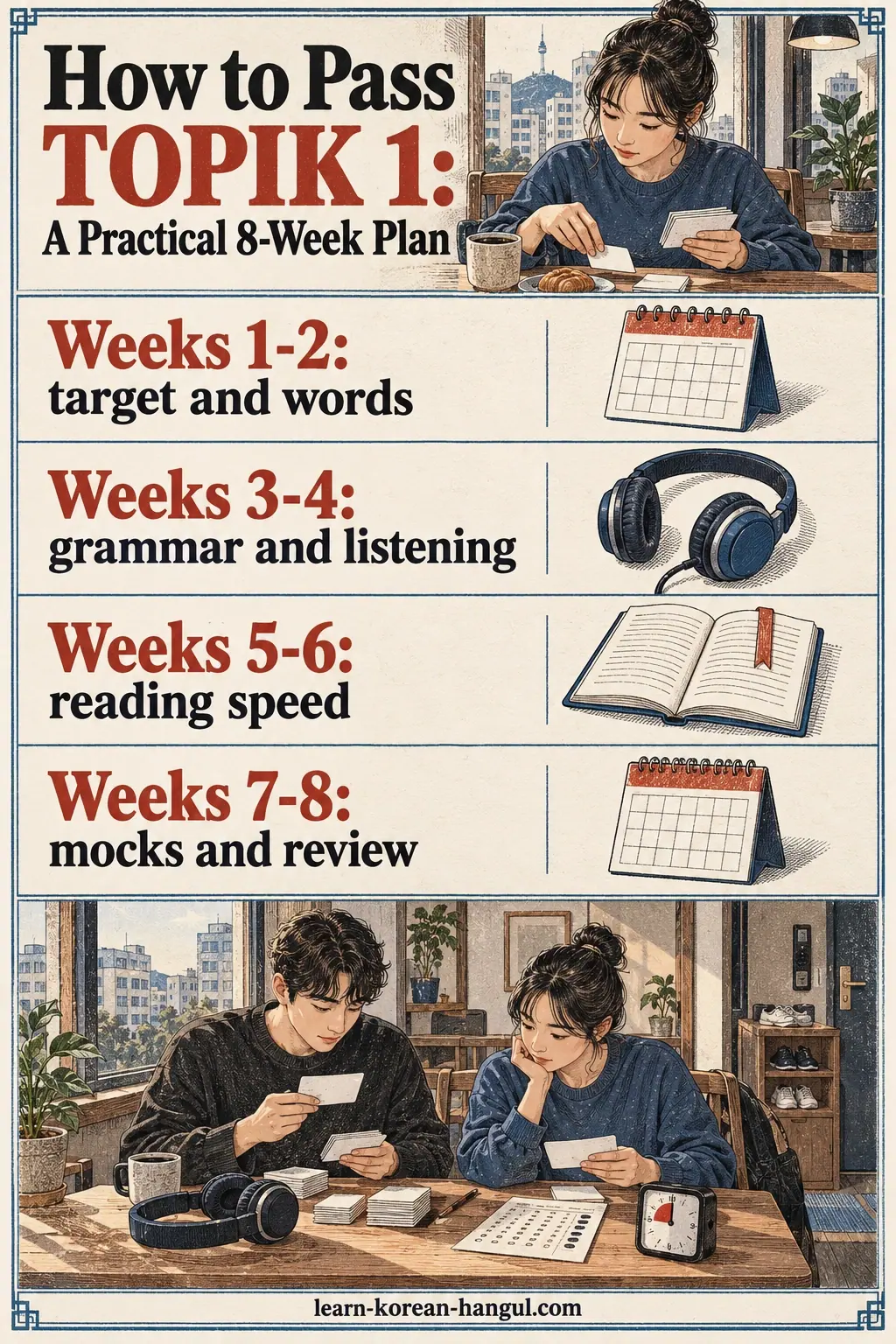
How to pass TOPIK 1: reach 80 points out of 200 for Level 1, or 140 for Level 2, by studying core vocabulary, basic grammar, listening and reading in short daily sessions. This six-step plan takes 8 weeks at 30-45 minutes a day for learners who read Hangul; its key success factor is timed practice with official past papers.
How to Pass TOPIK 1: before You Start
Passing TOPIK 1 is a question of arithmetic before it is a question of study. 80 points is 40% of the marks, so a Level 1 candidate can miss more than half the questions and still pass. 140 points is 70%, which needs solid accuracy in both sections. Knowing which target you need decides how hard the next eight weeks will be.
Before you start:
- Time: 8 weeks, 30-45 minutes a day, six days a week; about 24-36 hours in total.
- Difficulty: moderate for Level 1, demanding for Level 2.
- Typical cost: the test fee for your country, plus a course book if you do not have one. Official past papers are free on topik.go.kr.
- Materials: one beginner course book, a flashcard app or paper cards, the free past papers with audio and answer keys, a timer, printed answer sheets, a notebook for an error log.
- Prerequisites: you read Hangul without sounding out each letter, and you know polite present-tense sentences such as 저는 학생이에요. If not, spend two to four weeks on reading and basic sentences first.
The structure of the test, with its 30 listening and 40 reading questions, is explained on the TOPIK 1 exam format page; read it once before Step 1.
Step 1: Set Your Target Level and Test Date

Choose Level 1 (80 points) or Level 2 (140 points), then register for a session about eight weeks away.
How: take one official TOPIK 1 past paper untimed, mark it, and use the result to pick the target. Under 50 points, aim for Level 1. Between 50 and 100, Level 1 is safe and Level 2 is possible with steady work. Above 100, aim for Level 2. Check registration windows on TOPIK exam dates and on topik.go.kr, because they close weeks before the test.
You'll know it worked when you have a target number, a test date in your calendar and a baseline score written down.
Common mistake: choosing a date first and a target later. A date with no target leads to vague study; a target with no date leads to endless study.
The official past papers are called 기출문제 (gichulmunje) in Korean, and you will search for this word often.
Step 2: Build the Core Vocabulary (weeks 1-3)

Learn about 40 new words a day for three weeks, building towards an 800-word core of everyday vocabulary.
How: take words by topic, not alphabetically: family, food, places, transport, time, weather, shopping, hobbies. Use spaced repetition (reviewing each word just before you would forget it) in a flashcard app or with paper cards. Spend about 25 minutes a day on new words and 15 on review in week 1, then shorten the new-word time as grammar and listening start (see the weekly table below). A topic-by-topic list is on the TOPIK 1 vocabulary list.
You'll know it worked when you can read a past-paper reading text and understand most of the nouns without a dictionary.
Common mistake: learning words without sound. TOPIK 1 listening tests words you hear, so play the audio for every card and say the word aloud.
The 800-word figure is an estimate commonly cited by teachers and textbooks for Level 1, not an official list, so treat it as a working target.
Step 3: Learn the Key Grammar (weeks 2-5)

Master about 30 beginner grammar patterns: particles, polite and formal endings, past and future, and common connectors.
How: learn one to three patterns a day, each with one model sentence you can say from memory. Prioritise the patterns that appear in almost every TOPIK 1 text: 은/는, 이/가, 을/를, 에, 에서, -아요/어요, -았어요/었어요, -(으)ㄹ 거예요, -고, -지만 and -(으)세요. The full list with examples is on the TOPIK 1 grammar list.
Two model sentences show the connectors in action. The first joins two past actions with -고 ("and"):
주말에 친구를 만나고 영화를 봤어요.
jumare chingureul mannago yeonghwareul bwasseoyo.
At the weekend I met a friend and watched a film.
The second contrasts two facts with -지만 ("but"):
비가 오지만 우산이 없어요.
biga ojiman usani eopseoyo.
It is raining, but I do not have an umbrella.
없어요 is said [업써요]. Reading items 34-39 test exactly this kind of choice: which particle or ending fits the blank.
You'll know it worked when you score at least 4 out of 6 on the fill-the-blank questions of a past paper.
Common mistake: collecting patterns without using them. One sentence you can say beats ten you have only read.
Step 4: Train Listening Daily (weeks 3-8)

Listen to TOPIK-style Korean for 10-15 minutes every day, using past-paper audio and short beginner dialogues.
How: use a three-pass method. First, listen once without the script and answer the question. Second, listen with the script and underline what you missed. Third, shadow the recording: play it and speak along at the same time. Rotate through the item types: replies, places, topics, pictures and paired questions. Strategies for each type are on TOPIK listening.
You'll know it worked when you can answer listening questions 1-14 of a past paper with at least 10 correct.
Common mistake: listening only with the script. The test plays audio without text, so the first pass must always be blind.
Step 5: Build Reading Speed (weeks 3-8)

Read one short past-paper text a day under a time limit, then reread it slowly.
How: set a timer for 90 seconds per question, the average that the official timing allows, and answer. Then reread the text without the timer and look up every word you guessed. Note the instruction phrase, such as 알맞은 것 ("the correct one") or 맞지 않는 것 ("the one that does not match"). Start with questions 31-48 and add the longer texts from week 5.
You'll know it worked when you finish questions 31-48 of a past paper in 15 minutes with at least 12 correct.
Common mistake: neglecting Hangul reading speed. Learners who still decode syllable by syllable run out of time on the long texts, even when they know the words.
Step 6: Take Timed Mocks (weeks 4-8)

Sit three timed mocks from official past papers: a half mock in week 4, a full mock in week 6 and a final full mock in week 8. A mock test is 모의고사 (mouigosa) in Korean.
How: print an answer sheet, use the real timings (40 minutes listening, 60 minutes reading, no break), and mark answers as you go. Mark the paper with the official key, then write every wrong answer in an error log with the reason: vocabulary, grammar, misread instruction or time. Use papers from TOPIK past papers, and see TOPIK mock test for the full method.
You'll know it worked when your week 8 total is at least 10-15 points above your target cut score.
Common mistake: skipping timing practice. Untimed scores are typically higher than timed ones, so only a timed mock tells you whether you will pass.
What Does the 8-Week Plan Look Like?
The 8-week plan overlaps the six steps so that vocabulary and grammar feed listening and reading from week 3. Each week has one outcome you can check.
- 01
Weeks 1-2: Target and Words
Baseline score, test date, 500 words
TOPIK 1 Vocabulary ListCore words by topic.
- 02
Weeks 3-4: Grammar and Listening
800 words, 18 patterns, half mock
TOPIK 1 Grammar ListPatterns with examples.
- 03
Weeks 5-6: Reading Speed
30 patterns, first full timed mock
TOPIK past PapersOfficial papers with audio and keys.
- 04
Weeks 7-8: Mocks and Review
Final mock above the target cut score
TOPIK Mock TestHow to sit and review a mock.
| Week | Main focus | Daily split in minutes (about 40 in total) | Outcome by the end of the week |
|---|---|---|---|
| 1 | Baseline paper, vocabulary | 25 words, 15 review | target chosen; 250 words |
| 2 | Vocabulary, first grammar | 20 words, 10 grammar, 10 review | 500 words; 6 patterns |
| 3 | Vocabulary, grammar, listening starts | 15 words, 10 grammar, 15 listening | 800 words; 12 patterns |
| 4 | Grammar, listening, reading; half mock | 10 grammar, 15 listening, 15 reading | 18 patterns; half mock marked |
| 5 | Grammar finish, longer reading | 10 grammar, 15 listening, 15 reading | 30 patterns |
| 6 | Full timed mock, error log | mock day plus review days | first full total |
| 7 | Weak section, instruction phrases | 20 weak section, 20 mixed | error types reduced |
| 8 | Final mock, light review | mock day, then review only | final total recorded |
The week numbers assume a test at the end of week 8. If your test is earlier or later, the variations below adjust the plan.
How Do You Track Your Score?
Track your score with a simple table after every mock: section scores, total, gap to the target and the main error type. The gap column shows whether the plan is working.
| Mock | Week | Listening (/100) | Reading (/100) | Total (/200) | Gap to target | Main error type |
|---|---|---|---|---|---|---|
| Baseline | 1 | |||||
| Half mock | 4 | (×2 estimate) | ||||
| Full mock | 6 | |||||
| Final mock | 8 |
A worked example: a learner aiming for Level 1 scores 58 on the baseline, an estimated 76 at the half mock, 88 at week 6 and 97 at week 8. The final total is 17 points above 80, beyond the recommended 10-15 point margin. Had the week 6 score been 70, the right response would be to spend week 7 entirely on the weaker section.
What Mistakes Cost Learners Marks?
The mistakes that cost TOPIK 1 candidates the most marks are about habits, not knowledge. Each one below comes with its fix.
- Leaving answers blank. There is no negative marking, so a blank always scores zero. Fix: guess every item before time runs out.
- Slow Hangul reading. Decoding each syllable wastes minutes. Fix: read aloud for 5 minutes a day from week 1.
- Skipping timing practice. Untimed practice hides pacing problems. Fix: sit all three mocks under real timings.
- Misreading the instruction. Choosing the true statement when the question asks for the false one. Fix: circle 같은 것 or 맞지 않는 것 before reading the options.
- Late answer-sheet transfer. Copying answers at the end risks an empty sheet. Fix: mark the sheet after each page.
- Learning words without sound. Fix: play audio for every flashcard.
Variations for Different Situations
The 8-week plan adapts to three common situations.
- Only four weeks left: drop new grammar after week 2, keep daily listening and reading, and sit two full mocks (weeks 2 and 4). Aim for Level 1 unless your baseline is already above 100.
- Already at Level 1, aiming for Level 2: shorten vocabulary to week 1, extend reading to all eight weeks, and add a fourth mock in week 7. Level 2 needs 70% accuracy, so reading speed is usually the deciding skill.
- Twelve weeks or more available: use the extra weeks for a full beginner grammar review and more reading; the TOPIK 1 study plan and the general TOPIK study plan give longer schedules.
How Long Does It Really Take?
Passing TOPIK 1 takes about 24-36 hours of focused preparation for a learner who already has the basics, and more for a complete beginner. Many learners who study a few hours a week reach Level 1 in roughly three to six months from zero, and Level 2 in roughly six to twelve months. These are editorial estimates, not official figures.
Your time depends on three things: how many hours you study each week, whether your first language shares vocabulary with Korean, and whether you practise timed listening and reading rather than vocabulary alone.
How Many Hours a Week Should I Study for TOPIK 1?
Study about 3-5 hours a week for TOPIK 1, spread across six days. That is the 30-45 minute daily rhythm of this plan. Short daily sessions work better than one long weekend session, because vocabulary and listening depend on frequent review. If you can give more time, add it to your weaker section rather than to new material. What the result means once you pass is on TOPIK level 1.
Frequently Asked Questions
Can I pass TOPIK 1 in a month? Yes, if you already have the basics. A learner who reads Hangul fluently and has studied for a few months can often reach Level 1 with four focused weeks of past papers, listening and core vocabulary. Starting from zero, one month is rarely enough, because 80 points needs real comprehension, not only test tricks.
Is self-study enough to pass TOPIK 1? For most learners, yes. TOPIK 1 tests listening and reading only, so self-study with a course book, audio, flashcards and official past papers covers everything it measures. A teacher or tutor helps mainly with motivation and with explaining grammar you find confusing, not with any skill the test requires.
What is the passing score for TOPIK 1? TOPIK 1 has two passing scores: 80 out of 200 for Level 1 and 140 out of 200 for Level 2. There is no separate pass mark per section, so the total decides. Below 80, you receive your scores but no level. Confirm the cut scores in the current official guide on topik.go.kr.
Which TOPIK 1 section should I focus on? Focus on the section where your mock score is lower, because the cheapest points are there. Many learners find listening improves faster with daily practice, while reading speed builds more slowly, so start reading practice early. Both sections are worth 100 points, so neither can be ignored for a Level 2 target.
The Bottom Line on How to Pass TOPIK 1
How to pass TOPIK 1 comes down to a clear target, a fixed date and timed practice: 80 points for Level 1 or 140 for Level 2, eight weeks of 30-45 minute sessions, and three mocks from official past papers. Build an 800-word core and about 30 grammar patterns, train listening and reading every day, and finish with a final mock at least 10-15 points above your cut score. Your next step is the official papers on TOPIK past papers: where to find and how to use them.