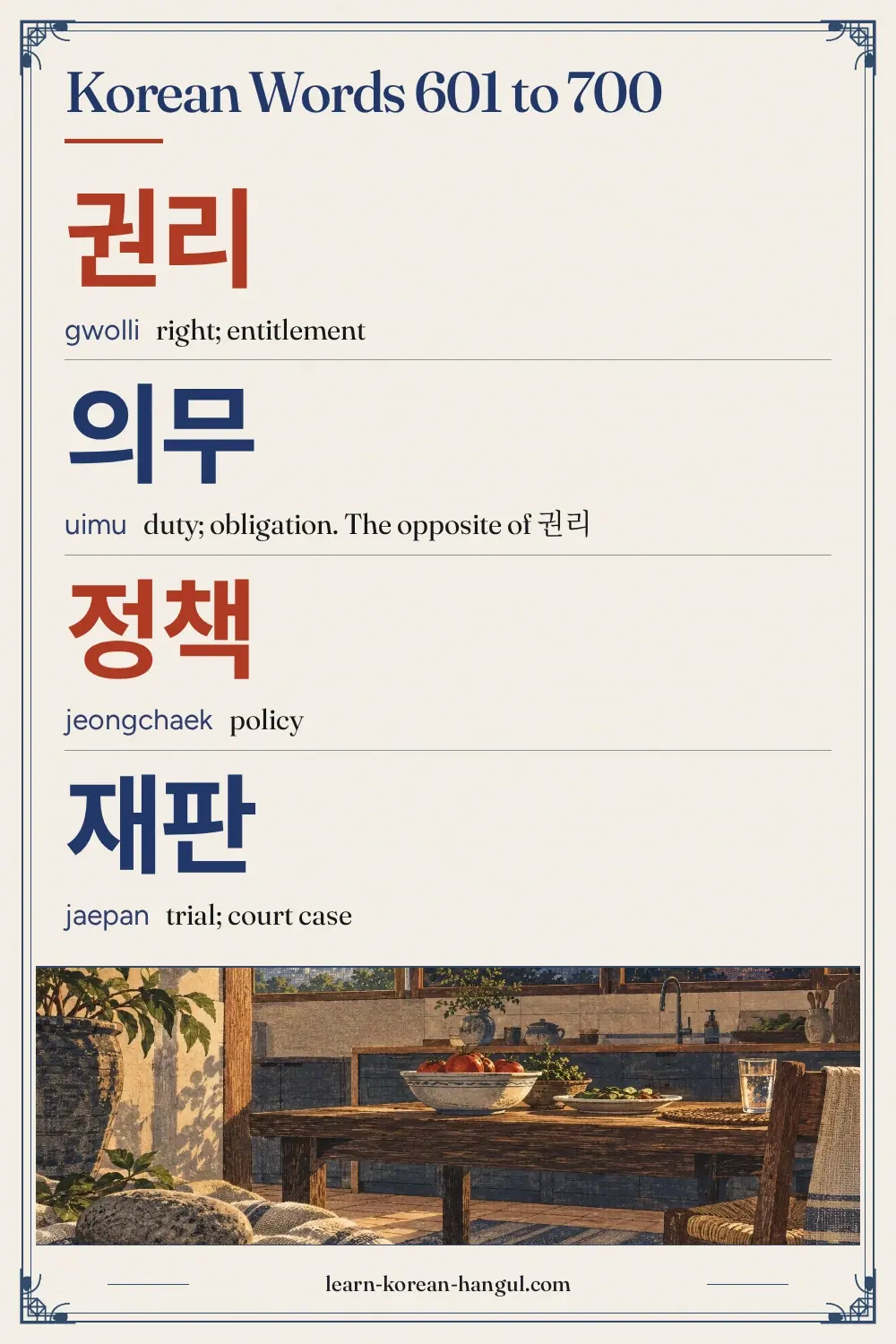
Korean Words 601 to 700 at a Glance
Korean words 601 to 700 are the second unit of the Top 1000 Korean Words list. Words 1 to 500 name the objects, people and routines of daily life. This unit moves to what you read in the news and hear at work: laws, prices, illness, school and change over time.
Of the 100 words, 96 are Sino-Korean (built from syllables of Chinese origin), 2 are native Korean and 2 are loanwords from English. The high Sino-Korean share is normal at this level, because formal and abstract words come mostly from that layer. The origin column marks each word. The first column is a suggested study order for a B1 learner. It is an editorial judgement and not a frequency count, so word 650 is not necessarily rarer than word 640.
| Group | Words | What it lets you do |
|---|---|---|
| Society and law | 20 | Follow news about rules, courts and public life |
| Money and business | 20 | Talk about prices, sales, costs and companies |
| Health and body | 20 | Describe symptoms, treatment and healthy habits |
| Education and culture | 20 | Talk about school, research and study plans |
| Time and change | 20 | Describe stages, trends, increases and chances |
These lists hold nouns, adverbs and connectors. Verbs are in the verbs section, and a few nouns here, such as 협력 (cooperation), can take 하다 to make a verb: 협력하다. You need to read Hangul to use the tables. If you cannot yet, start with reading Hangul.
Which Words Ranked 601 to 700 Should You Learn First?
Learn the words that match what you do this month before the rest. A learner who reads the news needs 정책, 경제적 and 증가 first, and a learner who studies at a Korean university needs 강의, 등록금 and 장학금 first. Pick the line that fits you:
- If you follow the news. 사회적, 법률, 정책, 피해, 증가 and 감소.
- If you work in an office. 매출, 비용, 예산, 고객, 수요 and 협력.
- If you visit a doctor. 증상, 치료, 통증, 검사, 처방 and 회복.
- If you study. 학문, 석사, 박사, 등록금, 강의 and 방학.
- If you plan for the future. 계획 is already in the first 500 words, so add 단계, 과정, 확대 and 필요성.
At 10 words a day the unit takes ten days, and at 5 words a day it takes twenty. Add a review day after each group.
Society and Law
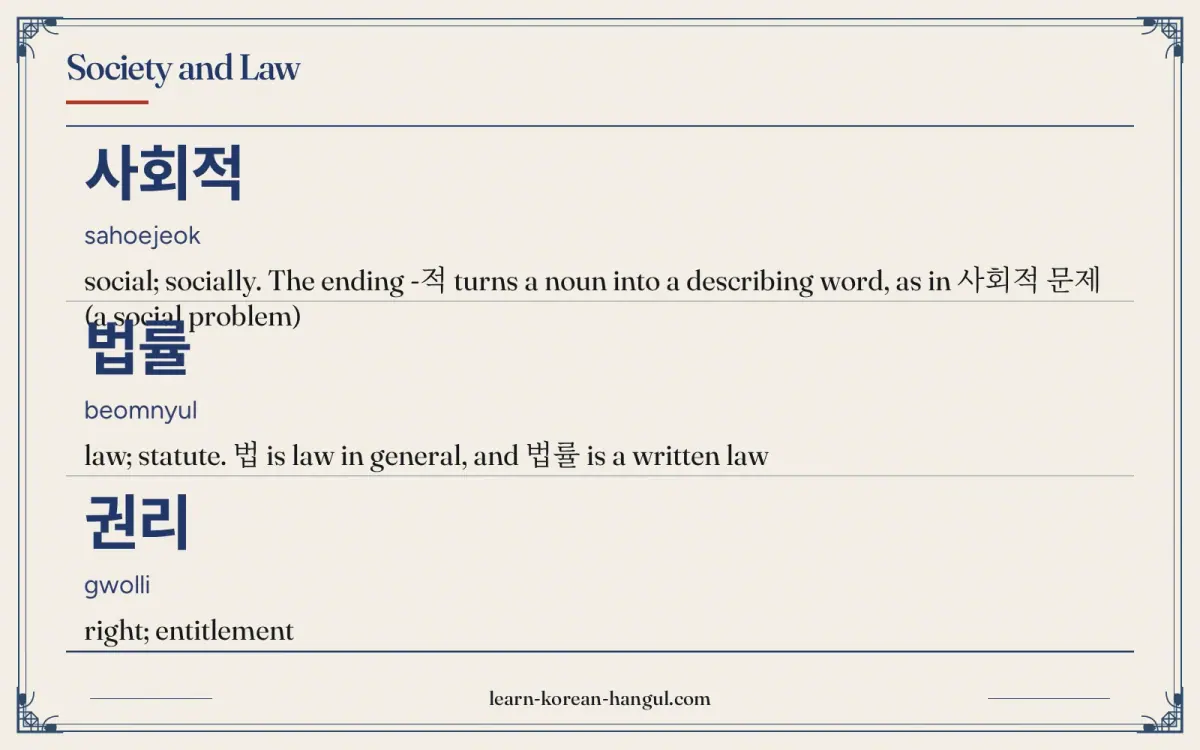
The society and law words describe how a community sets rules and settles disputes. 법률 (law), 권리 (right) and 의무 (duty) are the three base words. 제도 is the system, 정책 is the plan a government follows, and 재판, 판사 and 법원 name the court side. The ending -적 appears in the first word: 사회적 (social) is 사회 (society) plus -적, which turns a noun into a describing word. It usually comes before a noun, as in 사회적 문제 (a social problem), or takes 으로 to work like an adverb: 사회적으로 중요해요 (it is socially important).
| No. | Hangul | Revised Romanization | Origin | Meaning and note | Example sentence | Audio assetId |
|---|---|---|---|---|---|---|
| 601 | 사회적 | sahoejeok | Sino-Korean | social; socially. The ending -적 turns a noun into a describing word, as in 사회적 문제 (a social problem) | 사회적 문제가 커지고 있어요. (Social problems are growing.) | au-pg-vocabulary-core-words-top-1000-601-700-1; example: au-pg-vocabulary-core-words-top-1000-601-700-101 |
| 602 | 법률 | beomnyul | Sino-Korean | law; statute. 법 is law in general, and 법률 is a written law | 새 법률이 다음 달에 시작돼요. (A new law starts next month.) | au-pg-vocabulary-core-words-top-1000-601-700-2; example: au-pg-vocabulary-core-words-top-1000-601-700-102 |
| 603 | 권리 | gwolli | Sino-Korean | right; entitlement | 모든 사람에게 쉴 권리가 있어요. (Everyone has the right to rest.) | au-pg-vocabulary-core-words-top-1000-601-700-3; example: au-pg-vocabulary-core-words-top-1000-601-700-103 |
| 604 | 의무 | uimu | Sino-Korean | duty; obligation. The opposite of 권리 | 세금을 내는 것은 국민의 의무예요. (Paying taxes is a citizen's duty.) | au-pg-vocabulary-core-words-top-1000-601-700-4; example: au-pg-vocabulary-core-words-top-1000-601-700-104 |
| 605 | 규정 | gyujeong | Sino-Korean | regulation; official rule. 규칙 is a rule in general, and 규정 is a written regulation | 회사 규정을 확인해 주세요. (Please check the company regulations.) | au-pg-vocabulary-core-words-top-1000-601-700-5; example: au-pg-vocabulary-core-words-top-1000-601-700-105 |
| 606 | 제도 | jedo | Sino-Korean | system; institution. A set of official rules, as in 교육 제도 (education system) | 새로운 제도가 생겼어요. (A new system has been introduced.) | au-pg-vocabulary-core-words-top-1000-601-700-6; example: au-pg-vocabulary-core-words-top-1000-601-700-106 |
| 607 | 정책 | jeongchaek | Sino-Korean | policy | 정부가 새 정책을 발표했어요. (The government announced a new policy.) | au-pg-vocabulary-core-words-top-1000-601-700-7; example: au-pg-vocabulary-core-words-top-1000-601-700-107 |
| 608 | 재판 | jaepan | Sino-Korean | trial; court case | 재판은 다음 주에 열려요. (The trial opens next week.) | au-pg-vocabulary-core-words-top-1000-601-700-8; example: au-pg-vocabulary-core-words-top-1000-601-700-108 |
| 609 | 판사 | pansa | Sino-Korean | judge | 판사가 증인에게 질문을 했어요. (The judge asked the witness a question.) | au-pg-vocabulary-core-words-top-1000-601-700-9; example: au-pg-vocabulary-core-words-top-1000-601-700-109 |
| 610 | 범죄 | beomjoe | Sino-Korean | crime | 이 동네는 범죄가 적어요. (There is little crime in this neighbourhood.) | au-pg-vocabulary-core-words-top-1000-601-700-10; example: au-pg-vocabulary-core-words-top-1000-601-700-110 |
| 611 | 범인 | beomin | Sino-Korean | criminal; culprit | 경찰이 범인을 찾았어요. (The police found the culprit.) | au-pg-vocabulary-core-words-top-1000-601-700-11; example: au-pg-vocabulary-core-words-top-1000-601-700-111 |
| 612 | 피해 | pihae | Sino-Korean | damage; harm | 큰비 때문에 피해가 생겼어요. (The heavy rain caused damage.) | au-pg-vocabulary-core-words-top-1000-601-700-12; example: au-pg-vocabulary-core-words-top-1000-601-700-112 |
| 613 | 시민 | simin | Sino-Korean | citizen; city resident. 국민 is a citizen of a nation, and 시민 is a member of the community | 시민들이 공원에 모였어요. (The citizens gathered in the park.) | au-pg-vocabulary-core-words-top-1000-601-700-13; example: au-pg-vocabulary-core-words-top-1000-601-700-113 |
| 614 | 단체 | danche | Sino-Korean | group; organization | 단체 사진을 찍었어요. (We took a group photo.) | au-pg-vocabulary-core-words-top-1000-601-700-14; example: au-pg-vocabulary-core-words-top-1000-601-700-114 |
| 615 | 협력 | hyeomnyeok | Sino-Korean | cooperation | 두 나라가 서로 협력해요. (The two countries cooperate with each other.) | au-pg-vocabulary-core-words-top-1000-601-700-15; example: au-pg-vocabulary-core-words-top-1000-601-700-115 |
| 616 | 분쟁 | bunjaeng | Sino-Korean | dispute | 두 회사 사이에 분쟁이 생겼어요. (A dispute arose between the two companies.) | au-pg-vocabulary-core-words-top-1000-601-700-16; example: au-pg-vocabulary-core-words-top-1000-601-700-116 |
| 617 | 증인 | jeungin | Sino-Korean | witness | 증인이 법원에 나왔어요. (The witness came to court.) | au-pg-vocabulary-core-words-top-1000-601-700-17; example: au-pg-vocabulary-core-words-top-1000-601-700-117 |
| 618 | 질서 | jilseo | Sino-Korean | order; public order | 모두가 질서를 지켜요. (Everyone keeps order.) | au-pg-vocabulary-core-words-top-1000-601-700-18; example: au-pg-vocabulary-core-words-top-1000-601-700-118 |
| 619 | 공공 | gonggong | Sino-Korean | public; communal. Used before a noun, as in 공공장소 (public place) | 공공장소에서는 조용히 해야 해요. (You must be quiet in public places.) | au-pg-vocabulary-core-words-top-1000-601-700-19; example: au-pg-vocabulary-core-words-top-1000-601-700-119 |
| 620 | 법원 | beobwon | Sino-Korean | court of law | 법원은 시청 근처에 있어요. (The court is near city hall.) | au-pg-vocabulary-core-words-top-1000-601-700-20; example: au-pg-vocabulary-core-words-top-1000-601-700-120 |
Three points need care. 법 is law in general, while 법률 is a written statute, so people obey the 법 and the National Assembly passes a 법률. 국민 (citizens of a nation, from the first 500 words) and 시민 (members of a city or community) overlap, but only 국민 is tied to nationality. 피해 (damage) and 범죄 (crime) often appear together in news: 범죄 피해 means damage from crime. For more crime and court words, see the law and crime vocabulary page, and for politics see politics and government vocabulary.
Example Sentences
Each example is a short polite sentence. Many follow the pattern noun + 이/가 + verb, where 이/가 is the subject particle. Say a sentence aloud, then swap the first noun. In 새 법률이 다음 달에 시작돼요 you can replace 법률 with 제도 and get 새 제도가 다음 달에 시작돼요 (A new system starts next month). The particles are explained in the Korean particles guide.
How Do You Say Money and Business in Korean?
Business words follow the path of a product: 생산 (production), 상품 (goods), 수요 (demand), 수출 (export), 거래 (the deal), 고객 (the customer) and 매출 (the sales). The cost side is 비용, 예산, 손해 and 임금. When you read the economy news, 물가 (prices) and 경쟁 (competition) come up in almost every report.
| No. | Hangul | Revised Romanization | Origin | Meaning and note | Example sentence | Audio assetId |
|---|---|---|---|---|---|---|
| 621 | 소비 | sobi | Sino-Korean | consumption; spending | 겨울에는 전기 소비가 늘어요. (Electricity use rises in winter.) | au-pg-vocabulary-core-words-top-1000-601-700-21; example: au-pg-vocabulary-core-words-top-1000-601-700-121 |
| 622 | 소비자 | sobija | Sino-Korean | consumer. The ending -자 names a person who does something | 소비자는 싼 가격을 좋아해요. (Consumers like low prices.) | au-pg-vocabulary-core-words-top-1000-601-700-22; example: au-pg-vocabulary-core-words-top-1000-601-700-122 |
| 623 | 생산 | saengsan | Sino-Korean | production | 이 공장은 자동차 생산을 늘렸어요. (This factory increased its car production.) | au-pg-vocabulary-core-words-top-1000-601-700-23; example: au-pg-vocabulary-core-words-top-1000-601-700-123 |
| 624 | 수출 | suchul | Sino-Korean | export. The opposite of 수입 (import) | 한국은 반도체를 수출해요. (Korea exports semiconductors.) | au-pg-vocabulary-core-words-top-1000-601-700-24; example: au-pg-vocabulary-core-words-top-1000-601-700-124 |
| 625 | 상품 | sangpum | Sino-Korean | goods; item for sale. What a shop sells | 이 가게는 상품이 정말 많아요. (This shop has a really wide range of goods.) | au-pg-vocabulary-core-words-top-1000-601-700-25; example: au-pg-vocabulary-core-words-top-1000-601-700-125 |
| 626 | 수요 | suyo | Sino-Korean | demand. The opposite of 공급 (supply) | 여름에는 에어컨 수요가 늘어요. (In summer the demand for air conditioners grows.) | au-pg-vocabulary-core-words-top-1000-601-700-26; example: au-pg-vocabulary-core-words-top-1000-601-700-126 |
| 627 | 비용 | biyong | Sino-Korean | cost; expense | 이사 비용이 많이 들었어요. (The moving costs were high.) | au-pg-vocabulary-core-words-top-1000-601-700-27; example: au-pg-vocabulary-core-words-top-1000-601-700-127 |
| 628 | 예산 | yesan | Sino-Korean | budget | 이번 달 예산이 부족해요. (This month's budget is not enough.) | au-pg-vocabulary-core-words-top-1000-601-700-28; example: au-pg-vocabulary-core-words-top-1000-601-700-128 |
| 629 | 이익 | iik | Sino-Korean | profit; benefit | 회사의 이익이 늘었어요. (The company's profit increased.) | au-pg-vocabulary-core-words-top-1000-601-700-29; example: au-pg-vocabulary-core-words-top-1000-601-700-129 |
| 630 | 손해 | sonhae | Sino-Korean | loss; damage (financial) | 이 계약은 우리에게 손해예요. (This contract is a loss for us.) | au-pg-vocabulary-core-words-top-1000-601-700-30; example: au-pg-vocabulary-core-words-top-1000-601-700-130 |
| 631 | 매출 | maechul | Sino-Korean | sales; revenue | 이번 달 매출이 올랐어요. (This month's sales went up.) | au-pg-vocabulary-core-words-top-1000-601-700-31; example: au-pg-vocabulary-core-words-top-1000-601-700-131 |
| 632 | 고객 | gogaek | Sino-Korean | customer; client. More formal than 손님 | 고객이 전화로 문의했어요. (A customer made an enquiry by phone.) | au-pg-vocabulary-core-words-top-1000-601-700-32; example: au-pg-vocabulary-core-words-top-1000-601-700-132 |
| 633 | 거래 | georae | Sino-Korean | transaction; dealings | 두 회사는 오래 거래했어요. (The two companies have done business for a long time.) | au-pg-vocabulary-core-words-top-1000-601-700-33; example: au-pg-vocabulary-core-words-top-1000-601-700-133 |
| 634 | 경쟁 | gyeongjaeng | Sino-Korean | competition | 가게가 많아서 경쟁이 심해요. (There are many shops, so the competition is fierce.) | au-pg-vocabulary-core-words-top-1000-601-700-34; example: au-pg-vocabulary-core-words-top-1000-601-700-134 |
| 635 | 기업 | gieop | Sino-Korean | company; enterprise. 회사 is any company, and 기업 stresses the business as an organization | 큰 기업에서 일하고 싶어요. (I want to work at a big company.) | au-pg-vocabulary-core-words-top-1000-601-700-35; example: au-pg-vocabulary-core-words-top-1000-601-700-135 |
| 636 | 물가 | mulga | Sino-Korean | prices; cost of living. Said [물까]. It means the general level of prices | 요즘 물가가 많이 올랐어요. (Prices have gone up a lot lately.) | au-pg-vocabulary-core-words-top-1000-601-700-36; example: au-pg-vocabulary-core-words-top-1000-601-700-136 |
| 637 | 부동산 | budongsan | Sino-Korean | real estate | 부동산에서 집을 구했어요. (I found a house at a real estate agency.) | au-pg-vocabulary-core-words-top-1000-601-700-37; example: au-pg-vocabulary-core-words-top-1000-601-700-137 |
| 638 | 임금 | imgeum | Sino-Korean | wages. 월급 is a monthly salary, and 임금 is pay in general | 임금이 조금 올랐어요. (Wages rose a little.) | au-pg-vocabulary-core-words-top-1000-601-700-38; example: au-pg-vocabulary-core-words-top-1000-601-700-138 |
| 639 | 재산 | jaesan | Sino-Korean | property; assets | 그는 많은 재산을 기부했어요. (He donated a lot of his property.) | au-pg-vocabulary-core-words-top-1000-601-700-39; example: au-pg-vocabulary-core-words-top-1000-601-700-139 |
| 640 | 경제적 | gyeongjejeok | Sino-Korean | economic; economical. Another -적 word. It can mean about the economy or cheap to run | 경제적 어려움이 있어요. (There are economic difficulties.) | au-pg-vocabulary-core-words-top-1000-601-700-40; example: au-pg-vocabulary-core-words-top-1000-601-700-140 |
The word 경제적 is the second -적 word. It has two uses. 경제적 어려움 means economic difficulty, and 경제적인 차 means a car that is cheap to run. In the second use English says economical. 소비자 shows another ending: -자 names the person who does the action, so 소비 (consumption) becomes 소비자 (consumer). You will see the same ending in 환자 (patient) in the next group and in 투자자 (investor) on the finance and stocks vocabulary page. For everyday bank and money words, see the bank vocabulary page.
A Business Message That Uses 11 Words from This Unit
Here is a short formal message of the kind a company sends to a partner. The words from this unit are in bold.
안녕하세요. 이번 달 매출과 비용을 정리해서 보내 드립니다. 예산 안에서 새 상품을 준비하는 단계입니다. 고객 의견을 반영해 서비스 개선을 진행하겠습니다. 행사 기간이 변경되면 다시 연락드리겠습니다. 협력해 주셔서 감사합니다.
In English: Hello. We are sending you this month's sales and costs, organised. We are at the stage of preparing a new product within the budget. We will carry out service improvements that reflect customers' opinions. If the event period changes, we will contact you again. Thank you for your cooperation.
The sentences end in -ㅂ니다, the formal ending, which is common in written business Korean. In speech between colleagues you would more often hear the polite -요 ending.
Health and Body
Health words follow a visit to the doctor. You describe a 증상 (symptom) or 통증 (pain), the doctor makes a 진단 (diagnosis), gives a 처방 (prescription) and plans a 치료 (treatment), and you hope for a quick 회복 (recovery). The rest of the group is about staying healthy: 체력, 근육, 영양, 휴식 and 수면. 건강 (health) is already in the first 500 words.
| No. | Hangul | Revised Romanization | Origin | Meaning and note | Example sentence | Audio assetId |
|---|---|---|---|---|---|---|
| 641 | 증상 | jeungsang | Sino-Korean | symptom | 감기 증상이 있어요. (I have cold symptoms.) | au-pg-vocabulary-core-words-top-1000-601-700-41; example: au-pg-vocabulary-core-words-top-1000-601-700-141 |
| 642 | 치료 | chiryo | Sino-Korean | treatment | 치료는 한 달쯤 걸려요. (Treatment takes about a month.) | au-pg-vocabulary-core-words-top-1000-601-700-42; example: au-pg-vocabulary-core-words-top-1000-601-700-142 |
| 643 | 수술 | susul | Sino-Korean | surgery; operation | 다음 주에 수술을 받아요. (I have surgery next week.) | au-pg-vocabulary-core-words-top-1000-601-700-43; example: au-pg-vocabulary-core-words-top-1000-601-700-143 |
| 644 | 진단 | jindan | Sino-Korean | diagnosis | 의사가 진단을 내렸어요. (The doctor made a diagnosis.) | au-pg-vocabulary-core-words-top-1000-601-700-44; example: au-pg-vocabulary-core-words-top-1000-601-700-144 |
| 645 | 환자 | hwanja | Sino-Korean | patient | 병원에 환자가 많아요. (There are many patients at the hospital.) | au-pg-vocabulary-core-words-top-1000-601-700-45; example: au-pg-vocabulary-core-words-top-1000-601-700-145 |
| 646 | 예방 | yebang | Sino-Korean | prevention | 손을 자주 씻으면 감기 예방에 좋아요. (Washing your hands often helps prevent colds.) | au-pg-vocabulary-core-words-top-1000-601-700-46; example: au-pg-vocabulary-core-words-top-1000-601-700-146 |
| 647 | 통증 | tongjeung | Sino-Korean | pain; ache | 허리에 통증이 있어요. (I have pain in my lower back.) | au-pg-vocabulary-core-words-top-1000-601-700-47; example: au-pg-vocabulary-core-words-top-1000-601-700-147 |
| 648 | 체력 | cheryeok | Sino-Korean | physical strength; stamina | 운동을 해서 체력이 좋아졌어요. (I exercised and my stamina improved.) | au-pg-vocabulary-core-words-top-1000-601-700-48; example: au-pg-vocabulary-core-words-top-1000-601-700-148 |
| 649 | 근육 | geunyuk | Sino-Korean | muscle. Said [그뉵]: the ㄴ of 근 moves onto 육 | 근육이 아파요. (My muscles hurt.) | au-pg-vocabulary-core-words-top-1000-601-700-49; example: au-pg-vocabulary-core-words-top-1000-601-700-149 |
| 650 | 혈압 | hyeorap | Sino-Korean | blood pressure. Said [혀랍] | 혈압을 재 봤어요. (I measured my blood pressure.) | au-pg-vocabulary-core-words-top-1000-601-700-50; example: au-pg-vocabulary-core-words-top-1000-601-700-150 |
| 651 | 체중 | chejung | Sino-Korean | body weight | 요즘 체중이 줄었어요. (My weight has dropped lately.) | au-pg-vocabulary-core-words-top-1000-601-700-51; example: au-pg-vocabulary-core-words-top-1000-601-700-151 |
| 652 | 영양 | yeongyang | Sino-Korean | nutrition | 이 음식은 영양이 풍부해요. (This food is rich in nutrients.) | au-pg-vocabulary-core-words-top-1000-601-700-52; example: au-pg-vocabulary-core-words-top-1000-601-700-152 |
| 653 | 비타민 | bitamin | loanword | vitamin. From English | 아침에 비타민을 먹어요. (I take vitamins in the morning.) | au-pg-vocabulary-core-words-top-1000-601-700-53; example: au-pg-vocabulary-core-words-top-1000-601-700-153 |
| 654 | 휴식 | hyusik | Sino-Korean | rest; break | 주말에는 충분한 휴식이 필요해요. (You need enough rest at the weekend.) | au-pg-vocabulary-core-words-top-1000-601-700-54; example: au-pg-vocabulary-core-words-top-1000-601-700-154 |
| 655 | 수면 | sumyeon | Sino-Korean | sleep. A formal word. In daily talk people say 잠 | 수면이 부족하면 피곤해요. (If you lack sleep, you get tired.) | au-pg-vocabulary-core-words-top-1000-601-700-55; example: au-pg-vocabulary-core-words-top-1000-601-700-155 |
| 656 | 스트레스 | seuteureseu | loanword | stress. From English. The usual verb is 받다 (to receive) | 일 때문에 스트레스를 많이 받아요. (I get a lot of stress from work.) | au-pg-vocabulary-core-words-top-1000-601-700-56; example: au-pg-vocabulary-core-words-top-1000-601-700-156 |
| 657 | 면역 | myeonyeok | Sino-Korean | immunity | 잠을 잘 자면 면역이 좋아져요. (If you sleep well, your immunity gets better.) | au-pg-vocabulary-core-words-top-1000-601-700-57; example: au-pg-vocabulary-core-words-top-1000-601-700-157 |
| 658 | 회복 | hoebok | Sino-Korean | recovery | 회복이 빨라서 다행이에요. (I am glad the recovery is quick.) | au-pg-vocabulary-core-words-top-1000-601-700-58; example: au-pg-vocabulary-core-words-top-1000-601-700-158 |
| 659 | 검사 | geomsa | Sino-Korean | test; examination | 내일 건강 검사를 받아요. (I have a health check tomorrow.) | au-pg-vocabulary-core-words-top-1000-601-700-59; example: au-pg-vocabulary-core-words-top-1000-601-700-159 |
| 660 | 처방 | cheobang | Sino-Korean | prescription | 처방에 따라 약을 드세요. (Please take the medicine as prescribed.) | au-pg-vocabulary-core-words-top-1000-601-700-60; example: au-pg-vocabulary-core-words-top-1000-601-700-160 |
스트레스 is a loanword, and it is paired with a verb that surprises English speakers. Korean says you receive stress, 스트레스를 받다, and you relieve it with 스트레스를 풀다 (to release stress). 수면 and 잠 both mean sleep, but 수면 is formal and appears in articles and on medicine labels, while 잠 is the everyday word, as in 잠이 와요 (I feel sleepy). The health and medical vocabulary page has more words for the clinic and the pharmacy.
How Do You Say Education and Culture in Korean?
Education words describe the path through school and beyond: 학년 (grade), 학기 (semester), 방학 (vacation), 입시 (entrance exam), 등록금 (tuition), then 석사 (master's), 박사 (doctorate) and 대학원 (graduate school). The learning words are 학문, 학습, 교양 and 기초. The word for education itself, 교육, is in the previous unit. The last word of this group is 문화 (culture), which opens a word family you will see again in the next unit.
| No. | Hangul | Revised Romanization | Origin | Meaning and note | Example sentence | Audio assetId |
|---|---|---|---|---|---|---|
| 661 | 학문 | hangmun | Sino-Korean | learning; scholarship | 학문에는 끝이 없어요. (There is no end to learning.) | au-pg-vocabulary-core-words-top-1000-601-700-61; example: au-pg-vocabulary-core-words-top-1000-601-700-161 |
| 662 | 학습 | hakseup | Sino-Korean | learning; study. More formal than 공부 | 학습 계획을 세웠어요. (I made a study plan.) | au-pg-vocabulary-core-words-top-1000-601-700-62; example: au-pg-vocabulary-core-words-top-1000-601-700-162 |
| 663 | 교과서 | gyogwaseo | Sino-Korean | school textbook | 교과서를 가방에 넣었어요. (I put the textbook in my bag.) | au-pg-vocabulary-core-words-top-1000-601-700-63; example: au-pg-vocabulary-core-words-top-1000-601-700-163 |
| 664 | 교양 | gyoyang | Sino-Korean | general education; cultural refinement. A university 교양 class is a general education class | 교양 수업을 들어요. (I take a general education class.) | au-pg-vocabulary-core-words-top-1000-601-700-64; example: au-pg-vocabulary-core-words-top-1000-601-700-164 |
| 665 | 석사 | seoksa | Sino-Korean | master's degree | 석사 과정에 다니고 있어요. (I am in a master's programme.) | au-pg-vocabulary-core-words-top-1000-601-700-65; example: au-pg-vocabulary-core-words-top-1000-601-700-165 |
| 666 | 박사 | baksa | Sino-Korean | doctorate; doctor of philosophy. Also used to address a Ph.D. holder: 김 박사님 | 박사 학위를 받았어요. (I earned a doctorate.) | au-pg-vocabulary-core-words-top-1000-601-700-66; example: au-pg-vocabulary-core-words-top-1000-601-700-166 |
| 667 | 입시 | ipsi | Sino-Korean | entrance exam. Said [입씨] | 입시 준비로 바빠요. (I am busy preparing for entrance exams.) | au-pg-vocabulary-core-words-top-1000-601-700-67; example: au-pg-vocabulary-core-words-top-1000-601-700-167 |
| 668 | 대학원 | daehagwon | Sino-Korean | graduate school | 저는 대학원에 다니고 있어요. (I am attending graduate school.) | au-pg-vocabulary-core-words-top-1000-601-700-68; example: au-pg-vocabulary-core-words-top-1000-601-700-168 |
| 669 | 교수 | gyosu | Sino-Korean | professor. Add 님 for respect: 교수님 | 교수님이 강의를 해요. (The professor gives a lecture.) | au-pg-vocabulary-core-words-top-1000-601-700-69; example: au-pg-vocabulary-core-words-top-1000-601-700-169 |
| 670 | 강의 | gangui | Sino-Korean | lecture | 오늘 강의는 두 시에 끝나요. (Today's lecture ends at two.) | au-pg-vocabulary-core-words-top-1000-601-700-70; example: au-pg-vocabulary-core-words-top-1000-601-700-170 |
| 671 | 등록금 | deungnokgeum | Sino-Korean | tuition; registration fee. Said [등녹끔] | 등록금을 냈어요. (I paid the tuition.) | au-pg-vocabulary-core-words-top-1000-601-700-71; example: au-pg-vocabulary-core-words-top-1000-601-700-171 |
| 672 | 동아리 | dongari | native Korean | club; student group | 대학교 동아리에 들어갔어요. (I joined a university club.) | au-pg-vocabulary-core-words-top-1000-601-700-72; example: au-pg-vocabulary-core-words-top-1000-601-700-172 |
| 673 | 기초 | gicho | Sino-Korean | basics; foundation | 한국어 기초부터 공부했어요. (I studied from the basics of Korean.) | au-pg-vocabulary-core-words-top-1000-601-700-73; example: au-pg-vocabulary-core-words-top-1000-601-700-173 |
| 674 | 장학금 | janghakgeum | Sino-Korean | scholarship | 장학금을 받아서 기뻐요. (I am happy because I got a scholarship.) | au-pg-vocabulary-core-words-top-1000-601-700-74; example: au-pg-vocabulary-core-words-top-1000-601-700-174 |
| 675 | 학원 | hagwon | Sino-Korean | private academy; cram school | 저녁에는 영어 학원에 가요. (In the evening I go to an English academy.) | au-pg-vocabulary-core-words-top-1000-601-700-75; example: au-pg-vocabulary-core-words-top-1000-601-700-175 |
| 676 | 학년 | hangnyeon | Sino-Korean | school year; grade. Said [항년] | 제 동생은 삼 학년이에요. (My younger sibling is in third grade.) | au-pg-vocabulary-core-words-top-1000-601-700-76; example: au-pg-vocabulary-core-words-top-1000-601-700-176 |
| 677 | 학기 | hakgi | Sino-Korean | semester; school term | 새 학기가 3월에 시작돼요. (The new semester starts in March.) | au-pg-vocabulary-core-words-top-1000-601-700-77; example: au-pg-vocabulary-core-words-top-1000-601-700-177 |
| 678 | 방학 | banghak | Sino-Korean | school vacation | 방학에 여행을 가요. (I travel during the school vacation.) | au-pg-vocabulary-core-words-top-1000-601-700-78; example: au-pg-vocabulary-core-words-top-1000-601-700-178 |
| 679 | 유학 | yuhak | Sino-Korean | studying abroad | 내년에 한국으로 유학을 가요. (I am going to study in Korea next year.) | au-pg-vocabulary-core-words-top-1000-601-700-79; example: au-pg-vocabulary-core-words-top-1000-601-700-179 |
| 680 | 문화 | munhwa | Sino-Korean | culture | 한국 문화에 관심이 있어요. (I am interested in Korean culture.) | au-pg-vocabulary-core-words-top-1000-601-700-80; example: au-pg-vocabulary-core-words-top-1000-601-700-180 |
학습 and 공부 both mean study, but 학습 is the formal word used in textbooks and plans, as in 학습 계획 (study plan). In daily talk say 공부. 교수 is a university professor, and a school teacher is 선생님. Add 님 when you speak about or to a professor, as in 교수님. Education is also a topic of the Korean exam, and the official TOPIK information is on topik.go.kr. The TOPIK vocabulary page lists exam-oriented words.
Time and Change
This group describes how things move over time. 과정 (process), 단계 (stage) and 진행 (progress) describe steps. 시기, 순간, 기간 and 당시 name points and spans of time. 성장, 증가, 감소, 확대, 변동 and 개선 describe change, and 필요성 describes what must happen. The ending -성 is the partner of -적: it turns a noun or a root into a quality, so 필요 (need) becomes 필요성 (necessity), and 가능 (possible) becomes 가능성 (possibility), a word from the previous unit.
| No. | Hangul | Revised Romanization | Origin | Meaning and note | Example sentence | Audio assetId |
|---|---|---|---|---|---|---|
| 681 | 확대 | hwakdae | Sino-Korean | expansion; enlargement. The opposite of 축소 (reduction) | 사업 확대를 계획하고 있어요. (We are planning to expand the business.) | au-pg-vocabulary-core-words-top-1000-601-700-81; example: au-pg-vocabulary-core-words-top-1000-601-700-181 |
| 682 | 성장 | seongjang | Sino-Korean | growth | 아이의 성장이 빨라요. (The child's growth is fast.) | au-pg-vocabulary-core-words-top-1000-601-700-82; example: au-pg-vocabulary-core-words-top-1000-601-700-182 |
| 683 | 과정 | gwajeong | Sino-Korean | process; course | 결과보다 과정이 중요해요. (The process matters more than the result.) | au-pg-vocabulary-core-words-top-1000-601-700-83; example: au-pg-vocabulary-core-words-top-1000-601-700-183 |
| 684 | 단계 | dangye | Sino-Korean | stage; step | 지금은 준비 단계예요. (We are at the preparation stage.) | au-pg-vocabulary-core-words-top-1000-601-700-84; example: au-pg-vocabulary-core-words-top-1000-601-700-184 |
| 685 | 시기 | sigi | Sino-Korean | period; time of year | 이 시기에는 비가 자주 와요. (It rains often at this time of year.) | au-pg-vocabulary-core-words-top-1000-601-700-85; example: au-pg-vocabulary-core-words-top-1000-601-700-185 |
| 686 | 순간 | sungan | Sino-Korean | moment | 그 순간 전화가 울렸어요. (At that moment the phone rang.) | au-pg-vocabulary-core-words-top-1000-601-700-86; example: au-pg-vocabulary-core-words-top-1000-601-700-186 |
| 687 | 기간 | gigan | Sino-Korean | period; length of time | 행사 기간은 일주일이에요. (The event period is one week.) | au-pg-vocabulary-core-words-top-1000-601-700-87; example: au-pg-vocabulary-core-words-top-1000-601-700-187 |
| 688 | 최초 | choecho | Sino-Korean | the first; first ever | 그는 최초로 정상에 올랐어요. (He was the first to reach the summit.) | au-pg-vocabulary-core-words-top-1000-601-700-88; example: au-pg-vocabulary-core-words-top-1000-601-700-188 |
| 689 | 당시 | dangsi | Sino-Korean | at that time; back then | 당시에는 휴대폰이 없었어요. (Back then there were no mobile phones.) | au-pg-vocabulary-core-words-top-1000-601-700-89; example: au-pg-vocabulary-core-words-top-1000-601-700-189 |
| 690 | 현대 | hyeondae | Sino-Korean | modern times; contemporary | 현대 미술을 좋아해요. (I like contemporary art.) | au-pg-vocabulary-core-words-top-1000-601-700-90; example: au-pg-vocabulary-core-words-top-1000-601-700-190 |
| 691 | 전통 | jeontong | Sino-Korean | tradition | 한국의 전통 음식을 먹었어요. (I ate traditional Korean food.) | au-pg-vocabulary-core-words-top-1000-601-700-91; example: au-pg-vocabulary-core-words-top-1000-601-700-191 |
| 692 | 세대 | sedae | Sino-Korean | generation | 세대마다 생각이 달라요. (Every generation thinks differently.) | au-pg-vocabulary-core-words-top-1000-601-700-92; example: au-pg-vocabulary-core-words-top-1000-601-700-192 |
| 693 | 변경 | byeongyeong | Sino-Korean | change; alteration. 변화 is change in general, and 변경 is a deliberate alteration | 일정 변경 때문에 연락드려요. (I am contacting you because of a schedule change.) | au-pg-vocabulary-core-words-top-1000-601-700-93; example: au-pg-vocabulary-core-words-top-1000-601-700-193 |
| 694 | 증가 | jeungga | Sino-Korean | increase. The opposite of 감소 | 관광객 증가가 뉴스에 나왔어요. (The increase in tourists was in the news.) | au-pg-vocabulary-core-words-top-1000-601-700-94; example: au-pg-vocabulary-core-words-top-1000-601-700-194 |
| 695 | 감소 | gamso | Sino-Korean | decrease | 인구 감소가 걱정이에요. (The population decrease is a worry.) | au-pg-vocabulary-core-words-top-1000-601-700-95; example: au-pg-vocabulary-core-words-top-1000-601-700-195 |
| 696 | 개선 | gaeseon | Sino-Korean | improvement | 서비스 개선이 필요해요. (The service needs improvement.) | au-pg-vocabulary-core-words-top-1000-601-700-96; example: au-pg-vocabulary-core-words-top-1000-601-700-196 |
| 697 | 진행 | jinhaeng | Sino-Korean | progress; proceeding | 회의가 순조롭게 진행됐어요. (The meeting went smoothly.) | au-pg-vocabulary-core-words-top-1000-601-700-97; example: au-pg-vocabulary-core-words-top-1000-601-700-197 |
| 698 | 변동 | byeondong | Sino-Korean | fluctuation; change (up and down) | 환율 변동이 커요. (The exchange rate fluctuates a lot.) | au-pg-vocabulary-core-words-top-1000-601-700-98; example: au-pg-vocabulary-core-words-top-1000-601-700-198 |
| 699 | 필요성 | piryoseong | Sino-Korean | necessity; need | 운동의 필요성을 알고 있어요. (I know the need for exercise.) | au-pg-vocabulary-core-words-top-1000-601-700-99; example: au-pg-vocabulary-core-words-top-1000-601-700-199 |
| 700 | 흐름 | heureum | native Korean | flow; trend. From the verb 흐르다 (to flow) | 시대의 흐름을 따라가요. (I keep up with the trends of the times.) | au-pg-vocabulary-core-words-top-1000-601-700-100; example: au-pg-vocabulary-core-words-top-1000-601-700-200 |
변화 (change, from the first 500 words) and 변경 (a deliberate alteration) are close. If the weather changes, say 변화. If you change a booking, say 변경: 예약 변경 (booking change). 증가 and 감소 are opposites you can read as a pair, and they often take 하다: 인구가 증가하다 (the population increases).
Register Pairs
Some words in this unit have an everyday partner. Use the formal word in writing, news and meetings, and the everyday word in conversation.
| Formal or written | Everyday word | Meaning |
|---|---|---|
| 학습 | 공부 | study |
| 수면 | 잠 | sleep |
| 고객 | 손님 | customer |
| 시기 | 때 | time; period |
| 휴식 | 쉬는 시간 | rest; a break |
How Do You Pronounce These Words?
Most words in this unit are said as they are spelled, but the Sino-Korean syllables bring several sound changes. The table shows eight that learners often get wrong.
| Spelling | Pronunciation | What happens |
|---|---|---|
| 법률 | [범뉼] | ㄹ becomes ㄴ after ㅂ, and ㅂ then becomes ㅁ before ㄴ |
| 협력 | [혐녁] | The same pattern: ㄹ becomes ㄴ, and ㅂ becomes ㅁ |
| 근육 | [그뉵] | The ㄴ of 근 links forward, and 육 is said as 뉵 |
| 학년 | [항년] | ㄱ becomes ㅇ before ㄴ |
| 필요성 | [피료썽] | The final ㄹ of 필 links to 요, and 성 is said with a tense sound |
| 입시 | [입씨] | ㅅ is said as a tense sound after ㅂ |
| 물가 | [물까] | ㄱ is said as a tense sound in this word (dictionary pronunciation) |
| 장학금 | [장학끔] | ㄱ is said as a tense sound after the final ㄱ of 학 |
The rules come from the Standard Pronunciation rules (표준 발음법) of the 국립국어원. Revised Romanization does not write tensing that comes from a neighbouring sound, so it writes 필요성 as piryoseong and 장학금 as janghakgeum, even though the spoken forms are [피료썽] and [장학끔]. It does write the changes in 법률 (beomnyul), 협력 (hyeomnyeok), 근육 (geunyuk) and 학년 (hangnyeon). In everyday speech the ending -적 is often said with a tense sound, as in 사회적 [사회쩍], although dictionaries give the plain [사회적]. Learn the Hangul and use the audio.
Audio and Slow Playback
Each word has a normal clip, and five harder words also have a slow clip at 0.8 times the speed: 법률, 근육, 학년, 필요성 and 장학금. Nothing plays until you press a button.
Listen to 법률 first. You should hear a nasal m in the middle, so the word sounds close to beom-nyul. Then listen to 근육, where the second syllable begins with ny.
What Mistakes Do Learners Make with Words Ranked 601 to 700?
- Mixing up 수출 and 수입. The syllable 출 means out and 입 means in, so 수출 sends goods out of the country and 수입 brings goods in. They sound alike when said fast, so check the syllable.
- Using 국민 and 시민 as if they were the same. A foreign resident can be called a 시민 of a city, but 국민 means the nationals of a country.
- Using 사회적 as a noun. It is a describing word. Say 사회적 문제 (a social problem), not 사회적을 말해요.
- Translating "I am stressed" word by word. Learn the fixed pair instead: 스트레스를 받다 (to receive stress) and 스트레스를 풀다 (to release stress).
- Reading 학년 as hak-nyeon. It is said [항년].
- Calling a school teacher 교수. 교수 is for universities. A school teacher is 선생님.
The 스트레스 pair is the one that most changes how natural you sound, because the verb choice is fixed and you have to memorise it. The next sections turn the list into practice.
Practice: Flashcards and Worksheet
Study in three steps. First, run the deck in recognition mode until the 100 words feel familiar. Second, switch to listening mode and press the clip before the card turns. Third, take the quiz below. The deck stores your progress only in your browser. The vocabulary flashcard decks page lists the other decks, and the vocabulary worksheets page lists printable sheets. A printable worksheet for these words (word list, matching, writing practice, fill-in-the-blank exercises and answer key) is available in A4 and US Letter from the download card on this page.
The deck holds the same 100 cards as the tables above: Hangul, Revised Romanization and meaning.
Practice · 100
- 01사회적
Show answer
sahoejeok
social; socially
- 02법률
Show answer
beomnyul
law; statute
- 03권리
Show answer
gwolli
right; entitlement
- 04의무
Show answer
uimu
duty; obligation
- 05규정
Show answer
gyujeong
regulation; official rule
- 06제도
Show answer
jedo
system; institution
- 07정책
Show answer
jeongchaek
policy
- 08재판
Show answer
jaepan
trial; court case
- 09판사
Show answer
pansa
judge
- 10범죄
Show answer
beomjoe
crime
- 11범인
Show answer
beomin
criminal; culprit
- 12피해
Show answer
pihae
damage; harm
- 13시민
Show answer
simin
citizen; city resident
- 14단체
Show answer
danche
group; organization
- 15협력
Show answer
hyeomnyeok
cooperation
- 16분쟁
Show answer
bunjaeng
dispute
- 17증인
Show answer
jeungin
witness
- 18질서
Show answer
jilseo
order; public order
- 19공공
Show answer
gonggong
public; communal
- 20법원
Show answer
beobwon
court of law
- 21소비
Show answer
sobi
consumption; spending
- 22소비자
Show answer
sobija
consumer
- 23생산
Show answer
saengsan
production
- 24수출
Show answer
suchul
export
- 25상품
Show answer
sangpum
goods; item for sale
- 26수요
Show answer
suyo
demand
- 27비용
Show answer
biyong
cost; expense
- 28예산
Show answer
yesan
budget
- 29이익
Show answer
iik
profit; benefit
- 30손해
Show answer
sonhae
loss; damage (financial)
- 31매출
Show answer
maechul
sales; revenue
- 32고객
Show answer
gogaek
customer; client
- 33거래
Show answer
georae
transaction; dealings
- 34경쟁
Show answer
gyeongjaeng
competition
- 35기업
Show answer
gieop
company; enterprise
- 36물가
Show answer
mulga
prices; cost of living
- 37부동산
Show answer
budongsan
real estate
- 38임금
Show answer
imgeum
wages
- 39재산
Show answer
jaesan
property; assets
- 40경제적
Show answer
gyeongjejeok
economic; economical
- 41증상
Show answer
jeungsang
symptom
- 42치료
Show answer
chiryo
treatment
- 43수술
Show answer
susul
surgery; operation
- 44진단
Show answer
jindan
diagnosis
- 45환자
Show answer
hwanja
patient
- 46예방
Show answer
yebang
prevention
- 47통증
Show answer
tongjeung
pain; ache
- 48체력
Show answer
cheryeok
physical strength; stamina
- 49근육
Show answer
geunyuk
muscle
- 50혈압
Show answer
hyeorap
blood pressure
- 51체중
Show answer
chejung
body weight
- 52영양
Show answer
yeongyang
nutrition
- 53비타민
Show answer
bitamin
vitamin
- 54휴식
Show answer
hyusik
rest; break
- 55수면
Show answer
sumyeon
sleep
- 56스트레스
Show answer
seuteureseu
stress
- 57면역
Show answer
myeonyeok
immunity
- 58회복
Show answer
hoebok
recovery
- 59검사
Show answer
geomsa
test; examination
- 60처방
Show answer
cheobang
prescription
- 61학문
Show answer
hangmun
learning; scholarship
- 62학습
Show answer
hakseup
learning; study
- 63교과서
Show answer
gyogwaseo
school textbook
- 64교양
Show answer
gyoyang
general education; cultural refinement
- 65석사
Show answer
seoksa
master's degree
- 66박사
Show answer
baksa
doctorate; doctor of philosophy
- 67입시
Show answer
ipsi
entrance exam
- 68대학원
Show answer
daehagwon
graduate school
- 69교수
Show answer
gyosu
professor
- 70강의
Show answer
gangui
lecture
- 71등록금
Show answer
deungnokgeum
tuition; registration fee
- 72동아리
Show answer
dongari
club; student group
- 73기초
Show answer
gicho
basics; foundation
- 74장학금
Show answer
janghakgeum
scholarship
- 75학원
Show answer
hagwon
private academy; cram school
- 76학년
Show answer
hangnyeon
school year; grade
- 77학기
Show answer
hakgi
semester; school term
- 78방학
Show answer
banghak
school vacation
- 79유학
Show answer
yuhak
studying abroad
- 80문화
Show answer
munhwa
culture
- 81확대
Show answer
hwakdae
expansion; enlargement
- 82성장
Show answer
seongjang
growth
- 83과정
Show answer
gwajeong
process; course
- 84단계
Show answer
dangye
stage; step
- 85시기
Show answer
sigi
period; time of year
- 86순간
Show answer
sungan
moment
- 87기간
Show answer
gigan
period; length of time
- 88최초
Show answer
choecho
the first; first ever
- 89당시
Show answer
dangsi
at that time; back then
- 90현대
Show answer
hyeondae
modern times; contemporary
- 91전통
Show answer
jeontong
tradition
- 92세대
Show answer
sedae
generation
- 93변경
Show answer
byeongyeong
change; alteration
- 94증가
Show answer
jeungga
increase
- 95감소
Show answer
gamso
decrease
- 96개선
Show answer
gaeseon
improvement
- 97진행
Show answer
jinhaeng
progress; proceeding
- 98변동
Show answer
byeondong
fluctuation; change (up and down)
- 99필요성
Show answer
piryoseong
necessity; need
- 100흐름
Show answer
heureum
flow; trend
Korean Words 601 to 700 Worksheet
Try this eight-question check.
Practice · 8
What does 법률 (beomnyul) mean?
Show answer
law; statute
법률 means law or statute. Example: 새 법률이 다음 달에 시작돼요. (A new law starts next month.)
What does 예산 (yesan) mean?
Show answer
budget
예산 means budget. Example: 이번 달 예산이 부족해요. (This month's budget is not enough.)
Which word means "treatment" at a hospital?
Show answer
치료
치료 (chiryo) means treatment. 학기 is a semester, 임금 is wages and 분쟁 is a dispute.
What does the ending -적 do in 경제적?
Show answer
It turns a noun into a describing word
경제 means economy, and 경제적 means economic. The ending -적 makes a describing word.
Which word is the everyday partner of the formal word 학습?
Show answer
공부
학습 is the formal word and 공부 is the everyday word, and both mean study.
How is 법률 pronounced?
Show answer
[범뉼]
ㄹ becomes ㄴ after ㅂ, and ㅂ becomes ㅁ before ㄴ, so 법률 is said [범뉼].
Which word names a person who buys and uses goods?
Show answer
소비자
소비자 (sobija) means consumer. 환자 is a patient, 판사 is a judge and 범인 is a culprit.
Which word means "generation"?
Show answer
세대
세대 (sedae) means generation. 단계 is a stage, 순간 is a moment and 기간 is a period.
Where to Go Next
Go back to Korean words 501 to 600 if you need to review, or continue with Korean words 701 to 800, which covers culture, nature, technology and travel. The parent page is Top 1000 Korean Words. To see how one noun builds a family of words, open Sino-Korean words.
Frequently Asked Questions
How Do You Say Social in Korean?
Social is 사회적 (sahoejeok). It is 사회 (society) plus the ending -적, which turns a noun into a describing word. It comes before a noun, as in 사회적 문제 (a social problem). With 으로 it works like an adverb: 사회적으로 중요해요 (it is socially important).
How Do You Pronounce 문화 (munhwa)?
문화 is said mun-hwa. The first syllable ends in the n sound, and the second starts with h and the vowel sound wa. There is no sound change between the two syllables. Say them smoothly together and compare with the audio on the education and culture group.
How Many Words Ranked 601 to 700 Should I Learn First?
Learn about 30 first. Choose 10 words for your main need, such as news (정책, 증가, 피해), work (매출, 비용, 고객) or study (강의, 등록금, 석사). Add the pairs 권리 and 의무, 수출 and 수입, and 증가 and 감소, then finish the rest of the unit over the next two weeks.
Where Can I Practise Words Ranked 601 to 700 with Flashcards?
Use the vocabulary flashcard decks, which list every deck with audio. This page also carries a deck with all 100 words in recognition mode. Your progress stays in your browser, so it is not shared with other devices.
Is the Romanization on This Page Official?
It follows the Revised Romanization of Korean, which South Korea officially adopted on 7 July 2000 and whose rules the National Institute of Korean Language (국립국어원) publishes. It is a learning aid that does not show tensing caused by a neighbouring sound, so learn the Hangul and use the audio.
Is There a Printable Worksheet for Words Ranked 601 to 700?
A printable worksheet for these words (word list, matching, writing practice, fill-in-the-blank exercises and answer key) is available in A4 and US Letter from the download card on this page. For practice, write the Hangul from memory, cover the English column and check your answers against the tables.