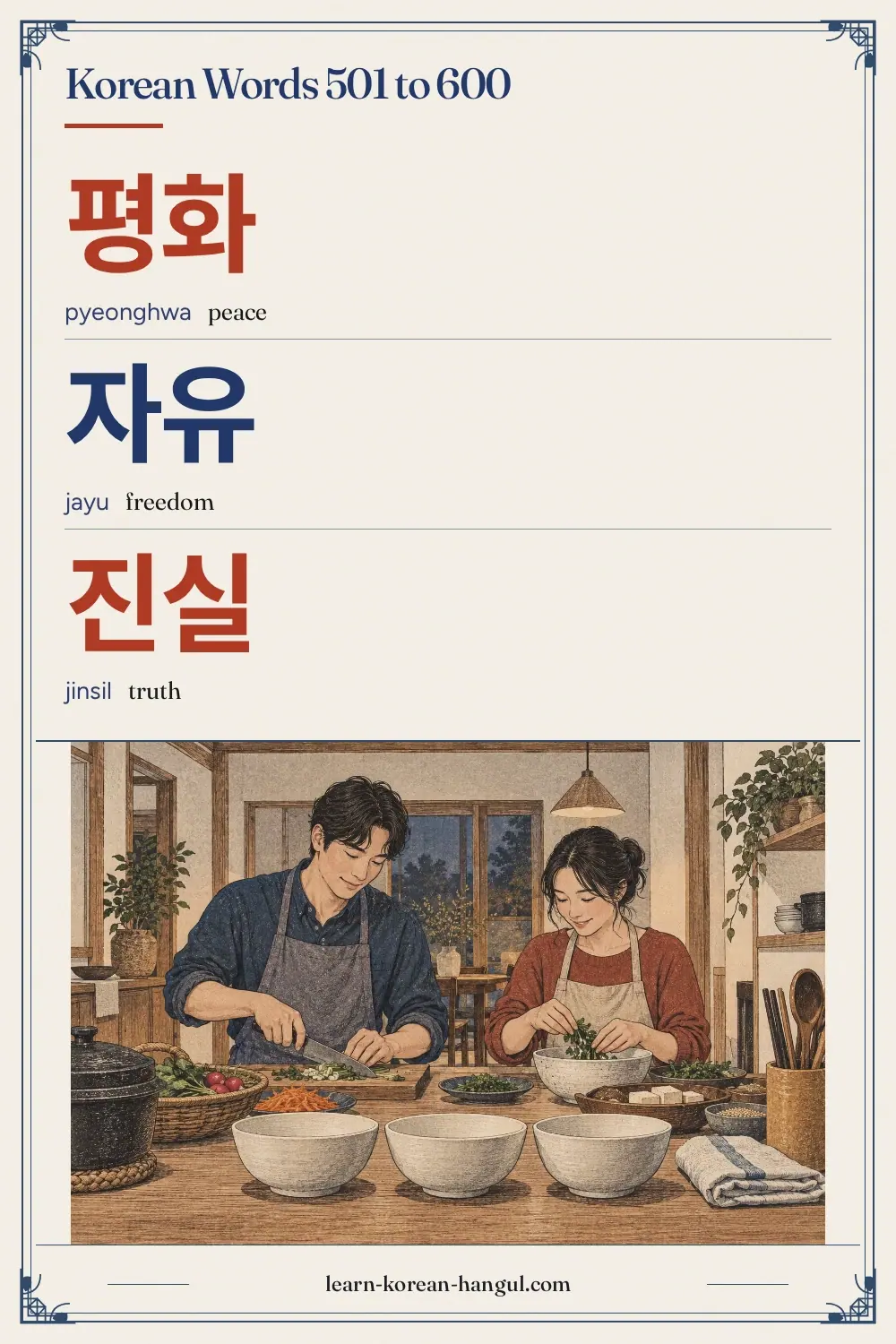
Each word has Hangul, Revised Romanization, audio and one example sentence, so the page works as a ready-made deck.
Key facts
- The order is an editorial study order, not a count from a corpus.
Korean Words 501 to 600 at a Glance
Korean words 501 to 600 move from the objects and places of the Top 500 to the ideas behind them. The first 500 words let you name a hotel or a newspaper. This block lets you say why something happened, who is responsible and how well a plan went. Many of these words are Sino-Korean (built from Chinese-derived syllables), and they appear in news, work and study every day.
Of the 100 words, 84 are Sino-Korean, 8 are loanwords (mostly from English), 6 are native Korean and 2 are mixed words that join a Sino-Korean syllable to a native one (댓글 and 한층). The origin column in every table marks each word. The list holds nouns and adverbs only. Verbs and adjectives have their own pages in the verbs section.
| Group | Words | What it lets you do |
|---|---|---|
| Abstract nouns | 20 | Name ideas such as freedom, truth, ability and rules |
| Work and study | 20 | Talk about research, a job, a team and a presentation |
| Relationships | 20 | Describe relatives, colleagues, friends and conflict |
| Media and technology | 20 | Talk about phones, apps, videos and data |
| Adverbs of degree and certainty | 20 | Say how much, how often and how sure |
One word of the earlier set belongs with this block. 미래 (mirae, future) is word 493 in Korean words 401 to 500. Learn it together with 과거 (gwageo, past) and 현재 (hyeonjae, present) from the first table below, because the three form one set of time words.
These tables assume you can read Hangul. If you cannot yet, start with reading Hangul. The next section says where to begin.
Which Words Ranked 501 to 600 Should You Learn First?
Learn the group that matches what you do every day, and add the adverbs of degree early because they work with any adjective you already know. A learner who uses Korean at work needs 업무, 보고서 and 발표 before 평화 and 진실. A learner who reads news needs 원인, 자료 and 발전 first.
- If you read news or study. 연구, 교육, 기술, 발전, 원인, 자료, 지식.
- If you work in Korea or with Korean colleagues. 업무, 보고서, 발표, 팀, 프로젝트, 출장, 급여, 동료.
- If you talk about people and feelings. 친척, 선배, 후배, 우정, 신뢰, 갈등, 오해, 감정.
- If you live on your phone. 앱, 화면, 검색, 영상, 댓글, 연결, 기능.
- If you want sentences with more nuance. 꽤, 무척, 대체로, 주로, 결코, 당연히.
- If you meet the big ideas in conversation. 평화, 자유, 진실, 인생, 가치, 책임.
At 10 new words a day, each group of 20 takes 2 days. Add one review day after each group, and the whole list takes 3 days × 5 groups = 15 days. At 20 words a day it takes 5 days plus review. Choose the pace you can keep.
Abstract Nouns
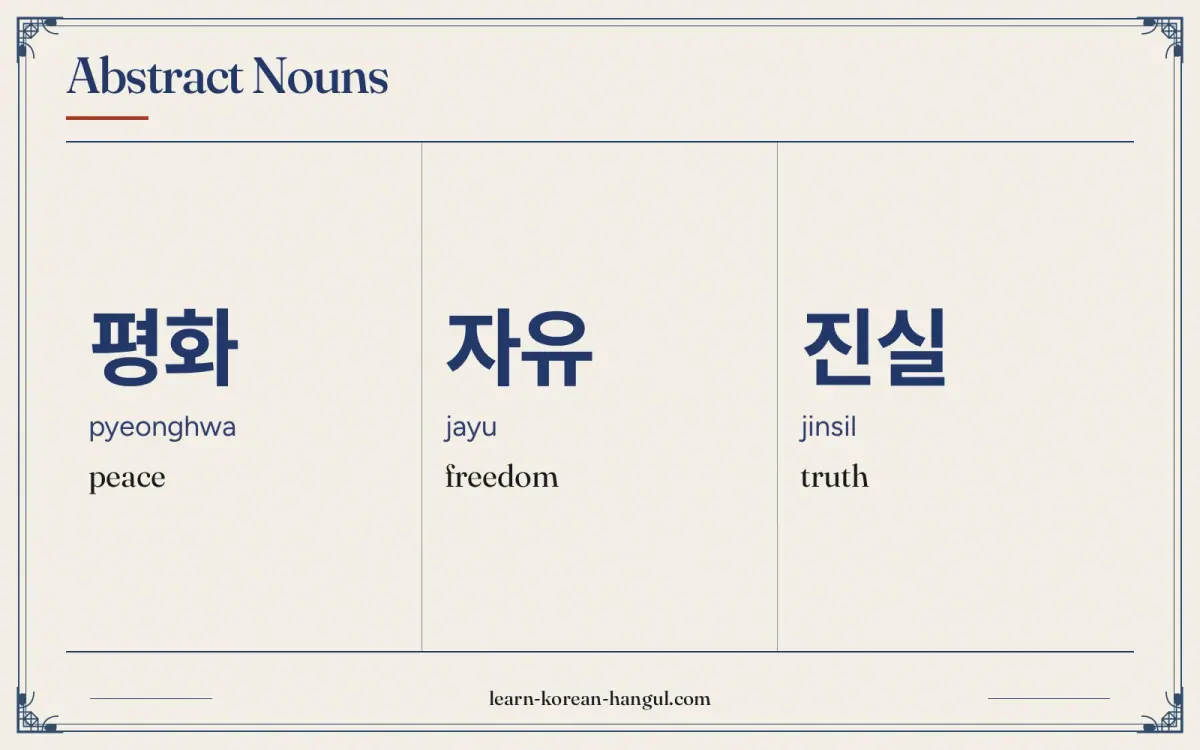
Abstract nouns name ideas that you cannot point at. 평화 (peace), 자유 (freedom) and 진실 (truth) are the ones you hear in speeches and songs. 능력 (ability), 책임 (responsibility) and 가치 (value) are the ones you need to give an opinion. Eight of these words (평화, 자유, 진실, 과거, 현재, 세계, 인생, 감정) also have their own pages: peace in Korean, freedom in Korean, truth in Korean, past in Korean, present in Korean, world in Korean, life in Korean and emotion in Korean.
| No. | Hangul | Revised Romanization | Origin | Meaning | Example sentence | Audio assetId |
|---|---|---|---|---|---|---|
| 501 | 평화 | pyeonghwa | Sino-Korean | peace | 모두 평화를 원해요. (Everyone wants peace.) | au-pg-vocabulary-core-words-top-1000-501-600-1; example: au-pg-vocabulary-core-words-top-1000-501-600-101 |
| 502 | 자유 | jayu | Sino-Korean | freedom | 저는 자유를 좋아해요. (I like freedom.) | au-pg-vocabulary-core-words-top-1000-501-600-2; example: au-pg-vocabulary-core-words-top-1000-501-600-102 |
| 503 | 진실 | jinsil | Sino-Korean | truth | 진실을 말해 주세요. (Please tell the truth.) | au-pg-vocabulary-core-words-top-1000-501-600-3; example: au-pg-vocabulary-core-words-top-1000-501-600-103 |
| 504 | 과거 | gwageo | Sino-Korean | past | 과거는 바꿀 수 없어요. (You cannot change the past.) | au-pg-vocabulary-core-words-top-1000-501-600-4; example: au-pg-vocabulary-core-words-top-1000-501-600-104 |
| 505 | 현재 | hyeonjae | Sino-Korean | present; current time | 현재 시간은 세 시예요. (The current time is three o'clock.) | au-pg-vocabulary-core-words-top-1000-501-600-5; example: au-pg-vocabulary-core-words-top-1000-501-600-105 |
| 506 | 세계 | segye | Sino-Korean | world | 세계는 넓어요. (The world is wide.) | au-pg-vocabulary-core-words-top-1000-501-600-6; example: au-pg-vocabulary-core-words-top-1000-501-600-106 |
| 507 | 인생 | insaeng | Sino-Korean | life (one's life) | 인생은 짧아요. (Life is short.) | au-pg-vocabulary-core-words-top-1000-501-600-7; example: au-pg-vocabulary-core-words-top-1000-501-600-107 |
| 508 | 능력 | neungnyeok | Sino-Korean | ability | 그는 능력이 있어요. (He has ability.) | au-pg-vocabulary-core-words-top-1000-501-600-8; example: au-pg-vocabulary-core-words-top-1000-501-600-108 |
| 509 | 가능성 | ganeungseong | Sino-Korean | possibility | 성공할 가능성이 있어요. (There is a possibility of success.) | au-pg-vocabulary-core-words-top-1000-501-600-9; example: au-pg-vocabulary-core-words-top-1000-501-600-109 |
| 510 | 발전 | baljeon | Sino-Korean | development; progress | 한국은 발전이 빨라요. (Korea's development is fast.) | au-pg-vocabulary-core-words-top-1000-501-600-10; example: au-pg-vocabulary-core-words-top-1000-501-600-110 |
| 511 | 책임 | chaegim | Sino-Korean | responsibility | 이 일은 제 책임이에요. (This job is my responsibility.) | au-pg-vocabulary-core-words-top-1000-501-600-11; example: au-pg-vocabulary-core-words-top-1000-501-600-111 |
| 512 | 가치 | gachi | Sino-Korean | value; worth | 이 책은 읽을 가치가 있어요. (This book is worth reading.) | au-pg-vocabulary-core-words-top-1000-501-600-12; example: au-pg-vocabulary-core-words-top-1000-501-600-112 |
| 513 | 전체 | jeonche | Sino-Korean | whole; total | 전체 가격이 얼마예요? (How much is the total price?) | au-pg-vocabulary-core-words-top-1000-501-600-13; example: au-pg-vocabulary-core-words-top-1000-501-600-113 |
| 514 | 부분 | bubun | Sino-Korean | part; portion | 이 부분이 어려워요. (This part is difficult.) | au-pg-vocabulary-core-words-top-1000-501-600-14; example: au-pg-vocabulary-core-words-top-1000-501-600-114 |
| 515 | 특징 | teukjing | Sino-Korean | feature; characteristic | 한국어의 특징을 배워요. (I learn the features of Korean.) | au-pg-vocabulary-core-words-top-1000-501-600-15; example: au-pg-vocabulary-core-words-top-1000-501-600-115 |
| 516 | 원인 | wonin | Sino-Korean | cause | 사고의 원인을 찾아요. (They look for the cause of the accident.) | au-pg-vocabulary-core-words-top-1000-501-600-16; example: au-pg-vocabulary-core-words-top-1000-501-600-116 |
| 517 | 수준 | sujun | Sino-Korean | level; standard | 이 수업은 수준이 높아요. (This class is at a high level.) | au-pg-vocabulary-core-words-top-1000-501-600-17; example: au-pg-vocabulary-core-words-top-1000-501-600-117 |
| 518 | 기준 | gijun | Sino-Korean | standard; criterion | 기준이 뭐예요? (What is the criterion?) | au-pg-vocabulary-core-words-top-1000-501-600-18; example: au-pg-vocabulary-core-words-top-1000-501-600-118 |
| 519 | 규칙 | gyuchik | Sino-Korean | rule | 규칙을 지켜요. (We follow the rules.) | au-pg-vocabulary-core-words-top-1000-501-600-19; example: au-pg-vocabulary-core-words-top-1000-501-600-119 |
| 520 | 감정 | gamjeong | Sino-Korean | emotion; feeling | 감정을 표현해요. (I express my emotions.) | au-pg-vocabulary-core-words-top-1000-501-600-20; example: au-pg-vocabulary-core-words-top-1000-501-600-120 |
Several pairs in this group look alike in English, and Korean separates them. 세계 is the world as a whole of countries, as in 세계 지도 (world map). 세상 (sesang) is the world of human life, as in 이 세상 (this world). For "life", 인생 is the course of a person's life, 생활 (saenghwal) is daily life and 생명 (saengmyeong) is biological life. 능력 is the capacity to do something, while 실력 (sillyeok) is the skill you have actually shown. 감정 is an emotion as an idea, while 기분 (gibun) is the mood you are in right now, as in 기분이 좋아요 (I feel good).
The pairs 기준 and 수준 also differ. 기준 is a standard you measure against, and 수준 is the level that something has reached. 규칙 is a rule of a game, a school or a company, while 법 (beop, law) is a rule set by the state.
Example Sentences
Each example is a short polite sentence. Most follow the pattern noun + 이/가 + adjective or noun + 을/를 + verb. Say each sentence aloud and then swap the first noun. Replace 평화 in 모두 평화를 원해요 with 자유 and you get 모두 자유를 원해요, which is also natural. The particles 이/가 and 을/를 are explained in the Korean particles guide.
성공할 가능성이 있어요.
seonggonghal ganeungseongi isseoyo.
There is a possibility of success.
이 책은 읽을 가치가 있어요.
i chaegeun ilgeul gachiga isseoyo.
This book is worth reading.
The second sentence shows the pattern 읽을 가치가 있어요, "there is value in reading", with the future-style modifier -ㄹ. You can reuse it with any verb: 볼 가치가 있어요 (it is worth watching).
How Do You Say Work and Study in Korean?
Work and study in Korean use mostly Sino-Korean nouns, which is why office and campus language looks dense on the page. 연구 (research), 논문 (thesis), 이론 (theory) and 실험 (experiment) belong to study. 업무 (duties), 보고서 (report), 발표 (presentation), 급여 (pay) and 승진 (promotion) belong to work. 전공 (major), 자격 (qualification), 경력 (work experience) and 취업 (getting a job) join the two.
| No. | Hangul | Revised Romanization | Origin | Meaning | Example sentence | Audio assetId |
|---|---|---|---|---|---|---|
| 521 | 연구 | yeongu | Sino-Korean | research | 저는 한국 문화를 연구해요. (I research Korean culture.) | au-pg-vocabulary-core-words-top-1000-501-600-21; example: au-pg-vocabulary-core-words-top-1000-501-600-121 |
| 522 | 교육 | gyoyuk | Sino-Korean | education | 교육은 중요해요. (Education is important.) | au-pg-vocabulary-core-words-top-1000-501-600-22; example: au-pg-vocabulary-core-words-top-1000-501-600-122 |
| 523 | 전공 | jeongong | Sino-Korean | major (field of study) | 제 전공은 경제예요. (My major is economics.) | au-pg-vocabulary-core-words-top-1000-501-600-23; example: au-pg-vocabulary-core-words-top-1000-501-600-123 |
| 524 | 논문 | nonmun | Sino-Korean | thesis; academic paper | 논문을 쓰고 있어요. (I am writing a thesis.) | au-pg-vocabulary-core-words-top-1000-501-600-24; example: au-pg-vocabulary-core-words-top-1000-501-600-124 |
| 525 | 지식 | jisik | Sino-Korean | knowledge | 그는 지식이 많아요. (He has a lot of knowledge.) | au-pg-vocabulary-core-words-top-1000-501-600-25; example: au-pg-vocabulary-core-words-top-1000-501-600-125 |
| 526 | 이론 | iron | Sino-Korean | theory | 이론과 실제는 달라요. (Theory and practice are different.) | au-pg-vocabulary-core-words-top-1000-501-600-26; example: au-pg-vocabulary-core-words-top-1000-501-600-126 |
| 527 | 실험 | silheom | Sino-Korean | experiment | 실험이 성공했어요. (The experiment succeeded.) | au-pg-vocabulary-core-words-top-1000-501-600-27; example: au-pg-vocabulary-core-words-top-1000-501-600-127 |
| 528 | 자격 | jagyeok | Sino-Korean | qualification | 이 일에는 자격이 필요해요. (This job needs a qualification.) | au-pg-vocabulary-core-words-top-1000-501-600-28; example: au-pg-vocabulary-core-words-top-1000-501-600-128 |
| 529 | 경력 | gyeongnyeok | Sino-Korean | work experience; career history | 경력이 있는 사람을 찾아요. (We are looking for a person with work experience.) | au-pg-vocabulary-core-words-top-1000-501-600-29; example: au-pg-vocabulary-core-words-top-1000-501-600-129 |
| 530 | 취업 | chwieop | Sino-Korean | getting a job; employment | 졸업 후에 취업을 준비해요. (After graduating, I prepare to get a job.) | au-pg-vocabulary-core-words-top-1000-501-600-30; example: au-pg-vocabulary-core-words-top-1000-501-600-130 |
| 531 | 업무 | eommu | Sino-Korean | duties; work tasks | 업무가 많아요. (There is a lot of work.) | au-pg-vocabulary-core-words-top-1000-501-600-31; example: au-pg-vocabulary-core-words-top-1000-501-600-131 |
| 532 | 보고서 | bogoseo | Sino-Korean | report (document) | 보고서를 내일까지 내요. (I hand in the report by tomorrow.) | au-pg-vocabulary-core-words-top-1000-501-600-32; example: au-pg-vocabulary-core-words-top-1000-501-600-132 |
| 533 | 발표 | balpyo | Sino-Korean | presentation; announcement | 내일 발표가 있어요. (I have a presentation tomorrow.) | au-pg-vocabulary-core-words-top-1000-501-600-33; example: au-pg-vocabulary-core-words-top-1000-501-600-133 |
| 534 | 프로젝트 | peurojekteu | loanword | project | 새 프로젝트를 시작해요. (We start a new project.) | au-pg-vocabulary-core-words-top-1000-501-600-34; example: au-pg-vocabulary-core-words-top-1000-501-600-134 |
| 535 | 팀 | tim | loanword | team | 우리 팀은 다섯 명이에요. (Our team has five people.) | au-pg-vocabulary-core-words-top-1000-501-600-35; example: au-pg-vocabulary-core-words-top-1000-501-600-135 |
| 536 | 조건 | jogeon | Sino-Korean | condition; terms | 좋은 조건이에요. (They are good terms.) | au-pg-vocabulary-core-words-top-1000-501-600-36; example: au-pg-vocabulary-core-words-top-1000-501-600-136 |
| 537 | 급여 | geubyeo | Sino-Korean | pay; salary | 급여는 매달 받아요. (I receive my pay every month.) | au-pg-vocabulary-core-words-top-1000-501-600-37; example: au-pg-vocabulary-core-words-top-1000-501-600-137 |
| 538 | 승진 | seungjin | Sino-Korean | promotion | 친구가 승진했어요. (My friend got promoted.) | au-pg-vocabulary-core-words-top-1000-501-600-38; example: au-pg-vocabulary-core-words-top-1000-501-600-138 |
| 539 | 출장 | chuljang | Sino-Korean | business trip | 내일 부산으로 출장을 가요. (I go on a business trip to Busan tomorrow.) | au-pg-vocabulary-core-words-top-1000-501-600-39; example: au-pg-vocabulary-core-words-top-1000-501-600-139 |
| 540 | 부서 | buseo | Sino-Korean | department | 저는 다른 부서에서 일해요. (I work in a different department.) | au-pg-vocabulary-core-words-top-1000-501-600-40; example: au-pg-vocabulary-core-words-top-1000-501-600-140 |
Work words come in formal and plain pairs. 업무 is the formal word for office duties, while 일 is the everyday word for work or a task. 급여 is the word on a pay slip, while 월급 (wolgeup, monthly pay) is what people say in conversation. 취업 covers the whole process of finding employment, and 출장 is a trip made for work, usually to another city. 발표 means both "presentation" and "announcement", so 정부가 발표해요 is "the government announces" and 내일 발표가 있어요 is "I have a presentation tomorrow".
The loanwords 팀 (tim) and 프로젝트 (peurojekteu) are written as they sound in English. 팀 is one syllable, so it is easy to say. 프로젝트 has five syllables in Korean, because every English consonant cluster gets a vowel: peu-ro-jek-teu.
The office and business vocabulary page goes deeper, and the meetings vocabulary page covers the language of the meeting room. The next group is about people.
Relationships
Relationship words show who you are to the other person. 친척, 부부, 형제 and 자매 are family words. 이웃, 동료, 선배, 후배 and 동창 name people around you at home, at work and at school. 연인, 이별, 만남, 우정 and 애정 describe close bonds, and 신뢰, 존경, 배려, 갈등 and 오해 describe how those bonds work or fail.
| No. | Hangul | Revised Romanization | Origin | Meaning | Example sentence | Audio assetId |
|---|---|---|---|---|---|---|
| 541 | 친척 | chincheok | Sino-Korean | relatives | 명절에 친척을 만나요. (I meet my relatives at the holidays.) | au-pg-vocabulary-core-words-top-1000-501-600-41; example: au-pg-vocabulary-core-words-top-1000-501-600-141 |
| 542 | 부부 | bubu | Sino-Korean | married couple | 그 부부는 사이가 좋아요. (That couple gets along well.) | au-pg-vocabulary-core-words-top-1000-501-600-42; example: au-pg-vocabulary-core-words-top-1000-501-600-142 |
| 543 | 형제 | hyeongje | Sino-Korean | brothers | 형제가 두 명 있어요. (I have two brothers.) | au-pg-vocabulary-core-words-top-1000-501-600-43; example: au-pg-vocabulary-core-words-top-1000-501-600-143 |
| 544 | 자매 | jamae | Sino-Korean | sisters | 우리는 자매예요. (We are sisters.) | au-pg-vocabulary-core-words-top-1000-501-600-44; example: au-pg-vocabulary-core-words-top-1000-501-600-144 |
| 545 | 이웃 | iut | native | neighbour | 이웃과 인사해요. (I greet my neighbours.) | au-pg-vocabulary-core-words-top-1000-501-600-45; example: au-pg-vocabulary-core-words-top-1000-501-600-145 |
| 546 | 동료 | dongnyo | Sino-Korean | colleague | 동료와 점심을 먹어요. (I eat lunch with a colleague.) | au-pg-vocabulary-core-words-top-1000-501-600-46; example: au-pg-vocabulary-core-words-top-1000-501-600-146 |
| 547 | 선배 | seonbae | Sino-Korean | senior (at school or work) | 선배가 도와줘요. (My senior helps me.) | au-pg-vocabulary-core-words-top-1000-501-600-47; example: au-pg-vocabulary-core-words-top-1000-501-600-147 |
| 548 | 후배 | hubae | Sino-Korean | junior (at school or work) | 후배에게 책을 줬어요. (I gave a book to my junior.) | au-pg-vocabulary-core-words-top-1000-501-600-48; example: au-pg-vocabulary-core-words-top-1000-501-600-148 |
| 549 | 동창 | dongchang | Sino-Korean | fellow alumnus; former classmate | 오늘 동창을 만나요. (I meet a former classmate today.) | au-pg-vocabulary-core-words-top-1000-501-600-49; example: au-pg-vocabulary-core-words-top-1000-501-600-149 |
| 550 | 연인 | yeonin | Sino-Korean | lover; partner | 두 사람은 연인이에요. (The two are a couple.) | au-pg-vocabulary-core-words-top-1000-501-600-50; example: au-pg-vocabulary-core-words-top-1000-501-600-150 |
| 551 | 이별 | ibyeol | Sino-Korean | parting; breakup | 이별은 슬퍼요. (Parting is sad.) | au-pg-vocabulary-core-words-top-1000-501-600-51; example: au-pg-vocabulary-core-words-top-1000-501-600-151 |
| 552 | 만남 | mannam | native | meeting; encounter | 오늘 만남이 즐거웠어요. (Today's meeting was enjoyable.) | au-pg-vocabulary-core-words-top-1000-501-600-52; example: au-pg-vocabulary-core-words-top-1000-501-600-152 |
| 553 | 우정 | ujeong | Sino-Korean | friendship | 우정은 소중해요. (Friendship is precious.) | au-pg-vocabulary-core-words-top-1000-501-600-53; example: au-pg-vocabulary-core-words-top-1000-501-600-153 |
| 554 | 애정 | aejeong | Sino-Korean | affection | 부모님의 애정을 느껴요. (I feel my parents' affection.) | au-pg-vocabulary-core-words-top-1000-501-600-54; example: au-pg-vocabulary-core-words-top-1000-501-600-154 |
| 555 | 신뢰 | silloe | Sino-Korean | trust | 신뢰가 중요해요. (Trust is important.) | au-pg-vocabulary-core-words-top-1000-501-600-55; example: au-pg-vocabulary-core-words-top-1000-501-600-155 |
| 556 | 존경 | jongyeong | Sino-Korean | respect; admiration | 저는 선생님을 존경해요. (I respect my teacher.) | au-pg-vocabulary-core-words-top-1000-501-600-56; example: au-pg-vocabulary-core-words-top-1000-501-600-156 |
| 557 | 배려 | baeryeo | Sino-Korean | consideration (for others) | 그는 배려가 깊어요. (He is very considerate.) | au-pg-vocabulary-core-words-top-1000-501-600-57; example: au-pg-vocabulary-core-words-top-1000-501-600-157 |
| 558 | 갈등 | galdeung | Sino-Korean | conflict | 팀에 갈등이 있어요. (There is conflict in the team.) | au-pg-vocabulary-core-words-top-1000-501-600-58; example: au-pg-vocabulary-core-words-top-1000-501-600-158 |
| 559 | 오해 | ohae | Sino-Korean | misunderstanding | 오해가 풀렸어요. (The misunderstanding was cleared up.) | au-pg-vocabulary-core-words-top-1000-501-600-59; example: au-pg-vocabulary-core-words-top-1000-501-600-159 |
| 560 | 소개 | sogae | Sino-Korean | introduction | 소개를 해 주세요. (Please introduce us.) | au-pg-vocabulary-core-words-top-1000-501-600-60; example: au-pg-vocabulary-core-words-top-1000-501-600-160 |
Senior and junior words depend on when someone entered a group, not on age. A 선배 is someone who joined your school or company before you, and a 후배 is someone who joined after you. The sunbae and hoobae page explains the habit in detail, and the word pages for senior and junior give examples. 동료 is a colleague of the same level in the same workplace, and 동창 is someone who went to the same school as you, as in 동창회 (dongchanghoe, alumni meeting).
For couples, 연인 is a neutral word for a partner or lover, and it works for any gender. Boyfriend and girlfriend are 남자 친구 and 여자 친구 (often written 남자친구 and 여자친구 online). The word pages for lover, colleague and neighbour cover each word in turn. 형제 means brothers (and, in questions such as 형제가 있어요?, siblings in general), and 자매 means sisters. To say "brothers and sisters" together, use 형제자매 (hyeongjejamae), and for one brother and one sister use 남매 (nammae). 존경 takes the object particle 을/를: 선생님을 존경해요 (I respect my teacher).
The friendship vocabulary page covers more words for friends. The next group is about the devices that connect people.
How Do You Say Media and Technology in Korean?
Media and technology words are a mix of Sino-Korean nouns and English loanwords. 기술 (technology), 영상 (video), 검색 (search) and 연결 (connection) are Sino-Korean. 스마트폰, 앱, 프로그램, 시스템, 로봇 and 데이터 come from English and are written as they sound. 댓글 (online comment) joins a Sino-Korean syllable to the native word 글 (writing).
| No. | Hangul | Revised Romanization | Origin | Meaning | Example sentence | Audio assetId |
|---|---|---|---|---|---|---|
| 561 | 기술 | gisul | Sino-Korean | technology; skill | 한국은 기술이 좋아요. (Korea is strong in technology.) | au-pg-vocabulary-core-words-top-1000-501-600-61; example: au-pg-vocabulary-core-words-top-1000-501-600-161 |
| 562 | 스마트폰 | seumateupon | loanword | smartphone | 제 스마트폰은 작아요. (My smartphone is small.) | au-pg-vocabulary-core-words-top-1000-501-600-62; example: au-pg-vocabulary-core-words-top-1000-501-600-162 |
| 563 | 프로그램 | peurogeuraem | loanword | programme; TV show; software | 이 프로그램은 재미있어요. (This programme is fun.) | au-pg-vocabulary-core-words-top-1000-501-600-63; example: au-pg-vocabulary-core-words-top-1000-501-600-163 |
| 564 | 화면 | hwamyeon | Sino-Korean | screen | 화면이 너무 밝아요. (The screen is too bright.) | au-pg-vocabulary-core-words-top-1000-501-600-64; example: au-pg-vocabulary-core-words-top-1000-501-600-164 |
| 565 | 영상 | yeongsang | Sino-Korean | video; footage | 영상을 보내 주세요. (Please send me the video.) | au-pg-vocabulary-core-words-top-1000-501-600-65; example: au-pg-vocabulary-core-words-top-1000-501-600-165 |
| 566 | 댓글 | daetgeul | mixed | online comment | 댓글을 남겼어요. (I left a comment.) | au-pg-vocabulary-core-words-top-1000-501-600-66; example: au-pg-vocabulary-core-words-top-1000-501-600-166 |
| 567 | 검색 | geomsaek | Sino-Korean | search (online) | 인터넷에서 검색해요. (I search on the internet.) | au-pg-vocabulary-core-words-top-1000-501-600-67; example: au-pg-vocabulary-core-words-top-1000-501-600-167 |
| 568 | 기계 | gigye | Sino-Korean | machine | 이 기계는 어떻게 써요? (How do I use this machine?) | au-pg-vocabulary-core-words-top-1000-501-600-68; example: au-pg-vocabulary-core-words-top-1000-501-600-168 |
| 569 | 로봇 | robot | loanword | robot | 로봇이 청소해요. (A robot cleans.) | au-pg-vocabulary-core-words-top-1000-501-600-69; example: au-pg-vocabulary-core-words-top-1000-501-600-169 |
| 570 | 발명 | balmyeong | Sino-Korean | invention | 전화는 큰 발명이에요. (The telephone is a great invention.) | au-pg-vocabulary-core-words-top-1000-501-600-70; example: au-pg-vocabulary-core-words-top-1000-501-600-170 |
| 571 | 개발 | gaebal | Sino-Korean | development (of a product) | 새 앱을 개발하고 있어요. (We are developing a new app.) | au-pg-vocabulary-core-words-top-1000-501-600-71; example: au-pg-vocabulary-core-words-top-1000-501-600-171 |
| 572 | 시스템 | siseutem | loanword | system | 시스템이 느려요. (The system is slow.) | au-pg-vocabulary-core-words-top-1000-501-600-72; example: au-pg-vocabulary-core-words-top-1000-501-600-172 |
| 573 | 자료 | jaryo | Sino-Korean | materials; data | 자료를 모아요. (I gather materials.) | au-pg-vocabulary-core-words-top-1000-501-600-73; example: au-pg-vocabulary-core-words-top-1000-501-600-173 |
| 574 | 잡지 | japji | Sino-Korean | magazine | 저는 잡지를 읽어요. (I read magazines.) | au-pg-vocabulary-core-words-top-1000-501-600-74; example: au-pg-vocabulary-core-words-top-1000-501-600-174 |
| 575 | 앱 | aep | loanword | app | 이 앱을 써 봤어요? (Have you tried this app?) | au-pg-vocabulary-core-words-top-1000-501-600-75; example: au-pg-vocabulary-core-words-top-1000-501-600-175 |
| 576 | 인공지능 | ingongjineung | Sino-Korean | artificial intelligence | 인공지능이 번역해 줘요. (Artificial intelligence translates for me.) | au-pg-vocabulary-core-words-top-1000-501-600-76; example: au-pg-vocabulary-core-words-top-1000-501-600-176 |
| 577 | 데이터 | deiteo | loanword | data | 데이터가 부족해요. (The data is insufficient.) | au-pg-vocabulary-core-words-top-1000-501-600-77; example: au-pg-vocabulary-core-words-top-1000-501-600-177 |
| 578 | 연결 | yeongyeol | Sino-Korean | connection | 인터넷 연결이 안 돼요. (The internet will not connect.) | au-pg-vocabulary-core-words-top-1000-501-600-78; example: au-pg-vocabulary-core-words-top-1000-501-600-178 |
| 579 | 제품 | jepum | Sino-Korean | product | 이 제품은 인기가 많아요. (This product is very popular.) | au-pg-vocabulary-core-words-top-1000-501-600-79; example: au-pg-vocabulary-core-words-top-1000-501-600-179 |
| 580 | 기능 | gineung | Sino-Korean | function; feature | 이 기능이 편리해요. (This feature is convenient.) | au-pg-vocabulary-core-words-top-1000-501-600-80; example: au-pg-vocabulary-core-words-top-1000-501-600-180 |
Some of these words have a close neighbour. 영상 is any video or footage, while 동영상 (dongyeongsang) is a video file you can play. 자료 is a broad word for materials or data, and 데이터 is data in the computing sense. 앱 is the standard short word for an application, and people also say 어플 in casual speech. 기술 means technology and also skill, so 운전 기술 is driving skill. 프로그램 can mean a TV programme, a computer program or the schedule of an event, and context tells you which. To say you post a comment, use the verb 달다: 댓글을 달다.
The word pages for technology, smartphone, app, comment and magazine each give extra examples. For news words, open the news and media vocabulary page. The last group changes the shape of your sentences.
Adverbs of Degree and Certainty
Adverbs of degree and certainty change how strong or how sure a sentence sounds. An adverb of degree answers "how much?", as in 꽤 맛있어요 (quite tasty). An adverb of certainty answers "how sure?", as in 분명히 들었어요 (I definitely heard it). Put the adverb directly before the word it describes.
| No. | Hangul | Revised Romanization | Origin | Meaning | Example sentence | Audio assetId |
|---|---|---|---|---|---|---|
| 581 | 꽤 | kkwae | native | fairly; quite | 이 식당은 꽤 맛있어요. (This restaurant is quite tasty.) | au-pg-vocabulary-core-words-top-1000-501-600-81; example: au-pg-vocabulary-core-words-top-1000-501-600-181 |
| 582 | 상당히 | sangdanghi | Sino-Korean | considerably | 시험이 상당히 어려웠어요. (The exam was considerably difficult.) | au-pg-vocabulary-core-words-top-1000-501-600-82; example: au-pg-vocabulary-core-words-top-1000-501-600-182 |
| 583 | 더욱 | deouk | native | even more | 날씨가 더욱 추워요. (The weather is even colder.) | au-pg-vocabulary-core-words-top-1000-501-600-83; example: au-pg-vocabulary-core-words-top-1000-501-600-183 |
| 584 | 대단히 | daedanhi | Sino-Korean | greatly; very | 대단히 감사합니다. (Thank you very much.) | au-pg-vocabulary-core-words-top-1000-501-600-84; example: au-pg-vocabulary-core-words-top-1000-501-600-184 |
| 585 | 몹시 | mopsi | native | extremely | 오늘은 몹시 피곤해요. (I am extremely tired today.) | au-pg-vocabulary-core-words-top-1000-501-600-85; example: au-pg-vocabulary-core-words-top-1000-501-600-185 |
| 586 | 무척 | mucheok | native | very; extremely | 무척 기뻐요. (I am very glad.) | au-pg-vocabulary-core-words-top-1000-501-600-86; example: au-pg-vocabulary-core-words-top-1000-501-600-186 |
| 587 | 굉장히 | goengjanghi | Sino-Korean | tremendously; very | 그 영화는 굉장히 재미있어요. (That film is tremendously fun.) | au-pg-vocabulary-core-words-top-1000-501-600-87; example: au-pg-vocabulary-core-words-top-1000-501-600-187 |
| 588 | 극도로 | geukdoro | Sino-Korean | to the extreme | 극도로 긴장했어요. (I was extremely nervous.) | au-pg-vocabulary-core-words-top-1000-501-600-88; example: au-pg-vocabulary-core-words-top-1000-501-600-188 |
| 589 | 한층 | hanchung | mixed | further; one level more | 실력이 한층 좋아졌어요. (My skills have improved further.) | au-pg-vocabulary-core-words-top-1000-501-600-89; example: au-pg-vocabulary-core-words-top-1000-501-600-189 |
| 590 | 다소 | daso | Sino-Korean | somewhat; to some extent | 다소 늦을 수 있어요. (I may be somewhat late.) | au-pg-vocabulary-core-words-top-1000-501-600-90; example: au-pg-vocabulary-core-words-top-1000-501-600-190 |
| 591 | 비교적 | bigyojeok | Sino-Korean | relatively | 이 길은 비교적 조용해요. (This road is relatively quiet.) | au-pg-vocabulary-core-words-top-1000-501-600-91; example: au-pg-vocabulary-core-words-top-1000-501-600-191 |
| 592 | 대체로 | daechero | Sino-Korean | generally; on the whole | 대체로 만족해요. (I am generally satisfied.) | au-pg-vocabulary-core-words-top-1000-501-600-92; example: au-pg-vocabulary-core-words-top-1000-501-600-192 |
| 593 | 대략 | daeryak | Sino-Korean | roughly; approximately | 대략 한 시간 걸려요. (It takes roughly an hour.) | au-pg-vocabulary-core-words-top-1000-501-600-93; example: au-pg-vocabulary-core-words-top-1000-501-600-193 |
| 594 | 결코 | gyeolko | Sino-Korean | never (with a negative) | 저는 결코 포기하지 않아요. (I will never give up.) | au-pg-vocabulary-core-words-top-1000-501-600-94; example: au-pg-vocabulary-core-words-top-1000-501-600-194 |
| 595 | 주로 | juro | Sino-Korean | mainly; mostly | 주로 집에서 공부해요. (I mostly study at home.) | au-pg-vocabulary-core-words-top-1000-501-600-95; example: au-pg-vocabulary-core-words-top-1000-501-600-195 |
| 596 | 분명히 | bunmyeonghi | Sino-Korean | clearly; definitely | 분명히 들었어요. (I definitely heard it.) | au-pg-vocabulary-core-words-top-1000-501-600-96; example: au-pg-vocabulary-core-words-top-1000-501-600-196 |
| 597 | 당연히 | dangyeonhi | Sino-Korean | of course; naturally | 당연히 가야죠. (Of course we should go.) | au-pg-vocabulary-core-words-top-1000-501-600-97; example: au-pg-vocabulary-core-words-top-1000-501-600-197 |
| 598 | 실제로 | siljero | Sino-Korean | in fact; actually | 실제로 가 보니까 좋았어요. (When I actually went, it was nice.) | au-pg-vocabulary-core-words-top-1000-501-600-98; example: au-pg-vocabulary-core-words-top-1000-501-600-198 |
| 599 | 점차 | jeomcha | Sino-Korean | gradually | 날씨가 점차 따뜻해져요. (The weather gradually gets warmer.) | au-pg-vocabulary-core-words-top-1000-501-600-99; example: au-pg-vocabulary-core-words-top-1000-501-600-199 |
| 600 | 특별히 | teukbyeolhi | Sino-Korean | especially; specially | 특별히 준비했어요. (I prepared it specially.) | au-pg-vocabulary-core-words-top-1000-501-600-100; example: au-pg-vocabulary-core-words-top-1000-501-600-200 |
From mild to strong, the degree adverbs run roughly like this: 다소 and 비교적 (mild or relative), 꽤 and 상당히 (moderate), 무척, 대단히 and 굉장히 (strong), 몹시 and 극도로 (very strong). The ranking is a rough guide, because tone and context change the strength. 결코 is special: it needs a negative ending in the same sentence, as in 결코 포기하지 않아요 (I will never give up). 더욱 and 한층 both mean "even more", and they often appear with a verb of change: 더욱 추워져요 (it gets even colder).
The adverbs ending in -히 keep the h in Revised Romanization when it follows ㄴ, ㅇ or ㄹ, as in daedanhi, sangdanghi and teukbyeolhi. The h is said very lightly, so 대단히 sounds close to [대다니], but the ㅎ is still written.
Notice how many of these adverbs are formal. 상당히, 대단히, 극도로 and 점차 are common in news and reports, while 꽤, 무척 and 주로 sound natural in conversation. The table in the speech and writing section below sorts them.
Which Verbs Go with These Nouns?
Abstract nouns usually travel with one or two fixed verbs, and learning the pair saves you from guessing. The verbs below are in dictionary form. Each pair is a common collocation, which is a set phrase that native speakers use without thinking.
| Noun + particle | Verb | Meaning |
|---|---|---|
| 평화를 | 지키다 | protect peace |
| 자유를 | 누리다 | enjoy freedom |
| 진실을 | 밝히다 | reveal the truth |
| 책임을 | 지다 | take responsibility |
| 규칙을 | 지키다 | follow a rule |
| 능력을 | 키우다 | develop an ability |
| 논문을 | 쓰다 | write a thesis |
| 발표를 | 하다 | give a presentation |
| 자격을 | 얻다 | obtain a qualification |
| 신뢰를 | 쌓다 | build trust |
| 오해를 | 풀다 | clear up a misunderstanding |
| 갈등을 | 겪다 | go through a conflict |
| 댓글을 | 달다 | post a comment |
| 앱을 | 설치하다 | install an app |
| 데이터를 | 저장하다 | save data |
The verb 지키다 appears twice because it means "to keep, protect, obey" and fits both 평화 and 규칙. 책임을 지다 can also be written as one word, 책임지다, with the same meaning. For conjugation, look up the verb in the 100 Korean verbs list or in the verb conjugation tool.
Syllables That Repeat across These Words
Sino-Korean syllables repeat, so one syllable you know unlocks several words. The syllable table below shows six that appear in this block. The hanja (the Chinese characters behind each syllable) are given only to show why the words are related.
| Syllable | Hanja | Words in this block | Earlier word that shares it |
|---|---|---|---|
| 발 | 發 | 발전, 발표, 발명, 개발 | 출발 (departure) |
| 업 | 業 | 취업, 업무 | 직업 (occupation) |
| 자 | 資 | 자료, 자격 | none |
| 실 | 實 | 실험, 실제로 | none |
| 유 | 由 | 자유 | 이유 (reason) |
| 기 | 技 | 기술, 기능 | none |
Be careful with look-alikes. 책임 (responsibility) is written with the hanja 責 and is unrelated to 책 (chaek, book), which comes from 冊. The same spelling can hide different meanings, so check the word, not only the syllable. The Sino-Korean words page explains how to use these syllable families, and the loanwords page covers words such as 앱 and 데이터.
How Do You Pronounce These Words?
Most of these words follow the spelling, but several undergo sound changes at syllable borders. The table shows eight that learners often get wrong.
| Spelling | Pronunciation | What happens |
|---|---|---|
| 능력 | [능녁] | ㄹ after a final ㅇ becomes ㄴ |
| 신뢰 | [실뢰] | ㄴ before ㄹ becomes ㄹ |
| 책임 | [채김] | The final ㄱ links to the vowel of the next syllable |
| 업무 | [엄무] | ㅂ before ㅁ becomes ㅁ |
| 조건 | [조껀] | ㄱ is said as a tense sound in this Sino-Korean word (dictionary pronunciation) |
| 출장 | [출짱] | ㅈ after a final ㄹ is said as a tense sound |
| 갈등 | [갈뜽] | ㄷ after a final ㄹ is said as a tense sound |
| 댓글 | [댇끌] | ㅅ is said as ㄷ, and the ㄱ after it is tensed |
Two more tensing cases are 몹시 [몹씨] and 잡지 [잡찌], where the second consonant is tensed after a final ㅂ. The rules come from the Standard Pronunciation rules (표준 발음법) of the 국립국어원 (National Institute of Korean Language). Revised Romanization does not show tensing caused by a neighbouring sound, so it writes 조건 as jogeon and 출장 as chuljang even though they are said [조껀] and [출짱]. It does show the nasal and liquid changes, so 능력 is neungnyeok and 신뢰 is silloe. The pages on tensification, nasalization and liquidization explain each change.
Audio and Slow Playback
Each word has a normal clip, and 5 key words also have a slow clip at 0.8 times the speed: 능력, 책임, 신뢰, 갈등 and 댓글. Nothing plays until you press a button.
Listen to 능력 first. The second syllable sounds like 녁, not 력, so the word is said close to 능녁. Then listen to 책임. The ㄱ at the end of 책 moves onto the empty ㅇ of 임, so you hear chae-gim, not chaek-im.
Which Words Are for Speech and Which for Writing?
Spoken Korean prefers short, plain words, and written Korean prefers formal Sino-Korean ones. This matters for the adverbs and the work words most. Use the table to pick the right word for the moment.
| Situation | Natural in conversation | More formal, written or report style |
|---|---|---|
| "very" | 무척, 꽤 | 상당히, 대단히, 극도로 |
| "mostly" | 주로 | 대체로 |
| "gradually" | 점점 | 점차 |
| pay | 월급 | 급여 |
| work | 일 | 업무 |
The table gives tendencies, not rules. 대단히 감사합니다 is polite in speech as well, and 꽤 can appear in writing. If you are unsure, copy the register of the person you are talking to, and use the polite -아/어요 or the formal -ㅂ니다/습니다 ending to match.
What Mistakes Do Learners Make with Words Ranked 501 to 600?
- Writing 꽤 as 꾀. The two are different words: 꽤 means "quite", while 꾀 means a trick or a clever plan. In Revised Romanization, 꽤 is kkwae.
- Using 결코 in a positive sentence. 결코 needs a negative or a refusal, so say 결코 가지 않아요 (I will never go), not 결코 가요.
- Calling two sisters 형제. When you describe the people, 형제 means brothers, so two sisters say 우리는 자매예요, not 우리는 형제예요. A mixed group is 형제자매. (In a question such as 형제가 있어요?, 형제 can still cover sisters.)
- Confusing 개발 and 발전. 개발 is to develop something new, such as an app, a product or a plan. 발전 is the progress that something makes, such as an economy or a skill.
- Saying 책임 as chaek-im. The ㄱ moves across: [채김].
- Treating 발표 as only "presentation". It also means "announcement", so check the subject. 정부 발표 is a government announcement.
- Using 연인 for a friend. 연인 means a romantic partner. A close friend is 친구, and a very close friend is 절친 in casual speech.
Of these, the sister-and-brother pair most often changes how a sentence lands with Korean family and friends, so say 자매 and 형제 with care. The next section turns the list into practice.
Practice: Flashcards and Worksheet
Drill these words with the vocabulary flashcard decks. A printable worksheet for these words (word list, matching, writing practice, fill-in-the-blank exercises and answer key) is available in A4 and US Letter from the download card on this page. Progress in the decks is saved only in your browser.
Korean Words 501 to 600 Worksheet
A good drill is the one-sentence swap. Take any example sentence from the tables, say it aloud, and replace the noun with another from the same group. Then write two sentences of your own that use words from different groups, such as 팀에 갈등이 있어서 업무가 느려요 (there is conflict in the team, so work is slow). Say them aloud, and check the pronunciation against the audio.
Try this five-question check.
Practice · 5
What does 책임 mean?
Show answer
responsibility
책임 (chaegim) means responsibility. 신뢰 is trust, 갈등 is conflict and 우정 is friendship.
Which word means 'colleague'?
Show answer
동료
동료 (dongnyo) means colleague. 이웃 is neighbour, 후배 is junior and 연인 is partner.
Which word means 'search (online)'?
Show answer
검색
검색 (geomsaek) means search. 영상 is video, 기계 is machine and 화면 is screen.
Which sentence is correct?
Show answer
결코 가지 않아요.
결코 needs a negative ending, so 결코 가지 않아요 (I will never go) is correct.
How is 능력 pronounced?
Show answer
[능녁]
After a final ㅇ, ㄹ becomes ㄴ, so 능력 is said [능녁].
Where to Go Next
This block opens the second half of the Top 1000 Korean Words list. Go back to Korean words 401 to 500 if you need to review the earlier abstract nouns, or open the Top 500 Korean Words hub. After you finish Korean words 501 to 600, the next blocks are Korean words 601 to 700 and Korean words 701 to 800. To study the whole list in a smart order, read how to learn Korean vocabulary.
FAQ
How do you say relationship in Korean?
Relationship is 관계 (gwangye), a word from the previous block, Korean words 401 to 500. This block adds the people words that fill a relationship: 연인 (partner), 동료 (colleague), 선배 (senior), 후배 (junior), 친척 (relatives) and 이웃 (neighbour). For a quality of a relationship, use 신뢰 (trust), 우정 (friendship) or 갈등 (conflict).
How do you pronounce 능력 (neungnyeok)?
능력 is said [능녁]. After the final ㅇ of 능, the ㄹ of 력 becomes ㄴ, so the second syllable sounds like 녁. The last consonant ㄱ is unreleased, so the word ends quietly. Revised Romanization shows the ㄴ and writes neungnyeok. Play the slow clip on this page and repeat it three times.
How many words ranked 501 to 600 should I learn first?
Learn about 30 first. Pick 10 from the group that fits your life, such as 업무, 보고서 and 발표 for work. Add five adverbs (꽤, 무척, 주로, 대체로, 결코), then 15 abstract nouns you meet often, starting with 능력, 책임, 가치, 원인, 기준 and 규칙. Return for the rest after a week.
Where can I practise words ranked 501 to 600 with flashcards?
Use the vocabulary flashcard decks hub, which lists every deck with audio. A deck for this block is planned. Progress stays in your browser. Until then, copy the five tables above onto cards, with Hangul on one side and English on the other, and say each word aloud before you turn the card over.
Is the romanization on this page official?
It follows the Revised Romanization of Korean, which South Korea officially adopted on 7 July 2000 and whose rules the National Institute of Korean Language (국립국어원) publishes. It is a learning aid and does not show tensing caused by a neighbouring sound, so learn the Hangul and use the audio to hear the real pronunciation.
Is there a printable worksheet for words ranked 501 to 600?
A printable worksheet for these words (word list, matching, writing practice, fill-in-the-blank exercises and answer key) is available in A4 and US Letter from the download card on this page. For practice, write the Hangul from memory, cover the English column and check your answers against the tables above, then repeat with the example sentences.