
Intermediate Korean Grammar Flashcards: Study the 26 Cards
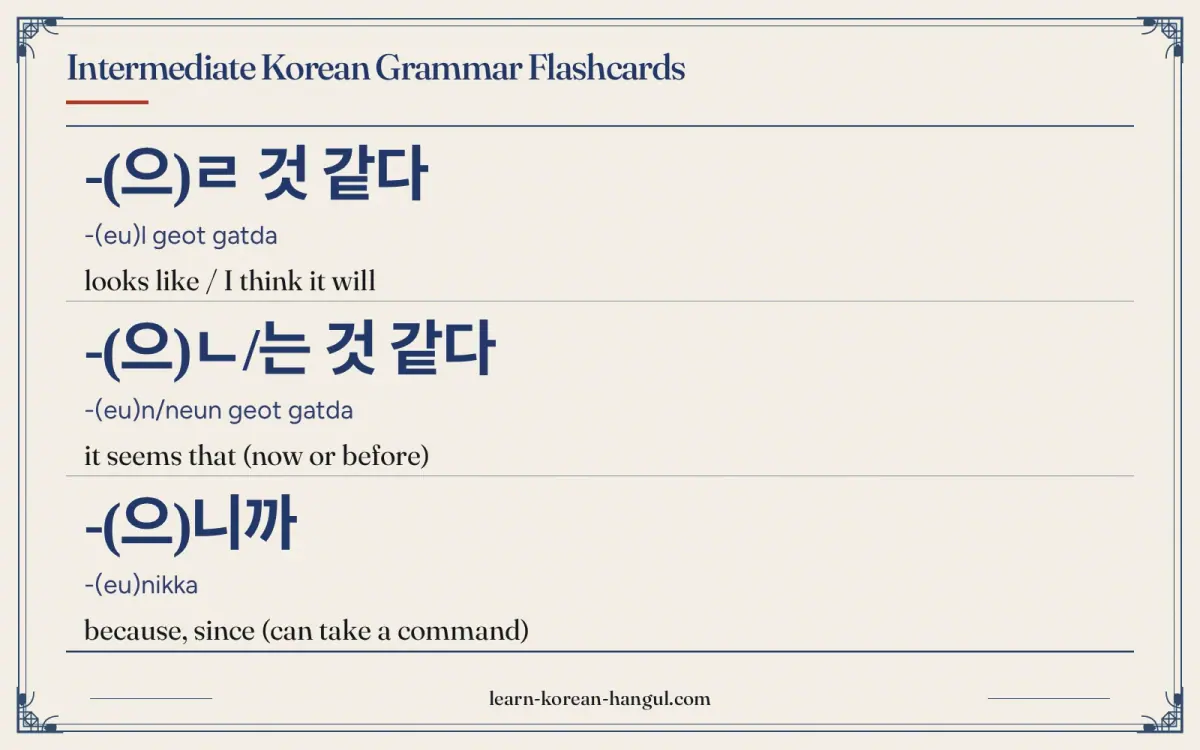
A grammar card works like a vocabulary card, with one difference: the front shows a pattern, and the audio plays an example sentence that contains it. The cards run in groups. Cards 1 to 3 are the noun modifiers, 4 and 5 are guesses, 6 to 8 are reasons, 9 to 13 are time and sequence links, 14 and 15 are purpose and change, 16 to 19 are trying, states, skills and experience, 20 and 21 are plans and choices, 22 to 24 are background and contrast, and 25 and 26 are limits and degree.
How Do I Use These Flashcards?
Use the deck above in four steps. It works with tap, click or keyboard, and nothing plays until you press an audio button.
- Choose a mode. Start with recognition (Hangul to meaning). Switch to recall (meaning to Hangul) or listening (audio to meaning) once recognition feels easy.
- Show the answer. Say the pattern and one example sentence aloud before you look at the answer, then try to build a second sentence with a different verb. Then press Show answer (or Space). Turn on the romanization toggle only if you need it; the table below always shows it.
- Grade yourself. Press Got it if you answered correctly without help, or Not yet if you hesitated or guessed.
- Finish the session. A session holds up to 20 cards (you can set 10, 20 or 40). With 26 cards, a first-time learner should expect about 3 days at the default limit of 10 new cards a day, with review sessions on top.
What Do the Three Modes Do?
Recognition shows the Hangul and asks for the meaning, so with the first card it shows -(으)ㄴ (past modifier) and you answer "(the one that) did". Recall reverses this: it shows the meaning and asks for the Hangul, and you may type the answer with your Hangul keyboard or just say it in your head. Listening plays a clip and hides the letters, which trains the ear. Recall is the hardest mode for grammar. It asks you to produce a pattern such as -(으)ㄹ수록 from its English meaning, so save it for cards that already feel familiar. The pronunciation audio is generated with text-to-speech and a Korean teacher approves it before it is switched on. Listening mode only uses cards whose audio is approved, and cards without approved audio are skipped in that mode with a note.
What Do Got It and Not yet Do?
Got it moves a card up one Leitner box, so it comes back later. Not yet sends the card back to box 1, so it returns in the same session or within 10 minutes. The grades are your own judgement; the deck does not score you or claim fluency.
Deck Scope: What Is and Is Not Covered
The deck covers 26 patterns that intermediate courses usually teach after the first polite endings: the three noun modifiers, two ways to guess, three ways to give a reason, the time links -(으)면서, -는 동안, -(으)ㄴ 후에, -기 전에 and -다가, and then purpose, change, experience, choice, background, contrast, prohibition and degree. The list is a representative study set, not an official syllabus.
What Is Left out of This Deck?
The deck does not repeat the beginner endings. For those, use the beginner korean grammar flashcards, which cover 25 patterns from 은/는 to -(으)ㄹ까요?. Cause, concession and speaker attitude patterns such as -더라도 are in the advanced Korean grammar flashcards. Irregular verbs (듣다 in 들으면서, 춥다 in 추우니까) appear inside examples but are not drilled here; the Korean conjugator shows their forms.
All 26 Cards in One Table
All 26 cards appear below in deck order. The table is plain HTML, so you can use it as a drill without the deck: cover the Meaning column, say each item aloud, then uncover it.
| # | Hangul | Revised Romanization | Meaning | Note | Lesson | Audio assetId |
|---|---|---|---|---|---|---|
| 1 | -(으)ㄴ (past modifier) | -(eu)n | (the one that) did | Example: 어제 본 영화가 재미있었어요. (eoje bon yeonghwaga jaemiisseosseoyo) The movie I saw yesterday was fun. Attaches to a verb stem to describe a noun by a finished action. | past modifier -(으)ㄴ lesson | au-pg-flashcards-intermediate-grammar-flashcards-1 |
| 2 | -는 (present modifier) | -neun | (the one that) is doing | Example: 지금 보는 드라마가 재미있어요. (jigeum boneun deuramaga jaemiisseoyo) The drama I am watching now is fun. Used with verbs only; adjectives take -(으)ㄴ. | present modifier -는 lesson | au-pg-flashcards-intermediate-grammar-flashcards-2 |
| 3 | -(으)ㄹ (future modifier) | -(eu)l | (the one that) will do | Example: 다음 주에 갈 곳을 찾고 있어요. (daeum jue gal goseul chatgo isseoyo) I am looking for a place to go next week. Often sits before a noun such as 곳, 때 or 사람. | future modifier -(으)ㄹ lesson | au-pg-flashcards-intermediate-grammar-flashcards-3 |
| 4 | -(으)ㄹ 것 같다 | -(eu)l geot gatda | looks like / I think it will | Example: 비가 올 것 같아요. (biga ol geot gatayo) I think it will rain. A guess about the future, also used to soften an opinion. | -(으)ㄹ 것 같다 lesson | au-pg-flashcards-intermediate-grammar-flashcards-4 |
| 5 | -(으)ㄴ/는 것 같다 | -(eu)n/neun geot gatda | it seems that (now or before) | Example: 밖에 비가 오는 것 같아요. (bakke biga oneun geot gatayo) It seems to be raining outside. A guess from what you see or heard; verbs use -는 for the present. | -(으)ㄴ/는 것 같다 lesson | au-pg-flashcards-intermediate-grammar-flashcards-5 |
| 6 | -(으)니까 | -(eu)nikka | because, since (can take a command) | Example: 추우니까 외투를 입으세요. (chuunikka oetureul ibeuseyo) Because it is cold, please put on a coat. Can be followed by a command or a suggestion; -아/어서 cannot. | -(으)니까 lesson | au-pg-flashcards-intermediate-grammar-flashcards-6; slow: au-pg-flashcards-intermediate-grammar-flashcards-27 |
| 7 | -아/어서 | -a/eoseo | because; and then | Example: 배가 아파서 병원에 갔어요. (baega apaseo byeongwone gasseoyo) My stomach hurt, so I went to the hospital. States a reason or a first step; no command after it and no past tense inside it. | -아/어서 lesson | au-pg-flashcards-intermediate-grammar-flashcards-7 |
| 8 | -기 때문에 | -gi ttaemune | because (firm, often written) | Example: 비가 오기 때문에 집에 있어요. (biga ogi ttaemune jibe isseoyo) I am staying home because it is raining. Sounds firmer than -아/어서; common in writing and speeches. | -기 때문에 lesson | au-pg-flashcards-intermediate-grammar-flashcards-8 |
| 9 | -(으)면서 | -(eu)myeonseo | while (two actions at once) | Example: 음악을 들으면서 공부해요. (eumageul deureumyeonseo gongbuhaeyo) I study while listening to music. Both actions share one subject. 듣다 becomes 들으 before a vowel (ㄷ irregular). | -(으)면서 lesson | au-pg-flashcards-intermediate-grammar-flashcards-9 |
| 10 | -는 동안 | -neun dongan | while, during | Example: 제가 요리하는 동안 기다려 주세요. (jega yorihaneun dongan gidaryeo juseyo) Please wait while I cook. The two parts can have different subjects, unlike -(으)면서. | -는 동안 lesson | au-pg-flashcards-intermediate-grammar-flashcards-10 |
| 11 | -(으)ㄴ 후에 | -(eu)n hue | after (doing) | Example: 밥을 먹은 후에 커피를 마셔요. (babeul meogeun hue keopireul masyeoyo) After eating, I drink coffee. Puts the verb in the past modifier form, then adds 후에. | -(으)ㄴ 후에 lesson | au-pg-flashcards-intermediate-grammar-flashcards-11 |
| 12 | -기 전에 | -gi jeone | before (doing) | Example: 자기 전에 책을 읽어요. (jagi jeone chaegeul ilgeoyo) I read a book before I sleep. The verb stays in its plain stem; tense goes only on the last verb. | -기 전에 lesson | au-pg-flashcards-intermediate-grammar-flashcards-12 |
| 13 | -다가 | -daga | while doing, then (a change) | Example: 걷다가 친구를 만났어요. (geotdaga chingureul mannasseoyo) I was walking and met a friend. One action is interrupted by another or turns into it. | -다가 lesson | au-pg-flashcards-intermediate-grammar-flashcards-13 |
| 14 | -(으)려고 | -(eu)ryeogo | in order to; intending to | Example: 한국어를 배우려고 서울에 왔어요. (hangugeoreul baeuryeogo seoure wasseoyo) I came to Seoul to learn Korean. Gives the purpose of an action; it is not used with commands. | -(으)려고 lesson | au-pg-flashcards-intermediate-grammar-flashcards-14 |
| 15 | -게 되다 | -ge doeda | come to; end up (a change) | Example: 한국에서 살게 됐어요. (hangugeseo salge dwaesseoyo) I ended up living in Korea. A change that happens to you rather than one you choose. | intermediate korean grammar | au-pg-flashcards-intermediate-grammar-flashcards-15; slow: au-pg-flashcards-intermediate-grammar-flashcards-28 |
| 16 | -아/어 보다 | -a/eo boda | try doing | Example: 김치를 먹어 봤어요. (gimchireul meogeo bwasseoyo) I tried eating kimchi. Also asks about experience: 먹어 봤어요? means Have you tried it? | -아/어 보다 lesson | au-pg-flashcards-intermediate-grammar-flashcards-16 |
| 17 | -아/어 있다 | -a/eo itda | be in a state | Example: 문이 열려 있어요. (muni yeollyeo isseoyo) The door is open. Describes the state left after a change; -고 있다 describes an action in progress. | -아/어 있다 lesson | au-pg-flashcards-intermediate-grammar-flashcards-17 |
| 18 | -(으)ㄹ 줄 알다 | -(eu)l jul alda | know how to | Example: 저는 운전할 줄 알아요. (jeoneun unjeonhal jul arayo) I know how to drive. About a learned skill; -(으)ㄹ 수 있다 is wider. | -(으)ㄹ 줄 알다 lesson | au-pg-flashcards-intermediate-grammar-flashcards-18; slow: au-pg-flashcards-intermediate-grammar-flashcards-29 |
| 19 | -(으)ㄴ 적이 있다 | -(eu)n jeogi itda | have done before | Example: 제주도에 간 적이 있어요. (jejudoe gan jeogi isseoyo) I have been to Jeju Island. Talks about experience; the opposite is 적이 없다. | -(으)ㄴ 적이 있다 lesson | au-pg-flashcards-intermediate-grammar-flashcards-19 |
| 20 | -(으)ㄹ까 하다 | -(eu)lkka hada | be thinking of doing | Example: 주말에 영화를 볼까 해요. (jumare yeonghwareul bolkka haeyo) I am thinking of watching a movie this weekend. An undecided plan, softer than a firm intention. | -(으)ㄹ까 하다 lesson | au-pg-flashcards-intermediate-grammar-flashcards-20 |
| 21 | -거나 | -geona | or (choose one) | Example: 주말에 영화를 보거나 쉬어요. (jumare yeonghwareul bogeona swieoyo) On weekends I watch a movie or rest. Joins two verbs as options; the tense goes on the last verb. | -거나 lesson | au-pg-flashcards-intermediate-grammar-flashcards-21 |
| 22 | -는데 | -neunde | and; but; background (verbs) | Example: 비가 오는데 우산이 없어요. (biga oneunde usani eopseoyo) It is raining, but I have no umbrella. Sets a scene or a contrast. After a verb, or 있다 and 없다, it is -는데. | -(으)ㄴ/는데 lesson | au-pg-flashcards-intermediate-grammar-flashcards-22 |
| 23 | -(으)ㄴ데 | -(eu)nde | and; but; background (adjectives) | Example: 날씨가 좋은데 산책할까요? (nalssiga joeunde sanchaekalkkayo) The weather is nice, so shall we take a walk? After an adjective the ending is -(으)ㄴ데; the second part often asks or suggests. | -(으)ㄴ/는데 lesson | au-pg-flashcards-intermediate-grammar-flashcards-23 |
| 24 | -아/어도 | -a/eodo | even if; even though | Example: 비가 와도 가요. (biga wado gayo) I go even if it rains. Add 되다 and it becomes the permission pattern -아/어도 되다. | -아/어도 lesson | au-pg-flashcards-intermediate-grammar-flashcards-24 |
| 25 | -(으)면 안 되다 | -(eu)myeon an doeda | must not | Example: 여기에서 사진을 찍으면 안 돼요. (yeogieseo sajineul jjigeumyeon an dwaeyo) You must not take photos here. States a ban. Write 돼요, not 되요. | -(으)면 안 되다 lesson | au-pg-flashcards-intermediate-grammar-flashcards-25 |
| 26 | -(으)ㄹ수록 | -(eu)lsurok | the more ..., the more ... | Example: 한국어는 공부할수록 재미있어요. (hangugeoneun gongbuhalsurok jaemiisseoyo) The more I study Korean, the more fun it is. The second half describes how things change as the first half increases. | -(으)ㄹ수록 lesson | au-pg-flashcards-intermediate-grammar-flashcards-26; slow: au-pg-flashcards-intermediate-grammar-flashcards-30 |
How Do I Read the Table?
Hangul is the pattern, and a leading or trailing hyphen shows that it attaches to a verb or adjective stem. Revised Romanization (RR) is a learning aid, so try to read the Hangul first. The Meaning column gives a short English gloss. The Note column gives an example sentence with its RR and meaning, plus a use hint. The Lesson column links to the lesson that explains the pattern. The last column lists the audio assetId, and the clip says the example sentence, not the bare pattern. A second ID marks a slow clip (0.8x).
Usage Notes for These Cards
Noun modifiers depend on tense and word type. For a verb, the past is -(으)ㄴ, the present is -는 and the future is -(으)ㄹ: 본 영화, 보는 영화 and 볼 영화 mean the movie I saw, the movie I am watching and the movie I will watch. For an adjective, the present is -(으)ㄴ, as in 바쁜 사람 (a busy person). This split is behind most modifier slips, and the -는 vs -(으)ㄴ vs -(으)ㄹ page compares the three side by side.
Two ways to say because. Both -아/어서 and -(으)니까 mean because, but only -(으)니까 can be followed by a command or a suggestion: 추우니까 입으세요 is natural, while 추워서 입으세요 is not. The -아/어서 vs -(으)니까 page sets out the difference.
Guesses look in two directions. -(으)ㄹ 것 같다 guesses the future (비가 올 것 같아요), while -(으)ㄴ/는 것 같다 guesses the present or past from what you see or heard (비가 오는 것 같아요). Both are also a polite way to soften an opinion.
-게 되다 marks a change that happens to you. 한국에서 살게 됐어요 says that circumstances brought you to live in Korea, which is different from choosing it with 살기로 했어요.
-고 있다 and -아/어 있다 are not the same. 입고 있어요 describes an action in progress, while 열려 있어요 describes a state that remains after something opened. The -고 있다 vs -아/어 있다 page explains when each one fits.
Which Sounds Do Not Match the Spelling?
Revised Romanization (RR) and the spelling hide several changes that you should hear in these patterns.
읽는 is said [잉는]. The cluster ㄺ keeps only ㄱ before another consonant, and that ㄱ turns into ㅇ before ㄴ. So 읽는 책 (a book that I read) is [잉는 책], and RR writes ingneun chaek. This is cluster simplification followed by nasalization.
먹은 후에 is said [머근 후에]. The final ㄱ of 먹 moves onto the empty ㅇ of 은, so you hear 머 + 근. This is liaison, and the same thing happens in every -(으)ㄴ form that follows a final consonant.
공부할수록 is said [공부할쑤록]. After the -(으)ㄹ ending, the ㅅ of 수 is tense, as in [할쑤]. RR does not show this tense sound and writes gongbuhalsurok. The standard pronunciation rules (표준 발음법, Article 27) describe this change.
What Mistakes Do Learners Make with Intermediate Grammar?
- Using -는 with an adjective as a modifier, as in 바쁘는 사람. Say 바쁜 사람, because adjectives take -(으)ㄴ in the present.
- Using -아서 before a command, as in 추워서 입으세요. Say 추우니까 입으세요.
- Putting a tense inside -기 전에, as in 먹었기 전에. The verb stays plain (먹기 전에), and the tense belongs to the last verb of the sentence.
- Writing 안 되요 for must not. The correct spelling is 안 돼요, because 돼요 is the contraction of 되어요.
Modifier forms cause the most slips, so give cards 1, 2 and 3 extra passes in recall mode.
How Does the Review Schedule Work?
The deck uses a simplified Leitner system with five boxes. A new card starts in box 1. Each Got it moves it up one box, and each Not yet returns it to box 1. The box sets how long the card waits before it is due again.
| Box | Wait until the next review |
|---|---|
| 1 | same session or 10 minutes |
| 2 | 1 day |
| 3 | 3 days |
| 4 | 7 days |
| 5 | 21 days |
Each session shows due cards first, oldest due first, then up to 10 new cards a day by default. A deck of 26 cards is introduced over 3 days at 10 new cards a day, but grammar cards are denser than words, so many learners take 5 new cards a day and finish in about a week. Progress is saved only in this browser, so clearing site data deletes it. Use the export button to save a small file with card IDs, boxes and due dates, and import it on another device. No account is needed.
Cultural and Practical Context
Intermediate Korean starts to sound natural when you connect ideas instead of speaking in short sentences. Connectors such as -(으)니까, -(으)면서 and -는데 let you give a reason, do two things at once or set a scene before asking a question. Korean speakers also use -(으)ㄹ 것 같다 and -(으)ㄴ/는 것 같다 often to make an opinion sound less direct, so a sentence such as 맛있는 것 같아요 can simply mean I think it is tasty.
Limits of This Deck
The deck holds 26 cards and one example per pattern, so it shows the main use of each pattern, not every nuance. Patterns with several uses, such as -는데 and -아/어서, are simplified; the lessons explain the rest. -게 되다 has no lesson of its own yet, so its row links to the intermediate grammar hub. All Korean text is generated and was reviewed and signed off by Min-ji Park on 15 October 2026, and each audio clip is checked by a Korean teacher before publication.
Next Steps after This Deck
After these intermediate korean grammar flashcards, go back to the beginner korean grammar flashcards if a basic ending feels shaky, or move on to the advanced Korean grammar flashcards. Write the patterns by hand with the intermediate korean grammar worksheet and build your own sentences with the korean sentence builder. The Korean grammar flashcards page lists every grammar deck, and the Korean flashcards hub lists all topics.
Frequently Asked Questions
What Is the Difference between -아서 and -(으)니까?
Both give a reason. Use -(으)니까 when the second part is a command, a suggestion or a question about what to do, as in 추우니까 입으세요. Use -아/어서 for a plain cause and result, as in 배가 아파서 병원에 갔어요. -아/어서 cannot take a past tense or a command.
How Do I Make a Verb into a Noun Modifier?
Take the verb stem and add a modifier ending that matches the time. For 보다 (to see), the past is 본, the present is 보는 and the future is 볼, so 본 영화 means the movie I saw. For adjectives the present is -(으)ㄴ, as in 큰 집 (a big house).
When Do I Use -(으)ㄴ/는 것 같다?
Use it to guess about the present or past from what you see or heard, or to soften an opinion. 밖에 비가 오는 것 같아요 means it seems to be raining outside. For a guess about the future, use -(으)ㄹ 것 같다 instead, as in 비가 올 것 같아요.
How Is -고 있다 Different from -아/어 있다?
-고 있다 describes an action in progress, such as 읽고 있어요 (I am reading). -아/어 있다 describes a state that remains after a change, such as 열려 있어요 (it is open). Many verbs take only one of the two, so learn each with its example.
Is My Progress Saved If I Close the Page?
Yes, in the same browser on the same device. Card boxes and due dates are stored locally and nothing is sent to a server. Clearing site data, using a private window or switching browsers removes them, so use the export button to keep a backup file. No account is needed.