Key facts
- Hanja help most with Sino-Korean vocabulary, the abstract words of news, study, work and exams.
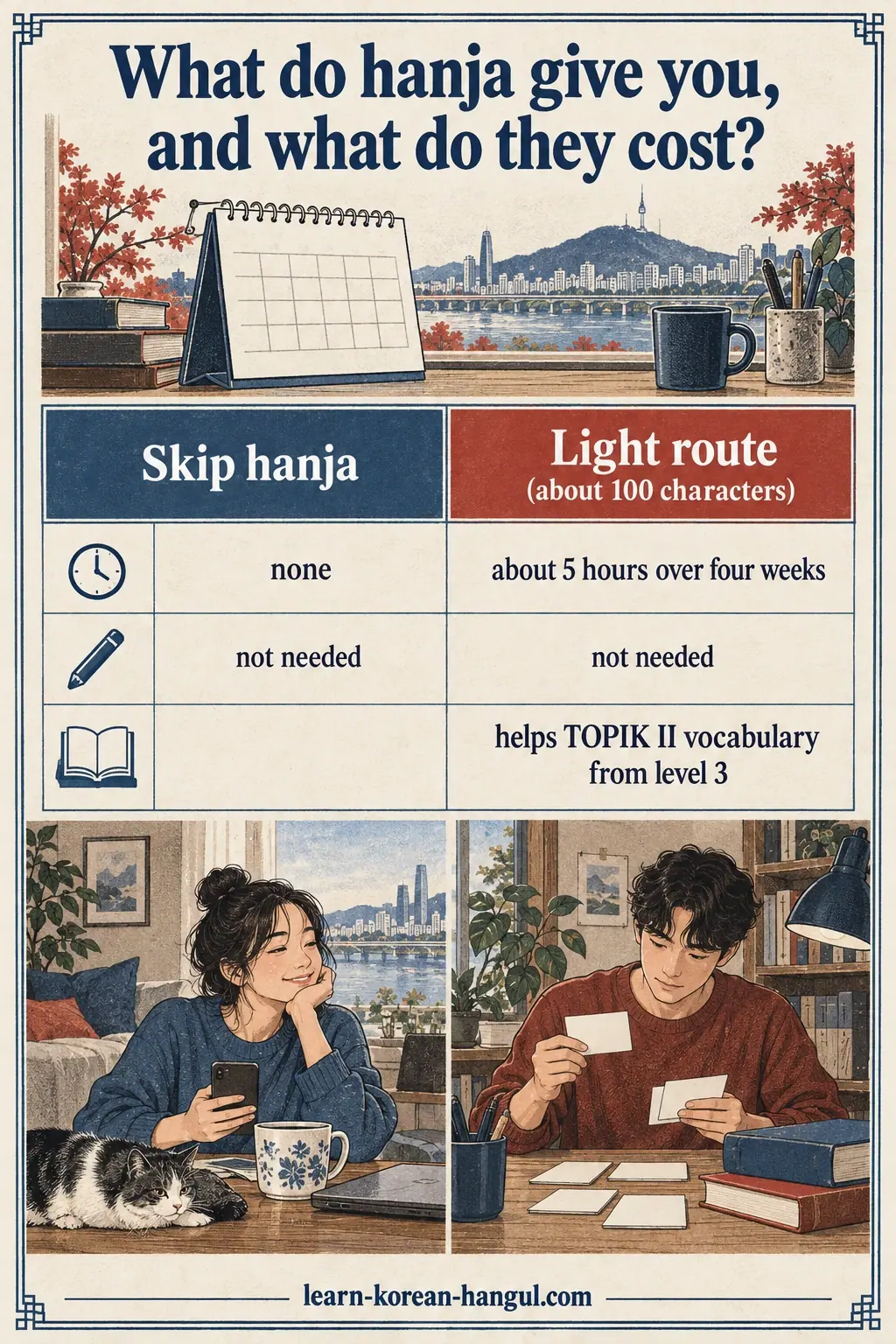
- A light route (recognising about 100 characters through words) costs about 5 hours over four weeks. Writing by hand costs far more and is rarely needed.
- Chinese and Japanese speakers can usually skip character study and learn the Korean readings instead.
Should I Learn Hanja? the Short Answer by Goal
The right answer depends on your level, your goal and the languages you already read. The table gives a verdict for five common learners, and the sections after it explain the reasons.
| Learner | Verdict | Why | First step |
|---|---|---|---|
| Complete beginner (A1 to A2) | Skip for now | Hangul, sounds and core words give far more return | Revisit at B1 |
| TOPIK 3 to 4 candidate (B1 to B2) | Yes, the light route | Sino-Korean words fill society, work and news topics | Learn about 20 high-yield characters |
| Chinese or Japanese speaker | Skip character study | You already know the shapes and meanings | Map words you know to Korean sounds |
| Academic, news or professional reader | Yes, go deeper | Law, medicine, history and news use many Sino-Korean terms | Word families, then radicals |
| Name-curious learner | Optional and small | Characters explain meanings in names | Learn the characters of one name |
If your goal is conversation or travel only, the beginner row applies to you: skip hanja and spend the time on listening and speaking. The rest of this page shows how each verdict works.
What Do Hanja Give You, and What Do They Cost?
Hanja give you a handle on Sino-Korean words, and they cost study time. Compare three routes: skipping hanja, a light route that recognises characters inside words, and a full route that also learns to write them.
| Criterion | Skip hanja | Light route (about 100 characters) | Full route (read and write) |
|---|---|---|---|
| Time cost | none | about 5 hours over four weeks (plan below) | many months of regular study |
| Vocabulary gain | none directly; word lists still work | a handle on many Sino-Korean words | the widest gain |
| TOPIK relevance | not tested directly | helps TOPIK II vocabulary from level 3 | little extra beyond the light route |
| Reading newspapers | most articles read fine in Hangul | headline shorthand and bracketed terms | most characters in print |
| Writing by hand | not needed | not needed | the only route that includes writing |
Two points stand out. First, the light route gives most of the benefit for a small fraction of the effort, because it works on recognition through words you already meet. Second, the writing column is a different project: it is useful for calligraphy and a few exams, and it is rarely needed in daily life.
How Much Does a Small Set of Characters Help?
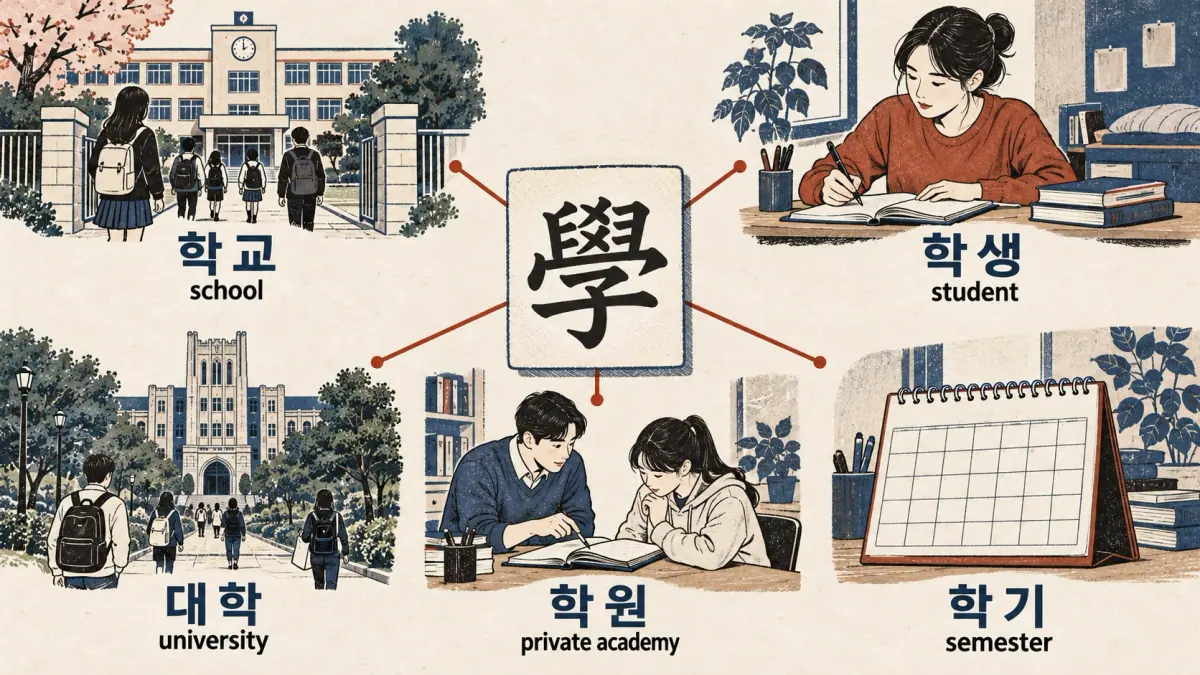
A common rule of thumb among teachers is that a small set of well-chosen characters opens up a large number of words. No source gives a precise figure, so this page does not give one either. The idea is easy to see with two examples.
- 學 appears in 학교 (school), 학생 (student), 대학 (university), 학원 (private academy) and 학기 (semester).
- 國 appears in 한국 (Korea), 미국 (the United States), 중국 (China), 외국 (foreign country) and 국가 (nation).
One character, five words. If you know the character, each new word is a small step rather than a new item. The effect is strongest at intermediate and advanced levels, where Sino-Korean words dominate formal topics. At beginner level you meet mostly native Korean words, so the payoff is smaller.
Should a Beginner Learn Hanja?

No, not yet. Beginner study has bigger priorities, and each hour spent on characters is an hour not spent on listening, speaking and core vocabulary. A beginner needs Hangul, the polite endings, numbers and the most common 500 or so words. Those are written in Hangul and carry the conversation.
There is one exception worth making. If you enjoy the characters, a tiny taste costs almost nothing. The weekday names are the easiest example, because you say the words every week: 월요일 (Monday) is 月 + 曜 + 日, and 일요일 (Sunday) is 日 + 曜 + 日. You do not need to memorise anything, but you will notice the pattern.
For most beginners, the plan is simple: skip hanja until you can hold a short conversation and read simple texts. Come back at B1.
Do I Need Hanja for TOPIK?
No. The TOPIK exam is written in Hangul, and it has no section or question type that asks you to read or write a character. The official guide is published on topik.go.kr, and it is the place to confirm the current specification before your exam. What hanja can do is make the vocabulary easier: many abstract words in TOPIK II reading and listening are Sino-Korean.
The effect is stronger as the level goes up. At TOPIK I (levels 1 and 2), the topics are daily life and the words are mostly native Korean or simple Sino-Korean. At TOPIK II (levels 3 to 6), the topics move to society, the economy, culture and the environment, and the vocabulary becomes more abstract. The TOPIK hanja page lists 20 high-yield characters for that stage and a two-week add-on plan. If your exam is less than a month away, the better use of time is mock tests and the TOPIK vocabulary list, and not character study.
Can Chinese and Japanese Speakers Skip Hanja?
Most can. If you already read Chinese characters, you do not need to learn them again. You need to learn how Korean reads them. That is a smaller task: map each word you know to its Korean sound. 學 is gaku in Japanese and xué in Mandarin, and it is 학 in Korean.
| If you read... | What carries over | What to learn |
|---|---|---|
| Japanese | many shapes and meanings; some words are identical in form | the Korean sound, usually one reading per character |
| Chinese | the meaning and the traditional form of many characters | the Korean sound, and that Korean uses traditional forms |
A caution: the same word can differ between languages. A Japanese or Chinese word may have a different meaning in Korean, or may not exist there. Use your knowledge as a guess, then check the dictionary. The hanja vs kanji vs hanzi page sets out the main differences, and the hanja word families pages help by grouping Korean words around one character.
Who Should Go Deeper?
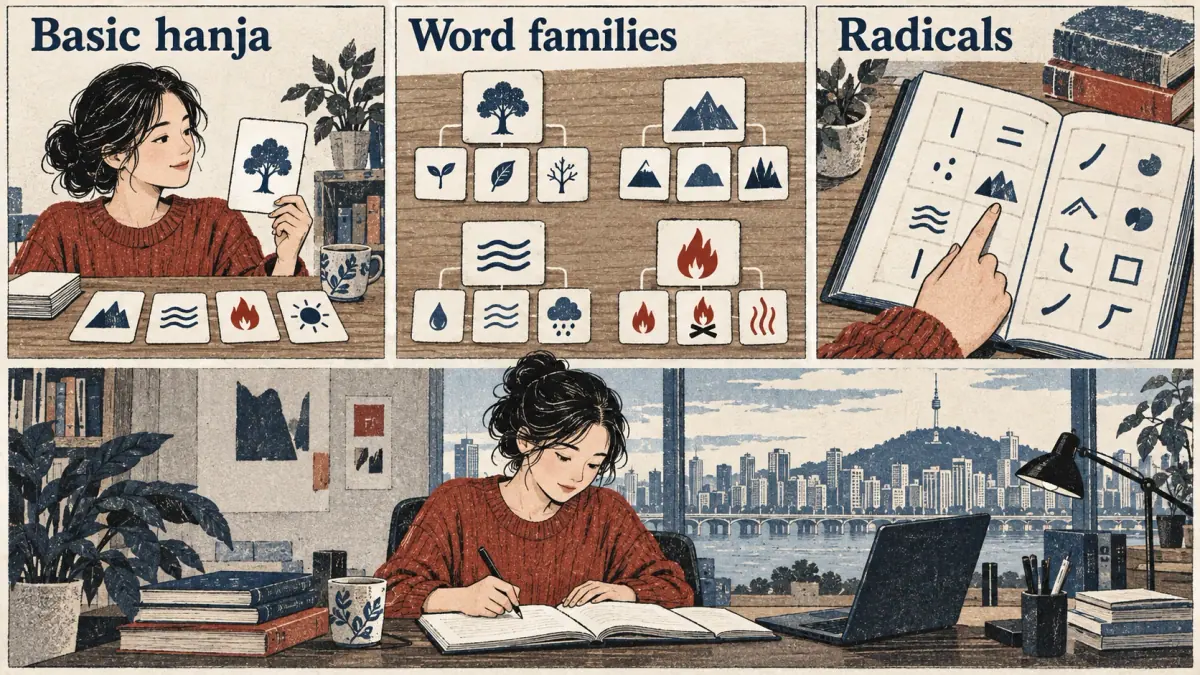
Go deeper if you read formal or specialised Korean. Academic papers, legal texts, medical articles and news analysis use a high share of Sino-Korean terms, and they sometimes add a character in brackets to separate two words that sound the same. Translators, researchers and people working in Korean institutions get the most from a deeper route.
For this group, the recommended order is:
- Basic hanja for the first set of about 100 characters, see basic hanja.
- Word families for the most productive characters, see hanja word families.
- Radicals for looking characters up and seeing parts, see hanja radicals.
Only after that does it make sense to think about the 1,800-character basic education list, or about writing by hand.
What about Learners Curious about Names?
Korean names are often chosen for the meaning of their characters, so a small amount of hanja knowledge explains a lot. A name like 민수 may be written with different characters in different families, and the same sound can have many meanings. If you are curious, learn the characters of one name you care about and read how they combine. This is a good small project and it does not require a plan. The lesson on hanja in Korean names shows how surnames and given names use characters.
How to Decide: Five Questions

Answer these in order. Stop at the first "yes" that gives you a verdict.
- Are you below A2? Skip for now.
- Is your TOPIK exam less than four weeks away? Skip. Use mock tests and word lists.
- Do you read Chinese or Japanese? Skip character study. Learn the Korean sounds.
- Do you plan to reach TOPIK 3 or above, or to read news, academic or legal Korean? Take the light route.
- Do you enjoy characters, or need them for names or research? Take the light route and go deeper if it holds your interest.
If none of these gives a "yes", you can skip hanja and lose nothing important.
A Four-Week Starter Plan

If you decide to start, use the light route: learn characters inside words, not from a list in isolation. The method is explained in more detail in how to learn hanja. The plan below covers the 100 characters of the basic hanja section in four weeks, at 25 characters a week. That is five characters a day on five days, with two days off. At about 15 minutes a day, the total is 4 weeks × 5 days × 15 minutes = 300 minutes, which is 5 hours.
| Week | Characters (25) | What you learn | Words to check |
|---|---|---|---|
| 1 | Numbers (10), nature and weekdays (10), first five of school (5) | 一 to 十, 日 月 火 水 木 金 土 山 川 天, 學 校 敎 書 文 | 월요일, 삼월, 학교 |
| 2 | Last five of school (5), people (10), country and society (10) | 字 語 先 生 讀, 人 男 女 子 父 母 兄 弟 家 民, 國 韓 社 會 公 場 市 門 世 界 | 한국어, 부모, 사회 |
| 3 | Time (10), directions (10), first five of size (5) | 年 時 間 今 前 後 午 夜 新 古, 東 西 南 北 上 下 中 內 外 方, 百 千 萬 大 小 | 시간, 오전, 대학 |
| 4 | Last five of size (5), body (10), actions (10) | 多 少 長 高 重, 口 目 手 足 心 耳 身 面 氣 力, 行 出 入 事 物 不 無 有 同 動 | 인구, 출구, 동물 |
Use this routine each day.
- Pick five characters from the week's list.
- Say each one with its 음훈, meaning first and sound last: 學 is 배울 학.
- Find two words you already know that contain it, such as 학교 and 학생.
- Cover and recall. Cover the character and say its meaning from the word, then reverse.
- Review the previous day's five before you start.
Success looks like this: by the end of the week you can look at ten Sino-Korean words and name the character in each one. If you slip behind, slow down. The hub's gentler pace is ten characters a week, which takes ten weeks, and it is a perfectly good way to learn.
As a first taste, here is a deck of the seven weekday names. Each card shows the word, its Revised Romanization and the character behind it. The table previews the same cards.
| Korean | RR | Meaning |
|---|---|---|
| 일요일 | iryoil | Sunday (日 sun) |
| 월요일 | woryoil | Monday (月 moon) |
| 화요일 | hwayoil | Tuesday (火 fire) |
| 수요일 | suyoil | Wednesday (水 water) |
| 목요일 | mogyoil | Thursday (木 wood) |
| 금요일 | geumyoil | Friday (金 metal, gold) |
| 토요일 | toyoil | Saturday (土 earth) |
Practice · 7
- 01일요일
Show answer
iryoil
Sunday (日 sun)
- 02월요일
Show answer
woryoil
Monday (月 moon)
- 03화요일
Show answer
hwayoil
Tuesday (火 fire)
- 04수요일
Show answer
suyoil
Wednesday (水 water)
- 05목요일
Show answer
mogyoil
Thursday (木 wood)
- 06금요일
Show answer
geumyoil
Friday (金 metal, gold)
- 07토요일
Show answer
toyoil
Saturday (土 earth)
What Are the Limits of Learning Hanja?
Hanja have real limits, and it is better to know them before you start.
- Handwriting is rarely needed. Outside exams and calligraphy, almost nobody writes hanja by hand in Korea. If you only need to read, skip writing.
- Meanings drift. A word does not always equal the sum of its characters. 인사 (人事) means "greeting" in daily life and "personnel" in companies.
- The same sound hides several characters. The syllable 문 is 問 "ask" in 문제, 文 "writing" in 문화 and 門 "gate" in 대문. Always learn the word first.
- Sound changes are not shown. The characters do not tell you that 학교 is said [학꾜]. Listen to the audio for each word.
- No test depends on them. You can reach the top TOPIK level without hanja.
The right mindset is that hanja are a tool for building vocabulary, not a requirement. If a character makes a word easier to remember, it has done its job.
What Mistakes Do Learners Make about Hanja?
- Starting too early. A beginner who studies characters before core grammar slows down both.
- Learning characters in isolation. A character you cannot place in two words you know is not yet useful.
- Trying to write everything. Writing is a separate project. Recognition first.
- Assuming each syllable has one character. Many syllables map to several characters.
- Trusting a literal reading. Check the dictionary when a decoded word looks odd.
Check Yourself: Who Should Learn Hanja?
Practice · 5
A beginner (A1) asks whether to start hanja. What is the best advice?
Show answer
Wait until about B1 and learn Hangul and core words first
At beginner level, Hangul, grammar and core vocabulary give more return. Hanja help more from intermediate level.
Does the TOPIK exam test hanja directly?
Show answer
No, it is written in Hangul
TOPIK papers are in Hangul. Hanja help only indirectly through vocabulary. Check topik.go.kr for the current guide.
A Japanese speaker wants to learn Korean. Which advice fits best?
Show answer
Skip character study and learn the Korean readings
Japanese readers already know many characters. They need the Korean sounds, usually one per character.
How long does the four-week starter plan take in total, at 15 minutes a day on five days a week?
Show answer
5 hours
4 weeks × 5 days × 15 minutes = 300 minutes, which is 5 hours.
Which is the best way to learn a hanja?
Show answer
Inside two or three words you already know
A character you can place in words you know is useful. Isolated lists and heavy writing are slow.
If an answer surprised you, go back to the table by goal and find your row.
The Bottom Line
You do not need hanja to learn Korean, and a beginner should wait. From about B1, or from TOPIK level 3 if you are preparing for the exam, a light route of about 100 characters learned through words gives a useful vocabulary shortcut for a few hours of work. Chinese and Japanese speakers can usually skip character study, and learners who never plan to read formal Korean can skip hanja for good. If you start, learn characters inside words, recognise before you write, and keep the dictionary as the judge of meaning.
The best next steps are What is hanja? for the basics, basic hanja for the first 100 characters, and the hanja hub for everything else. To see how the two scripts compare, read Hangul vs Hanja.
This page uses Revised Romanization only as a learning aid. The Hangul is the reference.
Frequently Asked Questions
Should I Learn Hanja?
Not at the start. A beginner should learn Hangul, core vocabulary and grammar first. From about B1, or TOPIK level 3 and up, a light route of about 100 characters learned inside words becomes a useful vocabulary shortcut. Some learners, such as conversation-only learners and many Chinese and Japanese speakers, can skip hanja for good.
Do I Need to Learn Hanja for Korean?
No. Everyday Korean is written in Hangul, and you can reach a high level without any character. Hanja help with Sino-Korean vocabulary, especially in news, study, law and work, but they are optional.
Do I Need to Know Hanja for TOPIK?
No. TOPIK is written in Hangul and has no question that tests characters directly. Hanja help indirectly, because many abstract words in TOPIK II are Sino-Korean. Check the current exam guide on topik.go.kr before your exam.
How Long Does It Take to Learn Hanja?
The light route in this guide takes about 5 hours over four weeks: 25 characters a week, five on each of five days, about 15 minutes a day. That recognises 100 characters through words. Writing by hand is a separate project that takes far longer and is rarely needed.
Can Chinese or Japanese Speakers Skip Hanja?
Most can skip character study, because they already know many shapes and meanings. They need to learn the Korean readings, usually one per character, and to check meanings in a dictionary because some words differ between languages.
Do I Need to Learn to Write Hanja?
Usually not. Outside exams and calligraphy, almost nobody writes hanja by hand in Korea. If your goal is to read, learn to recognise characters inside words. Add handwriting only if you have a specific reason.