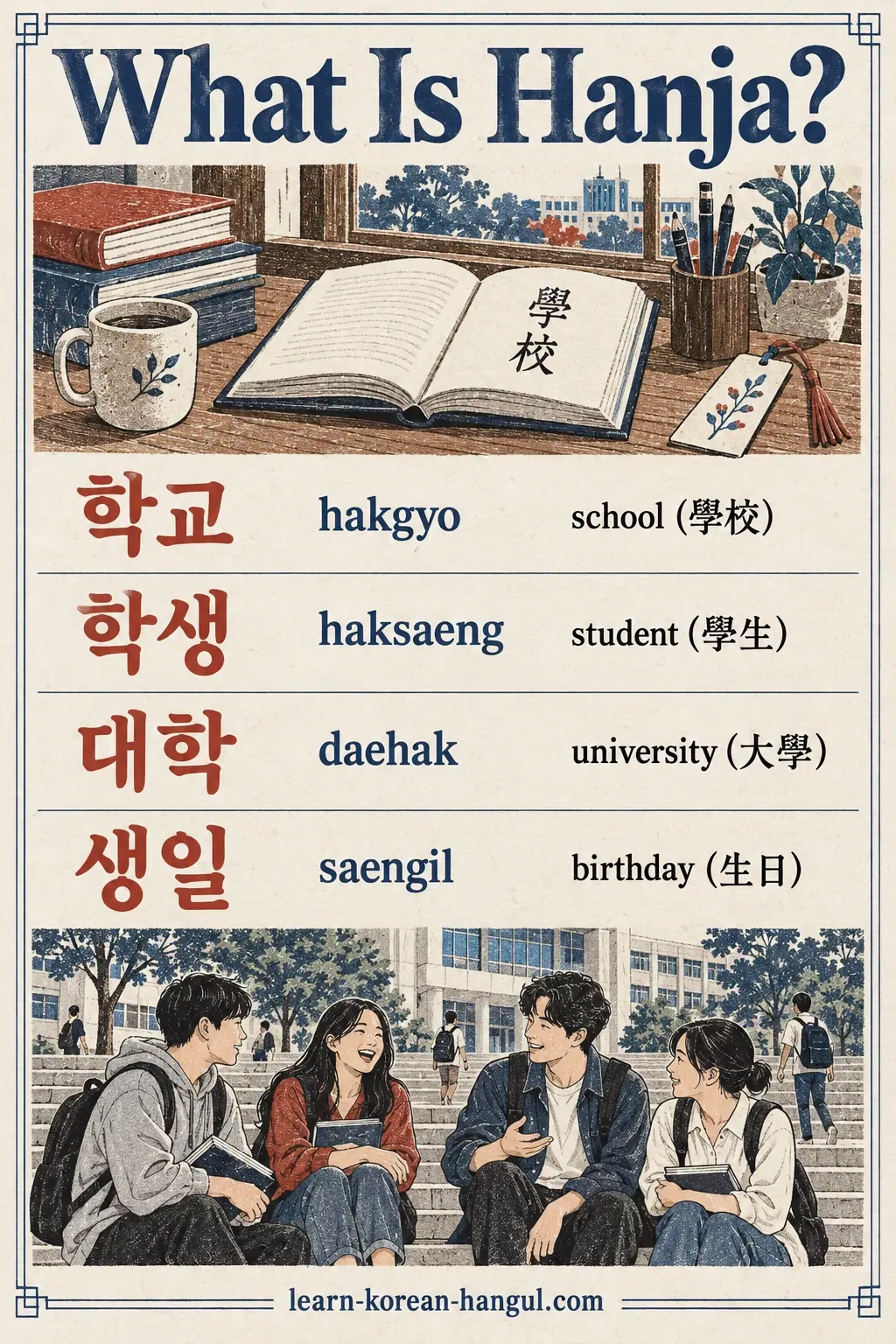
Key facts
- Hangul is an alphabet with 24 basic letters. Hanja are thousands of characters, and each one carries a meaning.
- Words built from hanja are called 한자어 (hanjaeo), Sino-Korean words. They are normally written in Hangul.
- Hanja still appear in names, some newspaper headlines, legal and academic texts, dictionaries and traditional signs.
- You can speak, read and write modern Korean without learning a single character.
What Is Hanja?
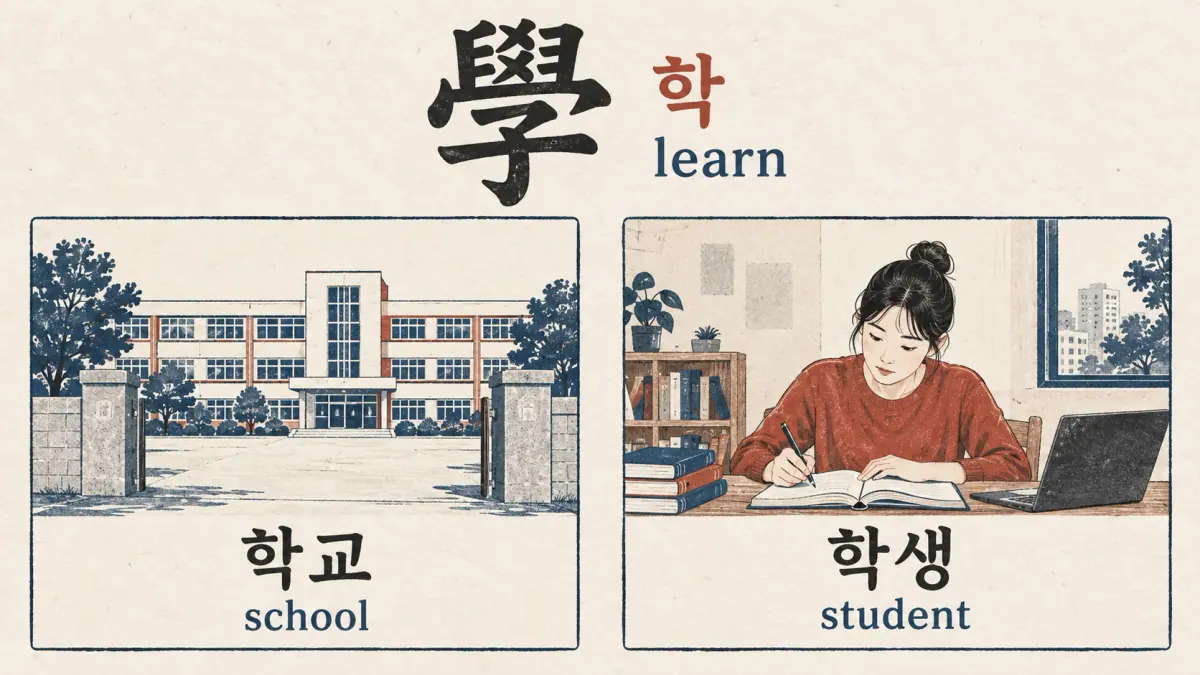
Hanja are the Chinese characters used in the Korean language. The word 한자 (hanja) is itself written 漢字, which means "Han characters", the characters of the Han people. Korean adopted them long before it had its own alphabet. Today every hanja has a fixed Korean reading, and Korean words made from them are called 한자어 (hanjaeo), or Sino-Korean words.
Two sentences capture the whole idea. First, a hanja is a character with a meaning and one Korean syllable of sound. Second, a Sino-Korean word is a word built from two or more such syllables, and it is written in Hangul in daily life.
Listen to the word 한자 itself. In standard pronunciation it is said [한짜], with a tense ㅉ.
A First Look at One Character
Take the character 學. Its meaning is "learn" or "study", and its Korean sound is 학. It appears inside the words 학교 (school) and 학생 (student). You do not need to write 學 to use those words. But when you see 학 in 학교, 학생, 대학 (university) and 학원 (private academy), you know the same character is working in each one.
| Hanja | Reading | Meaning | Words you may know |
|---|---|---|---|
| 學 | 학 | learn, study | 학교 [학꾜] (school), 학생 [학쌩] (student) |
| 生 | 생 | be born, live | 생일 (birthday), 학생 [학쌩] (student) |
| 人 | 인 | person | 한국인 [한구긴] (Korean person), 인구 (population) |
| 大 | 대 | big, great | 대학 (university), 대한민국 (Republic of Korea) |
Listen to one word for each character.
How Does a Hanja Carry Sound and Meaning?
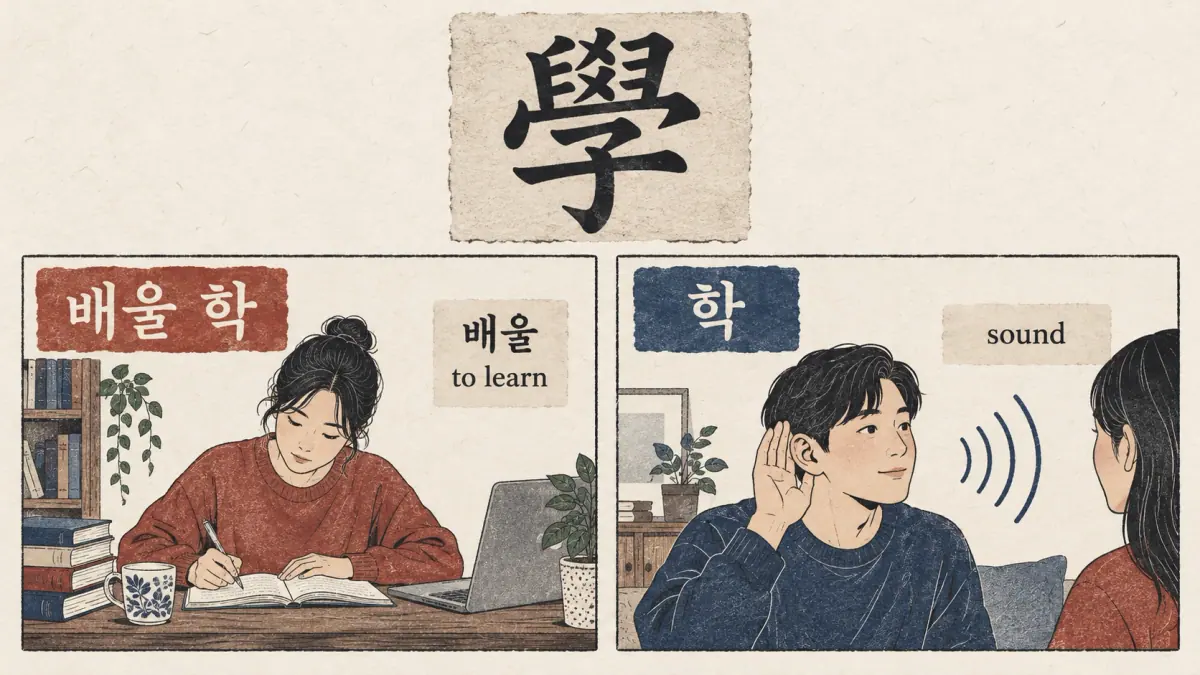
A hanja carries both a meaning and a sound, and Korean dictionaries show both in one label called the 음훈 (eumhun). The 훈 (hun) is a native Korean word that gives the meaning. The 음 (eum) is the Korean sound the character has inside words. Together they read like a short name: 學 is 배울 학, where 배울 means "to learn" and 학 is the sound.
The label always has the same order: the meaning word first and the sound last, so one short phrase checks both. Here are ten common characters.
| Hanja | 음훈 | Sound | Meaning | A word with it |
|---|---|---|---|---|
| 學 | 배울 학 | 학 | learn | 학교 (school) |
| 校 | 학교 교 | 교 | school | 교장 (principal) |
| 生 | 날 생 | 생 | be born, live | 생일 (birthday) |
| 日 | 날 일 | 일 | day, sun | 생일 (birthday), 일요일 (Sunday) |
| 大 | 큰 대 | 대 | big | 대학 (university) |
| 人 | 사람 인 | 인 | person | 한국인 (Korean person) |
| 國 | 나라 국 | 국 | country | 외국 (foreign country) |
| 外 | 바깥 외 | 외 | outside | 외국인 (foreigner) |
| 山 | 메 산 | 산 | mountain | 등산 (hiking) |
| 水 | 물 수 | 수 | water | 수영 (swimming) |
Notice that two characters can share the same native meaning word. 生 and 日 are both labelled 날, and only the sound tells them apart: 생 versus 일.
Another detail is that the hun word is often old or literary. 메 for "mountain" and 바깥 for "outside" are less common in daily speech than 산 and 밖. You do not need to memorise the hun words. Use them as a handle for the meaning, and learn the sound through real words.
How Are Hanja Different from Hangul?
Hangul is an alphabet, and hanja are a logographic script. Hangul letters stand for sounds, and the letters stack into syllable blocks. Hanja characters stand for meanings, and each character is already one syllable. King Sejong's court created Hangul in the 15th century (finished in 1443 and announced in 1446) to give Korean its own simple writing system. Hanja came from China and were the main written script for centuries before that.
| Hangul (한글) | Hanja (한자) | |
|---|---|---|
| Type of script | alphabet of sound symbols | characters that carry meaning |
| Number of symbols | 24 basic letters (14 consonants and 10 vowels) | thousands of characters |
| What one symbol stands for | a sound | a meaning plus one syllable |
| Origin | created in Korea in the 15th century | borrowed from China |
| Everyday role | writes all of Korean | appears in names, headlines, formal and academic texts |
| Learning time | a few days for the basics | years for broad knowledge |
The numbers matter for learners. You can learn the 24 basic Hangul letters in a short time, and they let you read every Korean word aloud. Hanja are different. South Korea's Ministry of Education keeps a list of 1,800 basic characters for schools, and large dictionaries include many more. Nobody needs all of them. For a learner, a few dozen to a few hundred well-chosen characters are the useful target, and you can reach that through the words you are already learning.
You can read more about how the two systems compare in the lesson on Hangul vs Hanja.
How Do Sino-Korean Words Work?
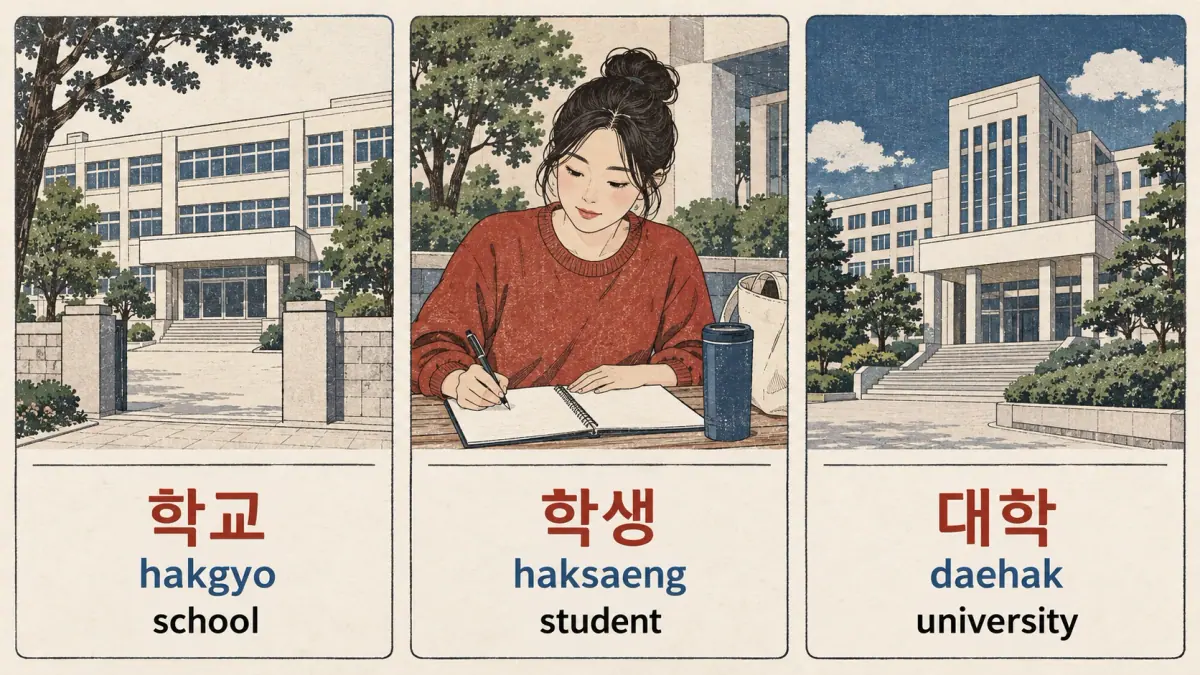
Sino-Korean words are built by putting two or more hanja syllables together, and the whole word means something related to the parts. 學 ("learn") and 校 ("school") make 學校, read 학교, "school". 學 and 生 ("be born, live") make 學生, read 학생, "student". 大 ("big") and 學 make 大學, read 대학, "university". The same character appears again and again, so every new word gives you a clue to the next one.
| Hangul | Hanja | Built from | Meaning |
|---|---|---|---|
| 학교 | 學校 | 學 learn + 校 school | school |
| 학생 | 學生 | 學 learn + 生 life | student |
| 대학 | 大學 | 大 big + 學 learn | university |
| 대학생 | 大學生 | 大學 university + 生 life | university student |
| 생일 | 生日 | 生 be born + 日 day | birthday |
| 한국인 | 韓國人 | 韓 Korea + 國 country + 人 person | Korean person |
| 외국인 | 外國人 | 外 outside + 國 country + 人 person | foreigner |
| 인구 | 人口 | 人 person + 口 mouth | population |
Read the table from left to right. 대학생 is 대학 plus 생, so a "university student" is built from "university" and "life", just as 학생 is built from "learn" and "life". The 인 in 한국인 and in 외국인 is the same character 人, which is how Korean makes a word for a person from anywhere: 중국인 (Chinese person), 미국인 (American), 일본인 (Japanese person).
Hanja words are not always literal. 인구 means "population", not "people's mouths". The parts give a handle on the meaning, but the dictionary decides. A good habit is to learn the word first and then use the character as a memory aid.
Here is a deck of eight Sino-Korean words. Each card shows the word, its Revised Romanization, the meaning and the hanja behind it. Use the table to preview them and the deck to practise.
| Korean | RR | Meaning |
|---|---|---|
| 학교 | hakgyo | school (學校) |
| 학생 | haksaeng | student (學生) |
| 대학 | daehak | university (大學) |
| 대학생 | daehaksaeng | university student (大學生) |
| 생일 | saengil | birthday (生日) |
| 한국인 | hangugin | Korean person (韓國人) |
| 외국인 | oegugin | foreigner (外國人) |
| 인구 | ingu | population (人口) |
Practice · 8
- 01학교
Show answer
hakgyo
school (學校)
- 02학생
Show answer
haksaeng
student (學生)
- 03대학
Show answer
daehak
university (大學)
- 04대학생
Show answer
daehaksaeng
university student (大學生)
- 05생일
Show answer
saengil
birthday (生日)
- 06한국인
Show answer
hangugin
Korean person (韓國人)
- 07외국인
Show answer
oegugin
foreigner (外國人)
- 08인구
Show answer
ingu
population (人口)
How Can You Decode a Word You Already Know?
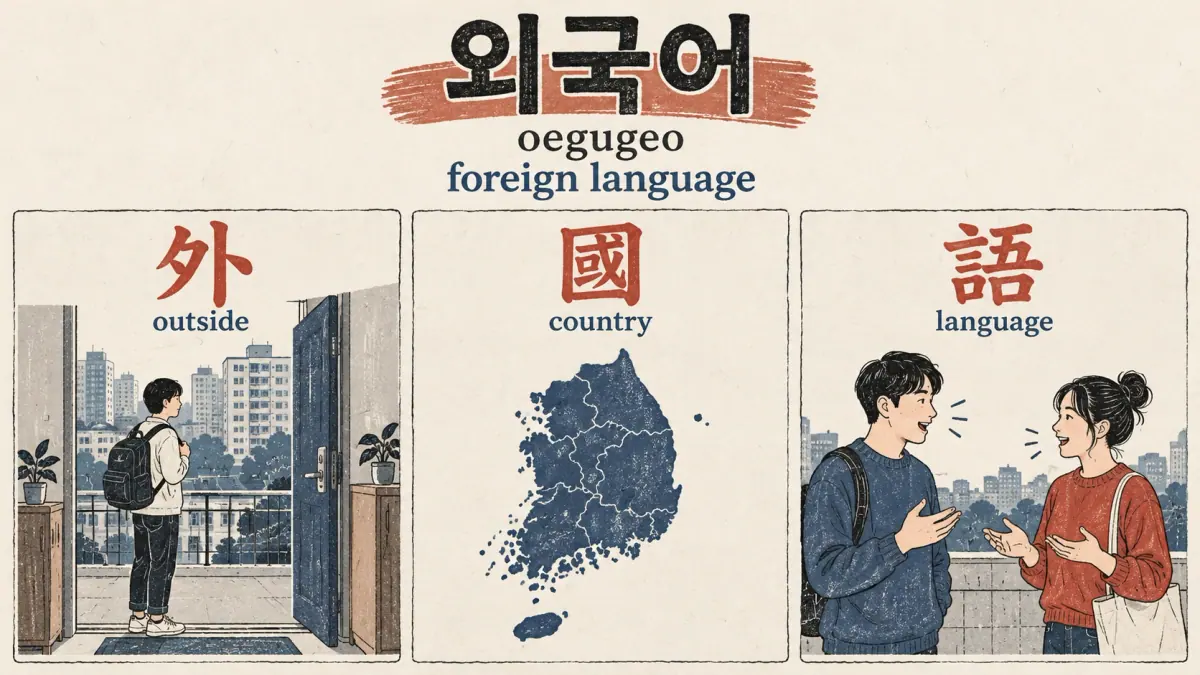
You can decode a Sino-Korean word in three steps: split it into syllables, give each syllable its likely meaning, and then check the dictionary. The easiest practice is with words you already know. Take 외국어 (oegugeo), "foreign language".
- Split the word. 외 / 국 / 어.
- Give each syllable a meaning. 외 is 外 "outside", 국 is 國 "country", and 어 is 語 "language".
- Join the meanings and check. "Outside-country language" is a foreign language. The dictionary agrees: 외국어.
The same three syllables show up in other words you may have met. 어 (語) closes the names of languages, 국 (國) names countries, and 인 (人) names people from a place.
| Pattern | Hanja | Examples |
|---|---|---|
| -어 "language" | 語 | 한국어 (Korean), 영어 (English), 중국어 (Chinese), 일본어 (Japanese) |
| -국 "country" | 國 | 한국 (Korea), 미국 (United States), 중국 (China), 외국 (foreign country) |
| -인 "person" | 人 | 한국인, 미국인, 중국인, 외국인 |
Try joining them. 한국 + 어 gives 한국어, "Korean language", and 한국 + 인 gives 한국인, "Korean person". With three little parts you can build more than a dozen words, and you will recognise new ones such as 독일어 (German) and 독일인 (German person) on first sight.
Be careful with the limits. The parts hint at the meaning, but they do not guarantee it. 인구 is "population", not "people's mouths", and 사회 (社會) is "society", not "company meeting". When a guess and the dictionary disagree, the dictionary wins.
Where Do Hanja Still Appear Today?

Hanja appear in a small number of places, and most of them are formal, traditional or specialised. Everyday text such as signs, menus, messages, novels and most news articles is written in Hangul. Here are the main places you will meet a character.
| Where | What you see | Example |
|---|---|---|
| Newspaper headlines | one-character shorthand for countries and places in some papers | 美 (미국, the United States), 中 (중국, China), 日 (일본, Japan), 北 (북한, North Korea) |
| Personal names | a hanja form of a name, chosen for its meaning | a name written 김민수 (Kim Minsu) may also have a hanja form |
| Traditional and formal signs | plaques, temple boards, calligraphy | the name board of a palace gate or a temple |
| Dictionaries | the hanja after each Sino-Korean headword | 학교 (學校) |
| Academic and legal texts | a hanja in brackets next to a term to avoid confusion | 사고(事故) versus 사고(思考) |
| Exams and tests | private hanja proficiency tests and school hanmun classes | 한문 (hanmun) in schools |
Names have their own lesson, hanja in Korean names, and the private tests are described in Korean hanja proficiency tests. How often each of these appears depends on the publication, the age of the reader and the field. Treat the list as a map of where to look, not as a measure of how much you will see.
Two examples show why brackets exist. Korean has many homophones, words that sound the same. 사고 can mean "accident" (事故) or "thought" (思考). 전기 can mean "electricity" (電氣) or "biography" (傳記). When the context does not settle it, a writer may add the character in brackets.
In speech, nobody says the character. The listener decides from the sentence, so 사고가 났어요 ("There was an accident") is clear, and 깊은 사고가 필요해요 ("Deep thought is needed") is clear too.
Are Hanja the Same as Chinese?
No. Hanja come from Chinese, but they are read with Korean sounds and used inside Korean grammar. A Korean reader who sees 學 says 학, a Mandarin reader says xué, and a Japanese reader says gaku. The shape is the same, and the sound belongs to each language.
| Character | Korean | Mandarin | Japanese |
|---|---|---|---|
| 學 | 학 (hak) | xué | がく (gaku) |
| 人 | 인 (in) | rén | じん (jin) |
| 大 | 대 (dae) | dà | だい (dai) |
Korean also keeps the traditional character forms, such as 學 and 國. Mainland China and Japan use simplified or revised forms, such as 学 and 国. The meanings mostly overlap, but some compound words differ, so a Chinese or Japanese speaker can often guess a Korean word without being sure.
Some Sino-Korean words did not come from China at all. Many modern terms, such as 경제 (economy) and 사회 (society), were coined or reshaped in Japan in the 19th century using Chinese characters, and then spread across East Asia. A few Sino-Korean words were also made in Korea. The simple point for a learner is that the characters give a word its building blocks, but the dictionary meaning decides.
Is Hanja the Same as Kanji?
Hanja and kanji are the same kind of thing, Chinese characters used in Korean and Japanese, but they are not identical. Kanji are used with kana in everyday Japanese writing. Hanja are used in Korean much less in daily writing. Japanese kanji usually have more than one reading, while a hanja usually has one Korean reading. So the shapes overlap, but the readings and the amount of use do not. The page on hanja vs kanji vs hanzi compares the three in detail.
Do Koreans Still Use Hanja?
Yes, but in a limited way. For centuries, educated Koreans wrote in classical Chinese and later in a mixed style of hanja and Hangul. Hangul was created in the 15th century, and over the 20th century it became the main script. A law in 1948 made Hangul the script for official documents, with hanja allowed alongside it for a time. Since then, the amount of hanja in everyday print has shrunk, and the question of how much to teach in school has been debated more than once.
Today, schools teach characters in the hanmun subject, and many adults recognise common characters in names and words. Knowledge varies with age, schooling and profession. No single figure describes it well, so treat any claim about "how many hanja Koreans know" with care. For where characters still appear, see Does Korean use hanja?, and for the longer story, see hanja history.
Why Do Hanja Matter for Learners?
Hanja matter because a large share of Korean vocabulary is Sino-Korean. Many dictionaries and teachers say that Sino-Korean words make up more than half of the headwords in a standard Korean dictionary. The exact share depends on how you count, and the share in everyday speech is lower. Still, the more formal and abstract the topic, the more Sino-Korean words you meet: economy, society, culture, politics, science, law.
For learners, hanja help in four practical ways.
- They explain word families. Once you know 學, you see the link between 학교, 학생, 학원 and 대학.
- They separate homophones. If two words sound alike, the characters tell you why they are different words.
- They help with reading levels. Intermediate and advanced texts use many Sino-Korean words. See Sino-Korean vocabulary and the comparison with native Korean words.
- They support exam vocabulary. The TOPIK exam is written in Hangul, but its vocabulary includes many Sino-Korean words. See TOPIK hanja for the details.
None of these makes hanja necessary. The question of whether to study them is covered in Should I learn hanja?, which gives a decision guide by goal.
What Are Hanja Not?
Four common beliefs are wrong or only partly right.
- "Hanja are Chinese words." They are Chinese-origin characters with Korean readings. Many Sino-Korean words do not exist in Chinese in the same form.
- "You must know hanja to read Korean." You do not. Everyday Korean is written in Hangul, and you can reach an advanced level without writing any character.
- "Each character has one meaning." Many characters have several. 日 can mean "day", "sun" or "Japan" depending on the word.
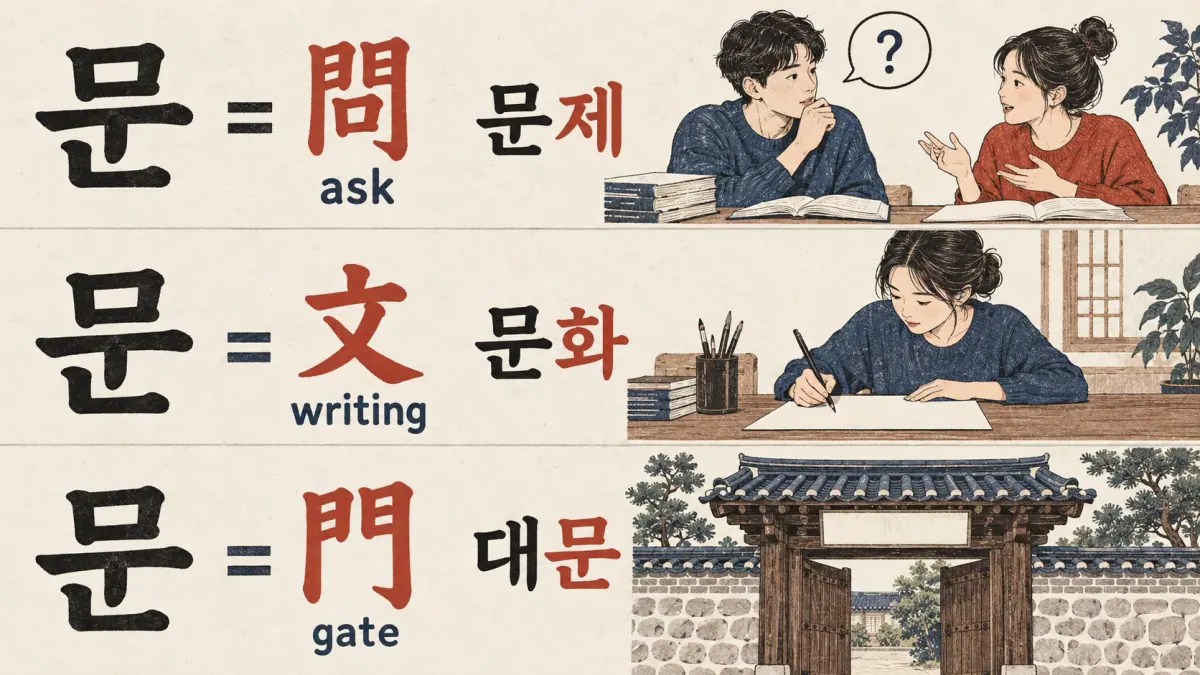
- "The same Korean syllable always means the same character." It does not. The syllable 문 is 問 "ask" in 문제, 文 "writing" in 문화 and 門 "gate" in 대문.
The last point is the one that catches learners. Sound alone does not tell you the character, and the character alone does not tell you the sound change. 학교 is written 學校 but said [학꾜], with a tense ㄱ.
How Do You Look up or Type a Hanja?
You rarely need to, but it helps to know how. Most Korean dictionaries show the hanja in brackets after a Sino-Korean headword, so looking up 학교 shows 學校. If you only know a character's shape, you can search by its radical or its stroke count. The lesson on hanja radicals explains the radical system, and the hanja lookup guide shows each search method step by step.
To type a hanja on a computer with a Korean input method, type the Hangul sound, such as 학, and then use the hanja conversion key to choose from a list of characters with that sound. The list shows each character with its meaning, which is why the 음훈 labels are useful: they let you pick 學 over the other characters that are also read 학. Typing hanja is a convenience, not a requirement for studying Korean.
Try It: Decode Five Words
Use what you learned about the characters to answer.
Practice · 5
What is the Korean sound of the character 學 (learn)?
Show answer
학
學 is 배울 학: the meaning word is 배울 and the sound is 학.
학생 is built from 學 and 生. What does 학생 mean?
Show answer
student
學 (learn) + 生 (life) make 학생, a student.
Which statement about Hangul and hanja is true?
Show answer
Hangul has 24 basic letters and hanja are thousands of characters
Hangul is an alphabet with 24 basic letters. Hanja are many characters that each carry a meaning.
Where do hanja still appear today?
Show answer
In names, some headlines, legal and academic texts and dictionaries
Everyday text is in Hangul. Hanja appear in a few formal, traditional and specialised places.
A Korean reader sees 學. How does the reader say it?
Show answer
hak
Korean reads 學 as 학 (hak). Mandarin says xué and Japanese says gaku.
If an answer surprised you, go back to the 음훈 table and read each label aloud, meaning first and sound last.
What Should You Learn Next?
The best next step depends on your goal. If you want to know whether to study characters at all, read Should I learn hanja?. If you want a first set, start with the basic hanja, learn the building blocks in hanja radicals or follow the hanja word families. The whole section is on the hanja hub.
This page uses Revised Romanization only as a learning aid. The Hangul is the reference. To remember the idea in one line: a hanja is a character with a meaning and one Korean syllable, and Sino-Korean words are built from them.
Frequently Asked Questions
What Is Hanja?
Hanja (한자, 漢字) are Chinese characters used in Korean. Each character carries a meaning and is read as one Korean syllable, such as 學 = 학 ("learn"). Korean words built from them are called Sino-Korean words (한자어), and they are normally written in Hangul in daily life.
What Is the Difference between Hanja and Hangul?
Hangul is an alphabet with 24 basic letters that stand for sounds. Hanja are thousands of characters that each stand for a meaning and one syllable. Hangul writes all of everyday Korean. Hanja appear in names, some headlines, formal and academic texts and dictionaries.
Are Hanja Chinese?
Hanja come from Chinese characters, but they are read with Korean sounds and used inside Korean grammar. The same character 學 is hak in Korean, xué in Mandarin and gaku in Japanese. Korea also keeps the traditional forms, such as 學, where mainland China and Japan use 学.
Do Koreans Still Use Hanja?
Yes, but in a limited way. Hanja appear in personal names, some newspaper headlines, legal and academic texts, dictionaries and traditional signs, and schools teach them in the hanmun subject. Everyday writing such as menus, signs and messages is in Hangul.
What Does 음훈 Mean?
음훈 (eumhun) is the label a dictionary gives a hanja. The 훈 is a native Korean word for the meaning, and the 음 is the Korean sound. 學 is labelled 배울 학: 배울 means "to learn" and 학 is the sound.
Do I Need to Learn Hanja to Read Korean?
No. You can read, write and speak Korean at a high level using only Hangul. Hanja help with vocabulary at intermediate and advanced levels, because many Sino-Korean words share characters, but they are optional.